Every October, the same thing happens in Indian B2B teams. Sales calls get pushed to after Diwali. Approvals slow down. Half your clients are on leave, and the other half are chasing their own festive targets.
So it’s easy to write off the festive season as dead time for B2B.
That’s a mistake. According to CAIT, Indian traders recorded ₹6.05 lakh crore in Diwali sales in 2025. Your clients are part of that spending. They buy gifts for their teams, sign off on tools for the year ahead and set budgets for the next quarter.
But festive season marketing works differently for B2B. Your buyers aren’t shopping for sarees, and a 40% off banner won’t win them over. What works is staying memorable while most of your competitors go quiet. Research from the LinkedIn B2B Institute found that 95% of B2B buyers are not in the market at any given time. The goodwill you build during Diwali is often what gets you the call in February.
In this guide, you’ll find:
- 10 festive marketing ideas built for small and mid-sized B2B teams
- A swipe file of real Indian festive campaigns to borrow from
- Diwali-to-New Year marketing calendar
- Tips for running several campaigns at once without your team burning out before the holidays begin
What Is Festive Season Marketing in B2B?
Festive season marketing is pretty much what it sounds like: you time your campaigns around Navratri, Durga Puja, Diwali, and later Christmas and New Year, because that’s when people are in a good mood and a lot more willing to talk, meet and spend. In B2B, the goal isn’t a quick sale. Think of it more as a few weeks where you get to remind clients you exist, maybe fix a relationship that’s gone a bit cold, and line up a couple of conversations for January.
In B2C, festive marketing usually means discounts and flash sales. B2B works more slowly. A purchase needs several sign-offs, and nearly 90% of global buyers say their purchase process stalled last year. A Diwali offer alone rarely closes a deal. What it can do is keep your brand in the conversation while the decision is being made.
Why B2B buyers still pay attention during the festive season
It’s true that people slow down at work around Diwali. Business relationships don’t stop, though, and in India this season has its own business customs:
- Gifting is part of doing business here: Dry fruit boxes from vendors, mithai from your CA’s office: by the end of October, everyone’s desk is full. Clients notice who sent something. They also notice who didn’t.
- Budgets get decided now: A lot of companies spend October to December locking Q4 plans and fighting over next year’s numbers. Get mentioned in those meetings and you’re on the shortlist.
- Buyers research on their own: Gartner found that 75% of B2B buyers prefer a rep-free sales experience. Send something they can open on their own time, like a short guide, a year-end report or a webinar recording.
- Your competitors go silent. Most B2B brands pause until January, so you get a much quieter room to be heard in.
How seasonal marketing differs for B2B and B2C
Seasonal marketing follows the same calendar for both, but the approach is very different:
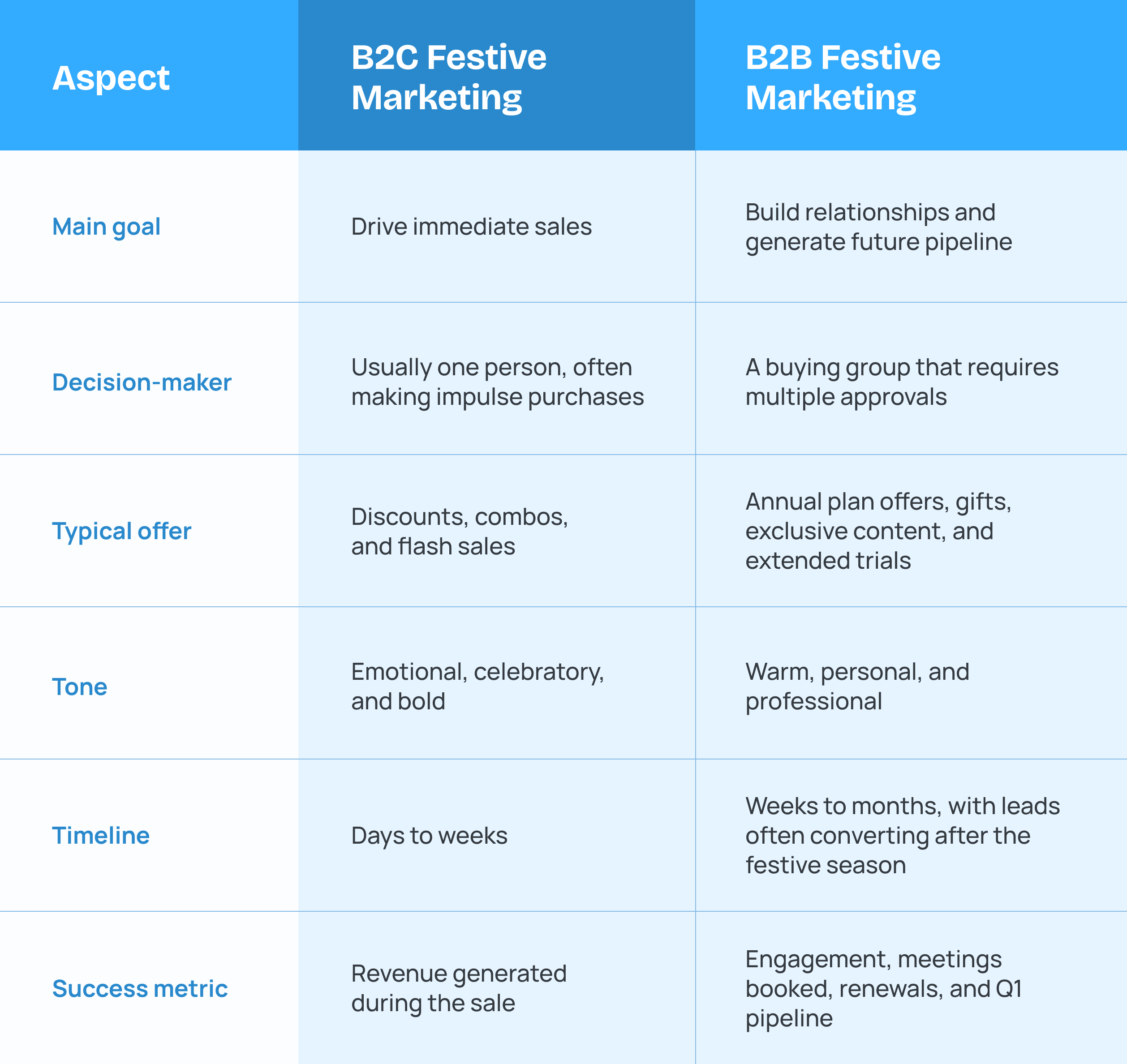
For a small or mid-sized B2B team, this changes how you plan. The best holiday marketing campaigns are the ones that feel personal, arrive on time and give clients a reason to remember you when they’re ready to buy.
10 Festive Marketing Ideas for B2B Teams
You don’t need a big budget or a 10-person team for any of these. Most can be planned in a week and run by one marketer with some help from sales. Honestly, don’t try all ten. Pick the two or three your clients would actually care about, and give those your full attention.
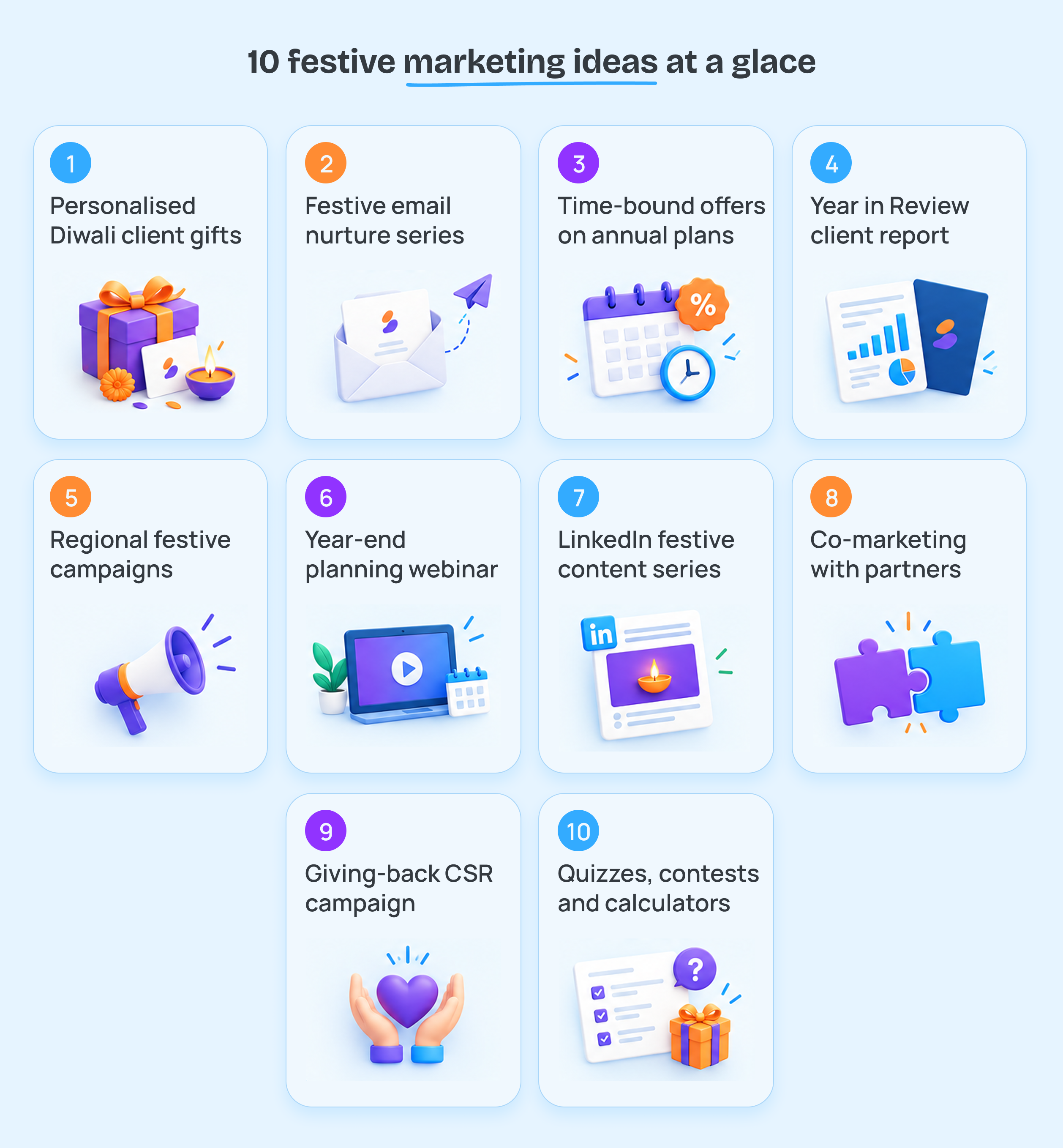
Send Diwali gifts your clients will talk about (not another dry fruit box)
Every client gets a dry fruit box. By the third one, they’ve stopped checking who it’s from.
The gifts people remember feel like someone thought about them, not about getting the logo on the packaging. 71% of buyers expect personalised interactions and 76% get frustrated when they don’t get them, says McKinsey.
How to do it on an SMB budget:
- Tier your list: Top 10 accounts get something personal. Everyone else gets a handwritten card and a small, good-quality sweet box. Don’t spread the budget evenly.
- Ask your account managers one question: “What does this client care about outside work?” It could be a book, a plant, a coffee subscription or a cricket match ticket.
- Support local makers: Pick a regional artisan brand like Channapatna toys, a Madhubani print, something from a Khadi store. It feels more personal, and you get a nice little line for the note about where it came from.
- Write the note by hand: Three lines, from the person who actually works with them, and no sales pitch.
- Order by mid-October: Couriers get slammed the week before Diwali, and a gift that arrives after Bhai Dooj misses the point.
Works best for: Any B2B business with a small group of high-value clients, such as agencies, consultancies, IT service firms, manufacturers and distributors.
Pro tip: Log every gift in your CRM or project tracker: who got what, when it was sent, when it was delivered. Next year you won’t send the same person the same thing twice.
Run a festive email nurture series (not just a greeting card)
A Happy Diwali from Team XYZ email with a stock image of diyas gets opened, scrolled past and forgotten.
Email is still one of the best-performing B2B channels. Litmus’s 2025 State of Email report found that 35% of marketing leaders get $10 to $36 back for every $1 they invest in email. The return comes from sending a sequence with a purpose, not one greeting.
A simple 3-email festive sequence:
- Email 1 (around Navratri): A useful resource such as a year-end planning checklist or a template. No ask.
- Email 2 (Diwali week): A short, warm greeting, signed by a real person, not Team. Add one line on what you’re grateful for this year.
- Email 3 (early November): Your festive offer or an invite to your webinar (see Idea 6), now that they’ve heard from you twice without being sold to.
Works best for: Businesses with a decent email list of clients and leads, especially SaaS, training and professional services companies.
Watch out for: Sending on Diwali day itself. Inboxes are full and nobody’s working. The day before Dhanteras or the week after Bhai Dooj usually gets better attention.
Launch time-bound festive offers on annual plans
Here’s where the festive season sale idea works for B2B, as long as you keep it sensible. Slashing your price to 50% off makes you look desperate. A well-built festive offer gives the buyer a reason to stop putting off a decision they were already considering.
Offers that work better than flat discounts:
- Extra months free on annual plans, e.g. “Pay for 12, get 14 if you sign before 15 November”
- Free onboarding or setup worth ₹X, which costs you time, not margin
- Upgrade at the old price, for existing clients moving to a higher tier
- A bundled add-on they’d normally pay extra for
Works best for: Subscription or retainer-based businesses, such as SaaS tools, agencies on retainers, AMC providers and B2B service contracts.
Keep it time-bound: A clear end date (ideally before your financial year’s Q4 begins) gives procurement a reason to move faster. Put the deadline in the subject line, the landing page and the sales team’s follow-ups so it’s the same date everywhere.
Publish a “Year in Review” report for your clients
Spotify Wrapped takes over Instagram every December because people love seeing their year in numbers. Your clients feel the same way about their work.
In a Gartner survey of tech buyers, 64% said they preferred a fully digital buying experience. A report they can open, forward to their boss and quote in their own review meeting fits that perfectly.
What to include:
- Campaigns run, hours saved, leads delivered, tickets closed, or whatever matters in your business
- 5 or 6 numbers at most, because nobody reads a 20-page PDF in Diwali week
- Their wins up front, with your role mentioned quietly towards the end
- One closing line about next year, like “Here’s what we’d love to do together in 2027”
Works best for: Agencies, SaaS companies, IT and consulting firms, logistics providers, or anyone with ongoing client work they can measure.
Keep it manageable: Build one Canva or Google Slides template and just swap the numbers for each client.
Go regional with Durga Puja, Navratri, Chhath Pujaand Pongal festive campaigns
India doesn’t have one festive season. It has several, overlapping across regions. Your Kolkata client has probably just come back from five days of pandal hopping, and your Chennai client is already thinking about Pongal, so the same Diwali email won’t mean the same thing to both. The fix is pretty easy. Add a “region” field in your CRM and plan your greetings, gifts or small meetups around whichever festival each client is celebrating. It’s a small change, but most competitors send everyone the same Diwali creative, so it gets noticed. Missed someone at Diwali? Pongal and Lohri come around in mid-January, and by then hardly anyone else is sending anything.
Works best for: Companies whose clients are scattered across states. Distributors, staffing agencies, logistics firms and most pan-India service businesses will find this useful.
Host a year-end planning webinar
Around November, your clients start figuring out next year. You could run a short session for them, 30 to 45 minutes, on something like “How we’d plan a 2027 marketing calendar” or “What 200 campaigns taught us this year.” Whatever you’re genuinely good at.
It really doesn’t need much. One person who knows their stuff, maybe ten slides and some time at the end for questions is plenty.
To get people to show up:
- Timing: Skip Diwali and Bhai Dooj week. The second or third week of November works better, once people are back in planning mode.
- Length: Under 45 minutes. Half the audience will have one eye on their inbox anyway.
- Co-speaker: Bring in a client or partner. People trust peers more than vendors, and the co-speaker will share it with their own network (more in Idea 8).
- Recording: Send it to everyone who registered, not just attendees.
- Repurpose: Turn it into 3 or 4 LinkedIn posts and a short blog, so one hour of work gives you content for most of December.
Works best for: Any business with expertise worth sharing, such as consultancies, SaaS companies, HR and finance firms, and industry suppliers.
Build a LinkedIn content series around the festive season
LinkedIn is where your B2B buyers are already scrolling, even during the holidays. A short, planned series over 2–3 weeks does better than one Diwali creative with your logo on it.
The Edelman–LinkedIn thought leadership research found that good thought leadership has a surprisingly strong influence on sales and pricing. Festive content is a natural way in.
Series ideas that work:
- Lessons from this year: One honest takeaway per post, from your founder or team leads
- Behind the scenes: Your team’s rangoli competition, the potluck where someone always brings too much chole, the office pooja. These posts tend to do better than anything polished, simply because people like seeing who they’re working with.
- Client shoutouts: A thank-you post for a client or two, tagging them for a project you did together this year (do check with them before you hit publish)
- Festive-themed tips: Something useful with a festive hook, like “the 5 things I always wrap up before the Diwali break,” written in your own voice rather than as a listicle
Keep it practical: Write and schedule the full series in one sitting before the festive rush. Post from personal profiles, not just the company page, because personal posts usually get much more reach.
Works best for: Honestly, almost any B2B business, though founder-led companies, consultancies, agencies and SaaS brands tend to get the most out of it.
Co-market with partners for bigger reach
Your partners are trying to stay visible this season too. Teaming up halves the effort and doubles the audience.
Easy ways to co-market:
- Co-host the year-end webinar from Idea 6
- Put together a joint festive gift box with a partner whose product complements yours
- Swap guest posts or newsletter features
- Bundle a joint offer for clients you both serve
Before you start: Agree upfront on who owns what, like design, landing page, promotion and leads, and when each piece is due. Co-marketing usually falls apart over unclear ownership, not bad ideas.
Works best for: Businesses with natural partners, like SaaS integrations, agencies and tech vendors, suppliers and distributors, or consultants and software providers.
Run a “giving back” CSR campaign
The festive season in India has always been about giving. A small, genuine giving-back campaign can say more about your brand than any ad.
Ideas that don’t need a big budget:
- Donate a set amount per client to a cause, and tell clients in your Diwali note that it was done in their name
- Swap the corporate gift budget for a donation, and let clients pick the cause
- Organise a team volunteering day and share it on LinkedIn
- Support a local NGO or artisan group, which also ties in nicely with Idea 1
One rule: Keep it real. Don’t spend more promoting it than you gave. People notice when a campaign is just for show.
Works best for: Any B2B business with a set of values it lives by, especially SMBs with close-knit client relationships.
Try festive quizzes, contests and calculators to get people engaging
Most festive posts get a like at best, and then people scroll on. Ask them to do something, like answer a quiz or send a photo, and they actually stop for a minute. Plus you end up learning things about them that no like count will ever tell you.
Formats to try:
- Festive quiz: “What kind of marketer are you this Diwali?” or an industry trivia quiz on LinkedIn
- Contest: Best Diwali office decoration, with clients sending photos and the winner getting a hamper
- Calculator: A simple ROI, savings or time-saved calculator tied to a festive offer
- Polls: Quick LinkedIn polls like “How many days off is your team taking this Diwali?” Easy to make, and good for engagement.
Tip: Keep it light and quick, under 2 minutes to complete. Whatever you build, use the responses for follow-ups in January.
Works best for: Businesses with an active social or email audience, such as SaaS companies, agencies, training providers and B2B brands targeting younger decision-makers.
Swipe File: 4 B2B Campaigns Worth Copying This Festive Season
Consumer brands get all the attention at Diwali, but some of the smartest seasonal plays come from B2B and SaaS companies. Here are four that small marketing teams and agencies can copy without a big-brand budget.
Swipe #1: Shopify’s Global Holiday Retail Report
🔗 See Shopify’s 2026 holiday outlook
What they did: Before the holiday rush, Shopify published a report telling its merchants what to expect this season. It covers how shoppers will behave, where sales will come from and what to fix before it’s too late. One stat from this year’s edition: 65% of shoppers plan to use AI for at least one shopping task.
Why it works for B2B: It shows up when clients are worried about the season, and it makes Shopify look like a partner, not just a platform.
Swipe it:
- Agencies: send clients a 2-page “Festive Season Outlook for [their industry]” in early October
- SaaS: share what you’re seeing across your customer base, like which days get the most activity and when teams go quiet
Swipe #2: Asana’s Anatomy of Work report
🔗 Read the Anatomy of Work index
What they did: Asana, a work-management tool, surveyed 9,615 knowledge workers about how collaboration is going inside companies. One finding: 55% of workers at highly collaborative organisations reported revenue growth over the previous three years. Marketers and managers quote it all the time, and every quote is free promotion for Asana.
Why it works for B2B: It’s about the customer’s world, not Asana’s features, so people share it without feeling like they’re sharing an ad.
Swipe it:
- Survey 50–100 of your own clients or followers on one question your industry argues about
- Publish the results as a short year-end report or LinkedIn carousel in December or January
Swipe #3: Postman’s State of the API report
🔗 See the State of the API report
What they did: Postman, an API platform that started in Bengaluru, runs a survey every year and turns it into a report. The 2025 edition, the 7th, drew more than 5,700 developers, architects and executives. Because it comes out every year, people now wait for it.
Why it works for B2B: Doing it every year turns one report into a tradition, the same idea as running your festive offer at the same time each year (Idea 3).
Swipe it:
- Run your client survey during the festive slowdown, when people have a bit more time to answer
- Release it as “The [Your Industry] Report 2027” in January, then repeat next year
Swipe #4: Cadbury Celebrations × Ogilvy India, “Not Just a Cadbury Ad”
🔗 See the Ogilvy case study
What they did: During Diwali, Cadbury used its festive ad to promote small local businesses hit by the pandemic. Depending on where the viewer was, the ad featured a nearby shop they could support.
Why it works for B2B: It’s a consumer brand, but the idea is pure B2B: make your client’s business the hero.
Swipe it:
- Agencies: post a Diwali “client spotlight” series featuring one client’s work per day
- SaaS: feature a customer story each week of the festive season instead of product updates
How to run holiday marketing campaigns without burning out
Coming up with festive campaign ideas is the easy part. Running three of them at once, while half your team is on leave and clients take a week to reply, is where it gets messy. Here’s what helps.
- Put everything on one board before October starts. Gifts, emails, LinkedIn posts, the webinar: every task goes in one place with a name and a date next to it.
- Choose fewer ideas than you think you can handle. Two campaigns done properly beat five half-finished ones. For each one, ask, “Who’s actually going to own this?” If the answer is “all of us,” drop it.
- Plan for slow approvals. Founders and clients get busy around Diwali, and sign-offs that normally take a day can take four. Set internal deadlines at least 3–4 days before anything has to go out.
- Create everything in one sprint. Write the emails, design the creatives and schedule the posts in one focused week in early October.
- Sort out leave first, then assign work. Ask who’s away and when before you hand out tasks, not after.
- Measure what matters. Track replies, meetings booked, renewals signed and leads on your Diwali post.
This is where project management tool for marketers saves a lot of back-and-forth. With 5day.io, you can set up each festive campaign as a project, give every task an owner and a due date, and see at a glance what’s stuck in approval. Once the season’s over, save the whole thing as a template. Next year, you won’t start from a blank page.