

Every agency begins in a state of closeness.
In this early stage, systems, apart from the fundamentals to keep operations stable, feel unnecessary. The founder holds the work together through presence, and intuition. Teams move quickly because they can see the whole picture, and the work carries an energy that clients respond to.
This period often becomes the reference point agencies try to preserve as they grow.
As the agency expands, that same closeness becomes harder to maintain. More projects run simultaneously, more people touch the work, and decisions travel further before they land. Creativity begins to compete with coordination.
The agencies that endure are the ones that learn how to translate their early intuition into something shareable. They build systems that capture how work moves without flattening the creative spirit behind it. These systems exist to remove uncertainty, so creative teams can focus on the work itself.
This article explores how agencies can design these systems that preserve creative momentum as they grow, so success does not dilute what made the work special in the first place.
What creative workflow actually means and why most agencies misdefine it
Most agencies try to fix friction by adding layers, without understanding how work actually moves, how it’s understood, emotionally processed, shaped, questioned, doubted, defended, and finally released into the world.
When workflow is defined too narrowly, the solutions stay shallow, and shallow solutions create the illusion of control while the chaos quietly continues underneath.
A creative workflow, however, is a living system of interpretation, and judgment.
It begins the moment work enters the agency; it continues through how that work is interpreted and translated into something actionable.
And it doesn’t end at delivery, it extends into how learning is captured, and how the next piece of work becomes better because of the last.
This is why workflow is fundamentally behavioral.
When agencies standardize creative workflows this way, something important shifts. The goal stops being process efficiency and becomes trust, and creative momentum.
Why creative work is uniquely hard to standardize
Creative work resists standardization because it is deeply human.
Two people can look at the same piece of work and feel entirely different things.This subjectivity means decisions can’t be automated. Ideas don’t move forward in straight lines. Attempts to force linearity onto this process don’t make it faster.
Creative work also attracts opinions. People see themselves in the output, and feedback is personal, and aspirational. Without thoughtful systems, this turns review cycles into power struggles or endless churn.
And then there’s attachment.
Creators care about their work. They defend it and grieve it when it changes. This emotional layer is invisible in generic project management frameworks, which treat output as interchangeable and people as neutral executors. That’s why borrowed systems fail agencies.
Creative agencies operate in a reality where ambiguity is constant, and emotion is inseparable from craft. Standardizing creative work without understanding these damages morale and slowly teaches people to play safe.
Read Also: Marketing Agencies – All You Need to Know Before Getting Started with 5day.io
The challenge, then, is not to force creativity into rigid systems, but to engage in agency process standardization that respect its nature while protecting the humans doing the work. That’s the work ahead with respect to creative project management.
The real cost of an unstandardized creative workflow
- Time drains into constant back-and-forths, and alignment meetings because expectations were never fully shared upfront
- Work gets duplicated or redone as ideas, decisions, and context live in people’s heads instead of the system
- Frequent context switching fragments focus, reducing creative depth and making “done” feel rushed
- Output quality becomes inconsistent across team members
- Project scope quietly expands through undocumented tweaks and quick fixes
- Senior talent absorbs delivery gaps, using high-cost hours to patch avoidable issues and shrinking margins
- Designers, writers, and strategists burn out from uncertainty, and loss of ownership over their work
- Founders turn into bottlenecks and fire-fighters
Creative Operations Management — The Missing Layer from traditional project management
| Traditional project management | Creative operations management |
| Focuses on tracking tasks, deadlines, and checklists | Focuses on how creative work flows through people, decisions, and stages |
| Answers “What needs to be done?” | Answers “How does work actually move, stall, and succeed?” |
| Optimizes for completion | Optimizes for sustainability, quality, and consistency |
| Treats projects as isolated units | Treats projects as part of an interconnected system |
| Assumes stable inputs and predictable work | Accounts for iteration and creative variability |
| Measures progress by task status | Measures progress by momentum, clarity, and risk |
| Relies heavily on individual heroics to meet deadlines | Reduces heroics by designing resilient systems |
| Stores knowledge in tickets and comments | Converts experience into reusable organizational knowledge |
The 5 core stages of a standardized creative agency workflow

Stage 1: Intake and briefing
Every creative problem that shows up later usually has a quiet origin point.
The brief.
A vague brief creates exponential downstream damage.
| When the objective is fuzzy | Creators guess |
| When the audience isn’t clearly defined | Messaging dilutes |
| When constraints aren’t stated | Teams design for a version of reality that doesn’t exist |
| When success criteria are missing | Feedback becomes subjective |
What looks like a creative miss later is often a comprehension failure at the start.
This is why intake and briefing are not administrative steps.
When this stage is rushed or informal, the rest of the workflow compensates through rework.
Standardization here means making them complete enough to be fair, to the people doing the work and to the clients expecting results.
That’s where structure matters.
Mandatory fields save a lot of time and effort down the line:
- A clearly articulated objective
- Defined audience
- Explicit constraints
- Success criteria
- Ownership matrix
When intake is treated with respect, something remarkable happens: teams move faster, and creativity sharpens.
Stage 2: Creative interpretation and alignment
This is the stage most agencies don’t even realize they’re missing. The brief lands, there’s a quick skim and, the team jumps into execution. But what’s actually happening beneath the surface is far more fragile.
Every person who reads a brief reads it through themselves, and because no one pauses to compare those movies, misalignment becomes inevitable.
This is why projects so often derail halfway through.
Creative interpretation and alignment are the moment where teams articulate how they’re reading the brief, what they believe the real problem is, and where they think the sharp edges lie. When this stage is skipped, teams drift apart.
Standardizing this stage means giving it a stable center. Internal alignment notes capture how the team is interpreting the ask, precisely as a translation of intent. They make visible what is otherwise assumed.
Creative interpretation and alignment is where trust is built quietly, long before the first draft is shared.
Stage 3: Execution
For many creatives, execution is where anxiety quietly peaks, because everything around the work is uncertain.
Execution should feel absorbing. Grounded. Almost invisible in its structure.
The paradox is that creativity thrives best when this stage is the least dramatic part of the process. When creators know exactly what they’re solving for, and what comes next, their minds are free to experiment, and refine. There’s a quiet confidence that settles in.
Standardization plays a deeply supportive role here.
Dependencies stop being hidden landmines when they’re visible upfront. Creators don’t have to chase context or approvals; they can trust that what they need will arrive when expected.
This is where tools stop feeling like project management software and start feeling like creative infrastructure.
With platforms like 5day.io, work is structured in a way that mirrors how creative minds actually move.
- Hierarchies make sense, so no one wonders how their task fits into the larger picture.
- Progress is visible, which reduces anxiety without adding surveillance.
- The next step is always clear, so creators don’t have to mentally juggle what’s coming while trying to focus on what’s now.
There’s a subtle emotional shift when execution is well-supported.
Stage 4: Review, feedback, and iteration
This is where good work most often begins to unravel.
In many agencies, review happens as a reaction rather than a designed moment. What starts as a search for improvement quickly turns into confusion.
Everyone wants the work to be better, but without structure, feedback becomes noise.
The real failure here is the absence of feedback architecture.
Multiple reviewers weigh in without clarity on whose voice carries what weight.
What inevitably happens is feedback comes late, when emotional energy is already spent and timelines are tight. This turns iteration from refinement into erosion.
Over time, creators start scanning for instructions instead of insight.
Standardization at this stage is an act of respect.
Clear review ownership protects both the work and the people making it. When everyone knows who reviews what, and why, feedback gains coherence.
Sequence matters because early feedback shapes direction. Timing matters because feedback is only helpful when there’s still room to respond thoughtfully.
Defining what “done” means is perhaps the most underrated form of kindness in a creative process. It sets an invisible boundary around effort.
Stage 5: Delivery, learning and optimization
For many agencies, delivery feels like exhale.
The work is technically done, but the experience of making it is left behind, unanalyzed and unresolved.
And that’s where growth quietly stalls.
Delivery should never be the end of the workflow.
It’s the only moment when the full truth of the process is visible. To walk away from that moment without reflection is to waste the most valuable data an agency ever produces.
Mature agencies treat delivery as a transition point.
They pause, not for long, not ceremonially, but with intention:
- What flowed smoothly
- Where friction appeared?
- Which decisions paid off?
- Which shortcuts created downstream pain?
These conversations are about memory. Without them, teams repeat the same mistakes with new faces and new projects.
Capturing what worked reinforces patterns worth repeating.
Over time, these reflections become reusable intelligence. The workflow evolves organically, guided by lived experience.
This is how agencies improve without suffocating themselves in process.
That’s how excellence compounds.
How to standardize creativity without over-engineering – The 5day.io way
Step 1: Establishing a stable creative foundation at the organization level

Before work even enters the system, 5day.io forces a decision most agencies postpone indefinitely: who does what, and with what authority.
Through organization setup, agencies define roles and permissions.
This is creative protection.
When roles are explicit, account owner, admin, manager, member, external collaborator, decision-making stops floating.
Custom roles and permissions in 5day.io allow agencies to reflect real-world creative hierarchies instead of generic “manager vs member” binaries. This is how standardization begins without centralization.
Step 2: Turning vague work into structured creative containers

Creative chaos often enters disguised as a project.
In 5day.io, projects are not loose buckets. They are structured creative containers with defined owners, clients, fields, priorities, budgets, timelines, and workflows.
Multiple project owners ensure leadership doesn’t collapse onto one person. Custom project fields allow agencies to encode what they care about, campaign type, content pillar, channel, urgency, without forcing every project into the same mold.
This is where standardization becomes modular.
Agencies can duplicate projects, save them as templates, and reuse proven structures, to repeat clarity. Each new project starts with inherited intelligence.
Step 3: Designing work hierarchies that mirror creative reality
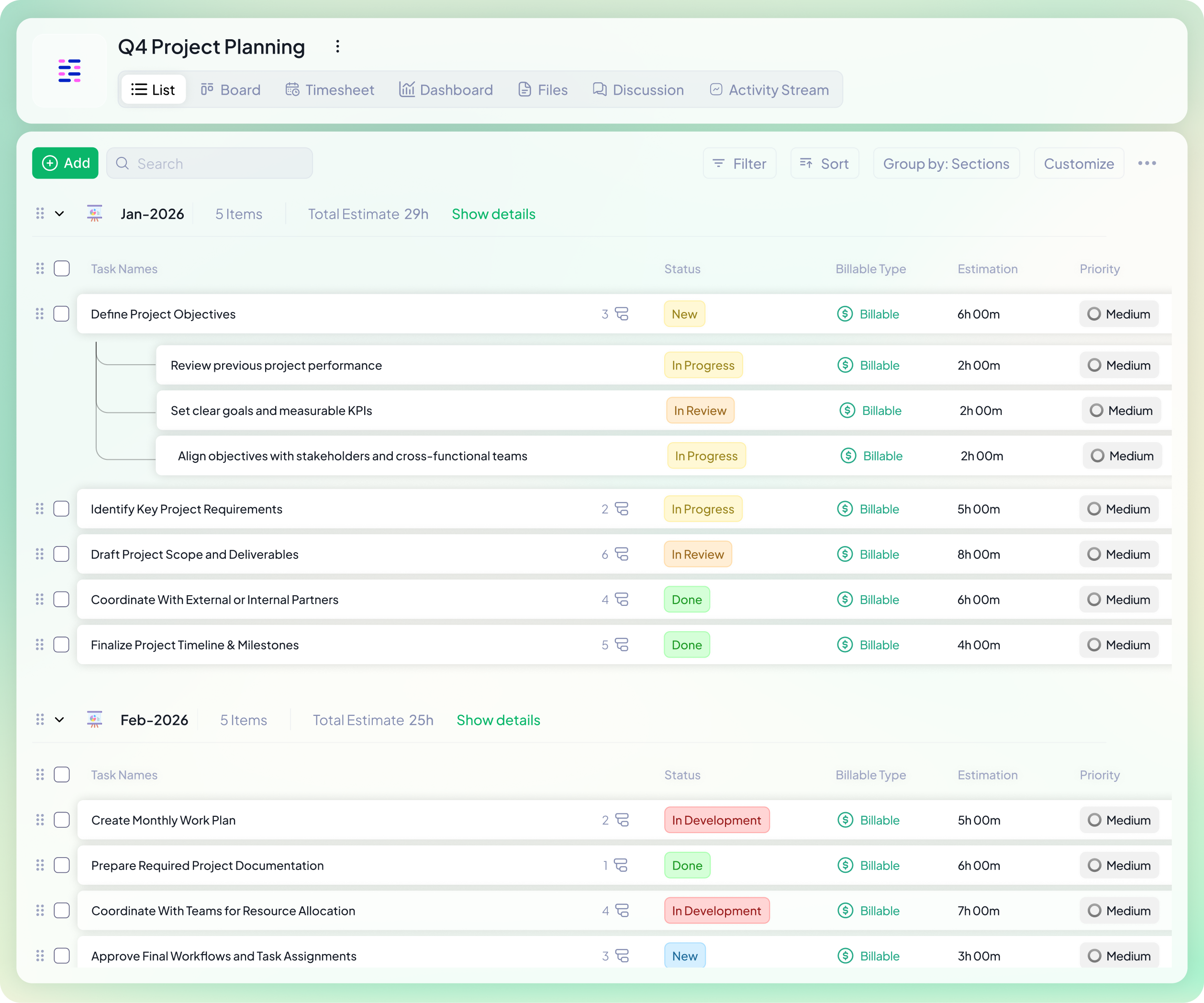
Most creative work doesn’t exist as a single task. It exists as layers of thinking, making, revising, and coordinating.
5day.io acknowledges this by allowing projects to break into sections, tasks, sub-tasks, and dependencies.
This hierarchy does something subtle but powerful: it externalizes thinking.
Creators no longer hold the entire project in their head.
Dependencies, start-to-start, end-to-end, start-to-end, replace guessing with sequence.
Step 4: Standardizing execution without scripting creativity
Execution is where creativity breathes, and where most tools accidentally suffocate it.
5day.io standardizes execution by stabilizing inputs.
Tasks carry descriptions, timelines, priorities, estimations, billable flags, tags, and custom fields that reflect agency language.
- Recurring tasks handle repeatable creative rhythms
- Linked tasks preserve continuity across projects
- Automation removes manual nudging
None of this dictates how to create, it simply removes the noise that prevents deep focus.
Step 5: Making collaboration contextual instead of chaotic
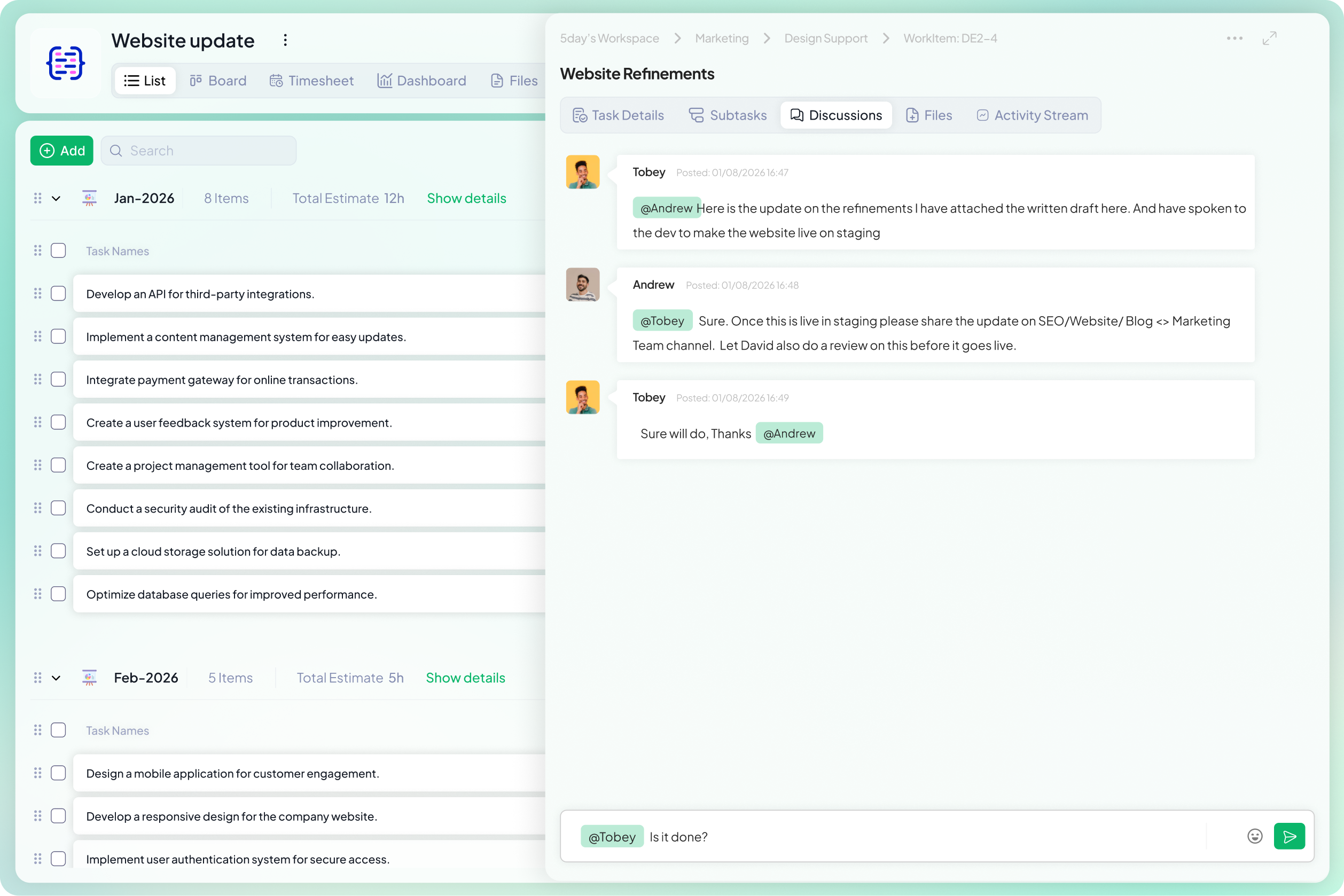
In 5day.io, collaboration lives inside the work. Files, discussions, comments, tagging, and activity streams stay anchored to the task they belong to.
This matters emotionally.
Creators no longer defend work in fragmented Slack threads, and decisions leave a trace. Moreover, conversations don’t reset every time someone new joins.
Collaboration becomes cumulative instead of repetitive.
Step 6: Replacing gut feel with creative visibility

5day.io surfaces progress through project-level analytics, widgets that track tasks, subtasks, time entries, and trends across formats like charts, tables, and single-value metrics.
Leaders stop asking people for updates.
They stop guessing where things are stuck. They intervene earlier, and with context.
Step 7: Understanding effort, capacity, and creative cost
Creative burnout is often a math problem disguised as a motivation problem.
Timesheet management in 5day.io reveals where energy actually goes, such as, billable vs non-billable, internal vs client work, overtime, capacity utilization.
When agencies see this clearly, standardization becomes compassionate.
Conclusion
The final transformation is quiet, but profound.
As structure stabilizes, founders stop being the mediator, and rescuer. Decisions don’t bottleneck because authority is designed in.
This is what standardizing creativity actually looks like, a system that holds clarity so humans can hold imagination.
That is the role 5day.io plays, as creative infrastructure built for how agencies really work.
Sign up for 5day.io’s 30-day free trial and see the tool in all its glory by yourself!