

Every startup founder secretly wants a montage.
The one where scrappy hustle turns into a hockey-stick graph while a synth soundtrack plays. But this dream montage only works if there’s a script behind it. That script is your marketing strategy.
This guide is that script. Six marketing strategies that are working right now. From GEO for AI visibility to intent-driven paid media and PLG loops, see how you can use these hyper-relevant strategies to grab your audience. Each of these are paired with the frameworks and templates to turn them into a system.
Let’s cue the music and build the montage that’s fire.
What Is a Marketing Strategy?
A marketing strategy is a long-term operational framework designed to help a business achieve a sustainable advantage over its competitors. It works to:
- dictate resource allocation
- define overall brand and product positioning
- outline how channels will work in harmony
- sync company goals with target market needs
The primary focus of building a marketing strategy is to drive long-term customer acquisition and retention.
Without a coherent strategy, marketing efforts devolve into isolated, reactive tactic. Activities like posting on social media or publishing blog posts become just an effort without a clear link to business revenue.
Marketing Strategy vs. Marketing Plan
Marketing strategy and marketing plan are often interchanged but critically different.
Think of Marketing Strategy as “Winter is Coming.” That is a stance. It’s a read on reality that says, there’s a threat bigger than the squabbles everyone’s distracted by. If you don’t prepare for it, nothing else you win will matter. It’s directional. It doesn’t tell you what to do today. It tells you what matters and what doesn’t matter.

The Marketing Plan, on the other hand, is what the Night’s Watch does to prepare for the winter. Every action the take like building the Wall, training recruits, and stocking supplies comes from the core belief of winter is coming.
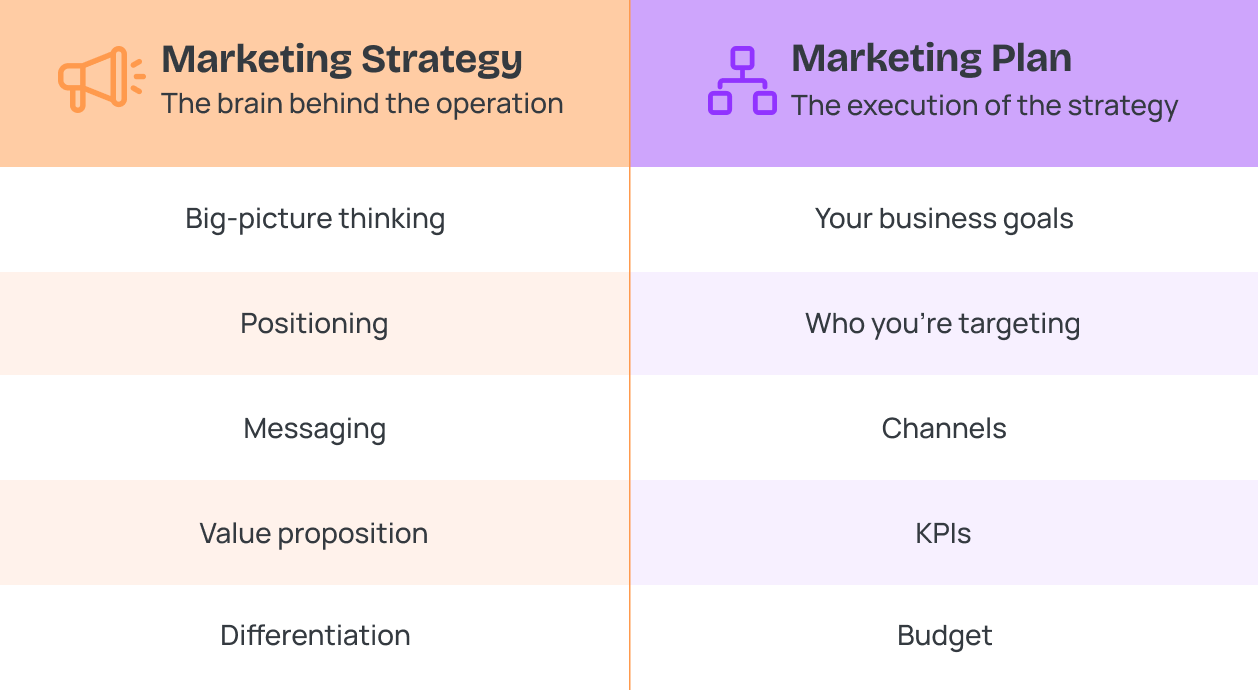
That’s the difference between a marketing strategy and a marketing plan. The strategy decides what direction the efforts will go into, and the marketing plan executes the effort. Without effort, the strategy is useless, and without the strategy, the effort will bring in no result.
A Framework & Audit to Execute Before Building a Marketing Strategy + Plan
Before we jump into the tactics, it’s important to see if you have a strong foundation to hold it. It’s easy to skip this step entirely and get excited about a new channel or campaign idea and just start building. But if your data’s off or your team’s stretched thin, no tactic is going to give results. This section is about slowing down for a minute to check what you’re working with, before you start stacking your marketing strategy on top of it.
1. Auditing Your Strategic Gap Before Building a Marketing Strategy Plan
A rigorous strategic gap analysis is key for teams to make sure that their ambitious growth tactics do not sit on top of broken operational foundations. A detailed gap analysis helps you correct any inaccurate baseline data or misaligned capacity problems beforehand.
To execute this, map out your current marketing outcomes, and your desired marketing outcomes. And then assess the difference in between
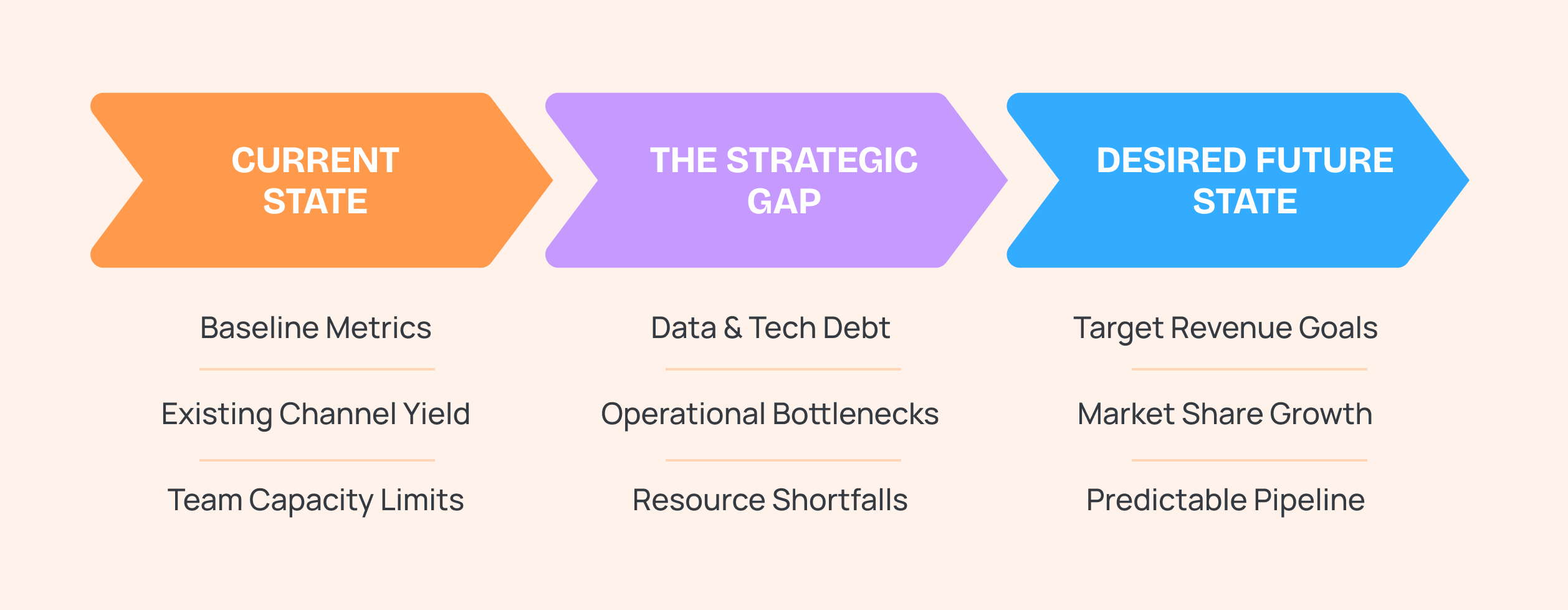
4 Pillars or Marketing Gap Audit
Performance & Data Gap
Resource & Capacity Gap
Tech Stack & Operations Gap
Channel Yield Gap
Steps to Perform a Marketing Gap Analysis
Step 1: Document Baseline Performance
Record exact trailing 12-month metrics for Customer Acquisition Cost (CAC), sales cycle length, pipeline velocity, lead-to-opportunity conversion rates, and channel-by-channel ROI.
Step 2: Map the Operational Bottlenecks
Interview channel leads, copywriters, and sales reps to identify where campaigns get stuck in review, where assets delay launches, and where sales reps report low lead quality.
Step 3: Quantify the Shortfall
Calculate the explicit difference between current monthly pipeline generation and the pipeline required to hit your new target goals.
Step 4: Prioritize Remediation Before Sprints
Fix foundational issues like attribution tracking, landing page load times, sales handoff protocols and anything such before scaling spend on new channels.
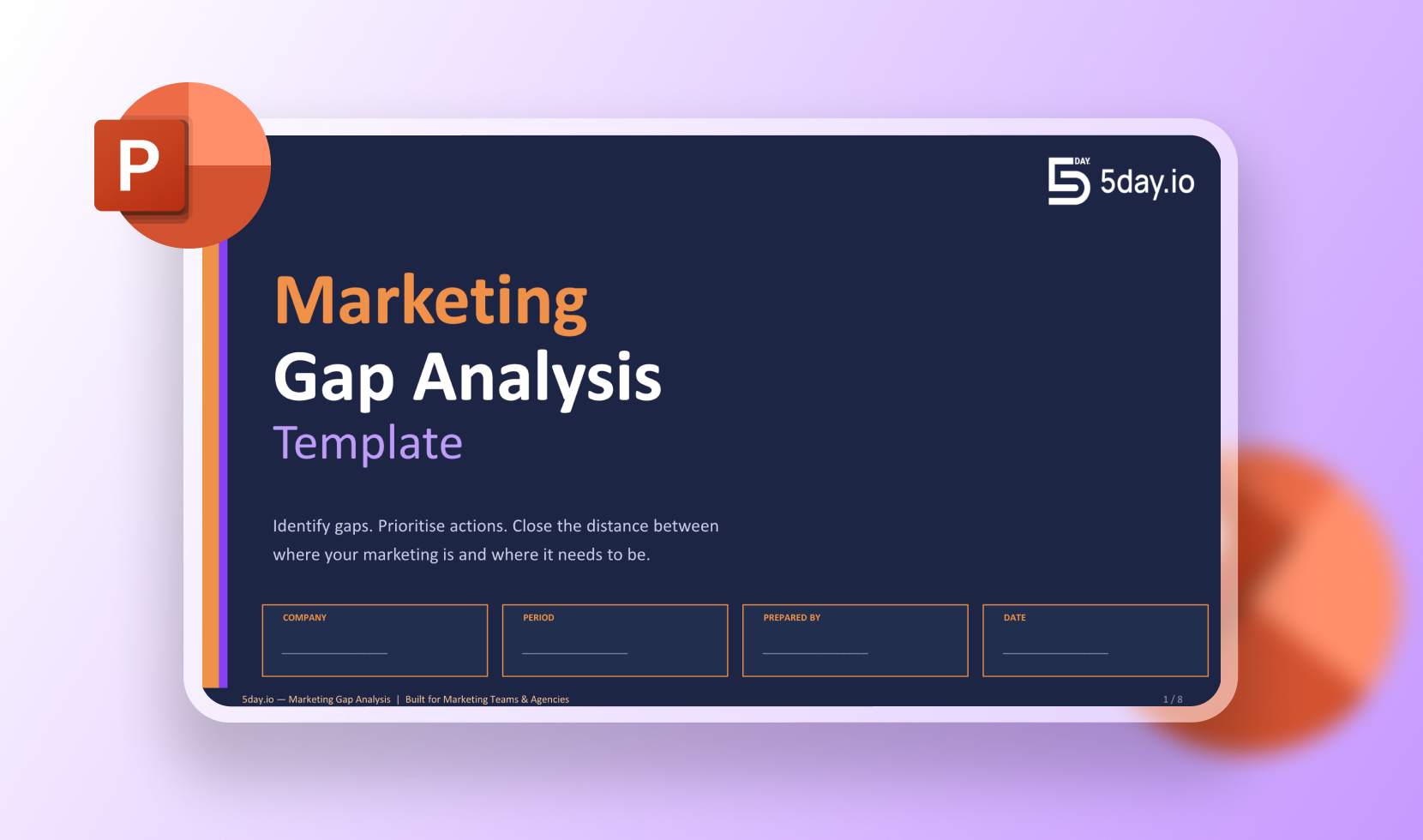
Try the 5day.io Gap Analysis Template for a pre-built template to benchmark current performance vs. targets.
2. The 7 Ps of Modern Marketing for Planning
The traditional 4 Ps framework (Product, Price, Place, Promotion) was developed for 20th-century physical goods.
But today’s digital business models require a more advanced version of that, to make sure your strategy addresses every customer touchpoint that impacts conversion and retention. The expanded 7 Ps framework helps with that.
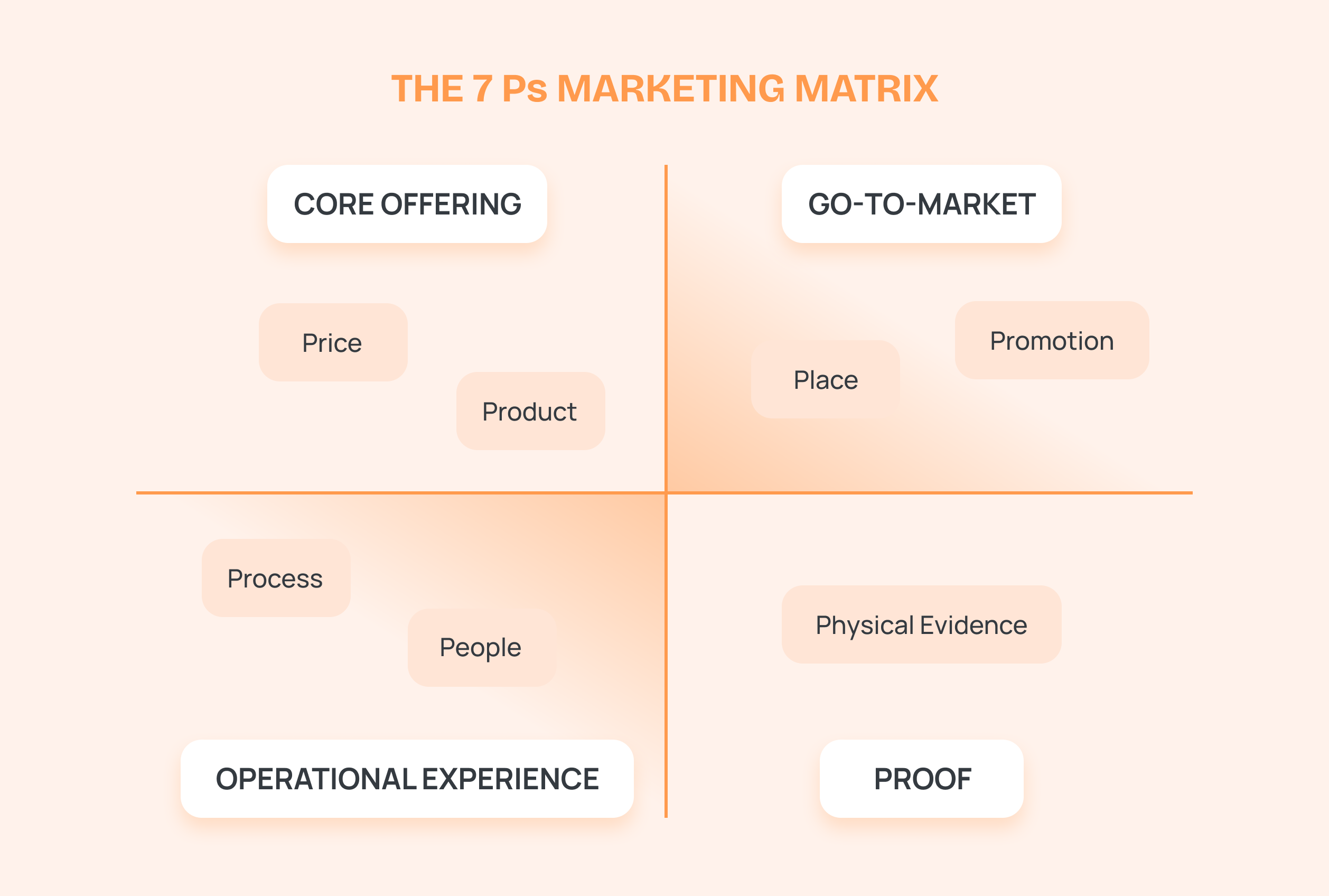
- Product: What real-world problem does your offering solve, and how does its feature set compare to alternative solutions?
- Price: What is your pricing model? Is it freemium, tiered SaaS, value-based, premium, and how does it position you against competitors?
- Place: Where do your target buyers research and purchase from? Is it a direct-to-consumer website, enterprise sales, third-party marketplaces or something else?
- Promotion: What combination of owned, earned, and paid media will educate prospects throughout their decision-making process?
- People: Who represents your brand and how do they impact buyer trust?
- Process: How seamless is the customer journey from first touchpoint to product onboarding and ongoing service support?
- Physical Evidence: What tangible proof points like case studies, UI previews, interactive demos, packaging, can your brand promise?
How to Put the 7Ps into Action?
To use the 7 Ps effectively, treat them as an interconnected system rather than a static checklist.
Think of it as a Domino; a change in Price immediately demands updates to your Process and People. According to Gartner’s B2B Buyer Survey, 67% of B2B buyers now prefer a rep-free experience, with 45% using AI tools directly during recent major purchases. This requires forward-thinking marketing teams to conduct a quarterly 7 Ps audit to map friction points across the buyer journey, using AI-driven personalization to dynamically tailor their marketing mix.
To put the updated mix in action:
- Map Interdependencies between all the Ps: Review how changes in one “P” ripple across the other six in your audience and company.
- Remove Process Friction: Audit digital handoffs from ad clicks to demo scheduling to see where gaps occur.
- Establish Unified Metrics: Tie every element of the 7 Ps to full-funnel business outcomes (CAC, pipeline velocity, LTV) rather than isolated channel vanities.
6 Proven Types of Marketing Strategies with Expert Tips & Execution Assets
Once your foundation’s solid, this is where things get fun. These are six marketing strategies that are moving the needle for startups right now.
This isn’t some recycled advice from a 2019 playbook. Some of these you’ve probably heard of, some might be new. Each one comes with the specific tactics, metrics, and assets you need to run it.
Pick the ones that fit where you’re at and go deep instead of spreading thin across all six. Deploying the right marketing strategies requires balancing high-intent acquisition with long-term retention engines.
Generative Engine Optimization Strategy a.k.a. Ways to Increase Visibility in AI
GEO as an inbound strategy has garnered a lot of hubbubs recently. And rightfully so. AI searches are ruling the Internet, and everyone wants a seat at the very top.
Infact, according to an experiment Ahrefs ran in December 2025, AI Overview was responsible for a 58% drop in CTR of the top-ranking pages. So yeah, I get why we all want to top that list.
Before we discuss some interesting, and highly regarded ways on how to build a GEO strategy, there is a case to be made that the way to dominate GEO is not entirely different than our old and trusty SEO strategy.
The basics to win on the internet as a brand remain the same, be it SEO or GEO:
- Answer the question better than anyone else
- Get straight to the point when answering questions
- Be insightful, give concreate data to back up your argument
- Build topical authority, or as GEO says, fan out your queries
- Add trust signals a.k.a. E.E.A.T
- Keep your technical trail or crawlability, schema markup, quick load times and clean architecture up
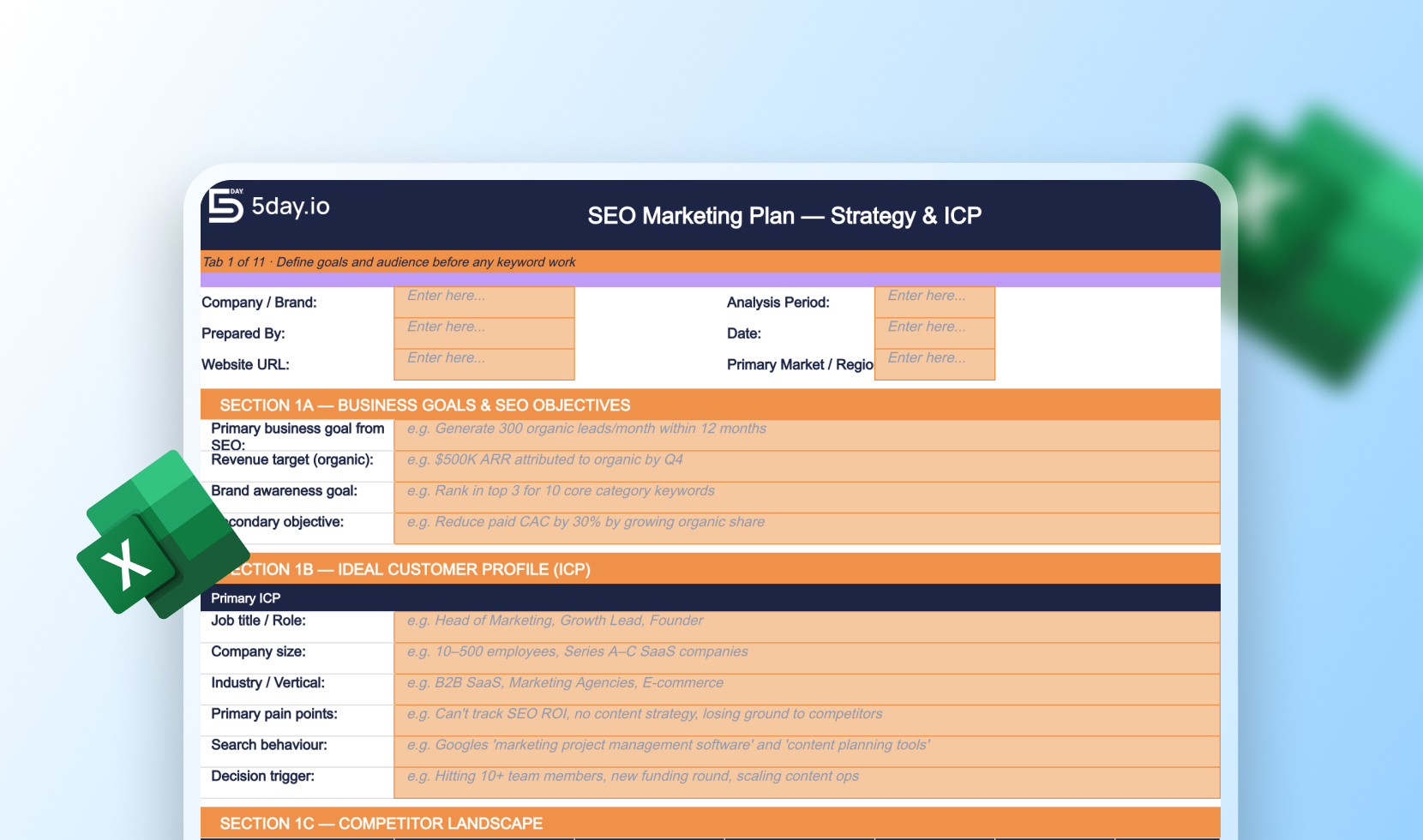
Interesting strategies to apply for GEO ranking
- Align messaging across third parties
LLM models do not rely on your website alone for data. They want co-occurrence of your brand and a consensus on what it stands for across the web. This means, you need to align your core product specs and brand definition across all credible third-party websites like Wikidata, Crunchbase, G2, Capterra, Product hunt and industry media. When multiple independent databases corroborate the same story, AI engines are more likely to site your brand as a verified option.
- Plan for multi-intent queries
It’s time to shift your content calendar from isolated keywords like best CRM to multi-constraint conversational prompts. Write for topics like “compare the best 3 CRMs for small to mid-sized business with native HubSpot integrations.” Topics like these will have sub sections of precise answers so it’ll help the discovery stage but more so it will increase the chance of visibility at consideration stage.
- Penetrate the dark social & communities

It’s not a hidden fact anymore that AI engines rely heavily on community discussions and social platforms to gauge subjective consensus. We’ve even started seeing answers pulled directly from Reddit threads in AI overview on Google as well. Establishing a recurring presence on platforms like Reddit, Quora, and other niche open forums specific to your industry is the way to go. This way, LLMs ingest your brand within the context of real user recommendations during web scraping cycles.
- Optimizing for context windows
AI engines do not pull your entire article or resource at once. They, before generating any answer, find a “context window” from your content. This means they only use the bits that make complete sense on their own. So, writing independent, self-contained paragraphs that make full logical sense even when taken out of context helps AI retriever pull from your library.
Metrics to track for GEO strategy
Metric | What It Does | How to Track |
AI Impression Share / Citation Rate | The number of times your brand or URL is cited as a source when target category prompts are queried | Tools like ZipTie or manual weekly prompt sampling in all known AI models |
Brand Sentiment in AI Answers | Whether the AI speaks about your product in a positive, negative, or neutral light when listing solutions | Manual qualitative prompt testing in all LLMs |
AI Referral Traffic | High-intent clicks originating directly from conversational AI platforms | Google Analytics referral filters |
Self-Reported Attribution Lift | Buyers who discover your brand via AI answers and navigate directly to your site | Adding a mandatory “How did you hear about us?” open-text field on sign-up/demo forms |
High-Intent Paid Media Strategy
It is no shock at all that paid media a high return strategy for almost all small to mid-range businesses. But in the same vein, smaller teams are also more budget conscious. And using broad targeting and unoptimized ad spend can quickly burn through the budget.
Thus, modern paid strategies now shift away from cheap, generic clicks toward capturing high-intent buyers who are actively in-market to purchase.
According to research done by Foundry in 2023, intent-based targeting garnered up to 2.5x increase in ad performance. Executing multi-touch performance campaigns that capture the audience at the exact moment of query is crucial to win today.
Interesting strategies to apply for paid media
- Bid on your biggest competitors
Also known as sunset bidding. This strategy involves bidding on your competitors’ key search terms instead of generic category keywords. Build dedicated landing pages targeting explicit queries like best alternative to X, Y pricing comparison etc.
- Retarget based on live site micro actions
Segment retargeting pools by user behavior instead of your usual page visits. Set up direct response offers to specific visitors like the ones who spent x amount of time on your website or used a specific free lead magnet.
- Reach out based on intent signals
Pair your paid campaigns with outbound which is triggered by intent signals. When your ICP interacts with your paid campaign for a specific category term, automatically trigger a personalized follow-up email addressing that pain point.
Metrics to track for intent based paid campaigns
Metric | What it Does | How to Track |
Cost Per Qualified Lead / Opportunity (CPQL) | The ad spend required to generate a sales-qualified opportunity rather than just a top-of-funnel contact | CRM integration tracking ad campaigns directly to qualified pipeline stages in an ops tool like 5day.io |
Pipeline Payback Period | How many months of customer revenue it takes to recoup the initial paid acquisition cost (CAC) | Calculating (CAC / Monthly Recurring Revenue per account) |
Click-to-Demo Conversion Rate | The percentage of paid ad clicks that result in a booked demo or trial signup | Google Analytics / CRM conversion goal tracking on high-intent landing pages |
Blended CAC vs. Paid CAC | The ratio between total acquisition costs across all channels versus isolated paid channel costs to check that paid media isn’t masking poor organic efficiency | Marketing ROI calculators and monthly finance audit reports |
Product-Led Growth (PLG) & Freemium Strategies
Product–led growth or PLG can be a curse or a boon, depending on what kind of audience you attract. According to industry conversion benchmarks, opt-in self-serve models convert accounts at an average median rate of 4.5% to 8% from free tier to paid.
Winning in PLG requires a longer game and planning in-app mechanics that turn active end-users into internal champions before sales initiatives.
Interesting ways to build a PLG & Freemium strategy
- The Reverse Trial Model
In this model, rather than putting users on a restricted free plan, you give every sign up 7-14 days of full enterprise-level access. No credit card needed. At the end of the period, downgrade the users automatically to a permanent free tier rather than taking away the access entirely. This lets them experience high-tier features upfront while maintaining zero-friction onboarding. Also, according to the same study mentioned above, the reverse-trial models can hit activation rates up to 18% to 32%. Which is almost 3x the regular cycle.
- PQL Threshold Trigger Method
This method uses intent driven triggers rather than basic usage tracking within your app. Here, you define your PQL based on a specific milestone like invited x members, completed creating x tasks or projects etc. This way, when users reach that threshold, you can automatically route them to sales reps for a workspace upgrade at peak engagement moments.
- In-Built Invitations VIA core Features
Design single player style features, but with multi-player participation. This means, create features that show value when one uses, but enhances 10x with other people’s participation. Sending secure link, sharing live dashboard etc works in a way where the product automatically invites external peers into your ecosystem as new free users.
- Gate Features Based on Usage Patterns
Avoid gating fundamental features that block initial user activation. Instead, place usage paywalls directly at points of operational scale. When a user hits a cap, surface contextual upgrade prompts showing the immediate ROI of unlocking the next tier.
Metrics to track for PLG or freemium strategy
Metric | What it Does | How to Track |
Time to Value (TTV) / Time to Activation | The elapsed time from initial signup to the exact moment a user completes their first critical action. | Product analytics platforms like Mixpanel to measure time to key event completion. |
PQL Conversion Rate | The percentage of free or trial accounts that hit specific product usage thresholds and convert to paid plans. | CRM and product analytics integrations tracking user cohorts from PQL status to closed-won. |
Free-to-Paid Conversion Rate | The overall percentage of freemium or free-trial signups that transition into revenue-generating accounts. | Billing engines (Stripe, Chargebee) paired with signup analytics. |
Product-Driven Expansion MRR | Monthly recurring revenue generated purely from self-serve seat additions, usage overages, or feature upgrades without direct sales intervention. | Subscription intelligence reporting segmented by expansion attribution source. |
Creator-Led & Micro-Community Marketing
As marketing evolves, more and more buyers are likely to develop banner blindness and messaging fatigue. Trust today has fundamentally shifted from faceless brands to peer networks and domain experts.
This is the main reason creator led micro communities are highly valued and sought after today. These platforms decentralize traditional promotion by embedding your brand directly into trusted niche ecosystems. And winning today requires operationalizing creator partnerships and community participation into a structured pipeline channel. If used right, this can actually be one of the best B2B marketing strategies in the modern day.
Interesting strategies to use for creator led community and micro community
- Internal creators program
Instead of relying solely on corporate channels, turn internal subject matter experts into recognized category creators. Provide them with dedicated content ops support, ghostwriters, and design assets to build personal audiences on LinkedIn and X, positioning your brand through authentic practitioner insights. One company doing this very well on LinkedIn is Ahrefs. Check out their people section!
- Co-creating Influencer Campaigns
Partner with 5 to 10 niche industry practitioners, who maintain small but highly engaged followings of target buyers for co-created content assets. Rather than paying for standard one-off sponsored posts, engage creators to host live teardowns and contribute in proprietary research templates of your product.
- Penetrate the Dark Social
Build or seed conversations within non-public micro-communities such as executive Slack groups, Discord servers, and local meetups. Equip community managers and brand champions with free access tools and open-source frameworks. Distribute non-promotional educational assets that naturally get shared when peers ask for vendor recommendations.
Metrics to track for influencer or micro creator marketing
Metric | What it Does | What to Track |
Dark Social / Self-Reported Attribution Lift | The volume of qualified leads citing creators, podcasts, or private communities during signup. | Mandatory open-text “How did you hear about us?” field on demo/trial forms paired with CRM data. |
Share of Voice (SOV) & Creator Reach | Total organic impressions and engagement generated across partnered and internal creator profiles. | Social listening platforms, LinkedIn analytics, and creator tracking tools. |
Branded Search & Direct Traffic Growth | High-intent sales opportunities generated from direct community links, private discount codes, or creator landing pages. | Google Analytics baseline tracking correlated with creator distribution schedules. |
Community Referral Pipeline & ACV | High-intent sales opportunities generated from direct community links, private discount codes, or creator landing pages. | Custom UTM parameters, dedicated partner vanity URLs, and CRM pipeline attribution. |
Lifecycle & Email Retention Automation
While top-of-funnel strategies drive pipeline velocity, Lifecycle & Email Retention Automation protects bottom-line revenue by maximizing Customer Lifetime Value ($LTV$). It also prevents churn and turns passive users into active brand advocates.
Interesting ways to build lifecycle and email retention strategy
- Send behavior triggered sequences
Instead of sending drip campaigns based purely on elapsed time (e.g., Day 1, Day 3, Day 7), trigger emails based on active user telemetry. Send celebration messages when a user hits a core milestone, or automatically dispatch target micro-tutorials when an account displays “stall signals.”
- Intervene before churn
Track decline in account-level health scores rigorously. It can be things such as decreasing login frequency, reduced team usage, or unclicked reporting dashboards. Automatically trigger a dedicated retention workflow that alerts the Customer Success Manager (CSM) while delivering sales collaterals most suitable to the user.
- Build win-back loops
Build automated win-back workflows for canceled or inactive accounts after 30, 60, and 90 days. Instead of leading with standard discounts, share major product update notes and newly launched integrations. You can also show revised platform capabilities built since their departure to reignite interest.
Key metrics to track for lifecycle & email retention automation
Metric | What it Does | How to Track |
Net Revenue Retention (NRR) | The percentage of recurring revenue retained from existing customers over a given period, including expansions and minus churn. | Subscription analytics and finance reporting |
Customer Churn Rate (Account & MRR) | The percentage of accounts or total recurring revenue lost over a specified timeframe. | Subscription management software (Stripe, Chargebee) tracking cancellations. |
Product Activation & Feature Adoption Rate | The proportion of subscribers who actively engage with core features within their first 30 days. | Product analytics platforms linked to lifecycle campaign cohorts. |
Expansion MRR / Upsell Rate | New recurring revenue generated purely from lifecycle cross-sells, upgrades, and seat expansions. | CRM pipeline reports attributed to lifecycle workflow clicks and automated prompts. |
Experiential & Event Marketing (Hybrid/Field)
Field and event marketing bridges digital touchpoints with high-trust, real-world relationships. These strategies accelerate pipeline velocity for target accounts late in the sales cycle and puts your brand in front of high intent audience.
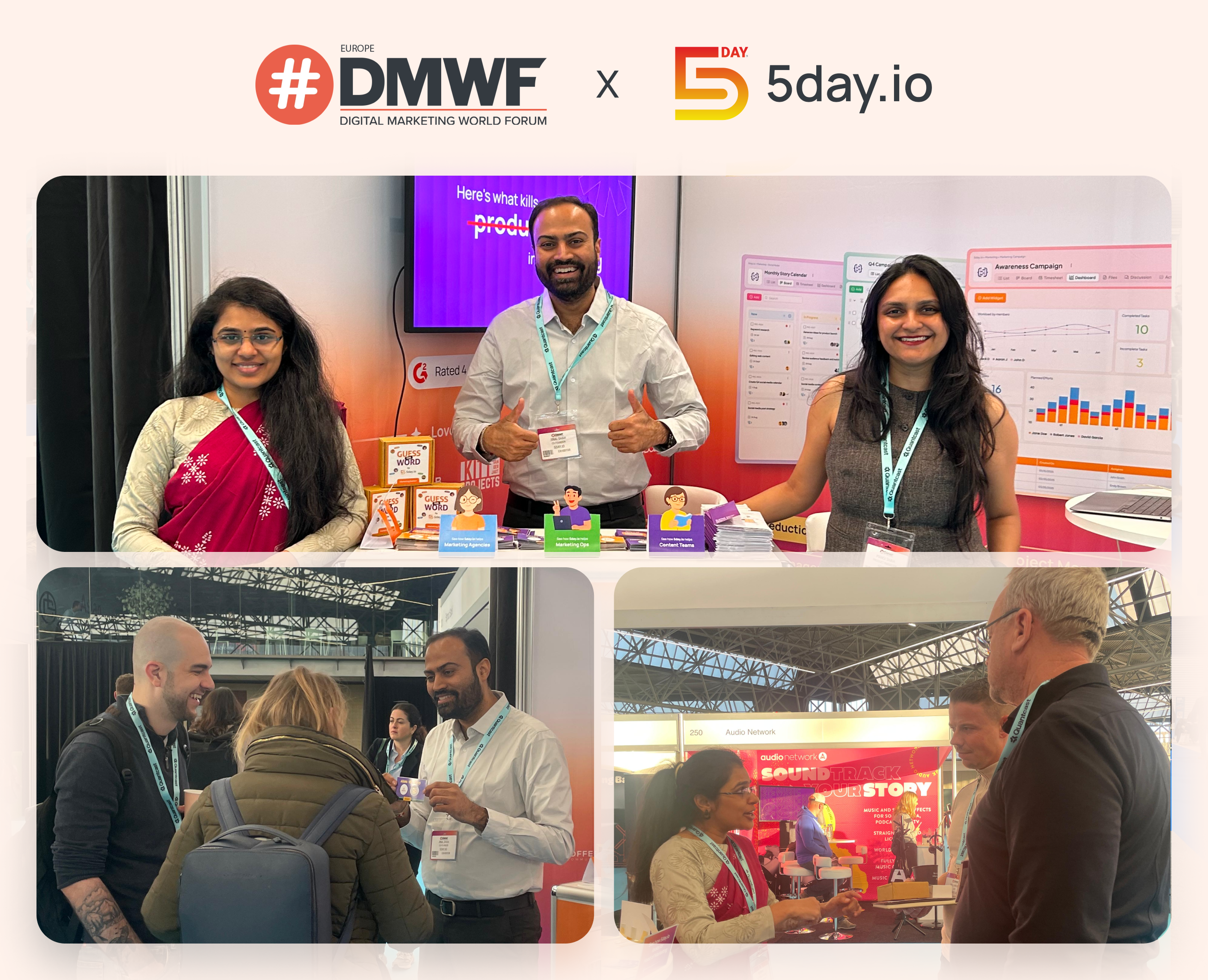
This is a strategy we tried ourselves as a startup in 2025. After the event, we had a highly personalized sequence of emails with all the people we met during, we took pictures with them and sent it to them in our outreach email. This strategy alone got us a demo with over 43% of the people we met there and around 76% conversions.
Interesting Strategies to Apply for Experiential & Event Marketing
- Host VIP executive dinners
Replace large, generic trade show booths with curated 10-to-15 person dinners for target enterprise buyers. Center discussions around a shared industry challenge rather than a product pitch.
- Set up live audits
Host virtual micro-events where attendees submit real-world samples for live expert optimization. Tear them down, or share suggestions that people trust and can follow easily. Use your expertise to build credibility.
Metrics to track for experiential & event marketing
Metric | What it Does | How to Track |
Event Pipeline Velocity Acceleration | The increase in deal progression speed for existing pipeline opportunities that attend an event. | CRM stage-duration tracking comparing event attendees vs. non-attendees. |
Cost Per Attended Meeting (CPAM) | Total event spend divided by confirmed 1:1 sales meetings completed on-site. | Event budget divided by logged rep meeting notes in CRM. |
Post-Event Lead-to-Opportunity Rate | The conversion percentage of event badge scans into active pipeline opportunities within 30 days. | CRM lead status tracking post-event. |
How to Build a Marketing Strategy and Apply it to Daily Work in 7 Steps
A marketing strategy only delivers bottom-line revenue when translated into a repeatable execution workflow. Without operational scaffolding, strategic plans sit idle in slide decks while teams return to reactive, ad-hoc tactics.
Follow this step-by-step framework to map business goals down to weekly execution sprints.
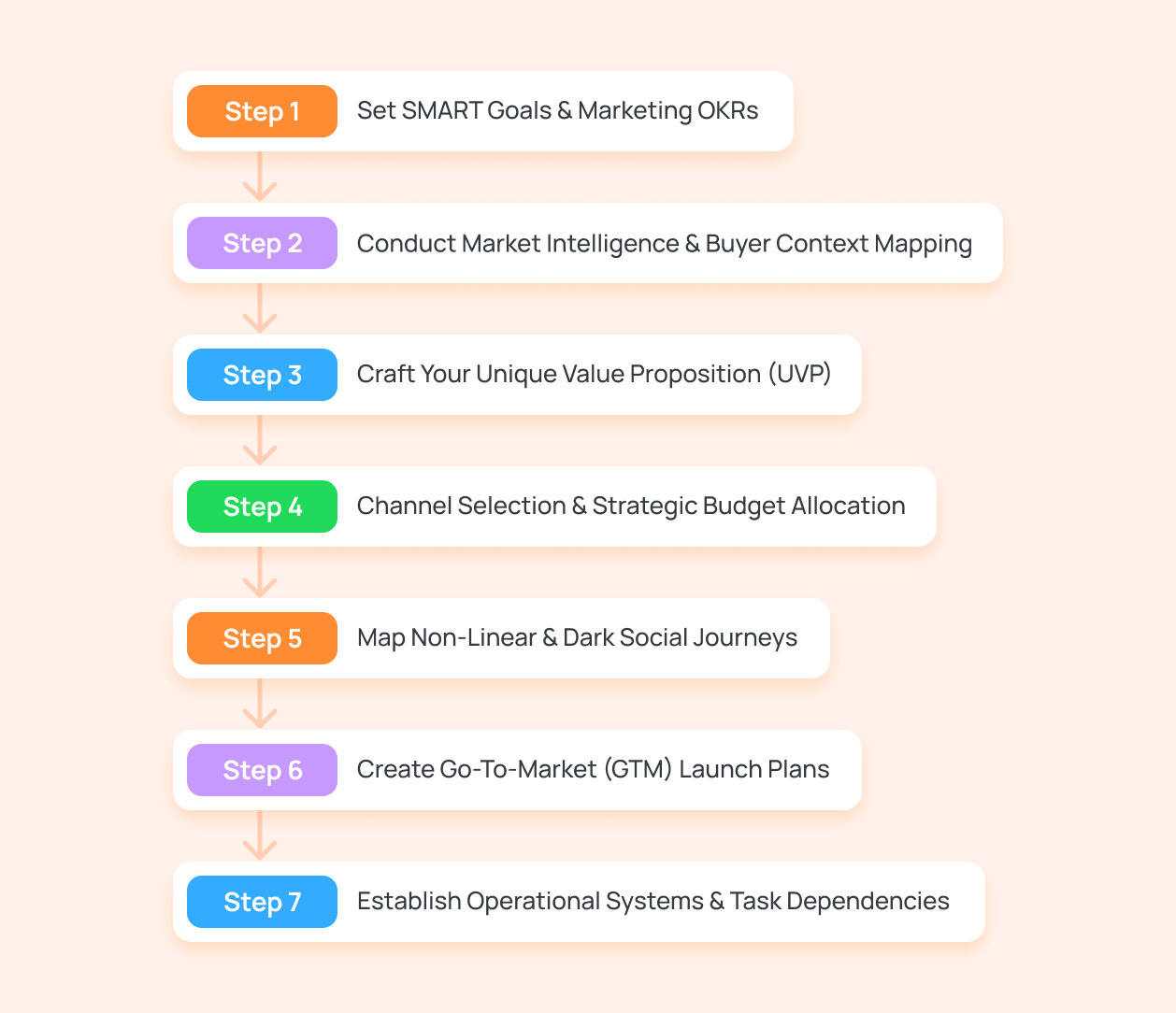
Step 1: Set SMART Goals & Marketing OKRs
The foundation of any strategic blueprint starts with connecting executive revenue targets directly to marketing activities. SMART goals, i.e. Specific, Measurable, Achievable, Relevant, Time-bound, provide overall business guardrails. OKRs or Objectives and Key Results on the other hand establish quarterly operational velocity.

Do not isolate marketing metrics to top-of-funnel vanity data like impressions or pageviews. Every Key Result must explicitly measure pipeline generation or revenue protection. Here’s how you tie it all to proper goals.
- High-Level Business Objective: Expand B2B SaaS ARR from $5M to $8M within the fiscal year.
- Marketing Objective: Accelerate qualified inbound pipeline generation while improving paid media payback.
- Key Result 1: Increase Sales-Qualified Opportunities (SQOs) from 45 to 80 per month.
- Key Result 2: Reduce Customer Acquisition Cost (CAC) payback period from 14 months to 9 months.
- Key Result 3: Scale self-serve Product-Qualified Lead (PQL) activation rate from 12% to 22%.
Step 2: Conduct Market Intelligence & Buyer Context Mapping
Traditional buyer personas rely heavily on static demographics like job title, age, geography. These fail to explain why a customer decides to buy today versus staying with their existing status quo.
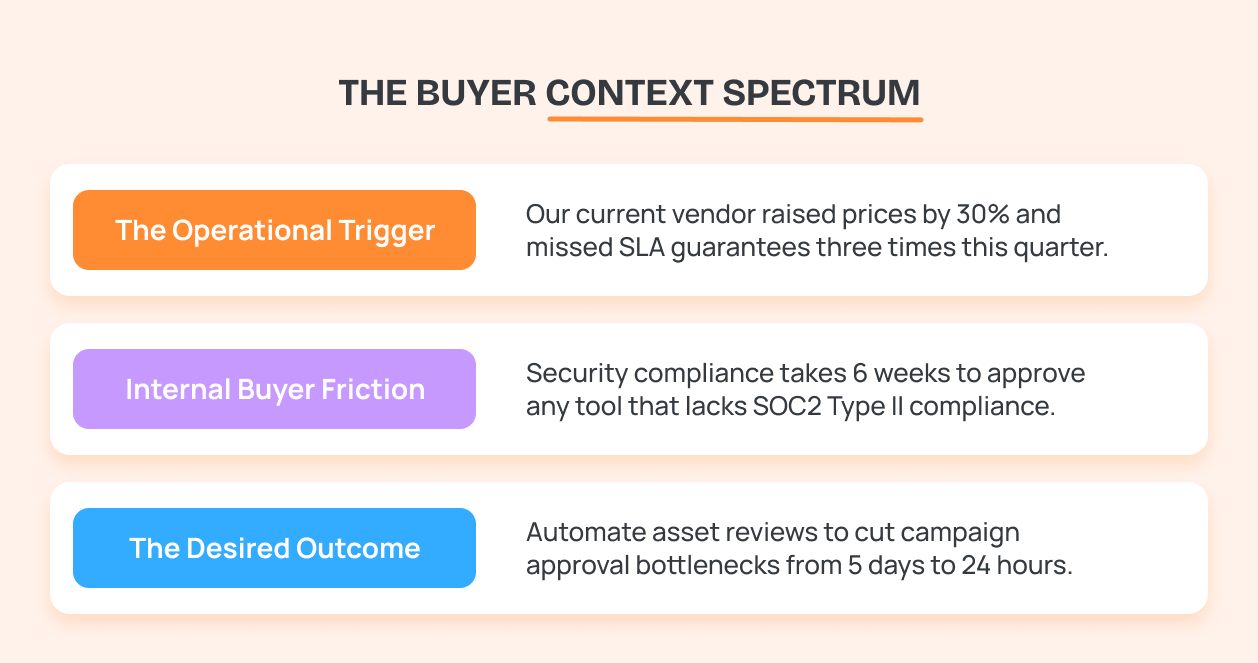
Modern context mapping shifts focus from basic firmographics toward operational triggers and friction points using the Jobs-to-be-Done (JTBD) framework.
Moving from Static Demographics to Buyer Friction Mapping
Instead of defining “Marketing Director Mary, Age 38,” analyze the exact business circumstances that force a prospect into the market:
How to Capture Real Buyer Context
- Analyze Sales Call Transcripts
Review call recordings (via Gong or Chorus) specifically during customer objection handling to extract verbatim buyer vocabulary.
- Execute Post-Onboarding Audits
Interview accounts within their first 30 days of software deployment. Ask: “What specific problem occurred the week before you booked a demo with us?”
- Conduct Churn Diagnostics
Run qualitative teardowns with departed accounts to identify missing product features or operational handoff failures.
Step 3: Craft Your Unique Value Proposition (UVP)
Even the best marketing strategy will fail to convert if your unique value proposition lacks clear differentiation against market alternatives. A Unique Value Proposition (UVP) is crucial for that. It is an explicit statement detailing the distinct value your solution delivers. This should be concrete and encapsulate your entire brand. Be it how it solves your customer’s primary pain point or why you are fundamentally different from alternative market options.
Positioning requires defining your defensible moat against category competitors across three core dimensions:
- Feature Capability Moat: Deep, specialized workflows built for specific use cases that broad, horizontal tools cannot easily replicate.
- Cost & Operational Efficiency Moat: Pricing structures or self-serve deployment models that reduce total cost of ownership (TCO).
- Ecosystem & Data Moat: Native integrations and community template libraries that create high switching costs once deployed.
The 3-Part UVP Formula
To construct a crisp positioning statement, populate this operational formula:
{We help} {Target Audience}] { solve} {Specific Core Problem}] { by } {Unique Operational Approach}], { unlike } {Primary Market Alternative}].
Step 4: Channel Selection & Strategic Budget Allocation
Now budget is tricky. And in startups especially, you see a lot of misallocation happen because early-stage startups copy enterprise marketing plays or scaling companies rely solely on early-stage experimental tactics. Your channel selection must, must, must match company revenue maturity and target audience density, along with today’s top marketing strategies that fit your goals.
Strategic Allocation Formulas by Revenue Growth Stage
Early-Stage Growth (Seed to Series A / under $2M ARR)
Focus resources on direct inbound capturing and rapid feedback loops.
- 80% Core & Direct Channels: Intent Search (SEO/GEO), Founder-Led Outbound, High-Intent PPC.
- 20% Experimental: Niche micro-community engagement and organic social teardowns.
Scaling Enterprise (Series B+ / $10M+ ARR)
Expand channels to balance immediate capture with long-term brand equity.
- 70% Core Proven Channels: Scaled Paid Media, SEO/GEO content networks, Account-Based Marketing (ABM).
- 20% Emerging Channels: Creator partnerships, field VIP events, dedicated co-marketing programs.
- 10% Experimental R&D: Emerging media formats, community sponsorships, original research labs.
I have found this great Reddit thread, link below, and this answer on it, which seems the most accurate so far.
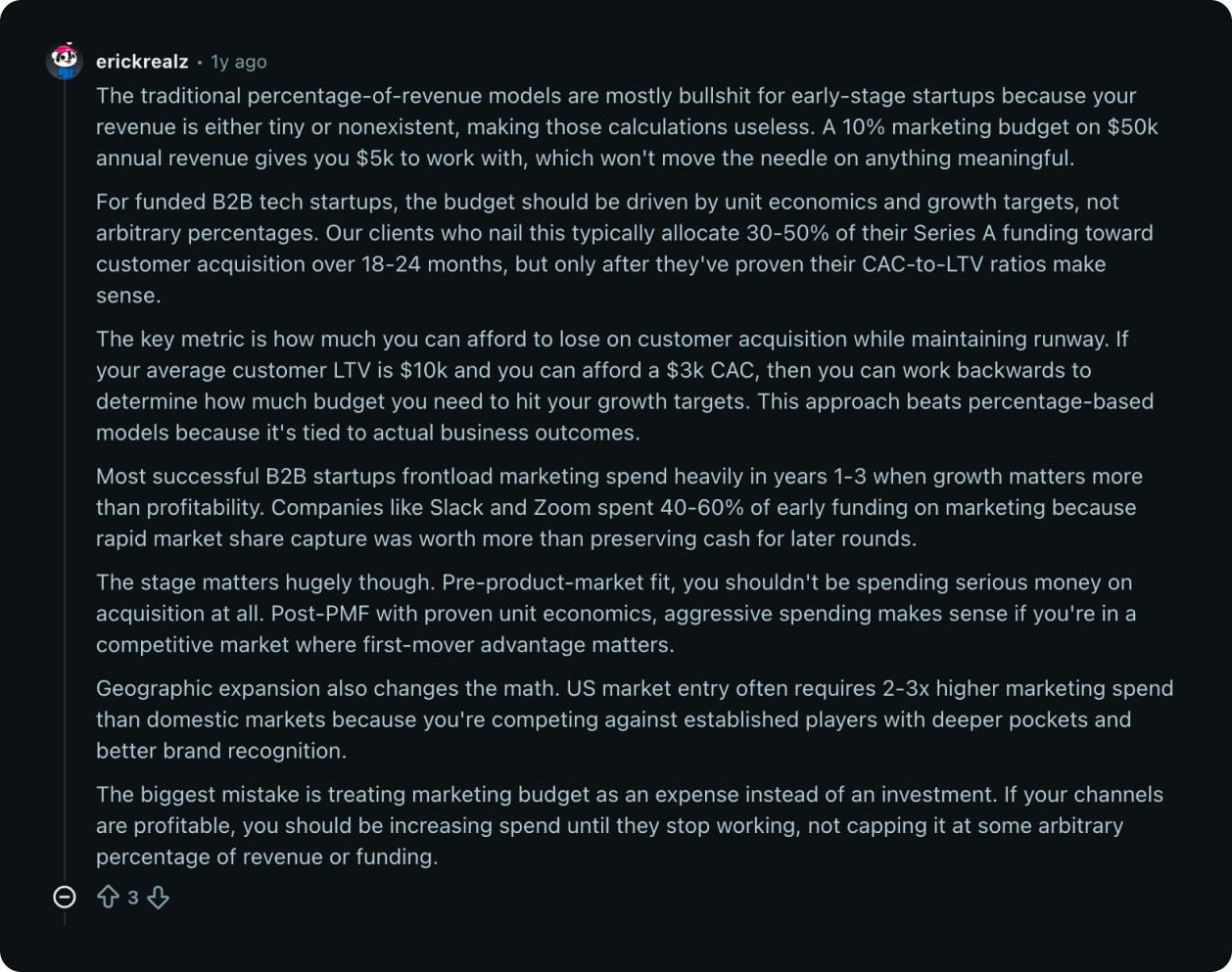
Source: This Reddit thread
B2B software buyers do not move sequentially from an impression to an ad click, followed bye a landing page, and instant demo booking. Modern decision-making takes place across untracked, dark-social channels. These include private Slack groups, Reddit discussions, peer podcasts, and offline word-of-mouth.
Capturing Untracked Social Touchpoints
To prevent misattributing offline community value to last-click paid channels:
- Deploy Mandatory Self-Reported Attribution (SRA)
Add an open-text form field to sign-up and demo pages: “How did you hear about us?” Keep it unpromoted and non-drop-down to capture raw customer wording.
- Triangulate Attribution Data
Combine software-based UTM tracking (first-touch/last-touch) with SRA responses and aggregate branded search volume spikes following community or podcast campaigns.
- Build Dark Social Distribution Nodes
Create free tools, open-source templates, and interactive teardowns designed specifically for users to screenshot and paste into private company Slack or Discord channels.
Step 6: Create Go-To-Market (GTM) Launch Plans
A Go-To-Market (GTM) launch plan aligns product, marketing, customer, and sales teams around a unified product release or expansion campaign. It details distribution timelines, asset ownership, and sales enablement handoffs.
Critical Components of an Operational GTM Blueprint
- Single-Threaded Ownership
Assign one GTM project lead responsible for cross-functional alignment across product management, content design, and sales engineering.
- Tiered Launch Scopes:
Tier 1 (Major Platform Release): Full press push, co-marketing webinars, high-intent paid ad support, product hunt launch, updated sales collateral.
Tier 2 (Feature Expansion): Lifecycle email announcements, targeted in-app prompts, documentation updates, dedicated customer success webinars.
Tier 3 (Maintenance/Improvement): In-app changelog posts and internal sales update summaries.
To manage your GTM well, check out 5day.io’s Go-to-Market Strategy & Product Launch Plan Template.
Step 7: Establish Operational Systems & Task Dependencies
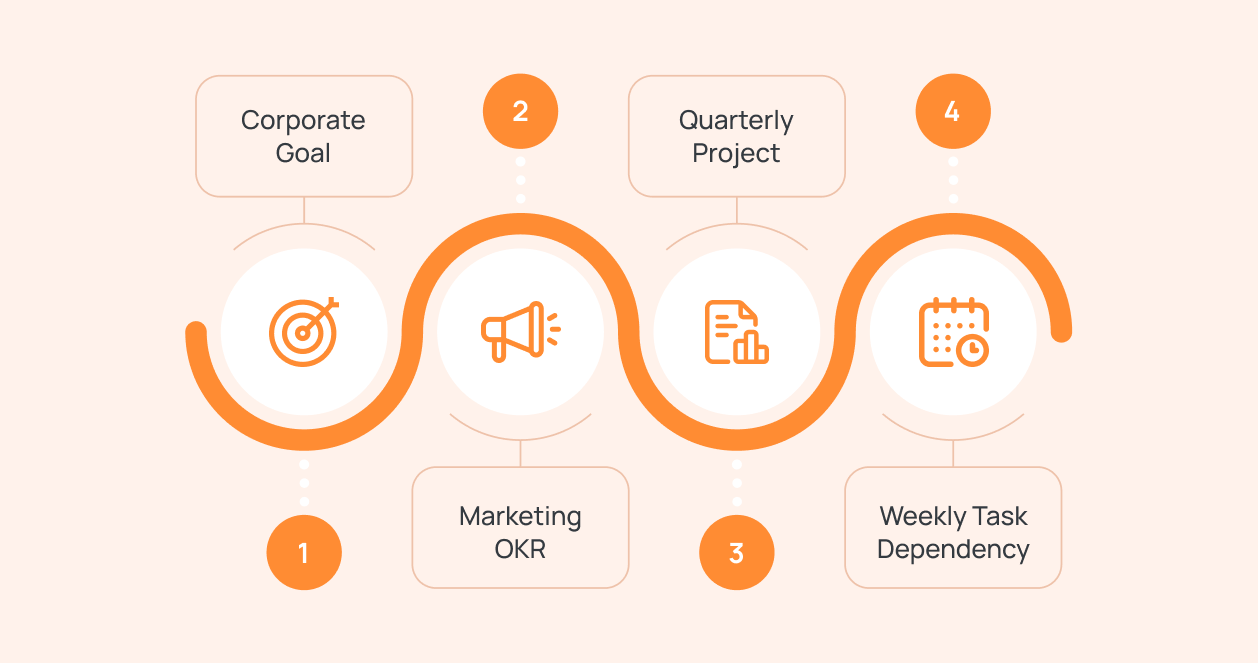
The primary failure point of strategic marketing is the execution gap. High-level OKRs get approved in January and then often dissolve into chaotic daily firefighting by March. Resolving this gap requires mapping strategic goals directly down to granular daily task dependencies.
The Strategy-to-Task Pipeline
To maintain operational alignment across marketing sprints, structure work through a strict 4-level functional pipeline:
Top Marketing Strategies for 2026
The best marketing strategies for 2026 combine clear fundamentals of AI and GEO along with customer attention.
Here are a few patterns that fit many small and mid sized businesses.
Evergreen content plus GEO aware SEO
Search still matters, but it is not only ten blue links anymore. Your modern marketing strategy should:
- Answer real questions with depth, not thin content
- Structure information so both search engines and AI systems can understand it
- Build authority around clear topics and entities
This approach lets you show up in classic search results and AI powered answers.
Lifecycle and retention first strategies
Acquiring new customers is expensive. Many 2026 guides point to lifecycle marketing as a primary driver of profit: onboarding, education, cross sell, and win back flows.
You can:
- Map key lifecycle triggers
- Set simple automation around value moments
- Combine product data, email, and in-app messaging
Account and segment based strategies for B2B
Instead of broad campaigns, many B2B teams win by focusing on:
- A tight set of industries or use cases
- Named accounts with real revenue potential
- Deep, tailored programs and sales alignment
This is easier to run when your framework for marketing strategy includes joint planning with sales and customer success, not only marketing.
Community and authority strategies
People trust peers more than brands. In crowded categories, community and authority play a big role:
- Specialist events and roundtables
- Private groups or forums
- Thoughtful content on niche topics
How Does AI and Automation Help in Modern Marketing Strategy?
AI and automation can help create a good strategy. However, they cannot replace the core thinking behind it. AI helps with content creation at scale. On the other hand, automation allows you to build consistent campaigns.
Teams that pair AI tools with human oversight see the best outcomes. When you think about AI in your marketing strategy:
- Use AI to explore ideas and suggest tests
- Keep humans in charge of ethics and final copy
- Respect privacy rules and clearly state how you use data
In short, treat AI as part of your work management platform and toolset.
Navigate the Marketing Strategy Execution Obstacles with 5day.io
A brilliant strategy executed poorly produces zero revenue. Marketing operations breakdown when strategy lives in static documents. If your task execution happens in disconnected chat apps and the project managers manually update status spreadsheets, it’s time for an upgrade.
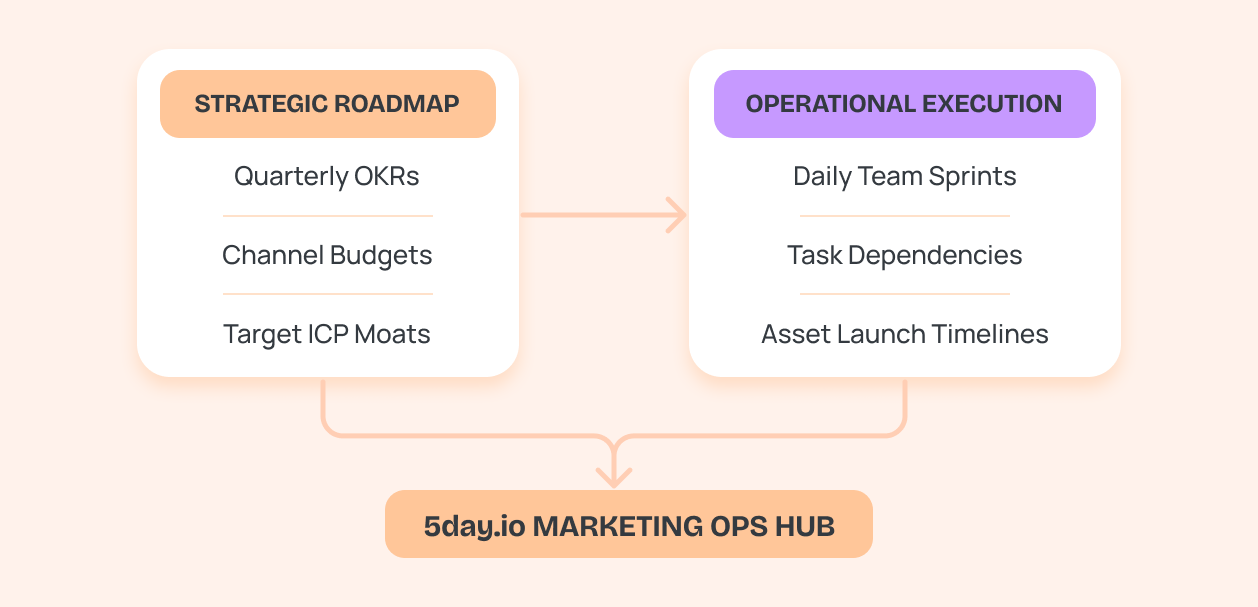
5day.io bridges this gap by centralizing your strategic roadmaps. Your OKRs, quarterly projects, and weekly tasks live in one connected workspace, so the “strategy-to-task pipeline” is clear.
Set up recurring templates for the campaigns you run every quarter and map task dependencies so bottlenecks get flagged before they delay a launch. You also get a real-time view of team utilization instead of finding someone overloaded after the deadline’s blown.
The strategy you just built deserves better than a spreadsheet and good intentions. Try 5day.io and see how it holds up when the plan meets real execution.
Try 5day.io. No credit card needed. Free for 30 days.