You could spend years building the next great product, but even the best products don’t sell themselves. Nobody buys something they’ve never heard of.
Marketing is how people hear about it. Word-of-mouth recommendations, a well-timed social post, trending hashtags, all of it puts your brand, product or business in front of the right people and keeps it in their minds.
Running that well, day after day, across a whole team or a roster of clients, is what this guide to marketing management is about – what the job looks like, and how to get better at it, whether you’re building one brand in-house or juggling five as an agency.
What Is Marketing Management?
Marketing management is the process of planning, organizing, executing, and analyzing marketing activities that promote a brand. It’s the umbrella that holds strategy, people, and execution together.
A marketing manager wears a lot of hats day to day. Their responsibilities usually include:
- Setting campaign goals and shaping the overall marketing strategy
- Digging into research on what customers want and what competitors are doing
- Building target audiences and buyer personas the team can use
- Handing off tasks and keeping different teams pointed in the right direction
- Reviewing campaign metrics and adjusting the course of action
- Managing content across channels, from social media to email to website
People often treat marketing and advertising as the same job, but they’re not. Advertising is one tactic inside a much bigger marketing management process: the research, the strategy, the campaign itself, and the numbers that come back afterward. Buying an ad gets a message in front of people. Managing all of it, before and after that ad runs, is the rest of the job.
The importance of marketing management shows up directly in results. Marketers who document their strategy report success 414% more than those who don’t. That gap makes the case for treating marketing management as its own discipline.
Marketing Management vs. Marketing Strategy
A strategy is just a decision on paper. Turning it into campaign, execution, and result is all marketing management.
A strategy answers three practical questions: who’s the customer, what does the brand stand for, and why pick this company over the next one. It gets decided once, usually by leadership, and then mostly sits still until the next planning cycle.
Marketing management is what happens after the strategy is built. It covers the day-to-day things like assigning tasks, running campaigns, tracking metrics, and adjusting tactics when something isn’t working.
Done well, this is strategic marketing management in practice; strategy and execution treated as one job instead of two disconnected ones.
Say a campaign misses its number. Was the strategy wrong, or did nobody run it well? The rest of this guide focuses on that second half, the functions, process, and decisions that turn a strategy into results.
Core Functions of Marketing Management
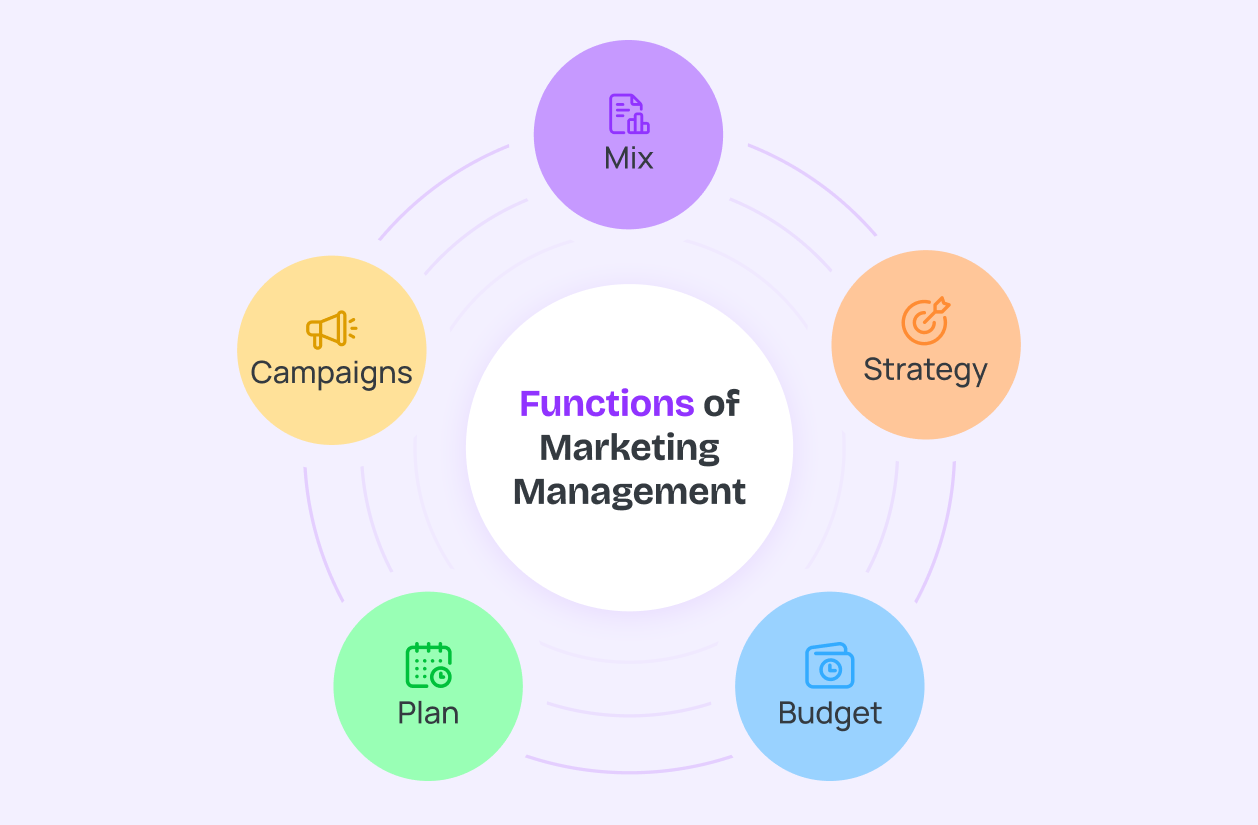
On paper, the core functions of marketing management are just five moving parts: the marketing mix, the strategy, the budget, the plan, and the campaigns that bring it all to life. Skip any one of them and the rest start to wobble.
1. Managing the marketing mix: The classic 4 Ps – product, price, place, and promotion don’t work separately. A great product priced wrong, or pushed through the wrong channel, still falls flat. Watching how the four sit against each other is a manager’s real work here
2. Setting the marketing strategy: It decides which channels get the budget, how fast the brand is trying to grow, and whether the team is playing for this month’s numbers or next year’s. Every other function takes its cue from that one call.
3. Planning the marketing budget: Budget usually gets decided before anything else, since it shapes what the team can do. Knowing the real cost of every task, tool, and campaign keeps spending from running ahead of results
4. Building the marketing plan: The plan turns strategy into execution. Resources, deliverables, and a timeline are all built to fit the budget. This is where the marketing management process gets mapped out step by step, not just talked about.
5. Running marketing campaigns: The actual activities that reach customers, from digital ads and email to social media, print, and even guerrilla or word-of-mouth efforts — each one timed and resourced to fit the plan around it.
None of these marketing management functions sit in a silo. A manager whose only strong at strategy but weak on budget, or great at campaigns but disconnected from the plan, ends up with poor results.
Types of Marketing Management
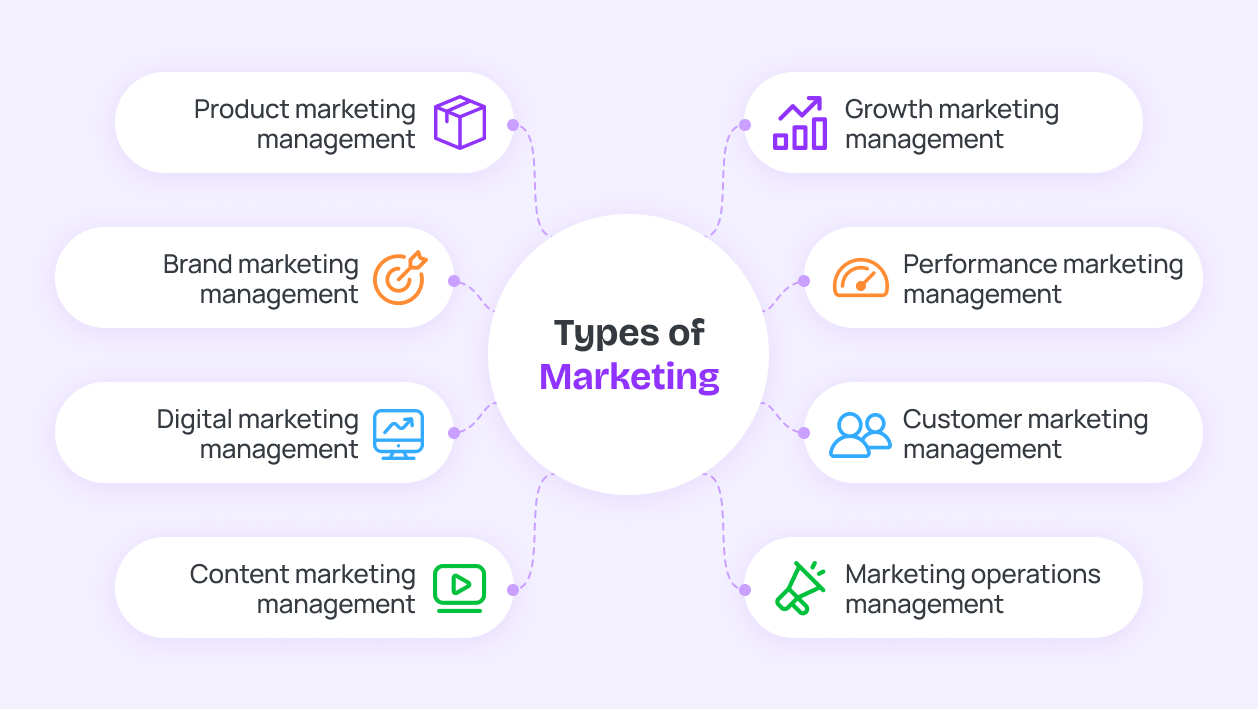
There are different types of marketing management based on the various pieces of how a business reaches its customer.
- Product marketing management handles how a product gets introduced to the market – the positioning, the messaging, and the launch plan. When a company rolls out a new feature and needs the right story around it, this is the work behind that
- Brand marketing management: cares less about this week’s campaign and more about how people think of the company a year from now. It shows up in things like tone of voice, visual consistency, and whether customers recognize the brand when they see it
- Digital marketing management ties every online channel together – website, ads, email, social so they don’t end up working against each other
- Content marketing management: plans what gets published and why, across blog posts, videos, and guides, whatever fits the audience
- Growth marketing management runs on testing – small experiments across pricing, onboarding, or messaging to see what turns a visitor into a customer
- Performance marketing management covers highly trackable, ROI-driven channels like paid search, paid social, and affiliate marketing, where everything ties to a measurable result
- Customer marketing management flips the focus to people who’ve already bought, retention, upsells, referrals. Make you realize that keeping an existing customer happy is almost always cheaper than finding a new one
- Marketing operations management: is the least visible type and probably the most necessary. It’s the tools, the workflows, and the approval chains that must work in the background so everyone else can do their jobs
The Marketing Management Process, Step by Step
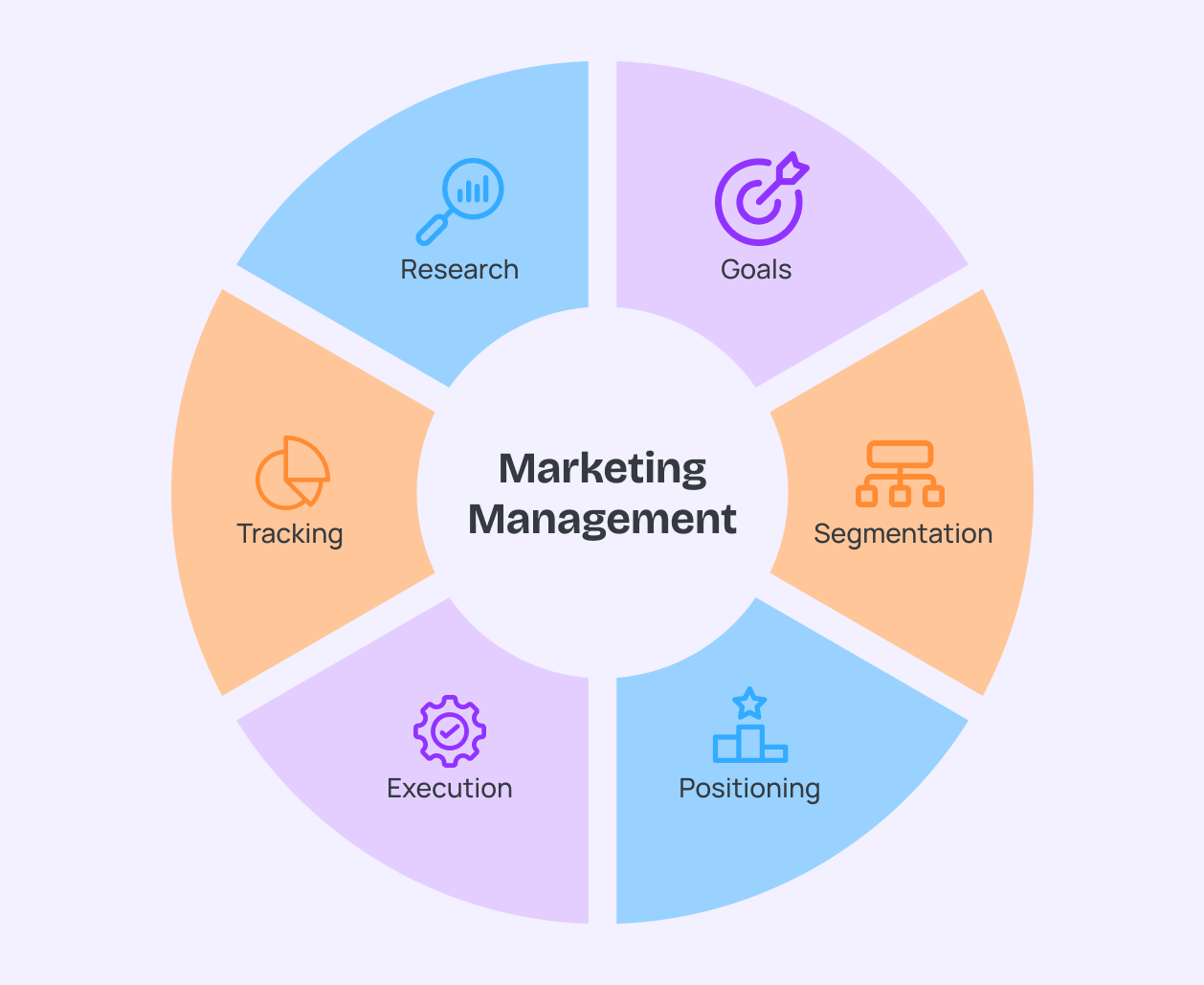
Marketing management processes follow a clear operating model. Leaders look hard at the market first, set the direction from there, get the team moving on it together, and keep adjusting as real performance numbers come back in.
Step 1: Market Research
Nothing else in the process should start until you understand the market – what customers are struggling with right now, what competitors are already doing about it, and which way demand is heading. If you skip this step, every decision after it, the budget, the channel mix, the messaging, is just a guess.
Step 2: Goal Setting and Strategy
Every goal needs a number and a business reason behind it. “Grow qualified leads by 25% this quarter to support a $2M pipeline” works because it’s tied to a pipeline target the sales team already cares about. “Increase brand awareness” is vague and there’s no number attached to it and hence, it doesn’t work.
Step 3: Segmentation and Targeting
Every part of marketing does not deserve the same attention. Say you’re running campaigns for a mid-market SaaS client: enterprise buyers on a 12-month sales cycle need a completely different pitch than the solo founders signing up same-day off a free trial.
Segmentation is how you tell those two groups apart. Sorting people by who they are, company size, industry, job title, and by what they do, what they buy, how often, how close they are to saying yes. From there it’s arithmetic: score each group on size and likelihood to convert and put real budget behind whichever two or three come out on top.
Step 4: Positioning and Messaging
Positioning is the internal decision about what makes the brand different. Messaging is that same call translated into something a stranger reads in eight seconds and understands. Get the first one wrong and the second never really recovers; no headline is clever enough to rescue a positioning decision nobody in the room believed.
Step 5: Campaign Execution
The core message doesn’t change from channel to channel, but its shape does. A cold email can afford three paragraphs of context. A paid social ad gets maybe six words before someone scrolls past it. A landing page sits in between, built to answer exactly the question that made someone click through in the first place. The goal is that someone reading an email should recognize the same brand from a LinkedIn ad or a Google search result.
Step 6: Performance Tracking and Optimization
Track results as they come in – click-through rates, conversions, cost per acquisition, instead of waiting until a campaign wraps up to check how it did. Then act on what the data shows: cut what isn’t working and put more budget behind what is.
Marketing Management in Agencies vs. In-House Teams
The core job of marketing management stays the same in agencies and in-house teams, but what gets managed, and who’s accountable for it looks completely different.
Dimension | Agencies | In-House Teams |
Scope | Multiple clients running at once, often across different industries | One brand, one product line, one set of goals |
Goals tied to | The client’s brief and agreed scope of work | Sales pipeline and product roadmap |
Budget model | Billed against hours or a retainer | Set against overall company revenue |
Reporting | Built client by client, since one dashboard rarely fits every account | Tied to internal KPIs and long-term brand equity |
Team structure | A shared pool of specialists split across several accounts | A small team covering most channels itself |
Biggest coordination challenge | Knowing who’s overloaded across accounts before a deadline slips | Keeping marketing aligned with sales and product |
Marketing management for agencies means running several plans at once without losing track of who’s overloaded – that’s usually why a marketing agency project management tool earns its place. In-house, the challenge flips, one small team covering everything, which is where in-house marketing team project management comes down to keeping priorities straight as they shift.
How to Manage a Marketing Team Effectively
How to manage a marketing team effectively is mostly about habits.
The skills that matter on a marketing team:
- Convert strategy into real work. “Improve social presence” isn’t a task; “post three times a week on LinkedIn targeting IT decision-makers” is.
- Make the call on the data early. A channel spending $3,000 a month for two leads has told you what to do with it
- Assign work to whoever is actually good at it. Handing a task to whoever’s free first usually costs more time fixing it later
- Say no early. An off-strategy request that gets approved eats into time and budget
What keeps a team aligned once the plan is live:
- Run check-ins around blockers. A meeting where nothing’s blocked could have been a two-line message instead
- Name one owner per campaign or channel. Shared ownership turns into no ownership when something slips
- Give feedback while the work is still warm. Wait for a quarterly review and the context that made it useful is already gone
- Kill sunk-cost campaigns fast. A channel that stopped working two weeks ago doesn’t need one more test
Common Marketing Management Challenges (And How to Solve Them)
Most marketing management problems come down to one root cause: too many disconnected systems holding pieces of the same plan. Some key learnings from Airtable’s Marketing Trends Report, and fixes at a glance:
- Low visibility into ROI: Only 25% of marketing leaders report strong ROI visibility, down from 33% a year earlier
How to solve it: Fix it by unifying campaign spend, performance data, and results in one system
- No single source of truth: 73% of marketing leaders check five to fifteen sources just to find current campaign data.
How to solve it: Centralize planning, briefs, and reporting in one marketing operations software instead of scattered spreadsheets and email threads
- Duplicated, disconnected data: 81% of teams have at least 30% of their marketing data duplicated across systems
How to solve it: Cut the number of places the same data lives, rather than adding another dashboard on top of it
- Rising content and campaign volume: 92% of marketing leaders saw request volume jump last year, many by 50-99%
How to solve it: Standardize intake and use templates for repeat campaign types
- Tool sprawl: The average marketing team runs 19 tools a day
How to solve it: Every extra tool is another place where information gets lost, consolidate instead of adding more
Same root cause behind all five: too many disconnected systems holding pieces of one plan.
That’s exactly what 5day.io is built to fix, one place to plan, track, and report on marketing work, instead of stitching it together across five tools. Try 5day.io for free!
Great products earn attention through the work that promotes them.
That’s what this guide to marketing management delivers: a plan turned into real work, on time, with a team that knows exactly who owns what.
Pick the one thing worth fixing today. Fix it, and momentum carries the rest.
Try 5day.io for free and run every piece of that work through one marketing management system.