

Tech stack has become the new inventory of weapons to scale a marketing agency. Even brilliant marketing talent can’t survive the competition if the right tools are not accessible.
The fix is not adding more tools. It is choosing a clear backbone that keeps work visible in one place, so your team stops switching tabs to find updates.
Therefore, a thoughtful tech stack turns that chaos into a streamlined marketing workflow automation. It keeps your marketing agency tech stack connected and ready for growth instead of thinking about which tool to use.
Make sure your CRM and reporting tools talk to each other. It will keep the work moving without copying pasting or missing handoffs. Also, this is where martech stack integration with project management software keeps your stack connected and easier to sc
A strong martech stack lets a small agency perform like a bigger one without burning budget or people. Here’s how you build it.
What Defines a Growth-Ready Marketing Agency Tech Stack
A good martech stack for an agency has a few clear traits, including:
- Aligned with your services and market. Tools match what you sell and how you deliver, instead of random experiments
- Integrated around a clear spine: Data and workflows link through a small number of core systems, so people do not copy paste between islands
- Right-sized for your stage: G2 data shows that many businesses run lean with one to six martech tools in active use, and only a minority juggle large stacks. A small agency does not need enterprise-scale complexity
- Friendly for creatives and marketers: Interfaces feel simple, support day to day tasks, and do not demand a full time admin to stay alive
- Measurable: You can answer simple questions like “Which channel drives the most qualified leads” or “Which retainers stay healthy” without manual detective work
Why a Strong Tech Stack is Critical for Agency Growth
Your tools should reduce friction in delivery and decision-making, not add more noise.
The marketing technology world exploded in size. Recent landscape reports count more than 14,000 marketing technology products, with nearly 28 percent growth in just one year. That choice sounds exciting until you try to run a small team inside it.
At the same time, research on martech usage shows a quiet crisis. It notes only about half of martech tools see active use, and a small slice of organizations can prove strong performance out of their stack. In other words, many teams pay for tools they barely touch.
For small and mid-sized agencies, a clear marketing technology stack matters because it:
- Protects the margin by cutting duplicate or idle tools
- Gives a shared view of work, data, and results
- Lets new hires ramp faster with a predictable workflow
Your stack should feel like a tidy studio, not a closet full of gear you never plug in.
Core Components of a Marketing Agency Tech Stack

Most agencies need a small set of tools that cover data, delivery, communication, and work management.
Exact tools vary, yet the categories stay similar. A modern marketing technology stack for an agency usually includes these layers.
CRM and pipeline
That system should anchor revenue reality. Also, it should feed insight into which campaigns and offers work best. You need one place to track:
- Leads and deals
- Decision makers and buying stages
- Win and loss patterns
Analytics and measurement
Better stacks use a short list of analytics tools instead of one niche tool per channel. Many small businesses rely on a mix of Google Analytics, ad platform dashboards, and one central dashboard tool. This layer covers:
- Web analytics
- Channel analytics and attribution
- Dashboards for clients and internal leaders
Content and creative tools
Agencies live on content, so this group is familiar. Keep the following layer standard, so people do not bounce between five design tools or three different asset folders.
- Design tools
- Copy and content editors
- Asset storage or DAM
Channel execution tools
Here, the danger is sprawl. Each new channel tends to arrive with its own interface and data model. Your job is to pick a realistic mix your team can run well. This set powers delivery:
- Email service or marketing automation
- Social scheduling
- Ad platforms and management helpers
Collaboration and knowledge
Make sure decisions and playbooks land in a searchable place, not only inside chat threads. Documentation and meeting tools support the real work:
- Chat for quick alignment
- A shared knowledge base
- Call or meeting recording where needed
Operations and work management
This is where a marketing agency management software or marketing agency software layer sits. You need:
- A calm project management tool for marketing agency work
- Clear boards and timelines for campaigns and retainers
- Capacity and workload views for designers, writers, and channel owners
A good work management platform becomes the hub that connects requests, briefs, tasks, handoffs, approvals, reporting and a lot more things. It does not replace your whole martech stack, but it keeps the stack usable for humans.
How to Build the Marketing Technology Stack
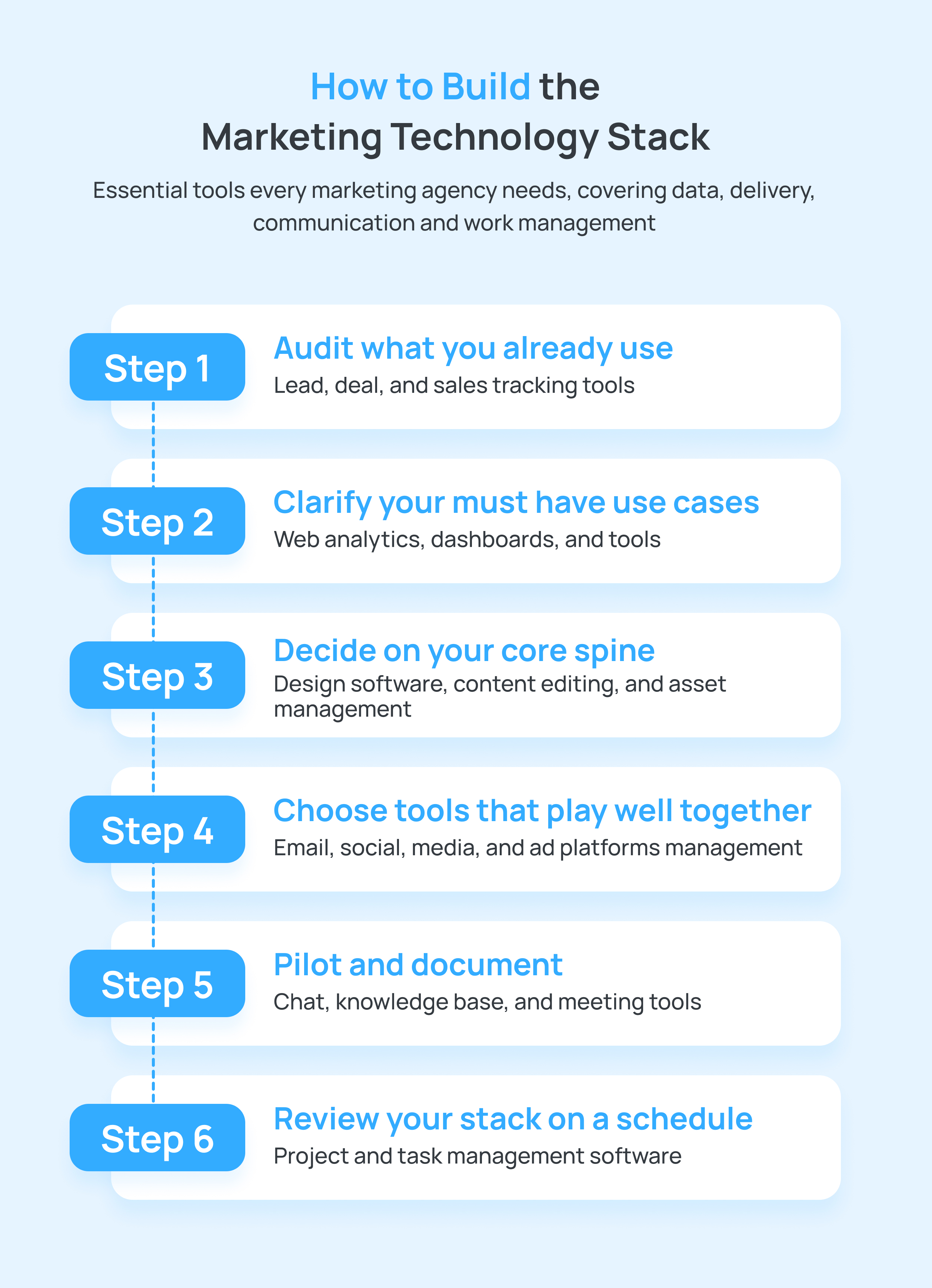
Build your stack in deliberate steps: audit, design, choose, connect, and keep reviewing.
There is no universal list of “10 tools every agency needs.” Instead, treat stack design like a project with clear steps.
Step 1. Audit what you already use
Mark which ones are essential and nice to have. Also, keep the unclear tools separated. When teams do this exercise, they often discover tools that nobody claims or understands.
List every tool in play:
- Name and main use
- Who uses it
- Cost and billing cycle
Step 2. Clarify your must have use cases
Link tools to real jobs. It helps you design a MarTech stack for agencies that mirrors how you work, instead of chasing vague trends.
- Manage leads and deals
- Brief and deliver campaigns
- Report results to clients
- Plan capacity and forecast revenue
Step 3. Decide on your core spine
Pick one central tool in each major layer. Everything else should plug into that core. This marketing tech stack design works fabulously – one main source per type of data.
- One CRM
- One main analytics dashboard
- One work management platform for projects and tasks
Step 4. Choose tools that play well together
You want a scalable tech stack for marketing agencies where new tools can join or leave without breaking everything. When you look at options:
- Check for native integrations with your spine
- Prefer open APIs or easy automation via popular connectors
- Avoid tools that lock data in rigid formats
If you want an overview on this, read our detailed guide about MarTech stack integration with project management software.
Step 5. Pilot and document
Do small pilots instead of agency wide jumps. During each pilot:
- Test real workflows, not only demo use cases
- Capture simple playbooks and checklists
- Gather honest feedback out of delivery teams
Step 6. Review your stack on a schedule
Aim for a light stack review twice a year. Many small businesses now aim for lean stacks with three to six active tools, and only a small share run large collections.
Each review asks:
- Which tools pay their way
- Which tools overlap with others
- Which gaps show up repeatedly in your work
Common Tech Stack Mistakes Growing Agencies Make
Most tech pain in agencies comes out of tool sprawl and weak training. As you grow, certain patterns show up again and again. So, what’s the best fix for it? You can:
- Buy tools to fix process problems
A messy approval process will not heal just because you add another platform. Clarify who decides and in what format first. Then pick tools that support that flow.
- Stop using duplicated tools for the same job
Two CRMs, three reporting tools, many analytics windows – this splits data and effort. Each core job should have one clear home.
- Set the owner for the stack
Someone needs clear responsibility for the agency tech stack. That person or small group:
- Tracks cost and usage
- Leads reviews and changes
- Guards against random purchases
Without this, your stack grows by accident.
- Plan for onboarding and training
Even the best tools fail when people do not know how to use them. Include training outlines and starter projects in your onboarding for each role.
- Don’t ignore data quality
All your smart tools break when data is messy. Simple habits help:
- Agreed naming patterns
- Clear fields for key data
- Regular health checks on contact and deal records
These habits keep your marketing tech stack accurate enough for real decisions.
How 5day.io Adds Wings to a Marketing Agency’s Tech Stack

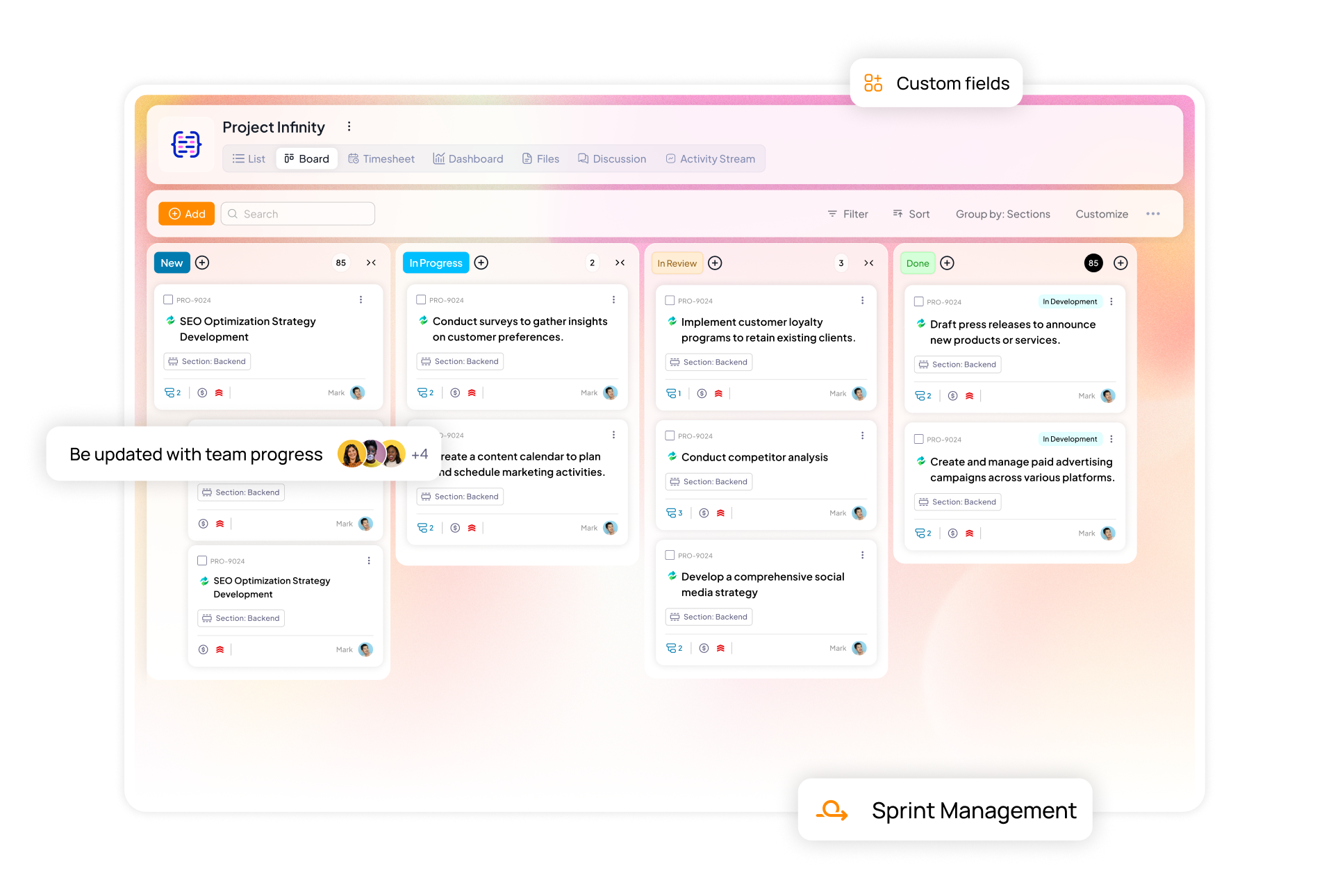
5day.io stays in the center of your stack as a calm work hub for all your marketing needs. Be it projects, tasks, delivery, assignment, deadlines, calendar, automations and a lot more, 5day.io has a smooth interface to make everything easily manageable.
Many agencies try to run projects in chat threads and spreadsheets. That works for a short time, then everything starts to look blurry. A dedicated project management software for marketing agency work solves that.
5day.io gives marketing teams:
- Clean project and campaign boards
- Timelines that show how client work overlaps
- Simple intake for briefs and requests
- Reporting that ties work to outcomes
As part of your marketing agency tech stack, 5day.io acts as the work management platform that links delivery and reporting. CRM, ads, email, analytics and everything that a marketing agency will stay in their lanes.
If you want a deeper look at how this plays out in real teams, book a 5day.io demo and opt for a 30-day healthy free trial. Don’t take our word for it, use 5day.io and see how this single tool has the potential to create marketing outlines and common workflows that bring in predictability and clarity from day one.
Future Proofing Your Marketing Agency Tech Stack
A future ready stack focuses on flexibility and AI aware habits. Technology will keep changing. That does not mean your stack must reset each year.
Key ideas that protect you:
- Choose tools with open data paths: APIs and export options matter as much as interface polish
- Favor vendors with clear roadmaps: Public product updates and support signals show stability
- Treat AI as a layer, not a separate stack: Many tools now add AI helpers inside existing workflows. Industry analysis points out that AI powered martech can help small teams act at enterprise scale, as long as humans still guide strategy and review.
- Keep humans in the loop: AI can draft, analyze, and summarize, yet humans still handle context, ethics, and client nuance
- Review security and privacy regularly: Data laws and client expectations change. Your stack should keep pace with those shifts
Future-proof does not mean future-proof against all change. It means you can swap tools calmly when needed because processes and data structures stay clear.
Final Advice
A growth-ready tech stack is not about stacking more tools, it is about keeping your workflow clean and easy for your team to run every day. Once your core systems are in place, adding marketing agency project management software helps you turn tool chaos into clear timelines and smoother client work.