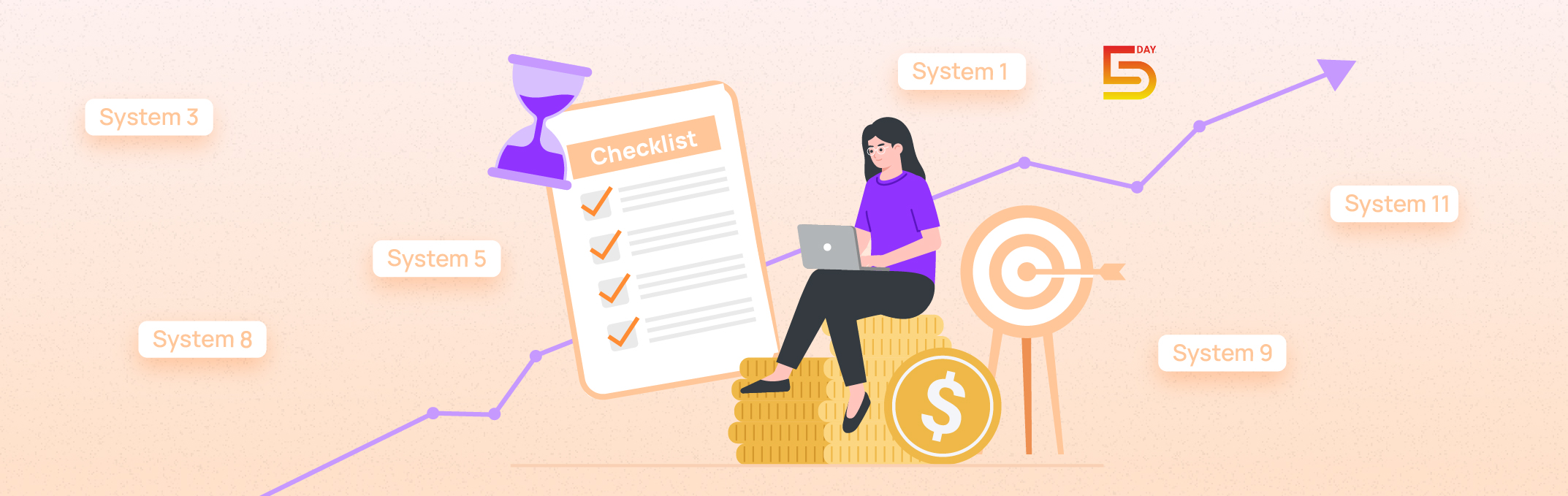

Scaling is often sold as an act of ambition. But scaling is about surviving what’s already knocking. The “can you also handle this?” turns into “we’re doing this now,” without any time to think. And because saying yes has always been how the agency survived, you say yes again.
But there’s a particularly dangerous middle zone almost no one talks about:
You’re too big to improvise, but too small to absorb mistakes.
Here is the uncomfortable truth that most founders only recognize in hindsight: scaling does not break agencies. Growth merely exposes what was already broken. The cracks were always there, but growth turns them into fault lines.
The real question is not whether you can scale an agency. The real question is far more uncomfortable: if you removed yourself from the day-to-day operations for thirty days, what would actually fall apart? Every honest answer points to something that is not yet reliable enough.
That is what this checklist is about. This is the work that must happen before scaling becomes dangerous.
What scaling actually means and what it absolutely does not
What scaling means | What scaling doesn’t mean |
When output increases faster than decision fatigue | Taking on more clients.
More clients without stronger systems simply multiply the same problems across a wider surface area. |
When the organization can handle more complexity without requiring more cognitive load from the same few people | Hiring more people
Adding headcount without clarity only spreads confusion faster. |
Each new client improves delivery clarity | Earning more revenue
Revenue can increase while the business becomes more exhausting to run. |
The difference between these two outcomes is the presence of systems.
Systems act as shock absorbers, and they exist to absorb impact when the business hits inevitable stress points. They prevent pressure from traveling upward until it lands squarely on the founder’s shoulders.
The cost of scaling without systems
There is a quiet belief that pausing to fix internal problems would slow growth, so the decision is made to push forward and deal with the mess later.
Later rarely comes.
When systems are missing, founders become the system, where every decision routes through them. The team adapts in survival mode. And people stop asking questions because answers take too long.
This is where “we’ll fix it later” quietly fails.
The bigger the agency becomes, the harder it is to change anything. At this stage, the business begins to tax its best people. High performers carry more weight, and reliable team members absorb chaos.
Clients feel it too, in terms of one great experience followed by a disappointing one.
This is the hidden cost of scaling without systems. It turns growth into a constant act of recovery instead of progress.
The 11-step agency scaling checklist
This is the only checklist you’ll ever need to go from wondering how to scale your agency to doing it without overwhelm.
System 1: The positioning and ICP lock system
The Positioning and ICP Lock System exists to eliminate ambiguity at the very front of the business. It ensures that everyone involved in selling, delivering, hiring, and prioritizing work is solving the same problem for the same kind of customer.
Without this system, every downstream function becomes harder than it needs to be.
What breaks without it
When an agency says, “We serve everyone,” it is signalling that no one inside the business knows where the edge is.
- Sales teams oversell because there is no clear definition of fit
- Delivery teams struggle because every client expects something slightly different
- Project scoping becomes reactive instead of intentional
- Timelines slip because the work keeps shape-shifting
Over time, the agency experiences ICP drift. Work that was once occasional becomes normal, and exceptions quietly become defaults.
The business slowly moves away from what it is actually good at, without ever consciously choosing to do so. ICP drift is one of the most silent killers of delivery efficiency.
How to build this system
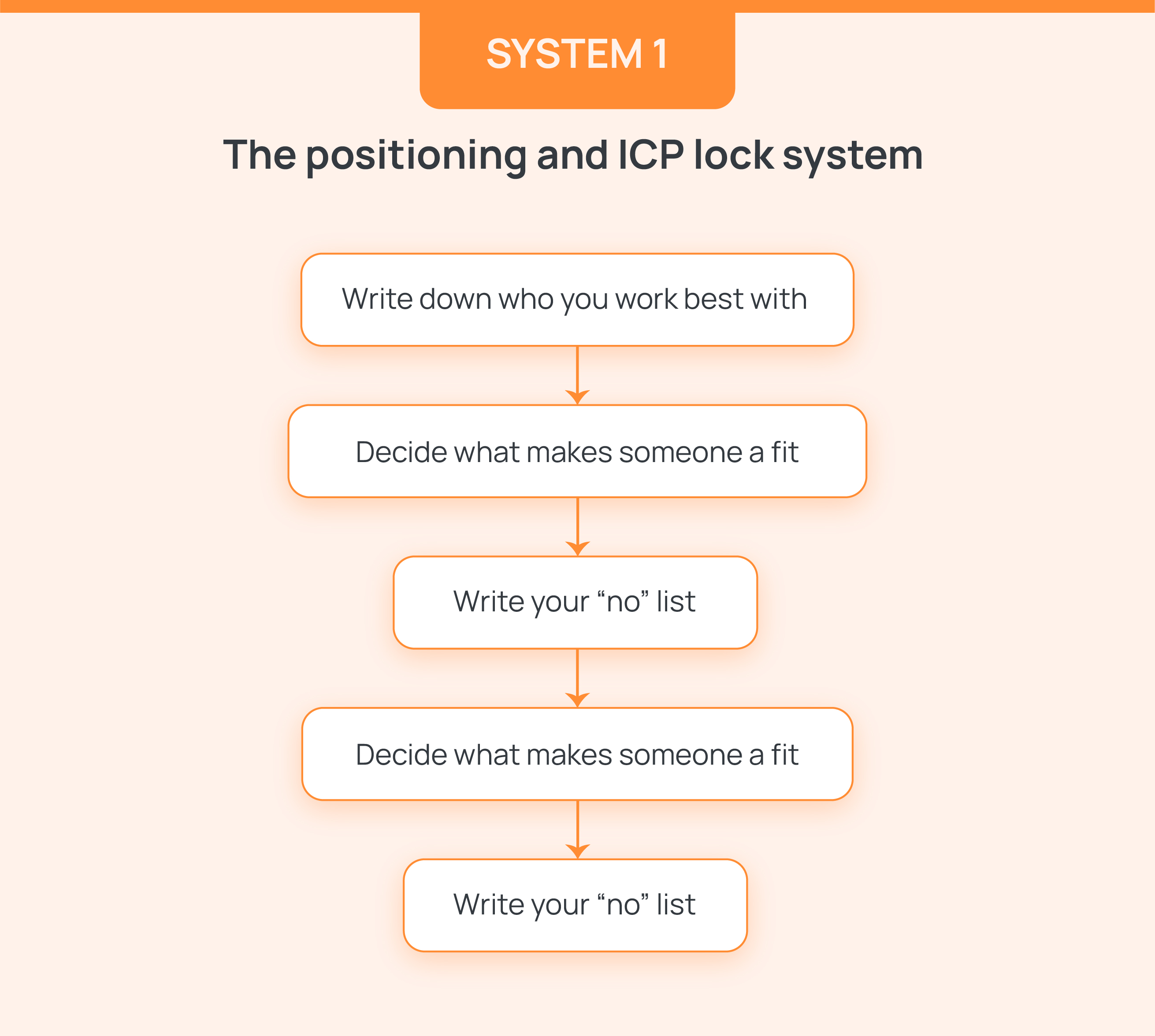
Start by writing down who the agency does its best work for, based on reality rather than aspiration. Look at past and current clients and identify patterns where delivery felt repeatable, profitable, and calm. This becomes the foundation of your ideal customer profile.
Next, define the non-negotiables. Document the minimum requirements a client must meet to be a good fit, such as company size, internal maturity, decision-making readiness, budget range, and expectations of collaboration. These criteria should be clear enough that fit can be assessed before deep sales conversations begin.
Then, make your “no” list explicit. Write down the types of clients, industries, behaviors, and requests the agency will not take on. This includes work that consistently creates friction, requires excessive customization, or pulls the team away from its strengths. Saying no on paper makes it easier to say no in practice.
After that, standardize what does not change. Clearly document which parts of your offering are fixed, repeatable, and non-customizable. This reduces ambiguity in sales, shortens onboarding, and protects delivery quality.
Finally, make this system visible and usable. Keep the positioning and ICP criteria accessible to sales, delivery, and leadership. Use it as a reference during lead qualification, scoping, and prioritization decisions. Revisit it periodically, but only update it deliberately, not reactively.
System 2: The lead qualification and sales filtering system
The Lead Qualification and Sales Filtering System exists to protect the agency from the hidden cost of bad demand. Its purpose is not to maximize the number of conversations, but to ensure that the conversations that do happen are worth having.
This system exists to create separation early, before time, energy, and credibility are spent on the wrong buyers.
What breaks without it
When the qualification is weak, bad-fit clients slip through quietly. They agree to the contract and then begin to strain the system from the inside.
Delivery suffers first, and scope creep becomes constant because expectations were never aligned.
This leads to high performers feeling frustrated because the work is harder than it should be.
Team members burn out or disengage, and founders have no other choice but to step back into execution to stabilize relationships that were never healthy to begin with.
How to build this system
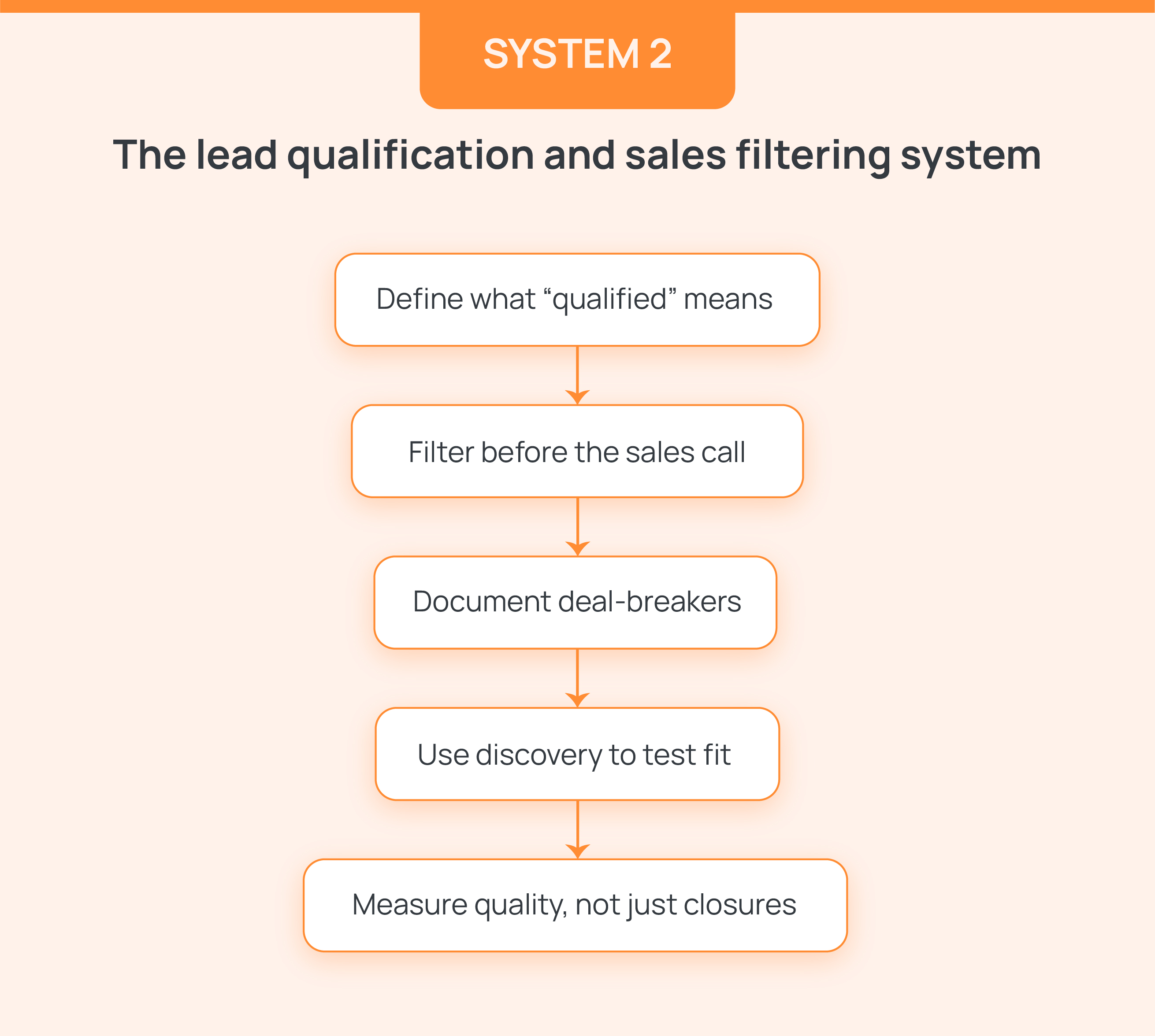
Start by defining what a qualified lead actually means for your agency. This should go beyond budget and include readiness, decision-making authority, internal alignment, and expectations of collaboration. A lead is only qualified if these conditions are met, not simply because interest exists.
Next, move the qualification earlier than the sales call. Introduce pre-call filters such as intake forms, discovery questions, or published criteria that surface fit before time is invested. This allows misaligned prospects to self-disqualify without confrontation.
Then, document your deal-breakers clearly. Write down the behaviors, constraints, timelines, and attitudes that consistently lead to difficult engagements. Make these non-negotiable and empower the sales team to walk away without escalation when they appear.
After that, design your sales process to test fit, not to persuade. Structure discovery conversations around validating alignment rather than selling possibilities. Ask questions that reveal how the buyer works, makes decisions, and defines success.
Finally, separate the closing skill from the filtering authority. Ensure that sales success is measured not just by deals closed, but by deals that deliver cleanly. Review churn, scope creep, and delivery strain as feedback into the qualification system.
System 3: Offer and scope definition system
The Offer and Scope Definition System exists to create stability at the point where promises turn into obligations.
Without this system, every engagement becomes a negotiation in motion.
What breaks without it
Retainers begin to implode under their own weight. What starts as flexibility turns into constant accommodation. Requests accumulate quietly, and delivery teams absorb extra work without formal acknowledgment.
Flexibility, in this context, becomes a lack of boundaries. The agency adapts endlessly while the client assumes expansion is included. Resentment grows on both sides.
Over time, delivery quality suffers. Timelines become unreliable. Teams spend more time negotiating what the work is than doing the work itself.
How to build this system
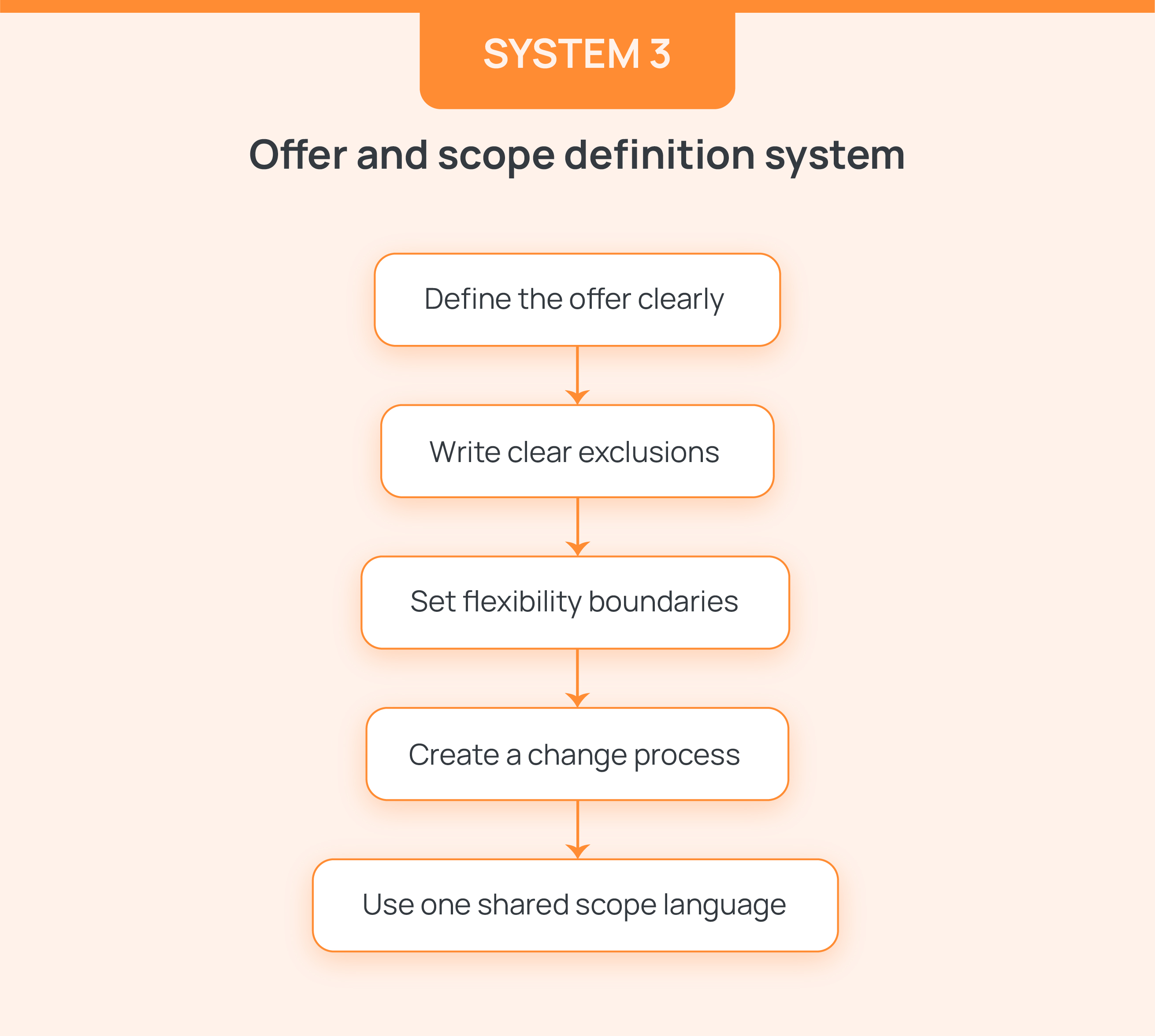
Start by turning your offer into a defined product rather than a loose promise. Clearly document what the client is buying in terms of deliverables, cadence, ownership, and outcomes. The goal is not to predict everything, but to remove ambiguity about what work looks like in practice.
Next, write exclusions as deliberately as inclusions. Document what is not part of the offer, especially the requests that tend to show up later and create silent scope creep. Exclusions protect both the team and the relationship by setting expectations early.
Then, define how flexibility actually works. Decide which parts of the offer can be adapted and which parts cannot. Flexibility should exist within boundaries, not instead of them. This allows the agency to respond to change without destabilizing delivery.
After that, create a simple change-request protocol. Document how new requests are evaluated, priced, and scheduled. This turns scope changes into a neutral process rather than an emotional negotiation.
Finally, train sales and delivery should reference the same scope language. The offer should sound the same before and after the contract is signed.
System 4: Pricing and margin visibility system
The Pricing and Margin Visibility System exists to reveal the true financial health of the agency. It replaces gut feel and surface-level revenue numbers with clarity about what the business keeps, sustains, and can safely reinvest.
What breaks without it
When pricing lacks margin visibility, agencies unknowingly subsidize their clients. Projects appear successful because invoices go out on time, but delivery quietly consumes more resources than planned.
Blended pricing is particularly dangerous. When different services, effort levels, and client demands are bundled into a single rate, true performance becomes impossible to assess.
Over time, the agency loses its ability to distinguish between healthy growth and expensive activity.
How to build this system

Start by separating revenue from effort. Document how much time and cost is actually required to deliver each type of work you sell. This includes delivery time, review time, coordination, and rework. Pricing should be evaluated against real effort, not assumptions.
Next, break blended pricing into visible components even if clients are billed a single rate, internally separate services, roles, and effort levels so you can see which parts of the work generate margin and which parts consume it. This internal clarity is essential, even if the client-facing price remains simple.
Then, calculate three baseline numbers and review them regularly: cost per client, cost per role, and cost per mistake. Cost per client reveals which accounts are healthy. Cost per role informs hiring decisions. Cost per mistake exposes the hidden tax of rework and unclear scopes.
After that, connect margin visibility to decision-making. Use margin data to guide pricing conversations, scope changes, and hiring plans. Decisions should be based on what strengthens the business, not on what feels busy or urgent.
Finally, review margins consistently, not reactively. Margin visibility only works when it is part of regular operations. Build a simple cadence for reviewing profitability trends so problems are caught early, while adjustments are still easy to make.
System 5: Client onboarding system
The Client Onboarding System exists to translate a signed agreement into a stable working relationship.
Without a deliberate onboarding system, agencies rely on momentum and goodwill to carry the relationship forward. That momentum fades quickly when clarity is missing.
What breaks without it
When onboarding is informal, teams start work without complete information, and access is requested in fragments. This leads to expectations being implied instead of stated.
The phrase “we’ll figure it out as we go” feels collaborative, but it pushes decision-making into delivery and forces teams to improvise under pressure.
Clients sense this immediately. Confusion in the first few weeks signals uncertainty, even if the work itself is strong.
What good enough looks like
A functional Client Onboarding System does not need to be complex. It needs to be consistent.
Good enough means information intake is standardized, so the team receives what it needs before work begins. It means access requests are documented, complete, and sequenced so delivery is not blocked. It means expectations around communication, turnaround times, and decision ownership are made explicit.
How to build this system
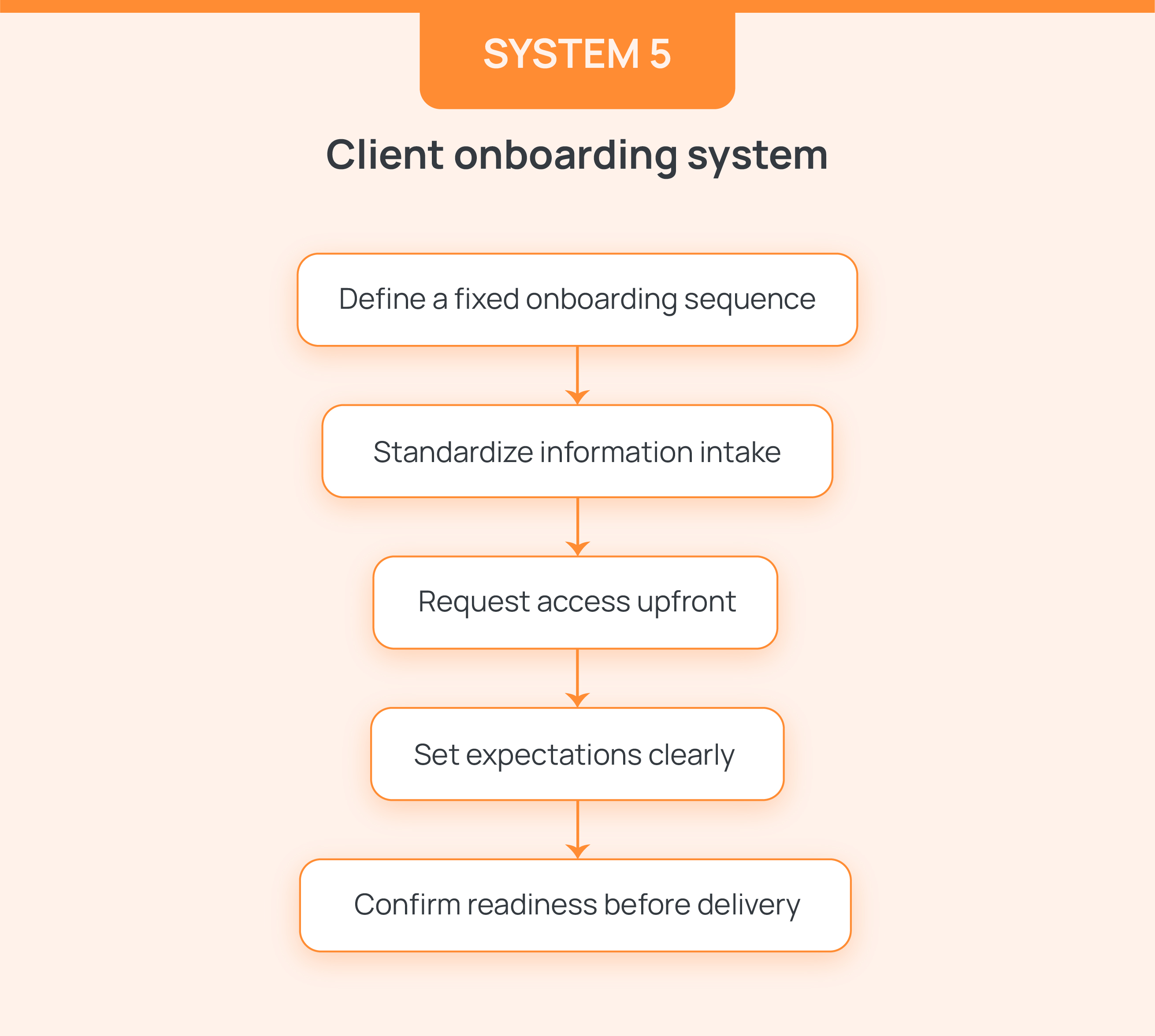
Start by defining a fixed onboarding sequence that applies to every new client, regardless of size or urgency. This sequence should happen before meaningful delivery work begins and should not be shortened under pressure.
Next, standardize information intake. Create a single, consistent way to collect business context, goals, constraints, success metrics, and historical knowledge. This ensures the delivery team starts with a shared understanding instead of assumptions.
Then, document and sequence access requirements. List every system, platform, and permission required for delivery, and request them in a deliberate order. Access should be treated as a prerequisite to progress, not something chased reactively during execution.
After that, make expectations explicit. Clearly define communication norms, review cycles, turnaround times, escalation paths, and decision ownership. This removes ambiguity about how the relationship will function day to day.
Finally, create a clear transition point from onboarding to delivery. Confirm that all required information, access, and expectations are in place before work begins. This signals readiness and establishes confidence on both sides.
System 6: Delivery workflow system
The Delivery Workflow System exists to ensure that work moves forward consistently, regardless of who is involved at any given moment. It protects execution from disruption caused by growth, burnout, or temporary absence.
What breaks without it
When delivery is hero-based, growth becomes fragile. A few experienced individuals carry disproportionate responsibility. They remember context, manage dependencies, and prevent issues before they surface.
As volume increases, this model collapses. Knowledge becomes siloed, and when someone takes leave or exits, execution slows or stalls entirely.
How to build this system
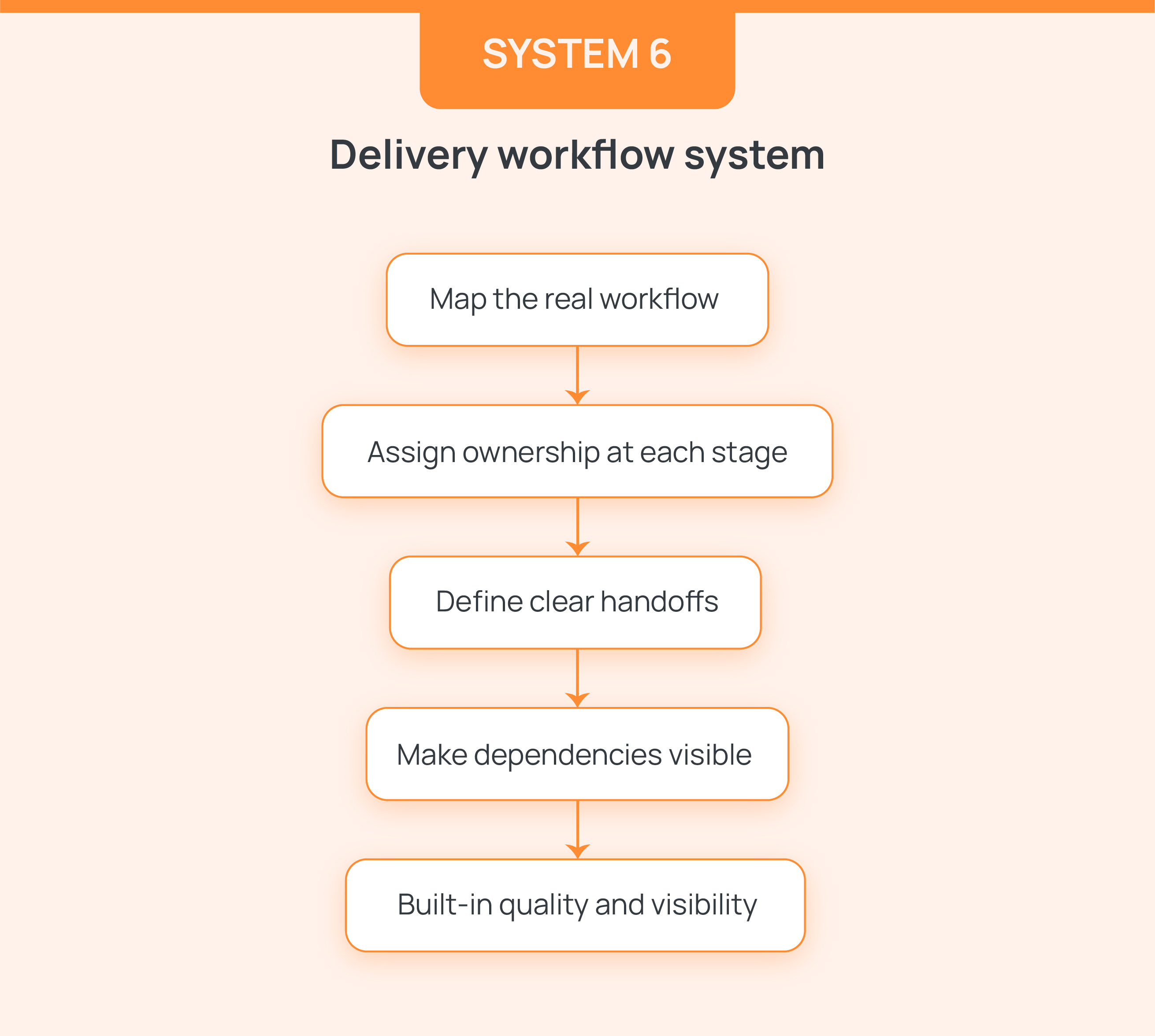
Start by mapping how work actually flows today, not how it is supposed to flow. Identify the common stages that most work moves through from intake to completion, and write them down in simple terms. This becomes the backbone of the workflow.
Next, define ownership at each stage. Decide who is responsible for moving work forward at every point, not just who is doing the work. Ownership should be clear enough that progress does not depend on memory or informal follow-ups.
Then, document key handoffs. Specify what “ready” means when work moves from one person or stage to another. This prevents work from being passed along with missing context and reduces rework later.
After that, make dependencies visible. Identify which tasks or inputs must be completed before other work can begin and build those dependencies into the marketing workflow. This allows the system to surface blockers early instead of relying on individuals to remember them.
Finally, design the workflow so that quality and speed come from structure, not urgency. Build review points into the flow and ensure progress is visible without constant checking. The goal is to reduce reliance on heroics and allow execution to survive people changes.
System 7: Capacity planning system
The Capacity Planning System exists to ensure that work fits the team’s actual ability to deliver it, not an assumed or idealized version of capacity.
What breaks without it
When capacity planning is weak, teams operate in a permanent state of overload. Work is assigned based on urgency rather than feasibility; every week feels full, and every delay feels personal.
The phrase “everyone is busy” becomes the default explanation for missed deadlines and declining quality. It sounds reasonable, but it provides no insight.
Over time, this leads to exhaustion and quiet disengagement.
How to build this system
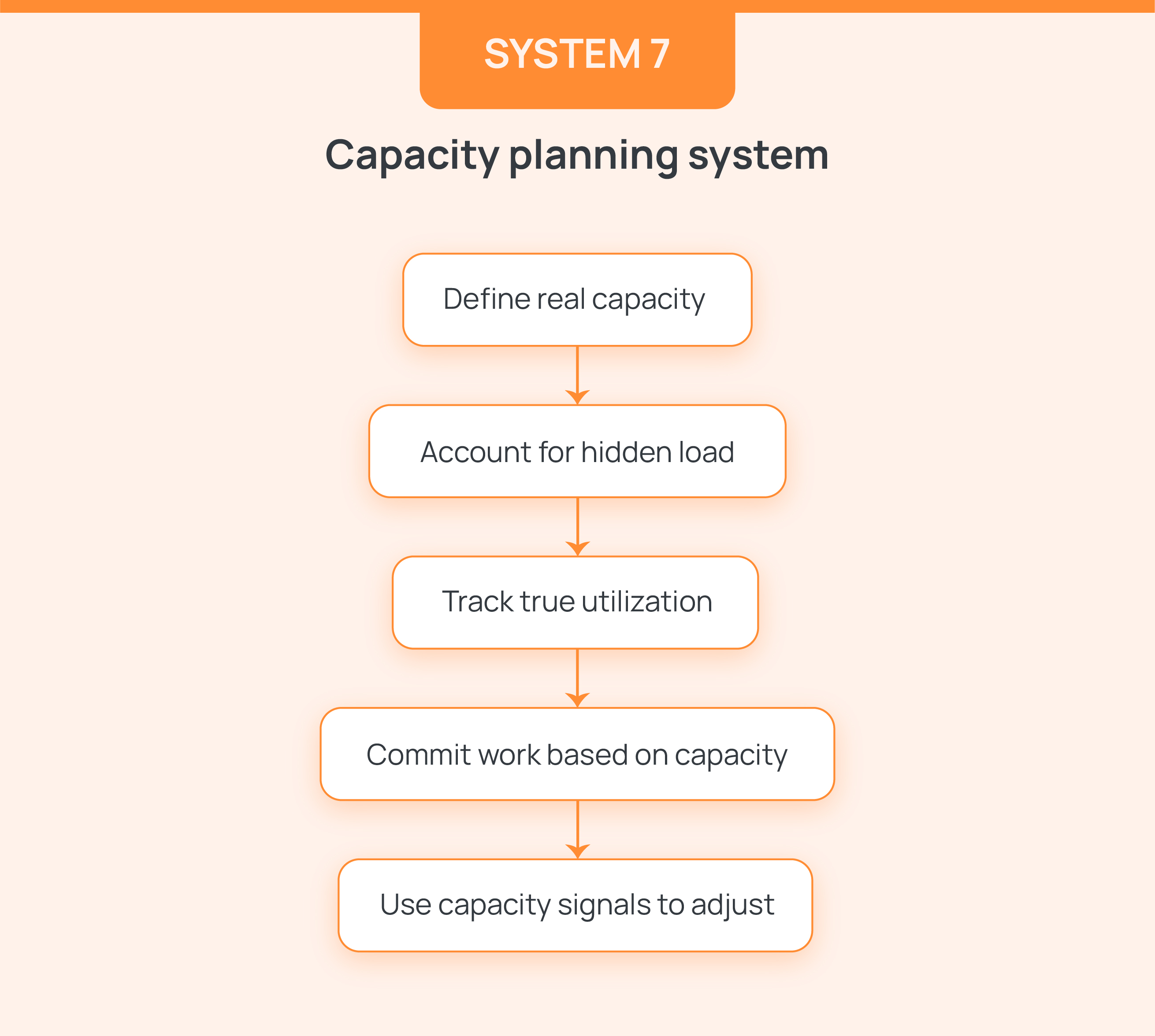
Start by defining what capacity actually means for your team. Capacity is not hours logged or calendars filled. It is the amount of focused, high-quality work a person or team can consistently deliver without burnout. Document this baseline realistically rather than optimistically.
Next, account for the hidden load. Identify the time consumed by meetings, reviews, coordination, context switching, rework, and support. This work often goes uncounted, but it directly reduces delivery capacity. If it is invisible, capacity will always be overestimated.
Then, track true utilization instead of busyness. Measure how much of the team’s time is spent on planned, value-creating work versus reactive or unplanned work. This reveals where overload is structural rather than temporary.
After that, plan work against capacity before committing to timelines. Accept new work based on available capacity, not urgency or pressure. When capacity is full, something else must move or wait. This trade-off should be explicit, not absorbed silently by the team.
Finally, use capacity signals to guide hiring and reprioritization. Sustained overload indicates a system problem, not a motivation issue. Capacity planning should inform when to hire, pause intake, or adjust scope, rather than pushing the team harder.
System 8: Hiring and role clarity system
The Hiring and Role Clarity System exists to ensure that people are set up to succeed within the organization. It creates clear ownership and accountability so that work progresses without constant escalation.
What breaks without it
When roles are vaguely defined, ownership becomes diffuse. Multiple people touch the same work, but no one truly owns the outcome. Decisions slow down as individuals wait for confirmation or defer responsibility upward.
Founders remain deeply involved because they are the only ones with enough context to decide. This dependence feels necessary, but it quietly prevents the business from scaling.
How to build the system

Start by defining roles around outcomes, not activities. Document what each role is accountable for delivering, rather than listing tasks they might perform. This ensures ownership is clear even as work evolves.
Next, clarify decision rights for every role. Specify which decisions a role can make independently, which require consultation, and which must be escalated. This removes hesitation and reduces unnecessary approvals.
Then, eliminate overlapping ownership. Review where multiple roles touch the same outcomes and decide who has final responsibility. Collaboration should support ownership, not replace it.
After that, hire for clarity, not coverage. Avoid hiring generalists to “fill gaps” once complexity increases. Instead, hire people into clearly defined roles with known decision boundaries so they can operate confidently without constant guidance.
Finally, make role clarity visible and reusable. Document roles, responsibilities, and decision rights in a shared place and use them consistently in hiring, onboarding, performance reviews, and prioritization discussions.
System 9: Knowledge management and documentation system
The Knowledge Management and Documentation System exists to protect the agency from knowledge concentration and accidental loss. It ensures that critical information, decisions, and processes are accessible beyond the individuals who currently hold them.
What breaks without it
When processes are undocumented, execution becomes fragile. Work slows when key individuals are unavailable. Mistakes are repeated because lessons are never captured. New hires take longer to ramp up because context must be rebuilt manually.
Undocumented systems do not fail loudly. They fail through inefficiency, inconsistency, and dependency.
As the agency grows, these small inefficiencies compound into operational drag.
How to build the system
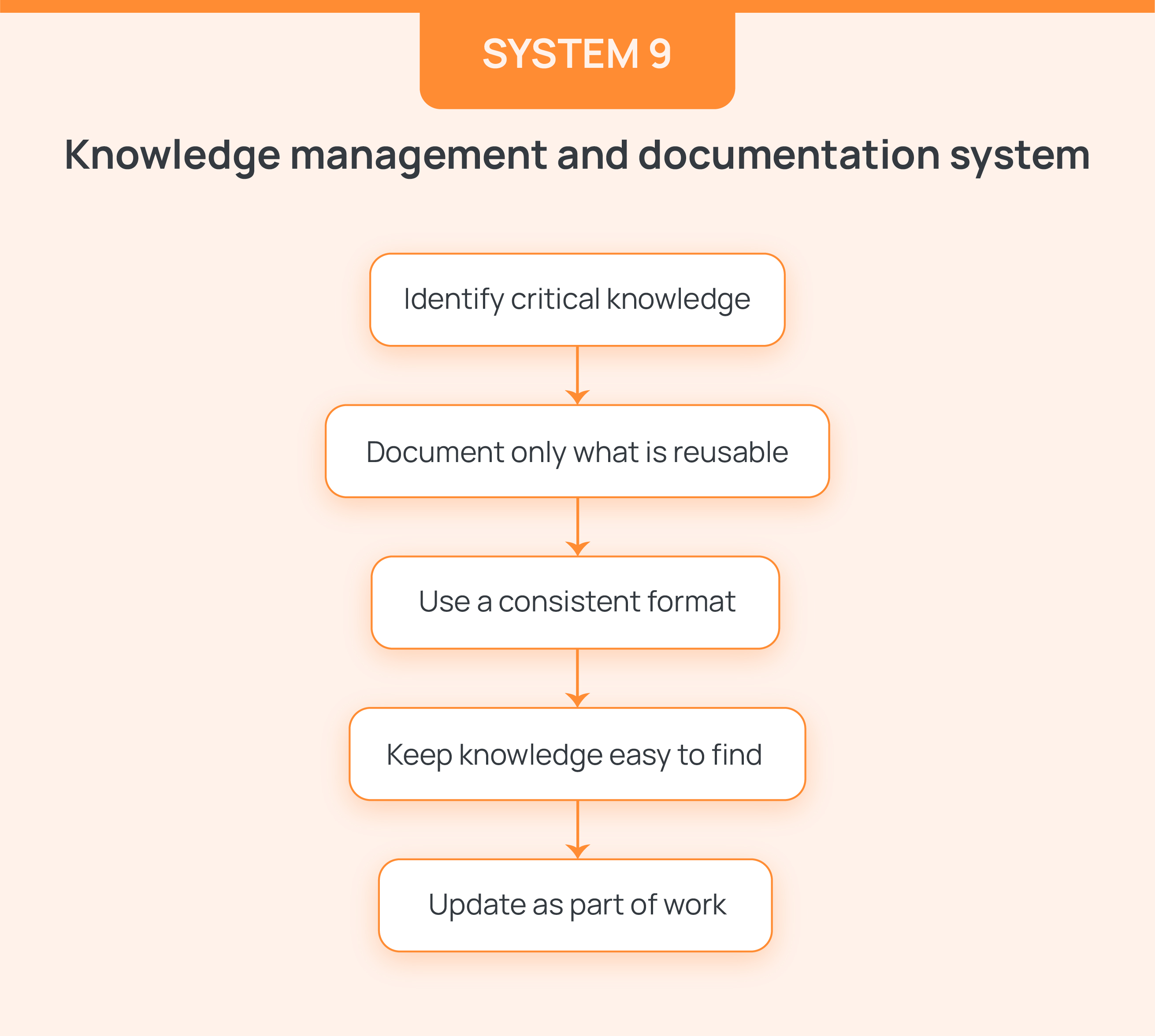
Start by identifying what the business cannot afford to lose. Focus on processes, decisions, and context that repeatedly slow work down when one person is unavailable. These are the highest-risk knowledge gaps and should be documented first.
Next, document for reuse, not completeness. Capture only what someone else would need to execute the work correctly without asking follow-up questions. Avoid documenting edge cases, one-off decisions, or personal preferences that add noise instead of clarity.
Then, standardize how knowledge is recorded. Use a consistent format for workflows, decision logs, and operating guidelines so information is easy to scan and update. Consistency matters more than detail.
After that, make documentation easy to find and easy to maintain. Store knowledge in a single, shared location and keep it close to where the work happens. If documentation requires effort to access, it will not be used.
Finally, build documentation into the workflow. Update knowledge as part of completing work, not as a separate task. When documentation is treated as a byproduct of execution, it stays current and relevant.
System 10: Quality control and review system
The Quality Control and Review System exists to protect the agency’s standards as volume increases. It ensures that quality remains stable regardless of who executes the work or how fast the business is moving.
What breaks without it
Quality rarely collapses all at once. It declines quietly.
Small compromises are made to meet deadlines, and feedback becomes inconsistent. Over time, the definition of “good enough” drifts without anyone consciously deciding to lower the bar.
Clients notice this before teams do, and trust erodes gradually.
As agencies grow, review effort does not scale automatically. What once felt manageable becomes burdensome, founders or senior leaders become the default quality gate, and reviews turn into bottlenecks.
To keep work moving, checks are skipped.
How to build this system
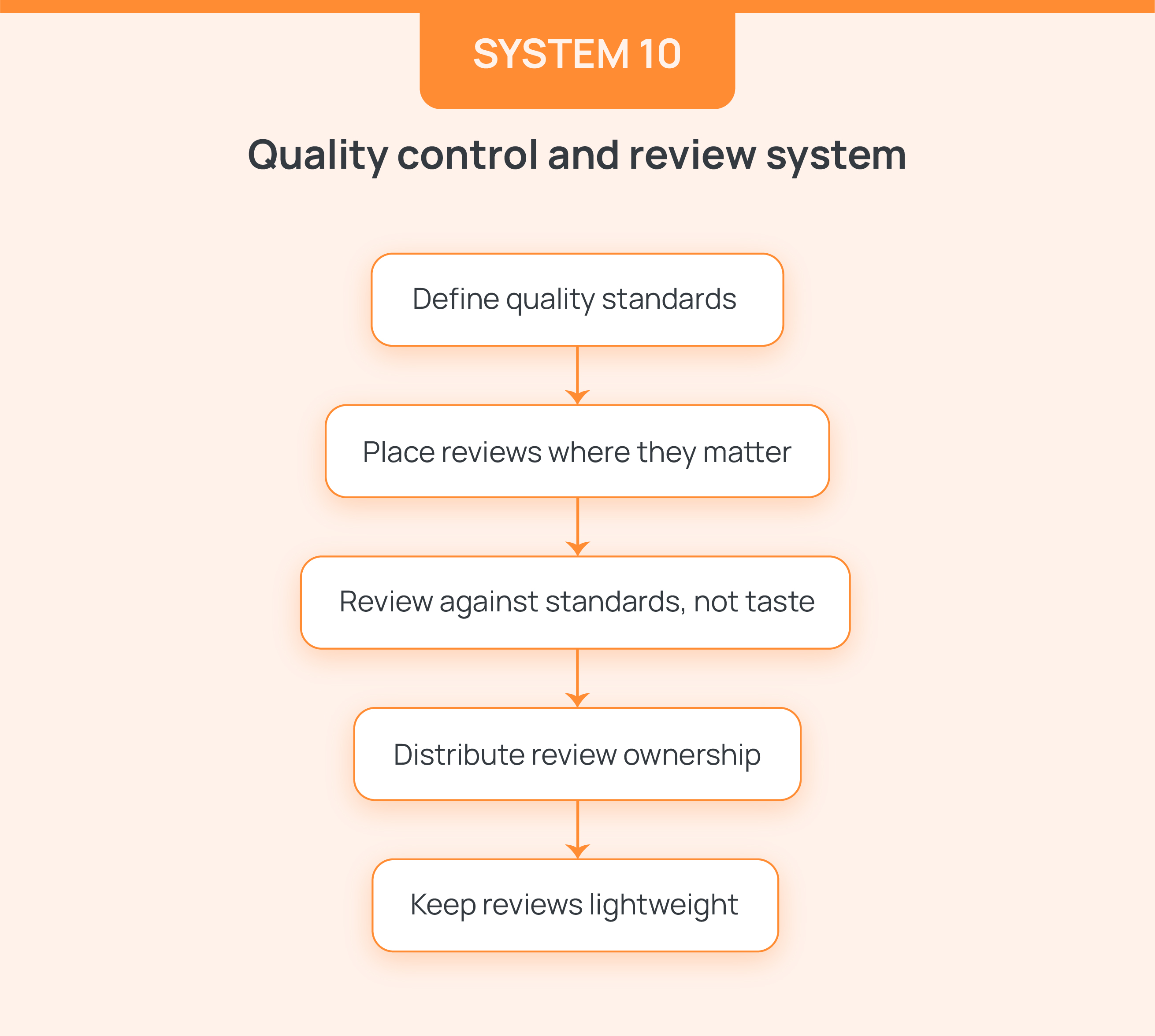
Start by defining quality in explicit, observable terms. Document what “good” looks like for key outputs so quality is measured against shared standards rather than individual taste. These standards should be clear enough that different reviewers reach similar conclusions.
Next, decide where review adds value. Identify the stages in the workflow where mistakes are most costly or hardest to fix later, and place review points there. Reviewing everything dilutes attention and creates bottlenecks.
Then, separate quality assurance from personal preference. Train reviewers to assess work against agreed criteria instead of how they would personally approach the task. This keeps feedback consistent and reduces friction.
After that, distribute review ownership. Avoid making founders or senior leaders the default quality gate for all work. Assign review responsibility to roles, not individuals, so quality control scales with the team.
Finally, make the review lightweight and predictable. Use simple checklists, templates, or structured feedback formats so reviews are fast, repeatable, and easy to complete. Predictability keeps reviews from slowing delivery.
System 11: Tooling and tech stack system
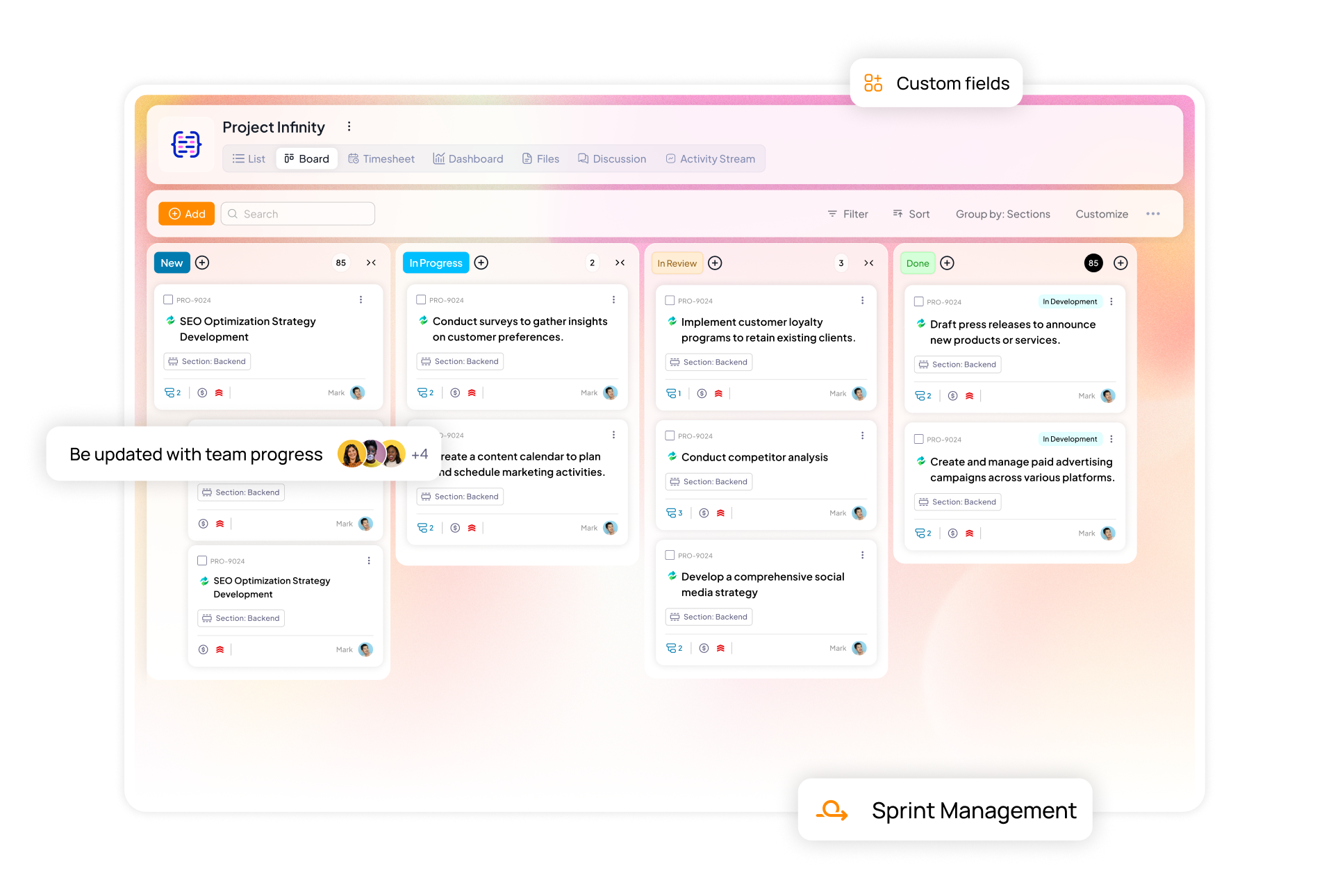
The Tooling and Tech Stack System exists to support how work actually flows through the agency. Its purpose is to create shared visibility and reduce friction.
What breaks without it
When tooling decisions are unstructured, fragmentation sets in, information spreads across systems, and context gets lost.
Over time, the tech stack becomes heavy without being helpful. Tools promise productivity, but the agency feels slower and less aligned. Over-tooling often comes from good intentions, but growth introduces new problems, and tools appear to offer fast solutions.
In reality, tools are used to compensate for missing systems. Instead of fixing workflows, agencies add software.
This creates the illusion of progress while increasing cognitive load.
How to build this system
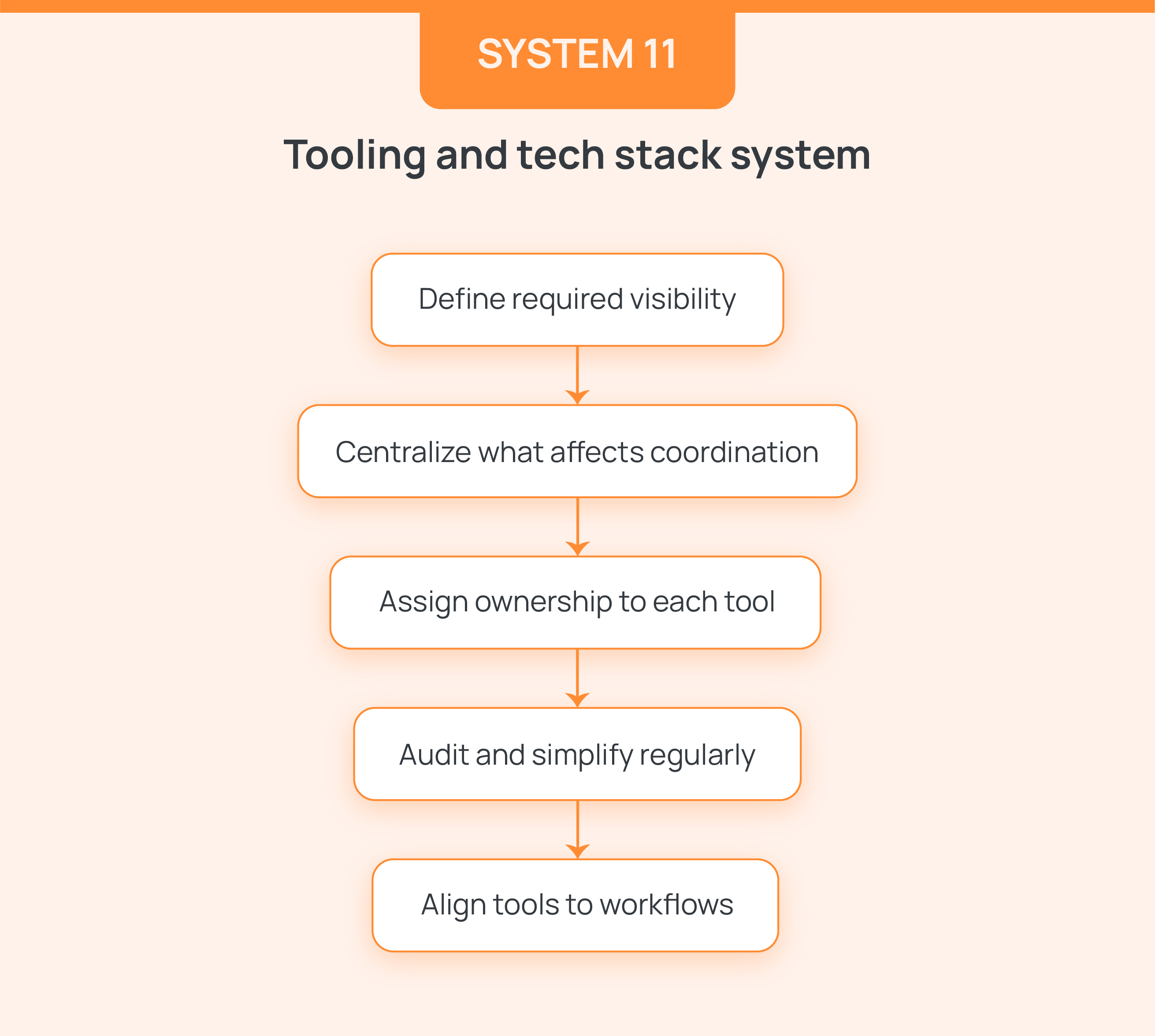
Start by defining what visibility the business actually needs. Identify the decisions that require shared context, such as delivery status, capacity, quality, and financial health, and work backward to determine which tools must support those views.
Next, decide what must be centralized and what can remain flexible. Centralize tools that affect coordination and decision-making across teams. Allow flexibility for individual productivity and creative work where fragmentation does not introduce risk.
Then, assign clear ownership to every tool. Document who is responsible for maintaining, configuring, and evaluating each system.
After that, audit the existing stack regularly. Remove or consolidate tools that duplicate functionality or no longer serve a clear purpose. Complexity should be reduced deliberately, not allowed to accumulate.
Finally, ensure tools reinforce workflows instead of compensating for their absence. Introduce or retain tools only after workflows are defined. The tool should support how work moves, not dictate it.