

Mansi handed Claude her job for a day, then graded the output the way she’d grade a new hire: speed, quality, accuracy, how often she had to step in, and would she ship it?
Watch the video to see if AI can replace a marketer or not? Watch the full breakdown
Benefits of AI for Marketing Productivity
AI’s biggest win for marketing teams is time. The use of AI in the marketing industry has gone from a nice-to-have to a baseline expectation in under two years.
Here’s where AI for productivity shows up on a real marketing team.
Automation of Repetitive Tasks
According to Deloitte, 84% of professionals say they waste time on repetitive, manual tasks at work. In marketing these tasks include creating reports, managing campaign data, and tagging audiences by hand. AI can automate these tasks, it can generate reports, segment audiences. So, does AI increase productivity? Yes, when it takes over tasks like these and frees up time for strategy and creative work instead. For teams handling project management for in-house marketing teams, this shows up fastest in the weekly reporting cycle, the same report getting rebuilt from scratch every Monday until AI takes over the assembly.
Agile, Personalized Content Creation
Clear communication matters in marketing, and AI helps you get there faster. AI writing tools help with framing sentences and organizing ideas. It can turn a rough draft into something more readable. AI eases the slow, mechanical part of the process, so you can spend time shaping the message and making creative calls. AI also speeds up the writing process itself. A first draft that used to take an hour can take a few minutes instead, without losing quality.
Data Analysis and Valuable Insights
You can’t check every number in your campaign dashboard every day. Nobody actually does. But something in that pile of data usually shifts before you’d notice it on your own, and that’s the part AI is decent at catching. Not perfect, just faster than staring at a spreadsheet for the twentieth time this month.
Improved Decision-Making
A decision that takes two weeks doesn’t help much, even with great data behind it. AI shortens that gap. It can flag a customer segment worth targeting or a budget move worth making, often before anyone on the team would’ve spotted it. That’s fewer guesses, and a better shot at moving before the competition does.
Ethics and AI in Marketing
Nobody talks about this part enough. If an AI tool quietly drops a group of customers from a campaign, that’s not some minor glitch to shrug off, it’s a bias problem, and it’s on you to catch it before launch. Trust doesn’t come back easy once it’s gone, no matter how good the next campaign’s copy is.
Integration with Other Technologies
A single AI tool only gets you so far. Sure, a writing assistant helps you bang out a first draft. But hook that same tool into your CRM or your project tracker, and it stops being one person’s shortcut, it becomes something the whole team actually uses. That’s where most of this is headed anyway, fewer one-off tools everyone forgets about, more systems that actually talk to each other.
How to Measure AI’s Impact on Marketing Productivity

You can’t measure what you don’t track, and it’s the same with AI. Here’s the simplest way to do it: grab a couple of marketing productivity metrics before AI even touches the workflow, then look at them again once it’s running. Numbers moved? Good, that’s your proof. Didn’t move? At least now you know before this turns into an expensive habit nobody questions.
Time saved per task
How to measure productivity? It starts with the clock. Pick a task AI now handles, like building a weekly report, and note how long it used to take versus how long it takes now. Multiply that difference by how often the task happens, and you’ve got real hours back, not a guess.
Output volume
Count what actually got made. How many blog drafts, ad variations, or email sequences did your team produce this month compared to last month? A jump in output, without a drop in quality, is a solid sign AI is pulling its weight.
Quality and error rate
Speed alone is not enough. Track how many pieces need heavy edits or get sent back before they go live. If AI saves time but doubles the revision work, that’s not a real productivity gain.
Campaign performance lift
Compare click-through rates, conversion rates, or cost per lead before and after AI got involved in targeting or personalization. A better number here proves the impact reaches past your team and into results.
Capacity freed up
The clearest sign of impact is what your team did with the time. If AI frees up ten hours a week and your team fills them with more busy work, nothing’s really changed. If those hours go into strategy or work that used to get pushed to next quarter, that’s the real win. This is especially true in marketing agency project management, where those freed-up hours often just get absorbed into a fifth or sixth client account instead of showing up as visible extra capacity.
How to Measure AI ROI in Marketing
A tool that saves time but costs more than it saves isn’t a win, it’s just a different expense.
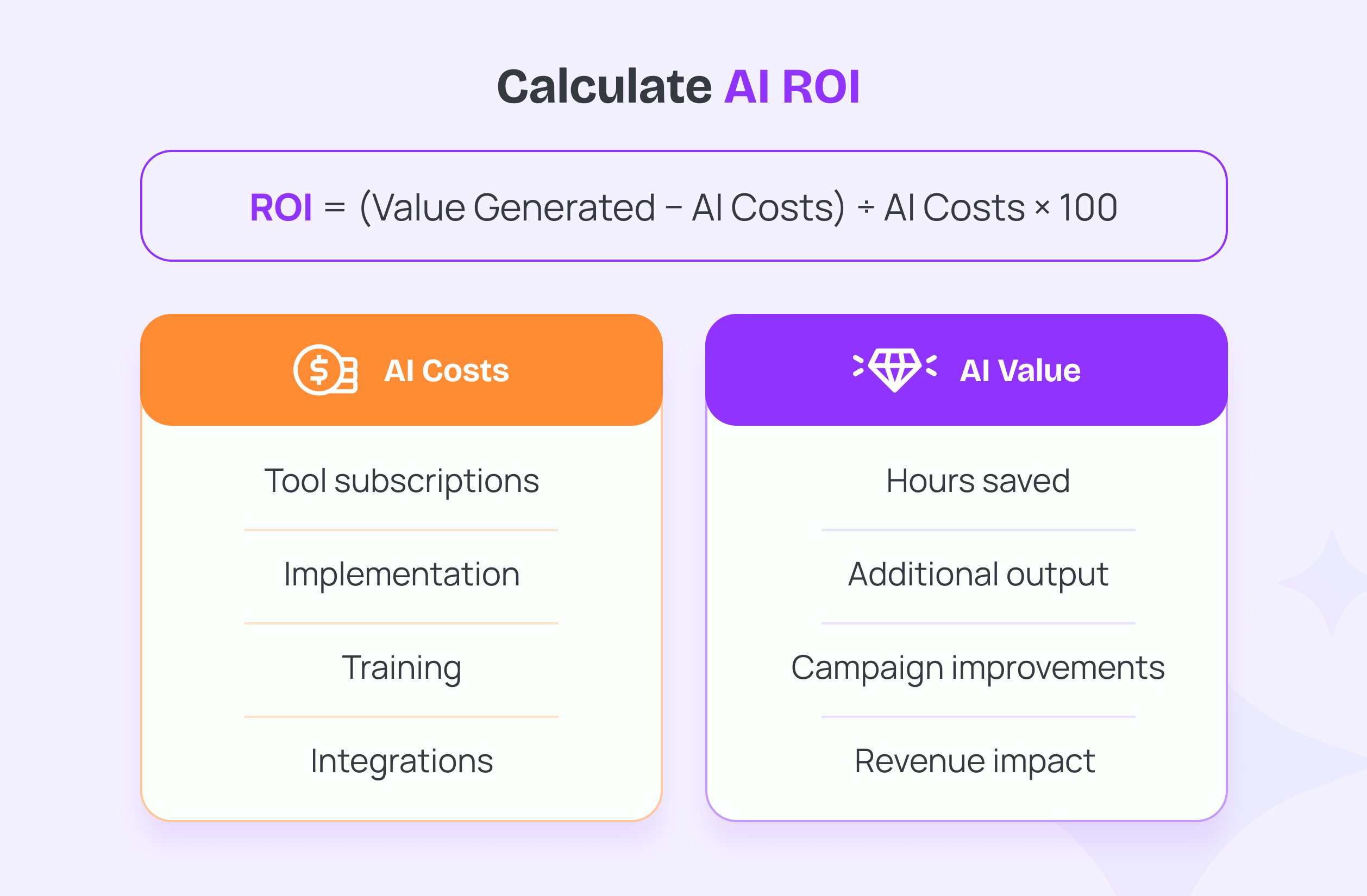
How to measure AI ROI comes down to comparing two simple things: what you put in, and what you get back. It’s the same math you’d use for any other investment, just applied to a chatbot subscription instead of a billboard.
What AI costs
Start with the real numbers, not just the subscription price. Add up the monthly tool cost, the time your team spent learning it, and any setup or integration work. A $50-a-month tool that takes a week of setup and training isn’t as cheap as it looks on the invoice.
What AI returns
This is where AI return on investment gets counted. Add up the hours saved on tasks AI now handles, multiply by what an hour of that person’s time is worth, and you get a dollar value for time. Then add anything AI helped produce that wouldn’t have happened otherwise, like extra content output or a lift in campaign performance.
A simple way to calculate it
Here’s the formula. Subtract what AI costs from what it returns, then divide by the cost. Say a tool costs $200 a month and saves your team 15 hours a month, worth $750 at $50 an hour, that’s a return of 275% on that tool alone.
AI ROI doesn’t have to be exact to be useful. Even a rough number, tracked the same way every month, tells you more than a gut feeling ever will, and it’s the number that holds up when someone asks if the tool’s worth renewing.
AI Impact in Action: A Few Examples
The formulas above only mean something once you see them applied. Here’s what that actually looks like across a few common marketing tasks.
Weekly reporting
A team spends four hours every Monday pulling campaign numbers into a deck. AI cuts that to 45 minutes by auto-generating the draft from connected dashboards. That’s roughly 13 hours saved a month, worth $650 at $50 an hour, against a $30-a-month tool. Run the ROI formula and that’s over 2,000% return, on one task alone.
Content production
A content team was shipping six blog posts a month. With AI handling first drafts and outlines, that climbs to nine, without adding headcount or missing the editing pass that catches AI’s mistakes. Output volume is up 50%, and because the quality and error rate metric didn’t move, that’s a real gain, not a vanity one.
Paid campaign targeting
An agency running paid social for a mid-size client used AI to flag underperforming audience segments daily instead of during the weekly review. Cost per lead dropped 18% over two months. That number shows up in campaign performance lift, and it’s the one that’s hardest to fake, since it comes from ad platform data, not a team’s self-report.
Each of these ties back to one of the five metrics from earlier. None of them needed a big rollout or a new dashboard, just a baseline, a task, and someone willing to check the number again a month later.
Common Mistakes Teams Make When Measuring AI’s Impact
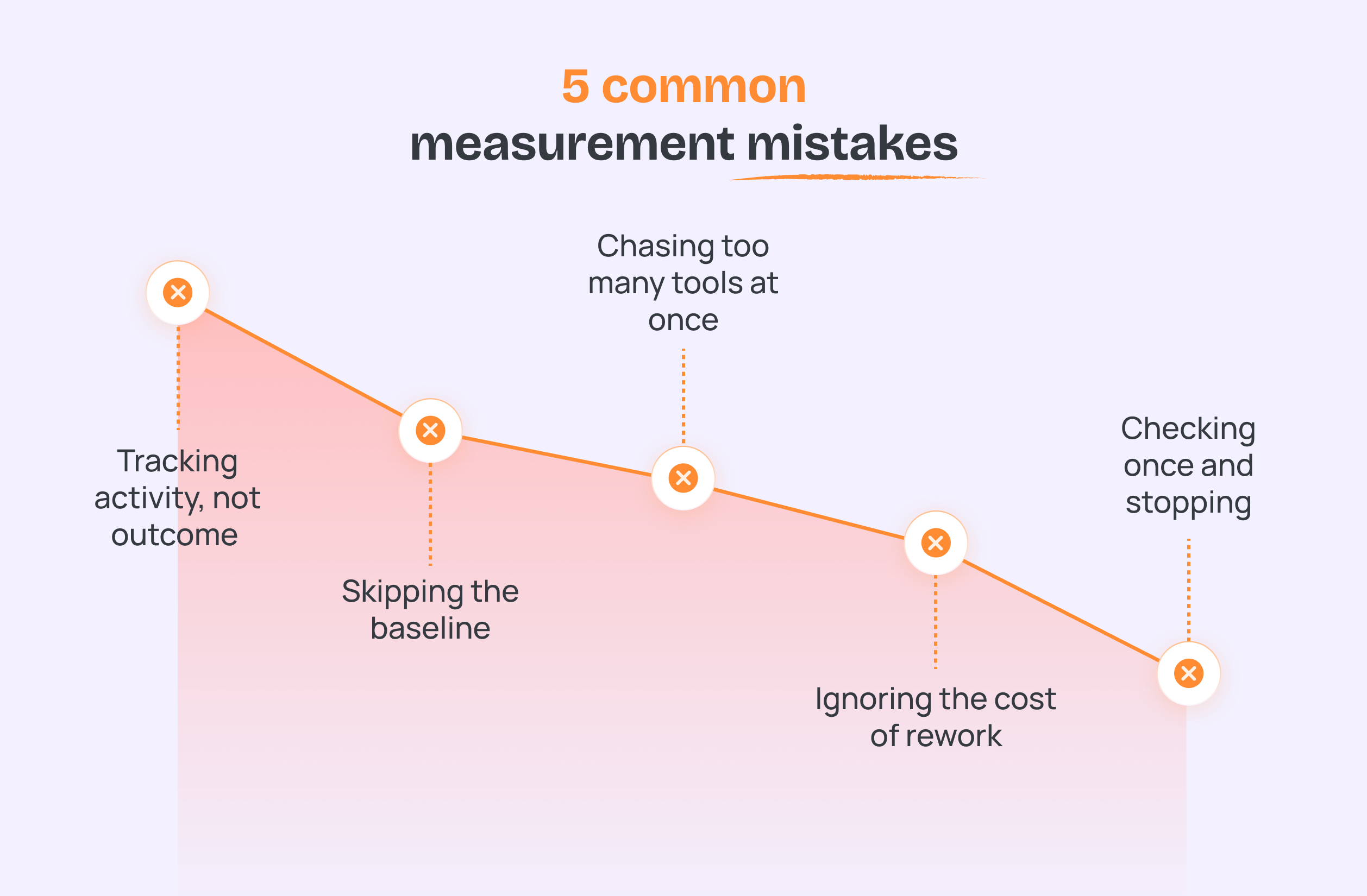
Most teams don’t get this wrong on purpose. Nobody set up the tracking before AI showed up, so the numbers that matter never got captured in the first place. Here’s where it usually goes wrong.
- Measuring activity instead of outcome: “We used AI 50 times this month” sounds impressive. It isn’t a metric though, it’s just proof the tool got opened. What actually matters is what got produced, saved, or improved because of it
- Skipping the baseline: No baseline, no proof. If nobody wrote down how long a task took before AI touched it, there’s nothing to compare against later. Even a rough guess, jotted down before launch, beats starting from zero.
- Chasing too many tools at once: Five new AI tools in one month, and good luck figuring out which one helped. Roll out one tool, track it for a few weeks, then move to the next. It’s slower, but it’s the only way to know what’s working
- Ignoring the cost of rework: Teams often count the time AI saves on the first pass and forget to count the time it costs in review and fixes. Both sides of that ledger matter
- Checking once and calling it done. A tool that looked great in week one can quietly stop earning its keep by week eight. Novelty wears off, old habits creep back in. Recheck the numbers every month or quarter, not just the week you rolled it out.
Key Takeaways
AI was never the hard part. Every tool on the market can write a headline or sort a spreadsheet faster than a person can. The hard part is looking at your team’s work six months from now and being able to say exactly what changed, and why.
That’s the entire point of measuring AI’s impact on marketing, not chasing a bigger number, but building enough confidence in your own numbers to make a real call. Keep the tool, drop it, or double down on it, backed by something you tracked yourself.
Start small. Pick one task this week, write down how long it takes, and check again in a month. That’s a better first move than any dashboard.