

For years, content teams structured their workflows around effort. Every campaign requires significant human input to research topics, create drafts, review, and prepare assets for launch. Because effort was expensive, teams had to be selective about what they produced and when they produced it.
AI changes that constraint.
Today, content teams can generate multiple strategic directions, messaging angles, and content variations within minutes. This doesn’t remove the need for human expertise. Instead, it shifts where teams apply judgment.
Understanding how content teams use AI now helps leaders redesign marketing workflows around more deliberate execution.
In the sections ahead, we’ll break down where AI fits across the content lifecycle, which tools support modern content operations.
Where AI fits in the content workflow for marketing teams

The impact of AI becomes clear when you look at the content workflow end-to-end.
Content operations have always followed a predictable structure. Teams research topics, define positioning, create drafts, review assets, distribute content, and measure performance. What changes now is not the structure itself, but the effort required at each stage.
Tasks that once slowed teams down can now happen quickly. This allows teams to evaluate more options before committing resources and move campaigns forward with greater clarity. These changes are driving the shift toward AI-powered content operations where teams connect planning and execution.
As a result, AI for content teams supports both strategic and operational decisions. It helps teams explore ideas faster, execute work with fewer delays, and maintain visibility across active campaigns.
AI can assist at virtually every step of the content creation process, supporting teams where effort was previously a limiting factor. Think of it as a flexible capability layer that strengthens each stage of the workflow.
Here’s how it fits in the entire content project lifecycle.
1. Ideation and research
AI tools help generate topic ideas and insights. For example, an AI assistant, like ChatGPT or an SEO platform, can analyze search trends and competitor content to suggest relevant topics.
Teams might also feed customer feedback or online forums into AI to uncover hot questions and pain points quickly.
2. Planning and strategy
Once the team selects topics, AI supports planning. Editorial tools schedule posts on the content calendar automatically. A marketing team project management platform, such as 5day.io, displays these tasks in Timeline or Calendar view so teams can track deadlines clearly.
AI can also identify content that needs updates. For example, when AI detects declining traffic on an older article, it can trigger a refresh recommendation. With workflow automation in 5day.io, the system can automatically create a task and notify the team without manual follow-up.
3. Creation and drafting
Generative AI speeds up writing and design. Writers use AI tools such as GPT-4 or Jasper to generate outlines or first drafts. They then refine the content by adding original insight, brand voice, and strategic context.
AI also increases visual content production. Tools like Canva Magic Write, Adobe Firefly generate graphics and infographics within minutes. Designers review these outputs and refine them to match campaign goals and brand standards.
4. Optimization and SEO
AI tools strengthen content performance after teams complete the draft. SEO platforms such as SurferSEO and MarketMuse analyze keywords, evaluate structure, and recommend improvements that increase search visibility.
AI also helps teams personalize content. For example, AI tools suggest email subject lines based on past engagement patterns. Many teams run AI-assisted A/B tests to evaluate headlines and calls to action. These tools then identify the highest-performing version and guide optimization decisions.
5. Distribution and publishing
AI tools streamline scheduling and publishing. Social media platforms such as Buffer AI and Hootsuite Insights generate post captions and recommend optimal publishing times based on audience behavior.
Automation workflows also move content forward without manual coordination. For example, when a team approves a piece of content, automation tools such as Zapier publish it or assign distribution tasks.
A centralized work management tool like 5day.io connects these activities. It notifies teams when content goes live and creates follow-up tasks such as engagement monitoring or performance review.
6. Analytics and insights
AI transforms campaign data into clear insights. Platforms such as HubSpot AI and Google Analytics analyze performance trends and identify which formats and channels drive results.
Marketing teams also use natural language queries to access insights quickly. For example, a marketer can ask, ‘Which blog generated the most leads this quarter?’ The system analyzes the data and provides a direct answer.
Teams use these insights to guide future planning and improve campaign performance.
Marketing teams achieve the best results when they combine AI capabilities with structured workflows. AI strengthens each phase of the workflow, but teams drive strategy, ensure quality, and make final decisions.
Top AI tools content teams use in 2026
Once teams understand where AI supports the workflow, the next decision is choosing the right tools to support execution.
Most content teams build a focused stack of tools that support specific stages such as research, drafting, optimization, distribution, and performance analysis. Each tool solves a distinct operational need, while the broader system ensures work moves forward without friction.
This shift also reflects a bigger change in how teams operate. AI tools now act as embedded support within existing workflows rather than standalone writing assistants. Teams connect these tools to their marketing team’s project management platform so that ideas, drafts, approvals, and publishing activities remain visible and organized.
By mid-2026, content teams use AI across a well-defined ecosystem. The tools below represent some of the most widely adopted options:
1. AI writing and content generation

Large language models such as OpenAI’s GPT-4, Anthropic’s Claude, Grok, and Google’s Bard power modern writing tools. Platforms like Jasper, Copy.ai, and Writesonic provide ready-to-use templates for blogs, social media posts, ad copies, and emails.
Marketing teams use these tools to generate first drafts and create content variations. These tools help writers start faster and focus on refining ideas.
SEO tools such as SurferSEO and MarketMuse analyze drafts and recommend keyword improvements. These platforms help teams strengthen structure and improve clarity.
2. Visual content and design
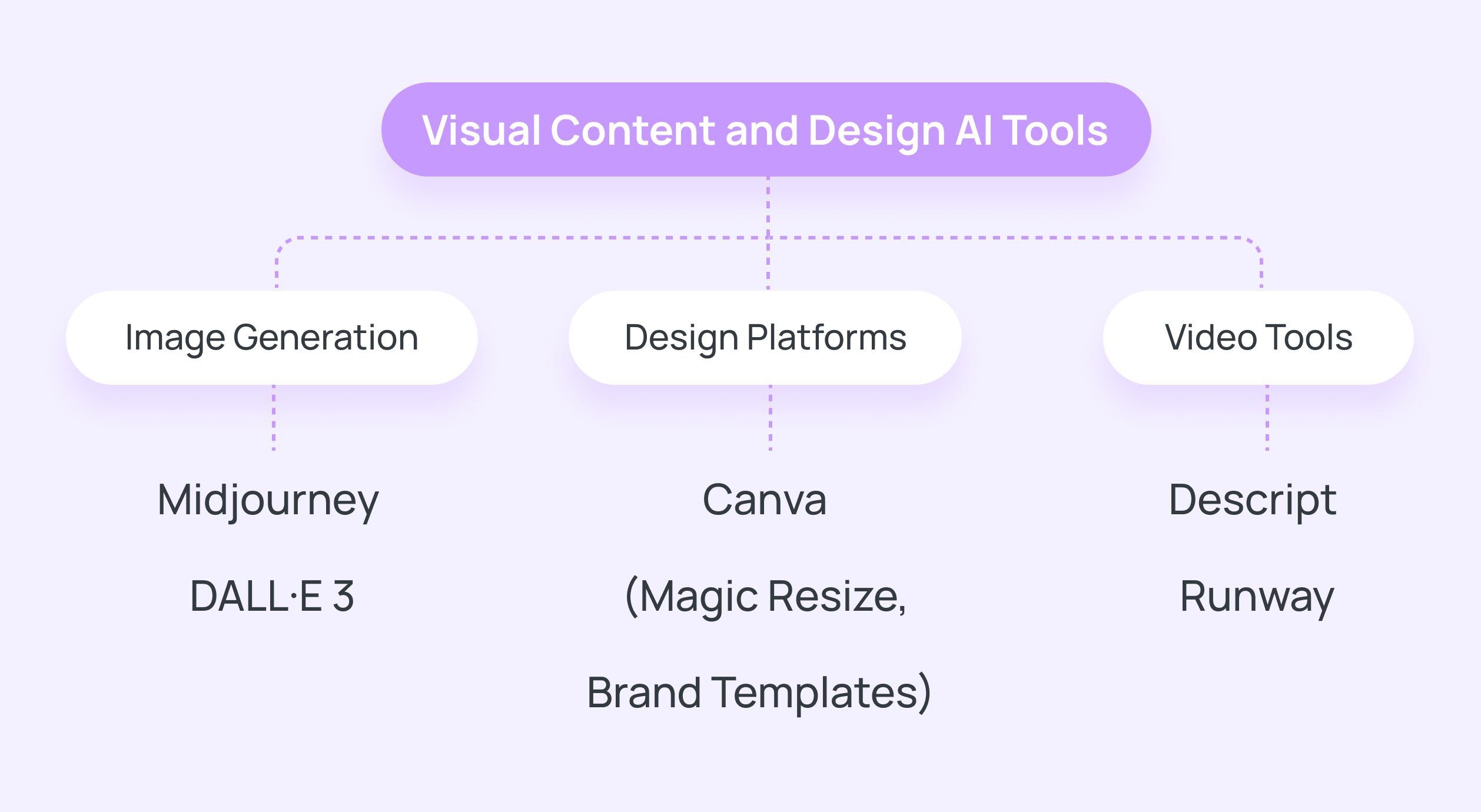
AI design tools speed up creative production. Platforms like Midjourney and DALL·E 3 generate custom images from text prompts within seconds. Teams use these visuals for blog illustrations, social media posts, and advertising creatives.
Canva’s AI features, including Magic Resize and Brand Templates, help marketers create graphics without relying on design teams. These tools simplify asset creation and maintain visual consistency.
Video tools such as Descript and Runway support fast video production. Teams use Descript to edit video and generate transcripts. Runway helps teams create short videos, animations, and visual content in no time.
3. Planning and project management
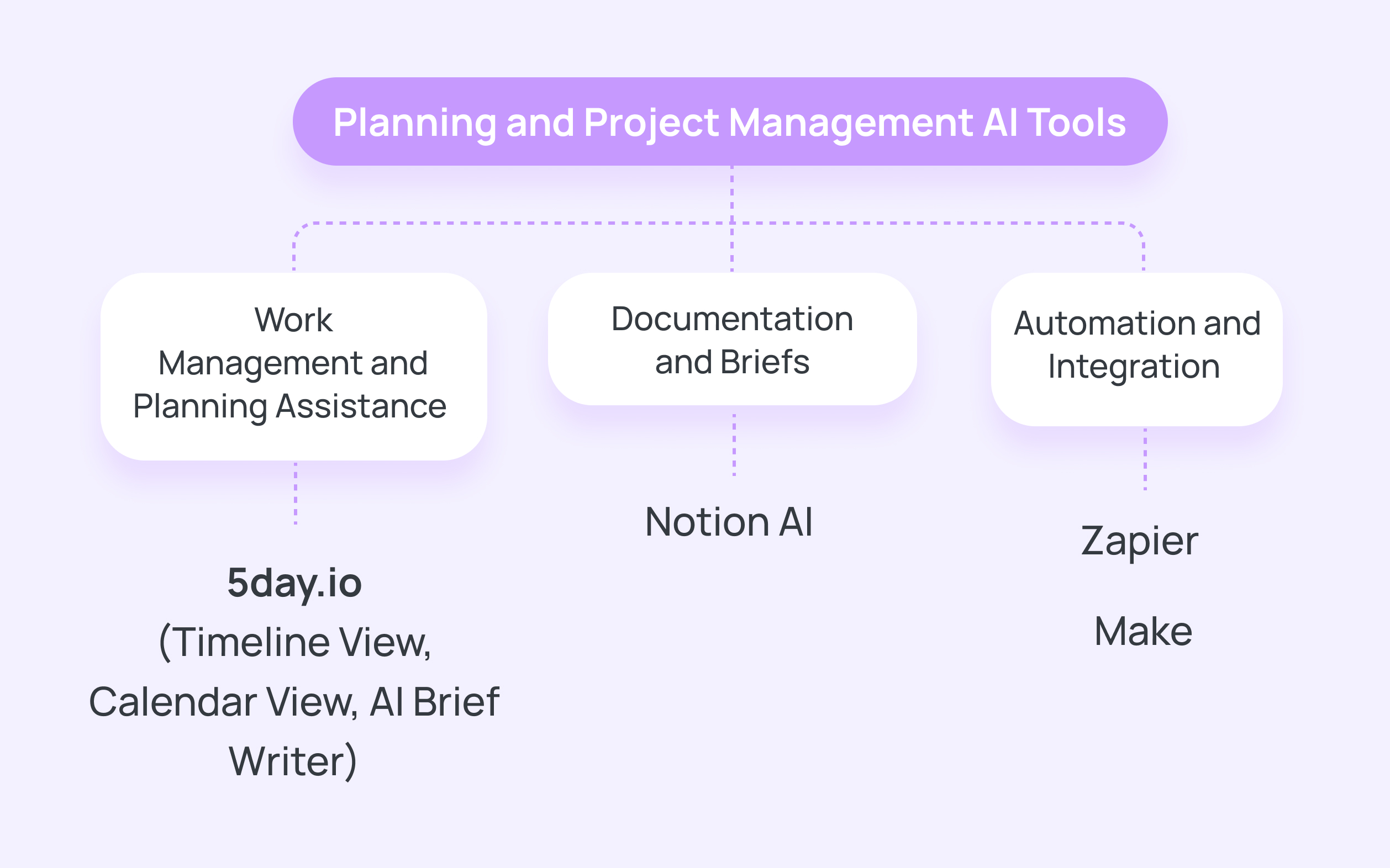
Planning sets the foundation for smooth execution. AI helps teams create structured plans, define clear briefs, and keep work organized without relying on scattered tools.
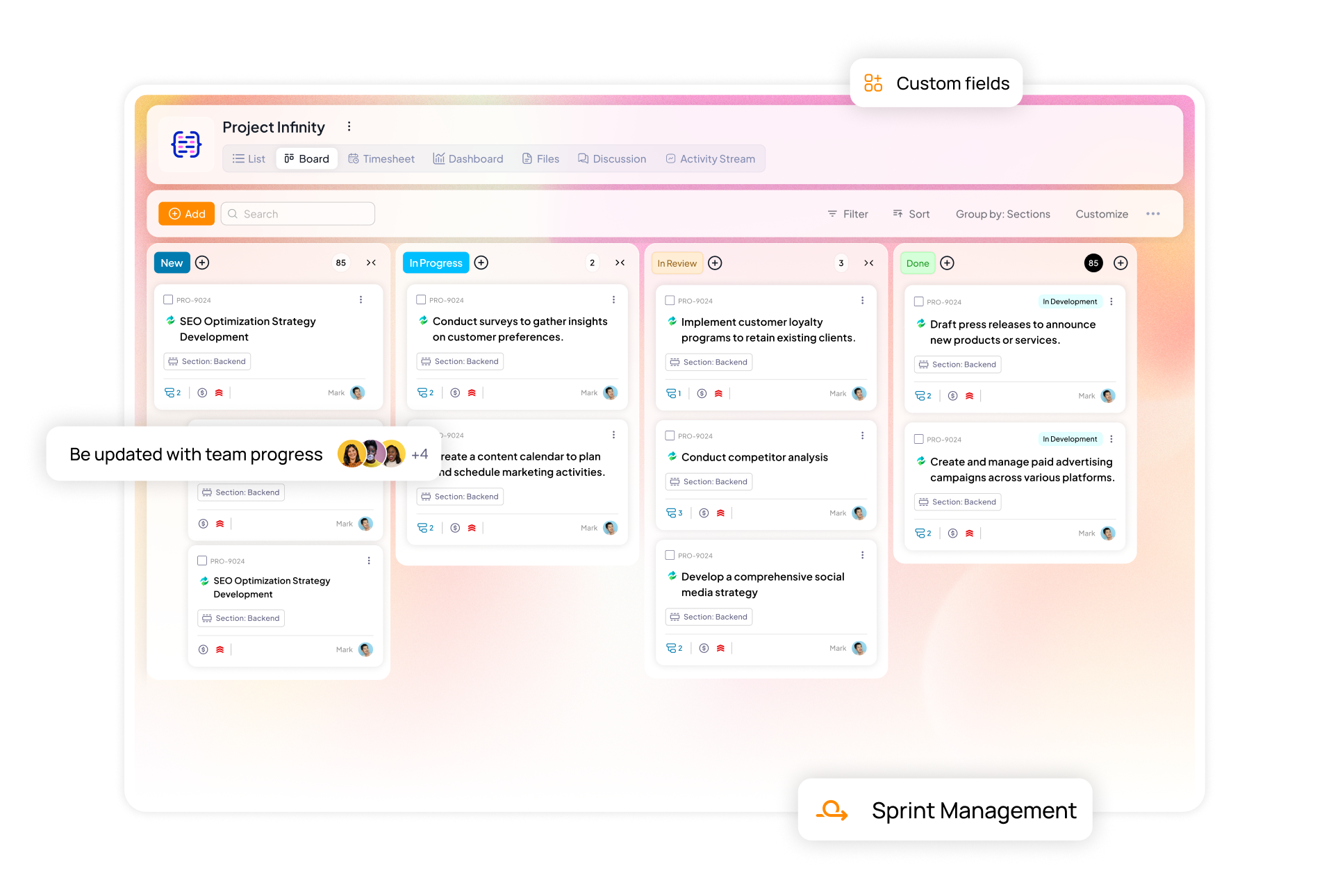
Work management platforms such as 5day.io help teams turn ideas into actionable tasks. Teams can assign work and track progress through Timeline and Calendar views. This shared visibility helps teams stay in sync and move campaigns forward without confusion.
AI also improves how teams prepare content before writing begins. In 5day.io, teams can use the built-in AI writer to generate structured briefs directly inside tasks. This helps writers start with clear goals and messaging.
Native AI agents further support planning by helping teams structure campaigns, identify relevant keywords, and generate LinkedIn topics and post ideas. These capabilities help teams move from planning to execution faster.
Documentation tools like Notion AI help teams create briefs and maintain internal documentation. Automation platforms such as Zapier and Make connect workflows by creating tasks, triggering reviews, and keeping teams informed as work progresses.
By combining AI-assisted planning with centralized work management, teams maintain clarity and execute content more efficiently.
4. Analytics and personalization

AI analytics tools help teams understand content performance. Platforms such as HubSpot AI and Salesforce Einstein analyze engagement data and identify patterns.
Ad platforms such as Albert.ai and Adobe Sensei adjust ad creatives and budget allocation based on performance. These tools help teams improve campaign efficiency.
Content personalization platforms such as Optimizely and Dynamic Yield deliver tailored content based on audience behavior. These systems help teams increase engagement and improve conversion rates.
These tools turn performance data into clear recommendations that guide future content decisions.
Pro tip: The right mix depends on your team’s goals and budget.
A lean marketing team might pair ChatGPT, Canva, Buffer, and 5day.io for coordination. A large enterprise might integrate an AI content platform and a digital asset management (DAM) system. The crucial point is integration.
The most effective AI content workflow is one where tools feed into a connected pipeline and do not create silos.
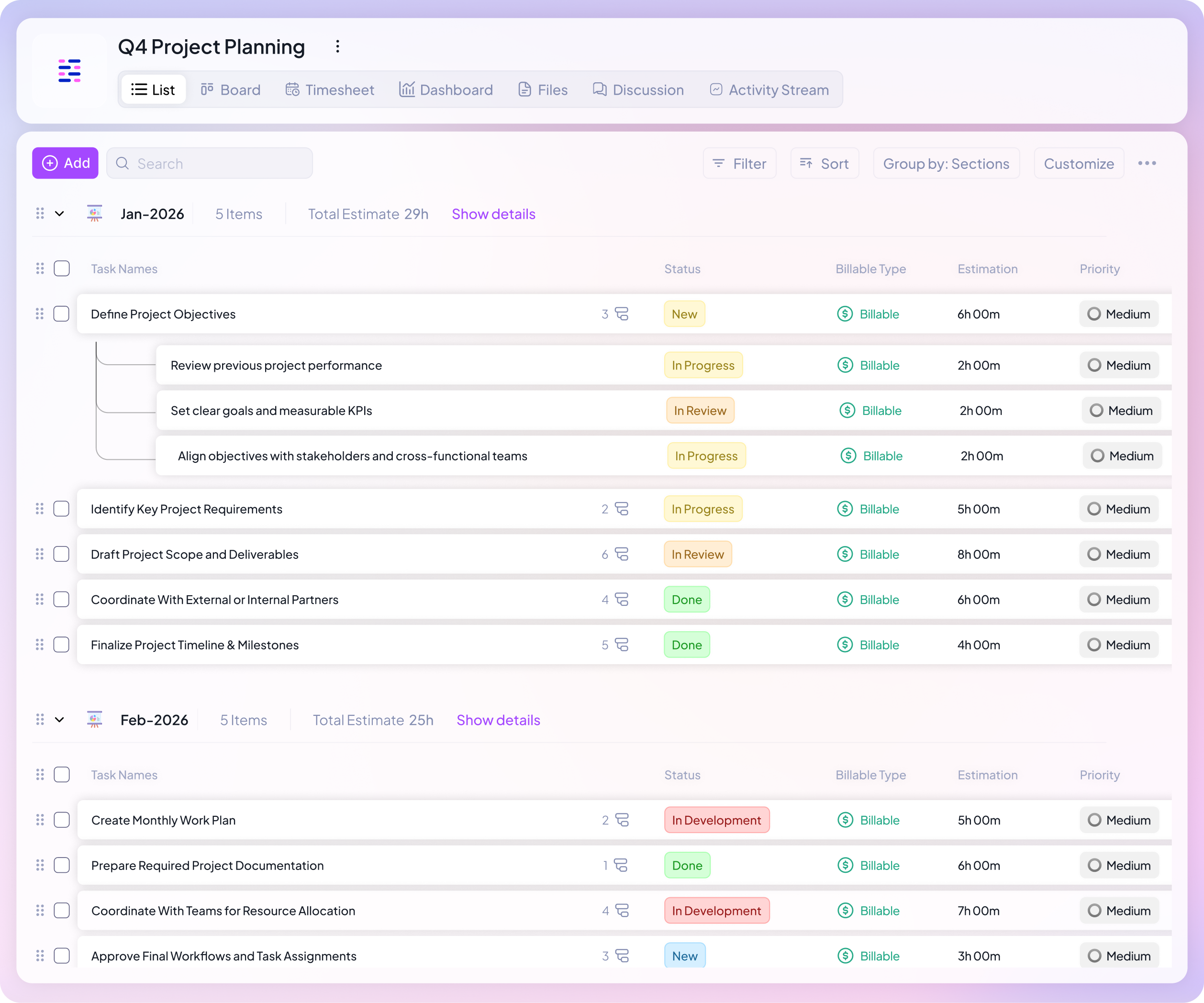
Example AI-powered content workflow for a marketing team with 5day.io
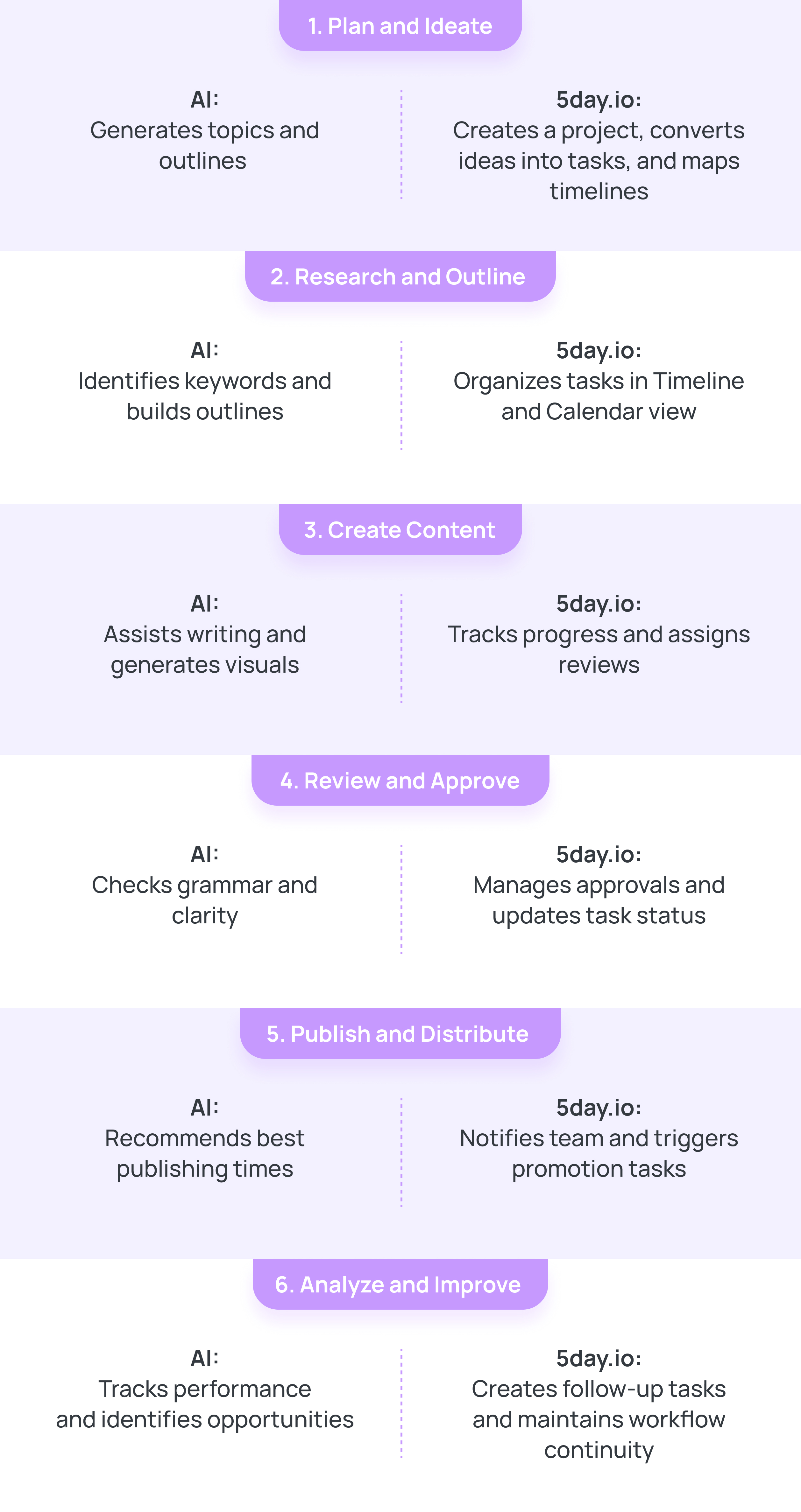
Understanding tools and use cases is useful. Seeing how they connect inside a real campaign is more practical. This structured coordination creates a repeatable AI workflow for content creation that improves speed and execution consistency.
Many teams experiment with AI in isolated tasks. Few redesign the full content execution path around it. The difference shows up in coordination and turnaround time.
To make this concrete, consider a marketing agency planning a quarterly content campaign. This scenario provides practical examples of AI in content marketing across planning, creation, publishing, and performance tracking.
The agency manages blog content, social posts, landing pages, and performance tracking for a B2B client. Instead of treating AI as a drafting assistant, the team builds it directly into its planning, execution, and review system.
Here’s one possible AI-assisted workflow using 5day.io and common AI tools:
1. Project kickoff and ideation
The manager creates a new project in 5day.io using a marketing calendar template and invites the team. During brainstorming, the team defines campaign themes.
An AI assistant such as ChatGPT generates blog title ideas and outlines. The team selects the strongest ideas and converts them into tasks on the 5day.io Timeline.
2. Research and outlining
The writer uses AI SEO tools such as Semrush or Ahrefs to identify relevant keywords. 5day.io displays these tasks in the Calendar view. The writer or an AI assistant creates a draft outline with headings and key points and attaches it to the task.
3. Content creation
The writer completes the draft in Google Docs or a CMS editor. AI content creation workflow includes tools such as Jasper or GPT-4 to expand sections or refine messaging. The designer generates a blog image using Midjourney and refines it in Canva. 5day.io tracks progress and assigns review tasks, such as editorial review.
4. Review and approval
AI tools such as GrammarlyGO check grammar and clarity. The editor reviews the content and updates the task status in 5day.io. The writer revises the draft if needed. The team approves the task and marks it complete once the content meets quality standards.
5. Publishing and distribution
The team publishes the content across selected channels. AI scheduling tools recommend optimal posting times. 5day.io integrations notify the team through Slack or email and trigger promotion tasks.
6. Analysis and follow-up
AI analytics tools such as Google Analytics or HubSpot track performance and identify trends. If content performs well or needs updates, automation creates follow-up tasks in 5day.io through Zapier integration. The team uses these insights to guide future campaigns.
These AI content workflow examples show how teams connect AI capabilities directly to execution systems.
Throughout the process, AI reduces manual effort and speeds execution. 5day.io provides visibility through Timeline and Calendar views. The platform tracks dependencies, creates tasks automatically, and keeps teams aligned as campaigns move forward.
Where content teams go wrong with AI and how to avoid it
A well-designed workflow can help teams move faster and stay organized. However, tools alone do not guarantee better outcomes. The way teams apply AI inside their content operations determines whether it improves execution or creates new inefficiencies.
Many marketing teams adopt AI quickly, but sometimes fail to adjust their processes. This often leads to inconsistent quality or disconnected workflows.
Here are some of the most common pitfalls to avoid when using AI for marketing teams:
1. Using AI without a strategy
Teams often assume that prompting ChatGPT will produce valuable content. It rarely works that way. Teams must define clear goals before using AI. These goals include audience needs, brand voice, and SEO targets.
Research from HubSpot shows that skills drive success more than tools. Teams should decide where AI fits inside the workflow. For example, they can use AI to draft outlines and gather sources. Writers should then add original insights and an expert perspective.
2. Skipping human review
Generative AI for content marketing sometimes produces incorrect facts or weak arguments. It can also create flat or repetitive language. Teams that publish without review risk damaging credibility.
Google now checks content quality more strictly. Teams should always include a review step. They can use AI for the first draft. Subject experts and editors must verify facts, improve clarity, add unique perspectives, and strengthen brand voice.
3. Ignoring brand consistency
AI often produces generic content. If every writer uses similar prompts, the output starts to sound the same. Marketing Dive describes this trend as blandification.
Teams must enforce clear brand guidelines. They should define tone, messaging priorities, and formatting standards. Some teams train custom AI models on their own content so the system reflects their brand voice more accurately.
4. Fragmented tool usage
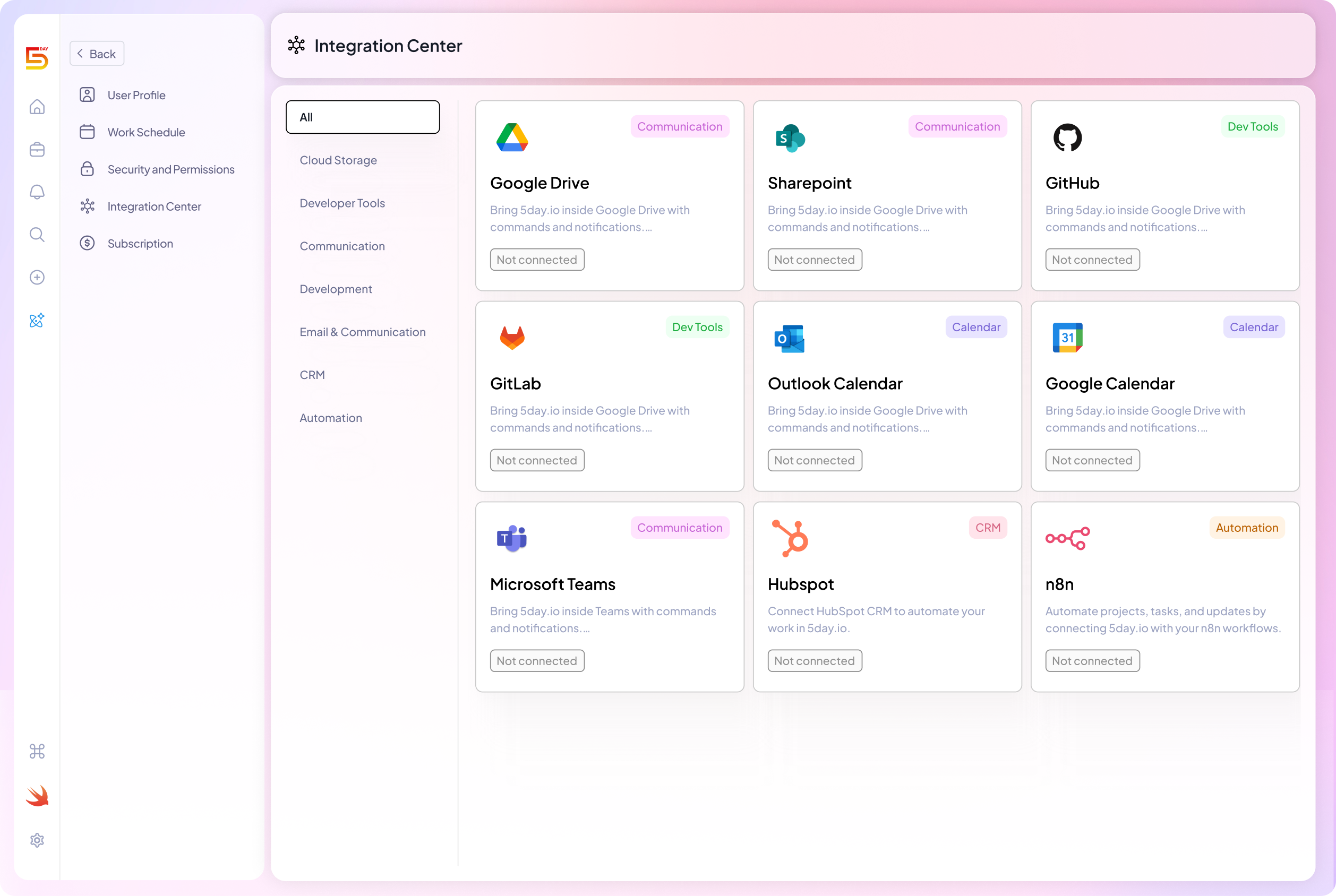
Disconnected tools slow teams down. When research lives in one app, drafts in another, and approvals in email, teams lose visibility.
Teams should centralize work inside one project or work management tool. For example, 5day.io keeps tasks, briefs, and assets in one workspace. Its integrations with Slack, Google Drive, and Zapier connect AI outputs directly to the project tracker.
1. Poor change management
Leaders must guide AI adoption carefully. Gartner advises companies to establish strong data governance during AI implementation.
Marketing leaders should train teams on how to use AI tools for content teams responsibly. They must define what data teams can share and how they handle privacy and compliance. Clear guidelines improve adoption and reduce risk.
Pro tip: The key is to avoid rushing into anything without planning. Use AI to handle the busywork, not to replace human judgment. When humans and AI each focus on their strengths, both content quality and efficiency improve.
The future of AI in content operations (2026–2028 trends)
As teams refine how they use AI in daily workflows, the conversation begins to shift.
Marketing leaders now evaluate how AI will influence planning cycles and execution speed over the next few years. Early adopters already see changes in how teams plan campaigns and respond to performance signals.
These shifts will continue as AI becomes more deeply embedded in content operations. The trends below highlight where content workflows are heading and how teams can prepare.
1. Agentic AI and hyper-personalization
Gartner predicts that by 2028, 60% of brands will use autonomous AI agents for one-to-one customer interactions.
For content teams, this means three major changes:
1. Content becomes modular
Teams will create reusable messaging blocks instead of single static assets. AI agents will assemble these blocks based on user behavior.
2. Planning becomes system-driven
Teams will define audience rules and message logic, while AI decides timing and delivery.
3. Feedback cycles shrink
AI will test variations continuously. So teams need fast workflows to monitor performance and refine messaging.
As personalization scales, structured workflows, and centralized visibility will matter even more. Teams will need clear control over content components to keep dynamic campaigns aligned with strategy.
2. Authenticity and trust
As AI-generated media becomes common, audiences will question what feels real. Brands will need to show transparency in how they create content.
Teams will adopt content labeling, verification tools, and stricter review processes. They will also invest more in original reporting, expert insights, and customer stories to strengthen credibility.
When content feels generic or automated, audiences disengage in no time. Clear brand voice and real expertise will matter more than volume.
3. Composable tech stacks
Marketing technology will become more modular and AI-enabled. Teams will connect writing tools, analytics platforms, automation systems, and the marketing team project management software into a unified workflow.
For content teams, this means tighter integration between tools. A draft may move from creation to scheduling without manual handoffs. Platforms like 5day.io will serve as the coordination layer to keep tasks, timelines, stakeholders, and approvals aligned across systems.
4. Ethics and governance
AI in content marketing introduces new compliance and privacy challenges. Teams must define clear policies around data usage and content ownership.
Content leaders will implement approval checkpoints and maintain visibility into how teams use AI tools. Strong governance will protect brand reputation and reduce legal risk.
Teams that manage AI responsibly will build long-term trust with their audiences.
5. Elevated human roles
Ironically, as AI handles more tasks, human strategy becomes even more valuable. Future teams may include roles like AI content strategist” or automation manager to oversee these tools.
Leaders will rely on human insight to interpret performance signals and guide brand direction. The human skills of empathy, storytelling, strategic insight, and ethical judgment will be the differentiators that AI can’t replicate.
The next few years will favor those who combine tech adoption with a solid strategy and ethical practices. The content teams that learn to use AI thoughtfully will pull ahead of the competition.
How 5day.io helps marketing teams turn AI into execution momentum
AI can accelerate research, drafting, optimization, and distribution. But speed alone does not create results. Without structure, AI outputs remain scattered across documents and tools. The real advantage comes when teams connect AI-generated work to a clear execution system.
5day.io helps marketing teams convert AI-assisted content creation into organized, repeatable workflows. Instead of treating AI outputs as isolated drafts, teams manage them as part of structured campaigns with defined timelines and accountability.
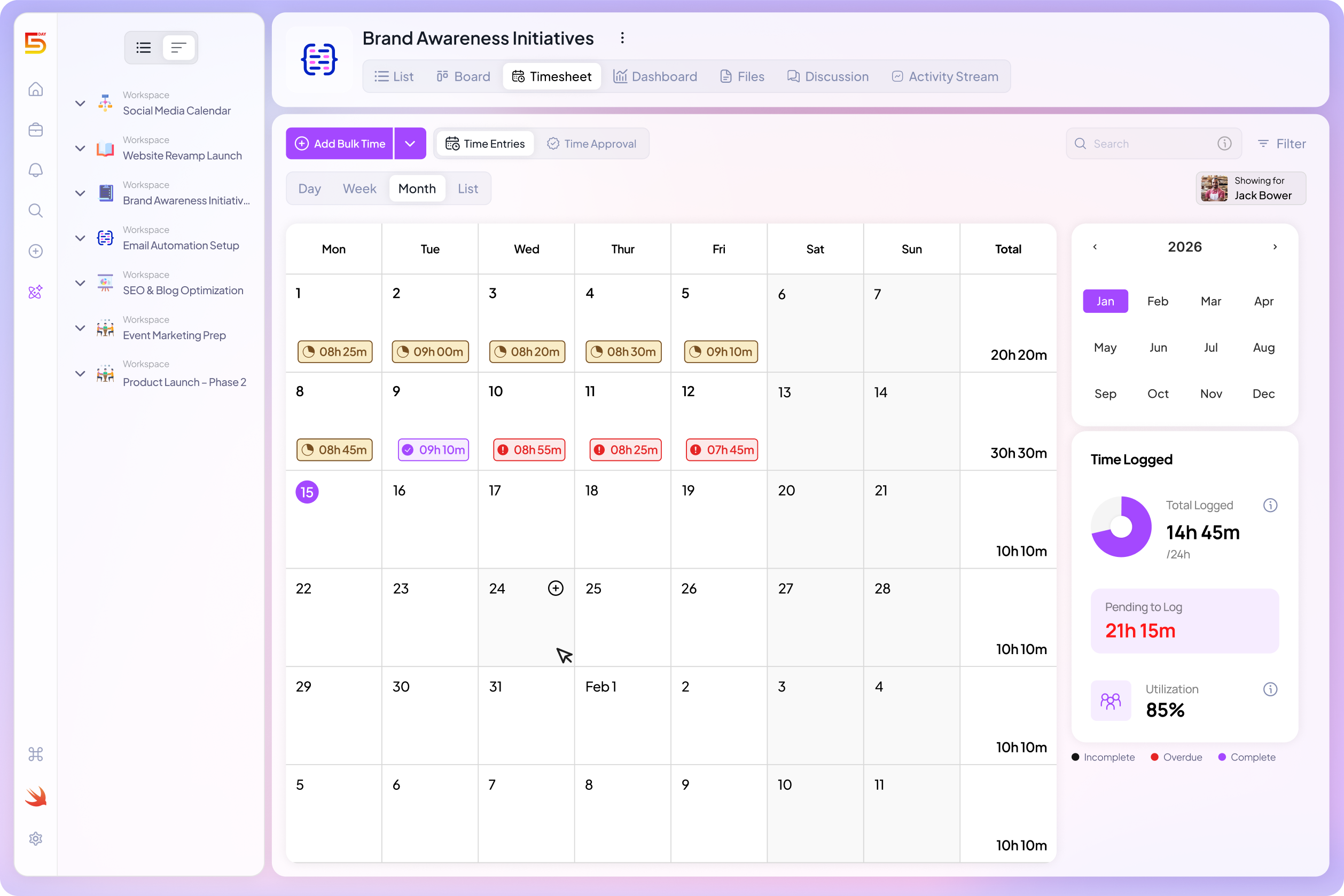
Marketing leaders use the 5day.io project management tool to:
- Convert AI-generated ideas into structured briefs and campaign tasks inside one centralized workspace
- Use AI agents to plan campaigns, research keywords, and generate LinkedIn content faster
- Align execution by tracking AI-assisted plans, tasks, and deadlines on a shared timeline
- Use Timeline and Calendar views to align AI-assisted content with campaign deadlines
- Run automation sequences that move content from draft to review to publishing without manual follow-ups
- Integrate with Slack, Google Drive, Zapier, and Teams, so AI outputs enter active workflows
- Assign clear ownership and permissions so writers, editors, and stakeholders have clarity
- Track campaign progress through real-time dashboards and fix risks before delays
This approach transforms AI from a writing assistant into a scalable operational layer. Teams that understand how to use AI in content marketing gain faster execution cycles. They reduce coordination overhead and gain full visibility into how content moves from idea to published asset.
When AI capability and structured execution work together, content operations become faster and easier to scale.
If you’re ready for AI-powered content operations in action, start your free trial with 5day.io today. No credit card needed.