
There’s no clear set owner for tasks because everyone is involved horizontally, no one can take ownership vertically.
Over time, this erodes trust in the process itself. Teams work harder but feel less certain that their effort is translating into results. That’s one of the most demoralizing failure modes in SEO campaign management.
The real bottleneck is the structure
Many SEO teams struggling at scale have the knowledge they need. What’s missing is a structure that allows all of that expertise to translate into consistent execution and visible progress.
Without a clear structure, strong strategies lose momentum. Work becomes harder to track, priorities start competing with each other, and progress feels fragmented even when effort is high. Over time, this friction slows teams down and makes SEO feel more chaotic than it needs to be.
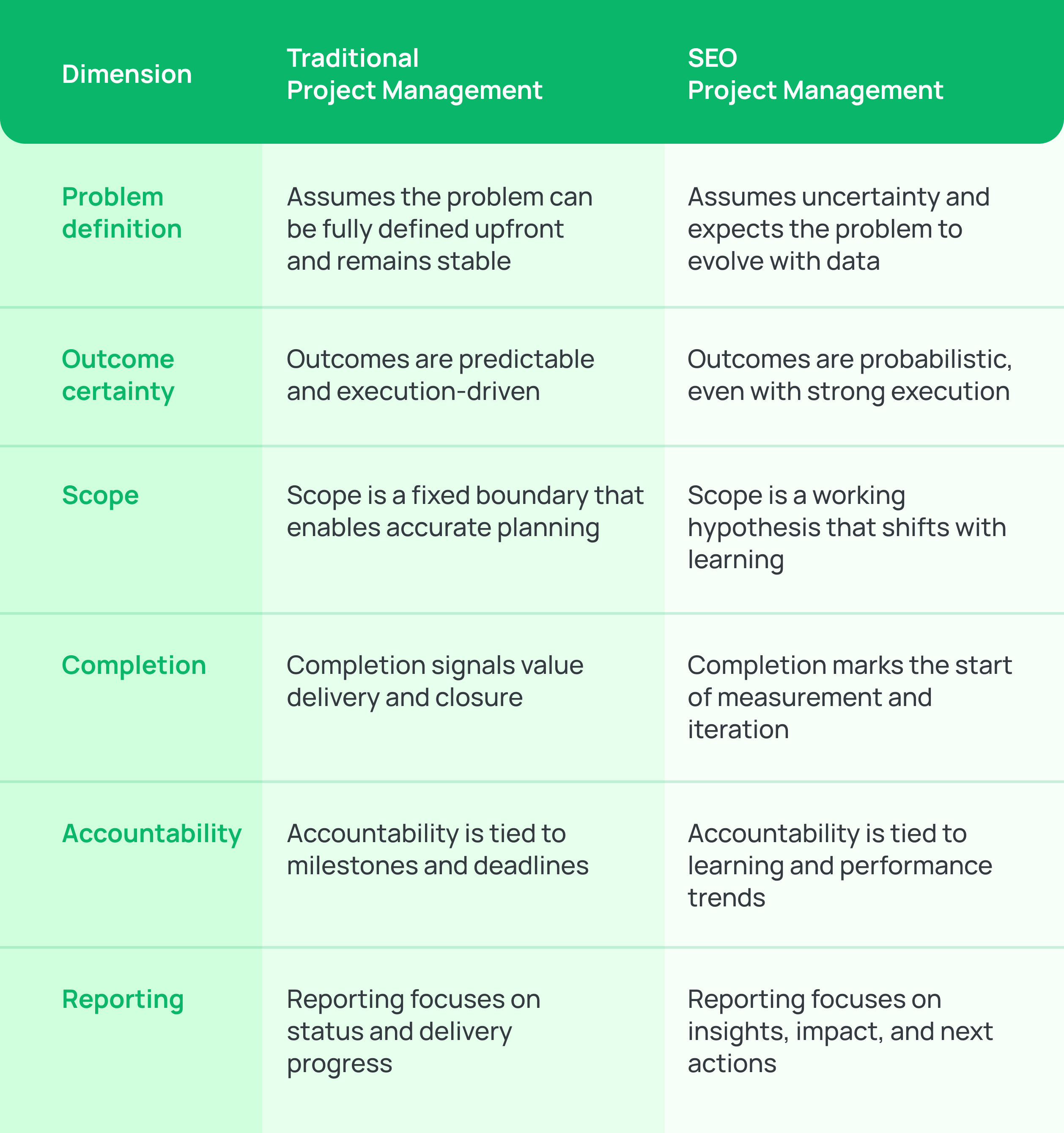
SEO Project Management vs Traditional Project Management
Breaking SEO into manageable workstreams
Technical SEO stream
The technical SEO stream is the foundation that most teams only think about when something breaks. It includes crawlability, indexation, site speed, Core Web Vitals, structured data, redirects, and architectural decisions that shape how search engines experience a site. Because the work is often invisible to users, it’s easy for this stream to become reactive rather than intentional.
In technical SEO, “done” never means permanently finished. It means the site is currently compliant with best practices, monitored for regressions, and prepared to surface new issues before they become costly. A technical task is only truly done when it has been implemented, validated, and placed under observation. Without that final step, fixes decay quietly over time.
Content and optimization stream
The content and optimization stream is where SEO becomes visible and creative. It includes research, content creation, on-page optimization, internal linking, updates, and consolidation. This stream tends to attract the most attention, partly because it produces tangible outputs and partly because it feels easier to control.
But this is also where SEO task management most often confuses activity with progress. Publishing content is not the same as finishing work. In this stream, “done” means content is aligned with intent, discoverable, integrated into the site’s internal structure, and actively monitored for performance. True completion includes iteration, updating, expanding, pruning, or repositioning based on how the content actually performs.
Tasks in this stream should flow like a loop, not a straight line. Research informs creation, creation leads to optimization, optimization leads to measurement, and measurement feeds the next round of decisions.
Task flow matters deeply here. Technical tasks shouldn’t exist as isolated tickets waiting in a backlog. They should move through a clear sequence: identification, prioritization based on impact, implementation, verification, and ongoing monitoring.
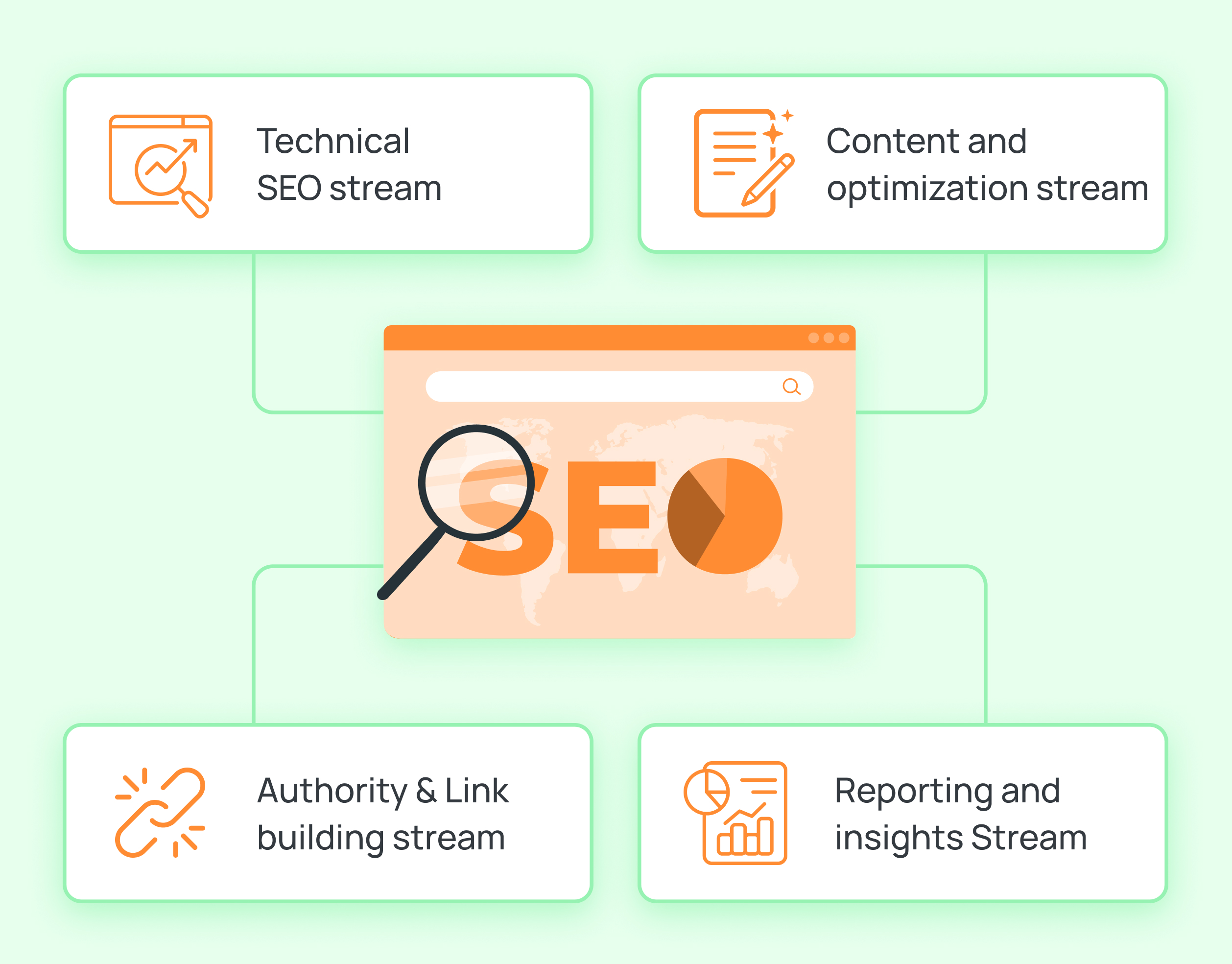
Authority & Link building stream
The authority and link-building stream is the slowest and most misunderstood part of SEO. It involves outreach, digital PR, partnerships, mentions, and signals of trust that live largely outside your own website. Progress here is incremental and difficult to force.
In this stream, “done” means a consistent process exists for identifying opportunities, executing outreach, tracking responses, and understanding what actually strengthens authority.
A link only counts as “done” when its relevance, quality, and impact are understood.
Task flow is especially important because this work spans long timelines. When these tasks aren’t tracked as a sequence, it’s impossible to distinguish between lack of effort and slow response.
Reporting and insights stream
The reporting and insights stream turns data into direction. Unfortunately, it’s often treated as a retrospective obligation rather than an active workstream.
In reporting, “done” means insights have been extracted, and next actions are clear. A report that doesn’t change behavior is incomplete.
Task flow here should mirror the SEO lifecycle itself. Data collection leads to analysis, analysis leads to interpretation, and interpretation leads to action. When reporting exists in isolation, it becomes descriptive, with teams looking at numbers without knowing what to do next.
Visibility across streams matters more here than anywhere else.
Reporting should illuminate how technical fixes affected content, how content supported authority, and how all three contributed to performance. This connective tissue is what turns SEO task management into SEO leadership.
Designing an SEO workflow that scales with you
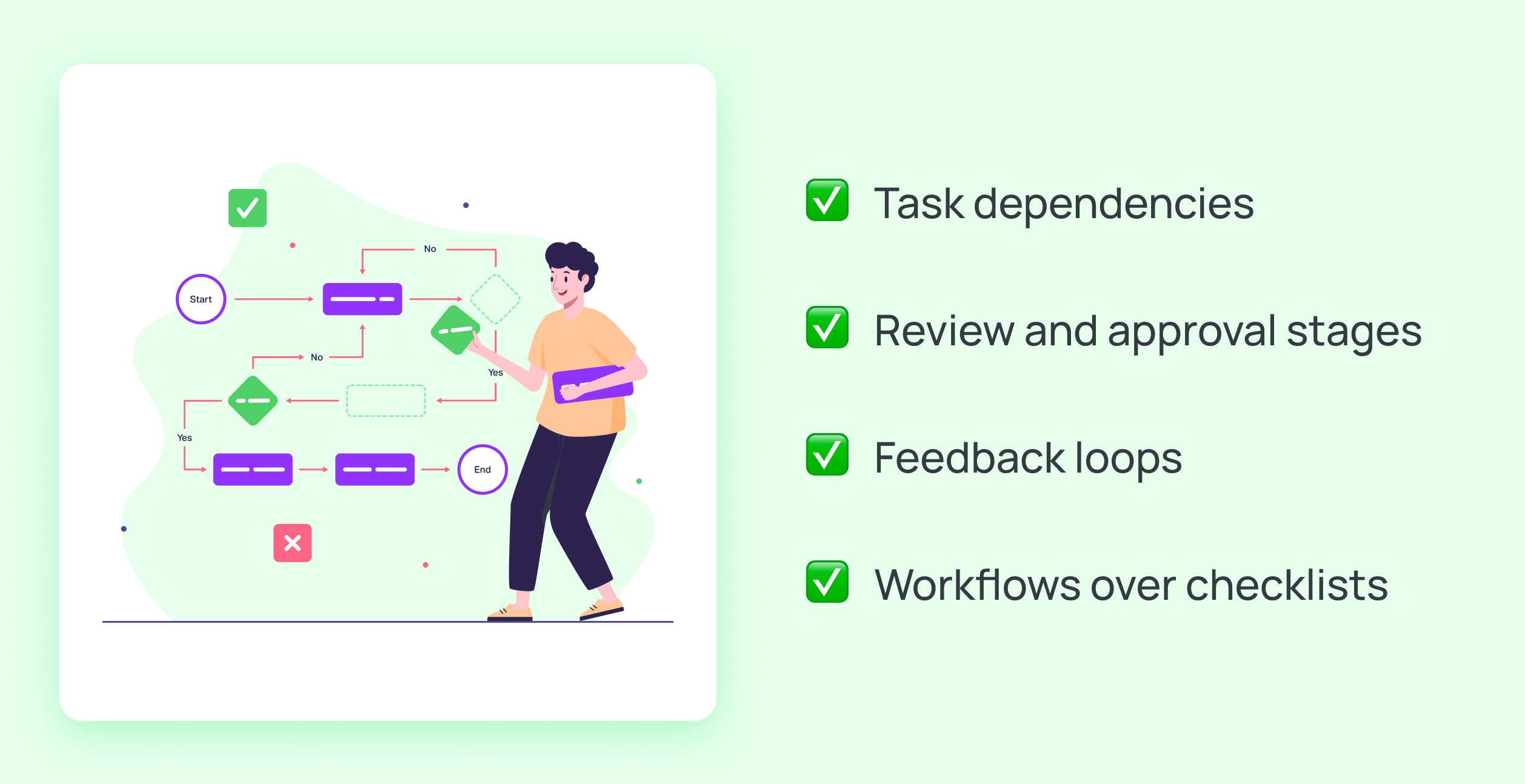
Why workflows beat checklists as campaigns grow
Checklists are comforting, and they create a sense of order, especially in the early days of SEO, when the work feels tangible and finite. Fix this issue. Add these links. Tick, tick, tick. For small sites or short bursts of work, this approach feels sufficient.
A checklist can tell you what to do, but it can’t tell you when, in what order, or why now.
Workflows, on the other hand, encode movement. They describe how work flows from idea to execution to learning and back again. As campaigns grow, this becomes essential. Without workflows, SEO becomes a pile of checked boxes that don’t add up to momentum. With workflows, SEO becomes a living system that can absorb complexity without collapsing.
Task dependencies: the hidden structure behind every SEO win
Every SEO outcome rests on invisible dependencies. Content depends on keyword research and technical accessibility. Rankings depend on internal linking and crawlability. Link building depends on assets worth linking to. Reporting depends on clean data and clear timelines.
A scalable SEO workflow makes these dependencies explicit. It ensures that tasks don’t exist in isolation, waiting to be completed in the wrong order. When dependencies are respected, teams stop rushing work that isn’t ready and stop blaming downstream teams for upstream gaps.
This is where SEO workflow management quietly creates leverage.
Review and approval stages that protect quality without killing momentum
As SEO scales, more visibility means more scrutiny. Without a defined review stage, quality becomes inconsistent.
A strong SEO workflow treats review as a designed phase, not an afterthought. It defines who reviews what, at which stage, and for what purpose. Early reviews focus on direction and intent. Later reviews focus on accuracy and alignment. Final checks ensure nothing breaks downstream.
When review stages are intentional, they protect momentum instead of threatening it. Teams know when feedback will arrive and what kind to expect.
Feedback loops: where SEO actually improves
SEO without feedback is guesswork. Yet many workflows stop at execution. Content is published, fixes are deployed, reports are sent, and then everyone moves on to the next task. Learning stays implicit, trapped in individual experience instead of shaping future work.
Scalable SEO workflow management builds feedback loops directly into the process. Performance data feeds back into prioritization. Missed expectations trigger investigation, not blame.
These loops are what turn SEO from a series of bets into a compounding system. Over time, teams do better SEO because the workflow remembers what worked even when people change.
When workflows become too rigid, teams quietly abandon them
One of the fastest ways to kill adoption is to design workflows that pretend SEO is predictable. Overly rigid workflows demand that every task follow the same path, regardless of context. They lock teams into timelines that reality refuses to honor.
When this happens, people don’t complain loudly. Instead, they bypass the workflow, and work moves in side channels. The official process exists, but the real work happens elsewhere.
A scalable workflow respects variability and guides behavior instead of policing it.
How good workflows prevent missed optimizations
Missed optimizations rarely happen because no one sees the opportunity at the right moment.
Well-designed workflows surface these moments. They prompt review at natural inflection points and ensure that performance gains lead to refinement.
Rework is one of the highest hidden costs in SEO. Content rewritten because the intent wasn’t clear, fixes redone because dependencies were missed, and strategy revisited because assumptions were never validated.
SEO workflow management reduces rework by slowing down the right moments and speeding up the right moments.
From a client or stakeholder perspective, SEO often feels opaque, as in work happens, but results take time. Without a clear workflow, updates sound vague and repetitive.
A strong workflow gives SEO a narrative.
It allows teams to explain not just what they’re doing, but where they are in the process and what comes next. Clients stop asking, “Why is this taking so long?” and start asking, “What are we learning from this phase?”
That shift is one of the quiet but powerful outcomes of good SEO workflow management.
Choosing the right SEO project management software
When evaluating project management software for SEO, look for a system that:
- Preserves context as work passes across multiple people, roles, and stages, without forcing teams to reconstruct decisions or history.
- Makes progress visible even when SEO results take time to show, so teams are not reliant on constant check-ins to stay aligned.
- Supports iterative workflows built around reviews, waiting periods, and learning loops, rather than rigid deadlines that misrepresent progress.
- Reflects how SEO work actually moves forward, with flexibility for shifting priorities and evolving hypotheses.
- Reduces the operational weight of coordination by giving teams a clear, shared view of what is happening and why.
- Helps clients understand not just what is being done, but what it means, without requiring manual status updates or over-reporting.
Putting It All Together — A Scalable SEO Management Framework (Powered by 5day.io)
Clear ownership: How 5day.io makes who acts next obvious
In 5day.io, ownership is enforced through explicit assignees, multiple assignee support, task dependencies, and status-based responsibility shifts.
When a task moves to a new stage, the assignee can see it immediately in My Work, where all tasks requiring action are automatically surfaced. Because ownership is embedded into the task structure, work does not sit idle waiting for reminders.
Everyone knows what they own, what is waiting on them, and what cannot move forward until they act.
Guided progress that removes friction
SEO work frequently depends on other work being completed first. In 5day.io, task dependencies and structured workflows guide work forward automatically once prerequisites are met.
This means people do not need to pause execution to ask what comes next or chase updates from others. The task itself shows its current state, what it is waiting on, and when it is ready to move forward. This way, 5day.io reduces unnecessary back-and-forth and lowers the mental load on the team, especially during long-running SEO initiatives.
Centralized visibility for teams, managers, and clients
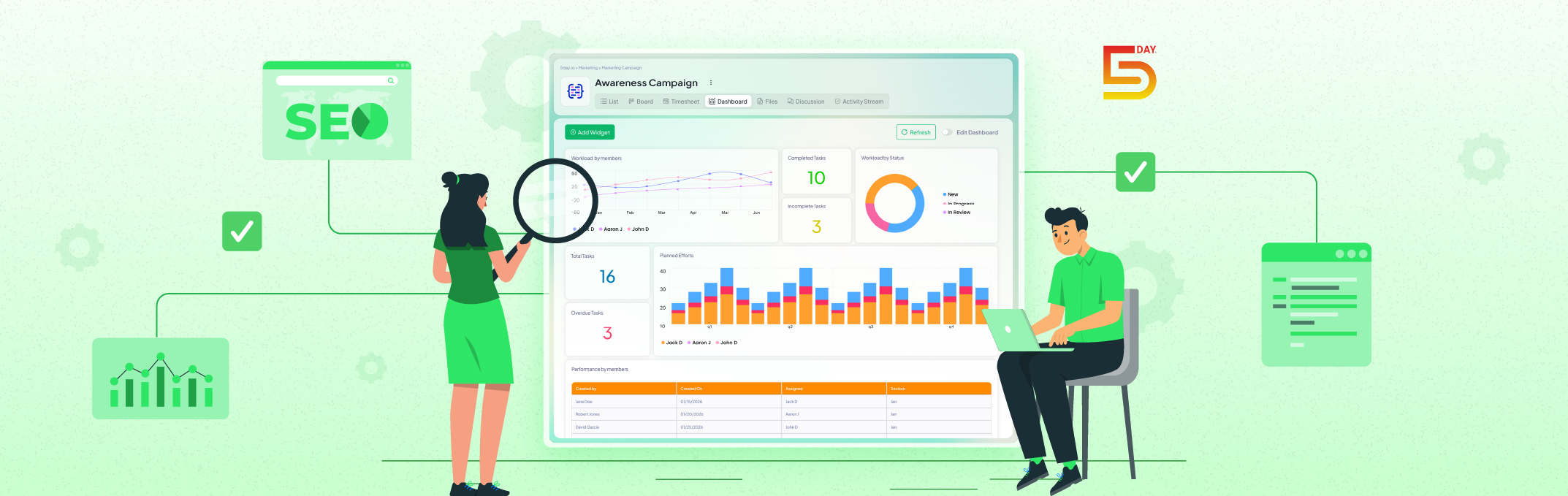
SEO progress is often fragmented across messages, documents, and tools, which forces teams into frequent check-ins just to stay aligned. 5day.io brings progress into one place through real-time task status, timeline and Gantt views, analytics widgets, and activity streams.
Teams stay aligned because everyone sees the same up-to-date view of the work. Managers can quickly spot bottlenecks, or overload using timeline views and project analytics, allowing them to intervene early and support the team proactively.
Clients benefit from this visibility as well.
With structured project views and progress indicators, clients can see what is moving, what is under review, and what is waiting on external factors. Progress feels reassuring because it is visible and grounded in the actual work.
This way of working adapts easily across agencies, in-house teams, and large SEO programs. As complexity increases, 5day.io scales alongside the work, preserving structure without getting in the way.
That is the framework. 5day.io is what keeps it together.
If you want to experience how 5day.io simplifies SEO management and keeps your sanity and scalability in your hands, sign up for 30-day free trial.