

A strong SEO marketing plan gives your team a clear path before content and reporting start pulling in different directions. That matters because SEO takes time, and quick wins are not the full story.
Ahrefs’ 2025 study found that only 1.74% of newly published pages reached Google’s top 10 within a year, while Google says Search Console should be used to track queries, clicks, impressions, and indexing issues as work progresses. A plan keeps that long game practical instead of vague.
Many SEO plans fall apart in month two. The audit is done, the keyword list exists, and then the work starts drifting. No one owns the roadmap. Content is not tied to clear goals, and technical fixes do not get prioritized. Reports show activity, but not business impact. That is why a useful SEO marketing plan and strategy needs more than a checklist.
A plan gets easier to run when SEO work is organized like a repeatable system. Building a scalable system to manage SEO campaigns can help teams know how to keep SEO marketing running for months.
An SEO marketing plan is the execution document that turns SEO strategy into scheduled work. It’s time to cherish beyond the basics.
What is an SEO Marketing Plan
An SEO marketing plan is a structured document that outlines your search goals, target topics, technical priorities, link acquisition work, and reporting process across a defined timeline. It is not just a list of keywords. It is the operating plan for how your team will improve organic visibility and connect that work to business results.
Google’s SEO Starter Guide points teams to Search Console and long-term management. The 5day.io template does the same in a more operational format by breaking SEO into strategy, intent mapping, content, technical work, backlinks, and metrics.
A good answer to “what should be included in an SEO plan” is simple. You need:
- a baseline audit
- goals and KPIs
- keyword and intent mapping
- a content roadmap
- a technical roadmap
- a link acquisition plan
- a reporting cadence
- owners and timelines
If any of those are missing, the plan usually becomes hard to run after the first month. Google also recommends helpful, reliable, people-first content and crawlable links, which means your plan cannot focus only on rank tracking. It needs to cover how content gets created and maintained over time.
The 3 Pillars of an SEO plan
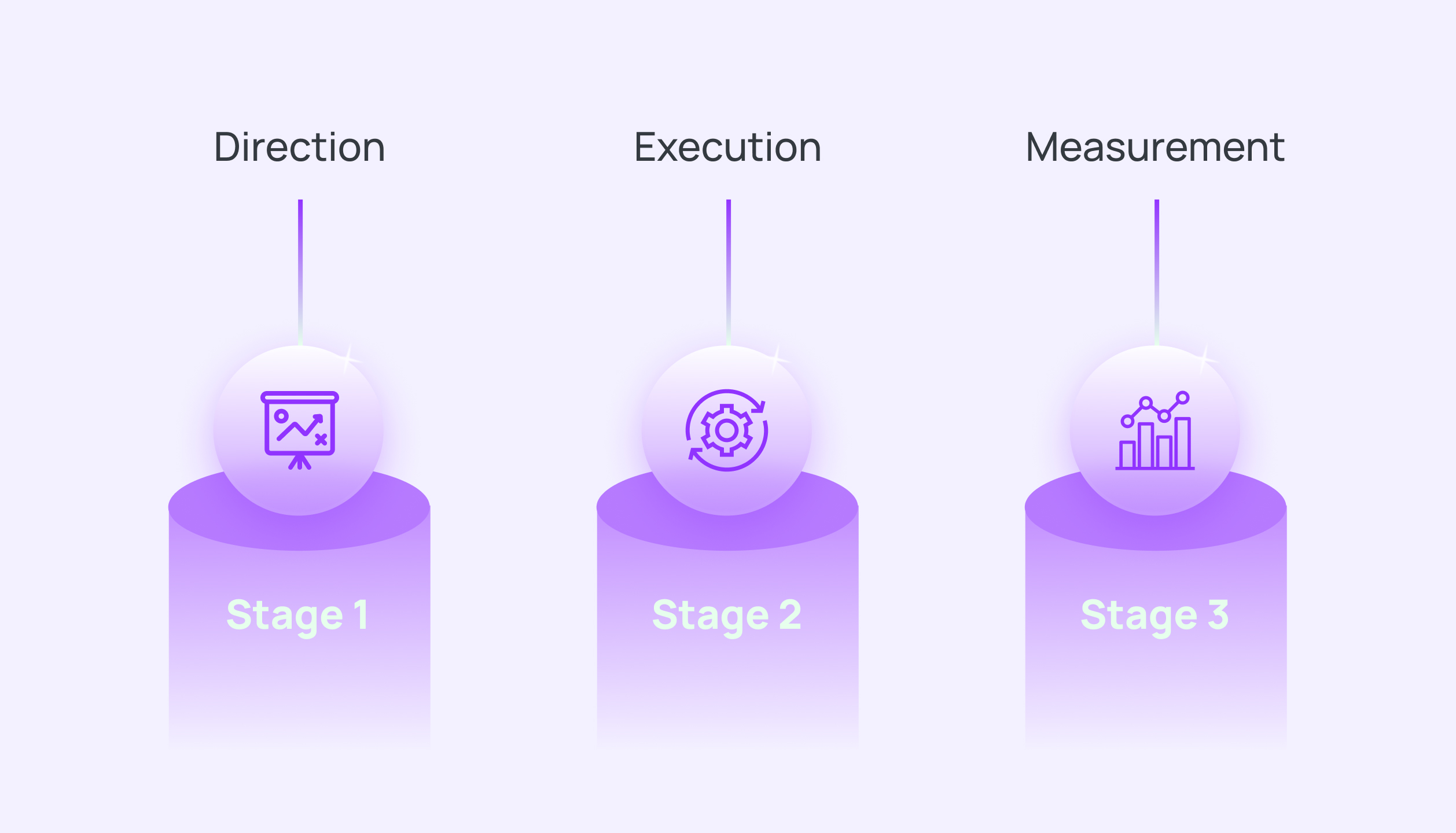
A strong SEO strategy plan for agencies or in-house teams should rest on three pillars: direction, execution, and measurement. Miss one of those, and the plan gets unstable fast.
Pillar | What it covers | Why it matters |
Direction | Audit findings, business goals, keyword targets, page priorities | Keeps the team focused on the right opportunities |
Execution | Content work, technical fixes, internal linking, link acquisition, owners | Turns strategy into tasks and deadlines |
Measurement | KPIs, reporting cadence, review meetings, course correction | Shows what is working and what needs to change |
Search Console and Google Analytics together help with the measurement pillar by showing how people discover and experience your site. The 5day.io template helps with direction and execution by turning those ideas into a working roadmap.
Create a Robust SEO Plan with These 7 Steps
The best way to answer how to create an SEO plan is to treat it like a sequence, not a brainstorm. Start with the audit, then set goals. Then build the roadmap.
Step 1. Run a baseline SEO audit before you plan anything
Do not start with keywords. Start with the current state.
Check your visibility and query data first
Google Search Console should be your starting point because it shows:
- which queries bring people to your site,
- how often your pages appear,
- how often they get clicked,
- and how they are indexed.
It also gives you sitemap submission, URL inspection, index coverage, and issue alerts. That makes it the best first stop for a practical SEO planning process.
Use Search Console and Analytics together
Google’s own documentation says Search Console and Google Analytics together give a more complete picture of how people discover and experience your website. That matters because searching for visibility alone is not enough. You also need to see what organic visitors do after they land.
Audit these five areas before you write the plan
Use the audit to answer five questions:
- Are the right pages indexed?
- Which queries already bring traffic?
- Which pages get impressions but weak clicks?
- What content is outdated, thin, or missing?
- What technical issues are blocking growth?
Prioritize technical reality, not every SEO issue
A baseline audit should not create a giant task dump. It should create a short list of issues that matter most. For most teams, that means:
- indexation and crawl issues
- weak page experience
- poor internal linking
- missing or thin high-intent pages
- weak conversion paths on organic landing pages
Google recommends good Core Web Vitals to search for success and for user experience more broadly. It defines Core Web Vitals as real-world measures of loading, responsiveness, and visual stability. That means technical SEO should not be treated like a separate department problem. It belongs inside the same SEO roadmap for marketing teams as content and reporting.
Step 2. Define your SEO goals and KPIs
If the audit tells you where you are, goals tell you what progress should look like.
Tie SEO to business outcomes first
The strongest SEO marketing strategy starts with business goals, not vanity metrics. A B2B SaaS team may care most about demo requests. An ecommerce brand may care more about revenue and product-page traffic. A local service brand may care about leads and qualified calls. Google Analytics conversions make this easier because key events can be turned into conversions and shared into reporting.
The 6 most important SEO KPIs
Most teams track too much. A better plan tracks a short set of metrics that connect SEO work to progress and outcomes.
KPI | What it measures | Why it matters | Reporting frequency | Vanity risk |
Organic clicks | Visits earned via Google Search | Best top-line signal for real search traffic | Weekly and monthly | Medium |
Impressions | How often pages appear in search | Good early signal for visibility growth | Weekly and monthly | High |
Average position for target terms | Ranking movement on tracked pages and queries | Helps you see progress before traffic scales | Monthly | Medium |
Organic conversion rate | Leads, purchases, or signups generated by organic traffic | Best business KPI for SEO ROI | Monthly | Low |
Referring domains or backlink growth | Growth in external sites linking to you | Useful proxy for authority and link momentum | Monthly | Medium |
Authority proxy such as Ahrefs DR | Strength of backlink profile in a third-party tool | Helpful directional signal, but not a Google metric | Monthly or quarterly | High |
KPI tracking works best when the team uses a short set of signals and reviews them on a fixed basis. Project management KPIs can help keep SEO goals measurable and owned.
Google defines clicks, impressions, and position in Search Console. Google Analytics supports conversion tracking using key events. Ahrefs defines Domain Rating as its own proprietary backlink-strength metric, which is why it should be used as a directional proxy, not as the main success measure. The “vanity risk” column is my planning framework based on how directly each KPI ties to outcomes.
Set realistic SEO timelines early
A big reason SEO plans fail is the bad expectation setting. Teams promise traffic too early, or they treat month one like month six.
Phase | Timeline | Primary focus | Expected outcomes | Team action |
Phase 1 | Month 1 | Audit, fixes, tracking setup, initial keyword map | Clear baseline and prioritized roadmap | Fix urgent issues and align owners |
Phase 2 | Months 2 to 3 | Publish priority pages and improve internal linking | Early movement on long-tail terms and stronger index health | Build content cadence and ship quick wins |
Phase 3 | Months 4 to 6 | Expand content clusters and improve authority signals | Measurable growth in organic clicks, rankings, and early conversions | Refresh winners and refine weak pages |
Phase 4 | Months 7 to 12 | Compound gains through consistency, links, and page improvement | Broader topic coverage and stronger business impact | Double down on what already works |
This timeline is a realistic planning model, not a Google promise. Ahrefs’ 2025 data shows how hard quick rankings can be, with only 1.74% of newly published pages reaching the top 10 inside a year in one sample, while 72.9% of top 10 pages were more than three years old. That is exactly why a solid SEO marketing plan example should include time expectations, not just tactics.
Step 3. Build your keyword strategy
The keyword strategy is not a giant export. It is a page-planning exercise.
Map keywords by intent, not only by volume
Google recommends using the words people would use to look for your content and placing them in prominent locations such as titles, headings, alt text, and link text. That points to a simple rule: choose keywords by page purpose and search intent first, then use volume and difficulty as filters.
A practical keyword map usually has these layers:
- commercial pages for services, product categories, or solution pages
- mid-funnel pages for comparison and evaluation
- educational pages for questions and topic clusters
- branded support pages for trust and navigation
Build clusters, not isolated keywords
Semrush defines keyword clustering as grouping search terms that share the same search intent and targeting them together on one page. That makes keyword strategy easier to scale because one page can target a cluster instead of one exact phrase. For a new site or a smaller team, this is one of the best ways to keep the SEO plan for marketing agency clients realistic.
Prioritize the first wave of pages
Do not try to target everything at once. Start with:
- your highest-value service or product pages
- the bottom-funnel questions buyers ask before converting
- supporting cluster pages that strengthen those money pages
That order helps you build rankings and commercial relevance together. If you are working in various industries that you want to rank with SEO, marketing industry project management can help keep the workflow streamlined.
Step 4. Build your content plan around SEO
A keyword list without a content plan is not a plan.
Start with page types, not random post ideas
The easiest way to build a content roadmap is to decide which page types of matter first:
- core service or solution pages
- comparison and alternative pages if appropriate
- buyer-question articles
- use-case pages
- proof pages such as case studies or testimonials
Google’s people-first content guidance says content should be created to benefit people, not to manipulate rankings. That is a useful filter for every content decision in your SEO strategy for marketing teams.
Use briefs so pages do not drift
Each planned page should have a short content brief with:
- primary intent
- target page type
- core questions to answer
- internal links to include
- conversion goal
- owner and due date
This is where the project structure starts to matter. 5day.io’s marketing features offer custom templates for recurring work, while its content workflow pieces emphasize reusable structures for briefing and review. That helps turn an SEO marketing plan template into actual content production.
Refresh old pages too
A strong SEO plan should include new content and updates to existing pages. Search Console impression data often shows pages that are visible but underperforming clicks or conversions. Those are usually faster wins than publishing ten brand-new articles with no existing traction.
Build internal linking on purpose
Google says links should be crawlable, so Google can find other pages on your site, and anchor text should help people and search engines understand what the page is about. That makes internal linking part of strategy, not cleanup. Good internal links help clusters support each other and help high-value pages collect more relevance.
Step 5. Build your technical SEO roadmap
Technical SEO should be prioritized by impact, not by fear.
Start with crawl and index basics
Make sure the right pages can be discovered, crawled, and indexed. Search Console gives you sitemaps, index coverage, URL inspection, and issue alerts for exactly this reason. If a page is important but blocked, missing, or poorly surfaced in internal links, content quality alone will not save it.
SEO work often gets blocked by hidden dependencies like dev fixes and analytics setup. Project dependencies help teams spot blockers before they slow down the roadmap.
Then fix user experience issues that affect results
Core Web Vitals matter because they measure loading and visual stability using real-world usage data. For checking the responsiveness of your website, there could be no better tool. Google says site owners should aim for good Core Web Vitals for search success and a better user experience. That makes them a real part of the roadmap, not a nice-to-have developer task.
Keep the roadmap simple
A useful technical roadmap usually includes:
- crawl and index fixes
- sitemap and canonicals review
- Core Web Vitals improvements
- mobile and template issues
- internal link and navigation fixes
- structured page cleanup for key templates
The order matters. Fix the things that block discovery or hurt key pages first.
Step 6. Build your link acquisition plan
Link building works best when it is treated as authority-building, not as trickery.
Focus on links that make sense for the brand
A healthy link plan can include:
- digital PR stories
- partner pages
- industry directories
- research or data assets
- case studies worth citing
- tools or checklists people want to reference
Ahrefs’ Domain Rating is one third-party way to monitor backlink strength over time, but the real point is not the score itself. It is the steady growth of relevant referring domains and useful mentions.
Stay away from manipulative tactics
Google’s spam policies are clear that techniques meant to deceive users or manipulate search systems can lead to lower rankings or removal. That is why your SEO marketing plan and strategy should center on useful assets and legitimate outreach.
Step 7. Set up your SEO reporting and review cadence
A plan only works if the team comes back to it. Once priorities are clear, the next step is turning them into a project plan with owners and deadlines. That same structure is covered in how to create a project plan.
Use one simple reporting loop
A practical cadence looks like this:
- weekly check for issues, launches, and blocked work
- monthly KPI review
- quarterly strategy refresh
Google’s documentation on Search Console and Analytics together supports this kind of joined-up reporting because one tool shows search performance, and the other shows on-site behavior.
Keep the report tight
A strong monthly SEO report should answer:
- what changed
- what moved the numbers
- what was shipped
- what is blocked
- what happens next
This is where project management software for marketing agencies starts to matter. SEO work spans writers, editors, developers, and account managers.
A simple SEO marketing plan example
Here is a simple SEO marketing plan example for a mid-sized B2B SaaS site.
- In month one, the team audits Search Console and Analytics and fixes indexation issues on core pages. It maps commercial keywords to five solution pages.
- In months two and three, it publishes those pages, adds supporting comparison content, and improves internal links.
- In months four to six, it builds a small cluster around one high-value use case and starts digital PR around an original data piece.
Reporting stays tied to organic clicks, demo-request conversion rate, and growth in referring domains. That kind of plan is easier to manage than a giant 12-month wish list, and it fits how SEO actually compounds over time.
The free SEO marketing plan template
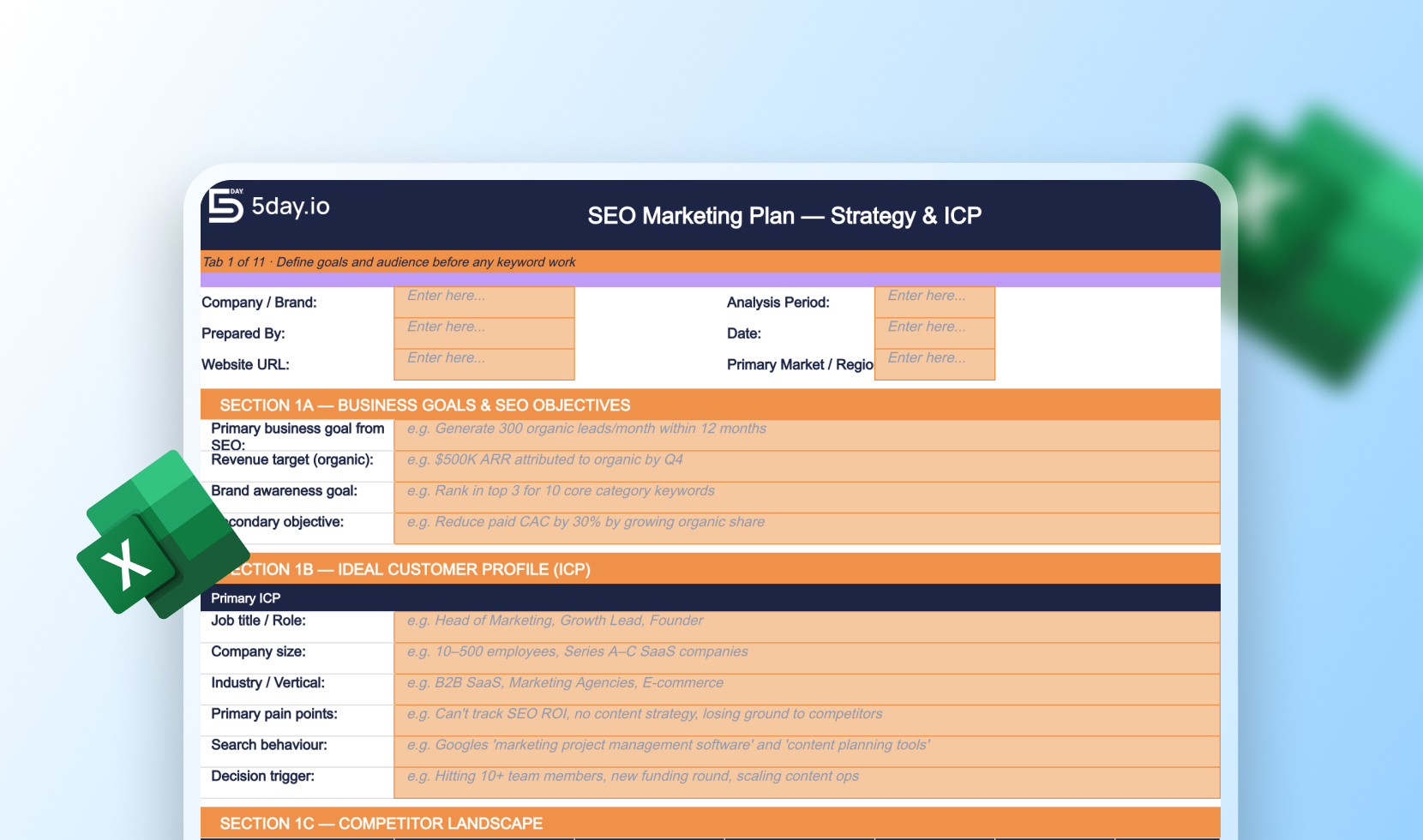
If you want a faster starting point, the 5day.io free SEO marketing plan template is built to organize strategy, keyword research, search intent mapping, content planning, technical SEO tasks, backlink strategies, and performance tracking metrics. It is presented as a beginner-friendly but still flexible planning sheet for startups, small businesses, marketing teams, and agencies.
What’s included in the template
The template is positioned as a complete SEO project plan template, not a narrow checklist. That matters because most teams do not need another blank spreadsheet. They need a working structure with roadmap sections and measurable outcomes.
How to customize it for different use cases
Use case | What to emphasize in the template |
Brand-new site | technical setup, long-tail keyword focus, foundational pages, early links |
Established site | content refreshes, internal links, conversion fixes, cluster expansion |
Agency client | phased roadmap, client-safe reporting, ownership, milestone reviews |
5day.io says the template can be adapted for SaaS, ecommerce, local businesses, and agencies. That makes it a solid starting point for a free SEO marketing plan template download that still feels useful after the first planning session.
AI and automation in your SEO marketing plan

AI is useful in SEO planning, but only when it supports the process instead of replacing judgment.
Where AI helps most
HubSpot’s 2026 marketing statistics page says nearly 75% of marketers reported using AI for media creation, and HubSpot’s 2025 AI trends reporting points to content creation as one of the most common AI use cases. In SEO planning, that makes AI useful for:
- keyword clustering
- competitor gap summaries
- draft content briefs
- meta description options
- reporting summaries
Where humans still need to lead
AI can speed up analysis. It cannot own business context, prioritization, client nuance, or editorial judgment. Google’s people’s first content guidance still matters here, and Google’s spam policies apply too. SEO work that is fast but weak will not hold up well.
Tools and workflow
- Semrush now positions its platform around AI-powered insights and keyword strategy building, including clustered opportunities and recommendations.
- seoClarity positions its AI assistant as a way to surface verified SEO optimizations.
- 5day.io fits a different part of the stack by keeping AI-supported writing, project updates, templates, and task organization inside one project management software environment.
That makes it easier for agencies and teams to keep AI output tied to real owners and deadlines. Running SEO well depends on a few core features. If you want to learn more about them, read our detailed guide about marketing teams project management software features.
Turning strategy into execution
The best SEO marketing plan is not the one with the biggest audit deck. It is the one your team can keep using in month two, month six, and month twelve. That means clear goals, a tight KPI set, realistic timelines, and a roadmap that turns into owned work.
A spreadsheet can hold a plan, but it struggles to run a living roadmap with dependencies and reviews. Marketing team uses project management over spreadsheets shows why teams switch once SEO work scales.
The free 5day.io template helps at the planning stage, and the broader 5day.io platform helps once the work needs templates, collaboration, time tracking, and clearer visibility across content, technical tasks, and reporting.