
That is what made the system function: a constant layer of human judgment, smoothing out what the structure could not handle on its own, and that is the part that is now under pressure.
What AI has done is remove the constraints that gave people the time and space to make those corrections.
When work moved more slowly, there were natural pauses where gaps could be noticed and addressed. There was time to ask clarifying questions, to realign direction, to adjust before the next stage locked things in. The system had friction, but it created opportunities to stabilize it.
As execution speeds up, those moments shrink.
Work moves forward faster, often before ambiguities are fully resolved. Outputs appear quickly, which creates the impression of progress, even when the underlying direction is still forming. The same level of quiet correction becomes harder to sustain because the system no longer gives them the same room to operate.
So the structure that once felt dependable begins to show its limits.
What AI actually changed: The behavior of work
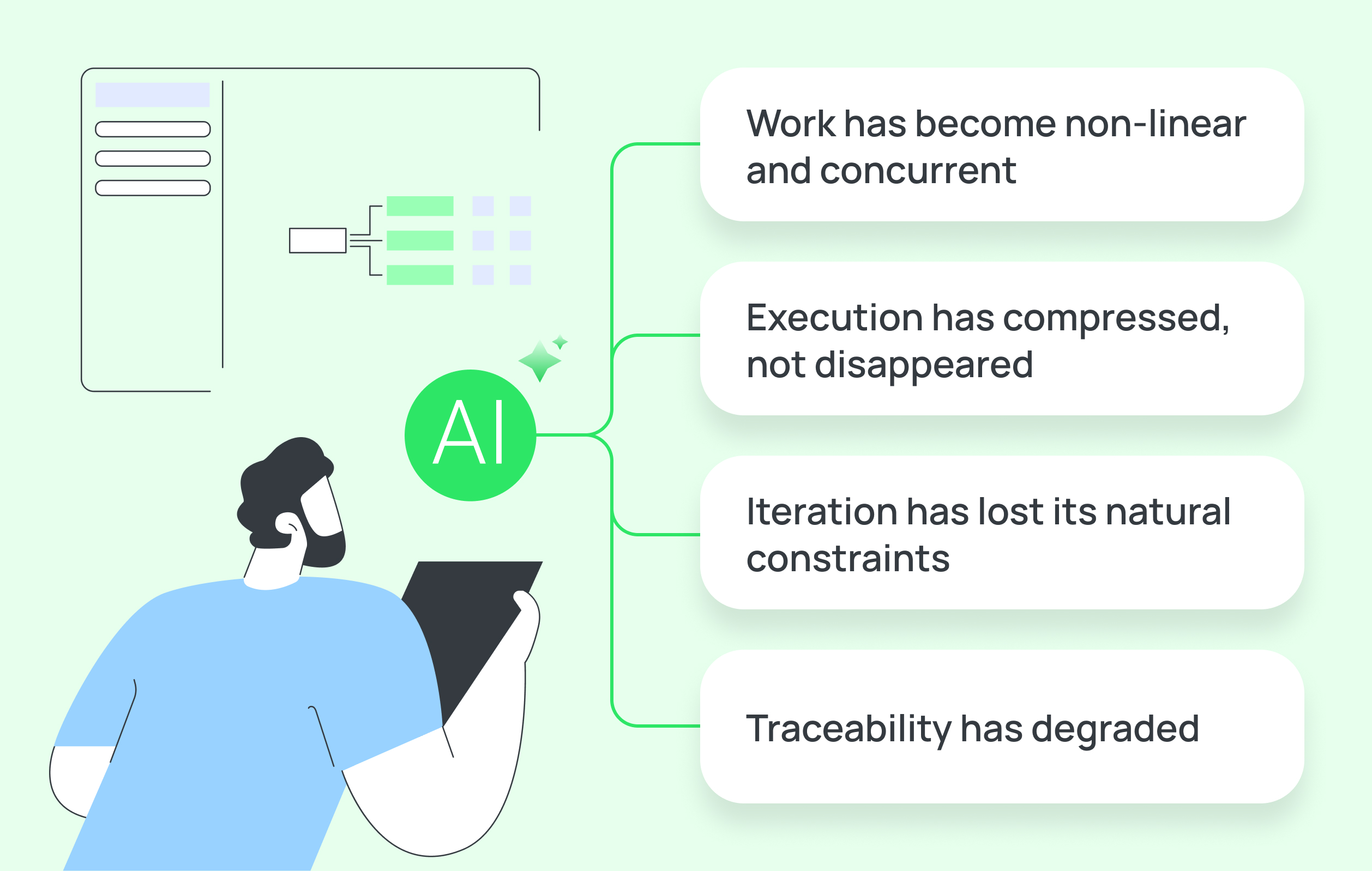
Work has become non-linear and concurrent
Work now unfolds across multiple fronts at the same time. Strategy, messaging, design exploration, and even early execution can all begin in parallel. People are contributing simultaneously, often shaping the same piece of work from different angles within a short span of time.
Dependencies still exist, but they are less visible. This creates a different kind of system.
Progress happens through continuous interaction between parts, rather than clean transitions from one stage to another. While this allows for speed and flexibility, it also makes it harder to see where alignment is strong and where it is fragile.
For project managers, this reduces the usefulness of traditional tracking. You are no longer just managing stages; you are managing convergence across parallel streams of work.
Execution has compressed, not disappeared
The barrier to producing something tangible has dropped significantly. As a result, the volume of client content creation increases meaningfully. There are more options on the table, and more directions that feel viable, at least initially, and that creates a new kind of workload.
Because while execution has compressed, evaluation has expanded.
Every additional output needs to be reviewed, interpreted, compared, and either refined or discarded. The effort that once went into producing the first version is now redistributed into deciding what to do with many versions.
This is where teams begin to feel a different kind of pressure of choosing what deserves to move forward, and that work is harder to quantify.
It is less visible in timelines and more dependent on judgment than on effort. AI reduces execution time, but it increases evaluation load.
Iteration has lost its natural constraints
Iteration used to have built-in limits.
Each revision required a meaningful investment, so teams were more deliberate about when and how they iterated. There were natural stopping points. Those constraints have largely dissolved.
But this creates a different challenge. If iteration is no longer limited by effort, it must be limited by judgment.
Someone has to decide when the work is ready enough to move forward, and recognize when additional refinement is adding value. You need someone competent to see when something is simply extending the process without materially improving the outcome.
This is where many teams struggle today.
Without clear decision discipline, work can remain in a prolonged state of “almost there,” consuming time and attention without reaching a resolution. The limiting factor in delivery is now the ability to make timely, confident decisions about the work.
Traceability has degraded
Another shift, less visible but equally important, is in how traceable work has become.
In the past, the path of a deliverable was easier to follow.
You knew where it started, and you could track changes through versions, feedback cycles, and approvals. Even if the process wasn’t perfect, it was relatively observable.
That clarity is fading.
Work now passes through multiple marketing team project management tools, prompts, iterations, and contributors in quick succession. Pieces of work are shaped collaboratively, often without a single, linear record of how they evolved.
As a result, it becomes harder to answer simple questions.
- Where did this direction originate?
- What changed between versions?
- Why was this decision made?
When traceability is low, alignment becomes harder to maintain. Feedback can feel repetitive because the rationale behind decisions is not always visible.
For project managers, this introduces a new layer of responsibility in ensuring that the rationale behind decisions remains legible, that people can understand how it got to where it is, and what needs to happen next.
What stable delivery looks like in an AI-augmented environment
Stability now depends on how early a team can establish shared understanding and how rigorously it can preserve that understanding as work expands. Work begins before it is fully defined and scales quickly across contributors.
Any ambiguity at the start is multiplied by parallel execution.
High-functioning teams accept this dynamic and focus on tightening the points where direction is set, decisions are made, and alignment is reinforced. The objective is to prevent divergence from compounding as activity increases.
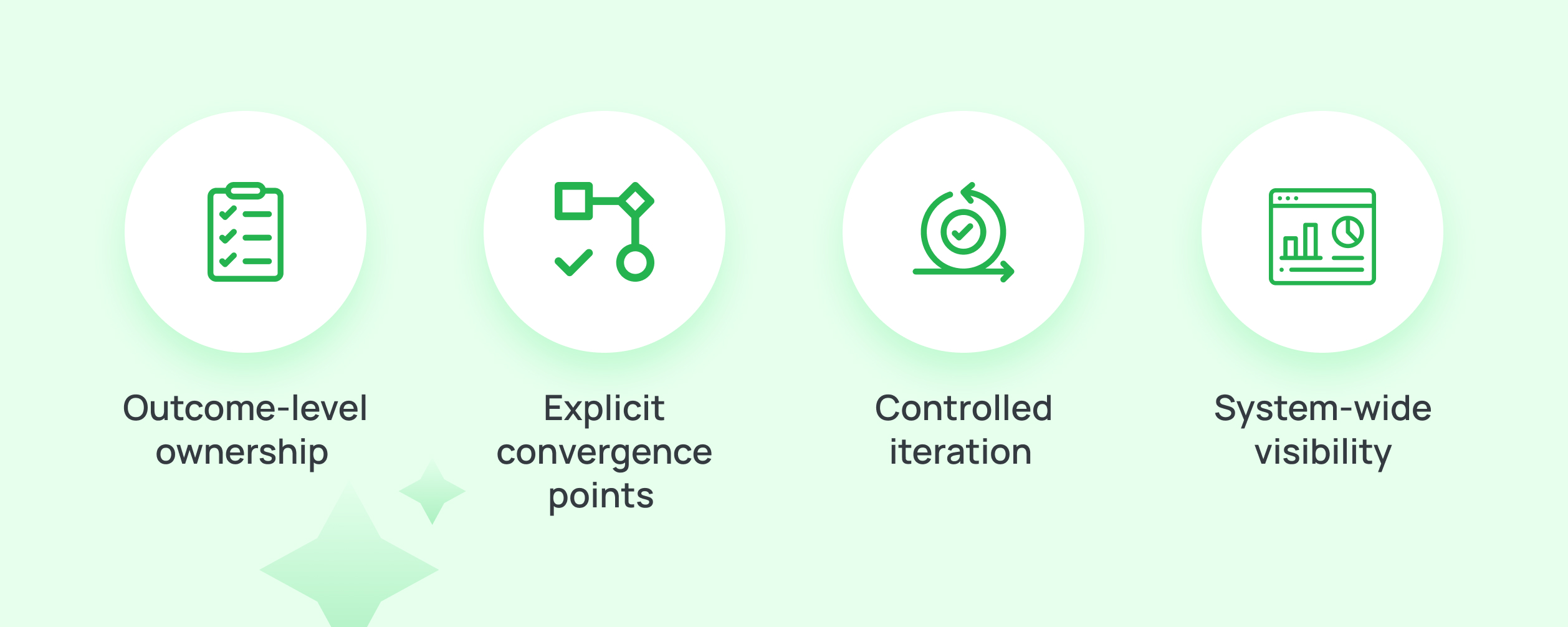
Outcome-level ownership
When multiple contributors shape the same deliverable, the primary risk is inconsistency in interpretation. Each contributor makes locally correct decisions that do not always align globally. Without a single owner responsible for the final state, these differences accumulate and appear as fragmentation late in the process.
Outcome-level ownership introduces a control mechanism for integration.
The owner is accountable for maintaining coherence across all contributions, ensuring that direction is interpreted consistently, and resolving conflicts in favor of the overall outcome. This role continuously evaluates whether the work still reflects a unified intent, rather than allowing each part to optimize independently.
This model works only when ownership includes authority.
The owner must be able to override local optimizations that weaken the whole, enforce consistency across iterations, and make directional calls without requiring consensus at every step.
When this is in place, the system gains a stable reference point that reduces ambiguity and prevents divergence from scaling unchecked.
Explicit convergence points
Parallel execution increases throughput but also accelerates the spread of misalignment. Differences in interpretation propagate across outputs and become embedded in the work. Continuous feedback does not prevent this because it distributes input without enforcing resolution.
Convergence points act as synchronization events that realign the system. They force all active work streams to collapse into a single, agreed direction before further expansion. The purpose is to eliminate competing interpretations and ensure that subsequent work builds on a stable foundation.
The placement of these points determines their effectiveness.
They must occur before the cost of correction escalates, but after enough work has been produced to make meaningful decisions. Each convergence point should reduce the number of active directions and increase clarity.
If ambiguity remains after these points, it will expand again as work continues.
Controlled iteration
Iteration has become significantly easier with AI, and that has quietly changed how teams move through work.
When generating multiple options takes very little effort, the volume of exploration naturally increases. With more possibilities in front of them, teams often spend longer evaluating, comparing, and refining, which can slow down the moment of commitment.
Progress, however, depends on choosing a direction and moving forward with it.
Controlled iteration brings intention into this process. It ensures that each cycle of work reduces uncertainty and moves the team closer to a clear decision. Over time, the range of possibilities should narrow, allowing one direction to emerge with confidence.
A useful way to observe this is by looking at what happens after each iteration. When the number of viable options increases or remains unchanged, it often means that decisions are being deferred rather than resolved.
Controlled iteration introduces clarity around selection. It encourages teams to define what they are choosing and what they are setting aside at each stage. With clear criteria and deliberate closure, iteration becomes a path toward convergence rather than an open-ended loop.
System-wide visibility
In a concurrent system, misalignment is often a result of partial visibility.
Contributors act on incomplete or outdated context, leading to outputs that diverge despite aligned intent. The lack of a shared, current view of the work delays the detection of these divergences.
System-wide visibility ensures that the state of the work is consistently accessible and understood. It includes the current direction, underlying assumptions, decisions made, and dependencies between contributors.
This allows teams to identify and address divergence at the point of origin rather than after it has propagated across outputs.
Visibility at this level reduces the need for reactive correction. It also reduces cognitive load by providing a stable reference for decision-making, allowing contributors to operate with confidence in the current state of the work.
What this changes
Delivery stability is determined by how effectively a team can maintain alignment under conditions of continuous change.
Execution speed amplifies both progress and misalignment. The system will generate output regardless. The differentiator is whether that output converges toward a unified outcome.
Teams that achieve stability shift their focus from managing tasks to managing alignment. They establish ownership that enforces coherence and create synchronization points that reset direction.
These mechanisms ensure that speed produces consistent, aligned outcomes rather than fragmented progress.
The role of systems: From task tracking to coherence creation
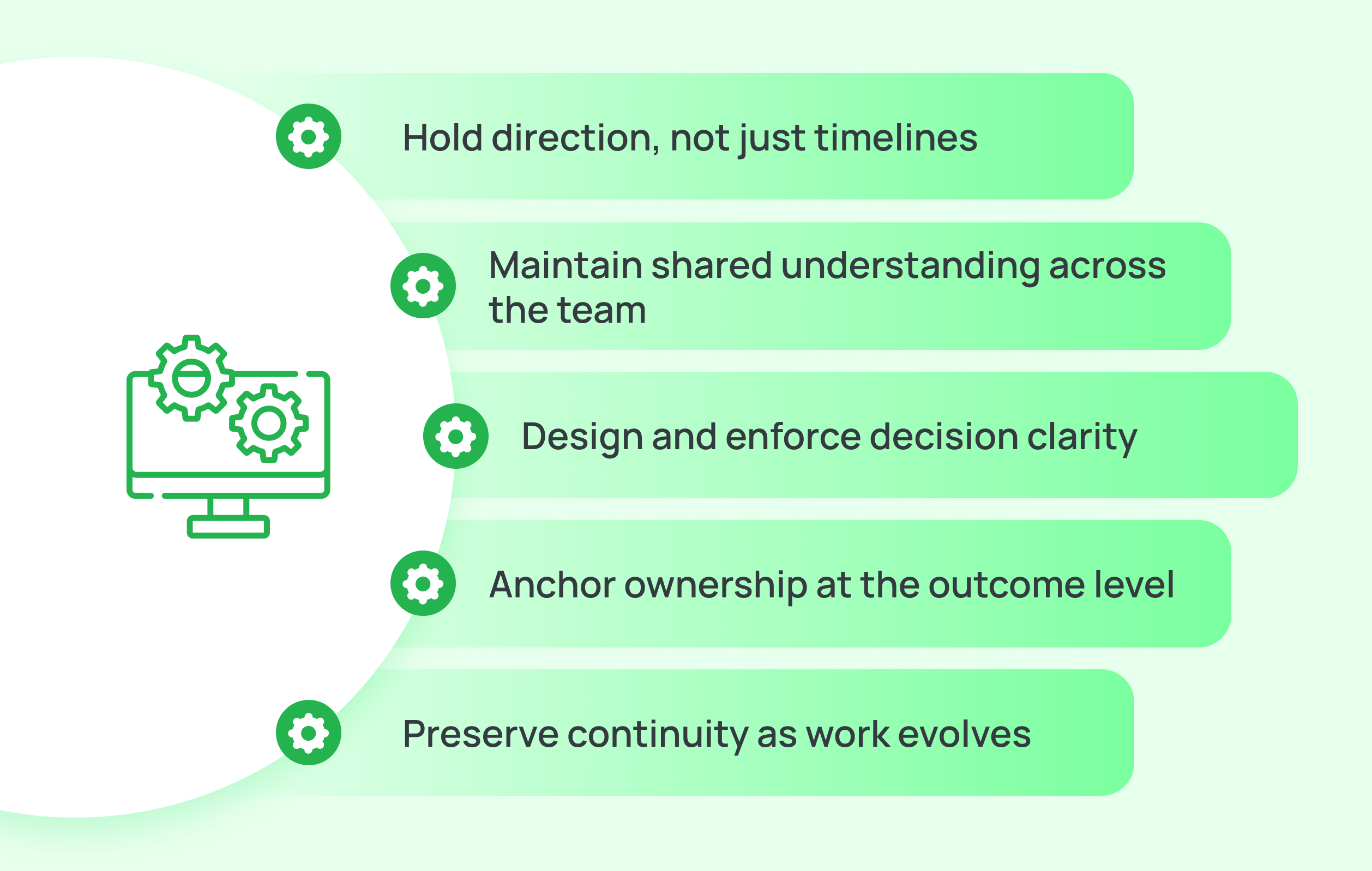
The breakdown in delivery today comes from a loss of shared understanding while the work is actively being created. Teams are producing continuously, across multiple contributors and tools, but the system that holds that work together is not keeping up.
What gets lost is not activity, but coherence.
Traditional systems were never designed to solve for this. They were built to track work after it was defined. What is needed now is something fundamentally different: systems that hold the work together while it is still forming.
Systems can no longer just track work
Task tracking assumes that work can be broken down, assigned, and completed in parts that add up cleanly. That assumption no longer holds.
A task can be completed exactly as intended and still weaken the overall output if the direction has shifted or if other parts of the work have evolved differently. Completion only confirms activity.
This creates a dangerous illusion.
Teams see progress because tasks are being closed, but the deliverable itself may be fragmenting underneath.
This is where task tracking fails as a primary control mechanism.
It answers operational questions, but misses structural ones.
As work becomes more interdependent, this gap widens. The more parallel the execution, the less reliable task completion becomes as a signal of delivery health. A system that only tracks work will always be one step behind the problem.
Visibility must extend to the state of the work
What teams need now is visibility into the state of the work.
At any point, the critical questions are about direction and alignment.
- What version of the idea is the team currently working with?
- What assumptions are active?
- What decisions have shaped the work so far?
- Where is interpretation starting to diverge?
Without answers to these, teams operate in a fragmented context.
Each contributor works with what they understand, which is often slightly different from others. These differences are subtle enough to go unnoticed early, but significant enough to create misalignment as work accumulates. By the time it surfaces, it has already spread across multiple outputs.
This is why reviews feel heavier and slower.
Systems that maintain visibility into the state of the work remove this friction. They make the current direction explicit, and this is what enables speed without drift.
Ownership must be anchored within the system
Multiple contributors influence the same output, often at different times and with different perspectives. This is not a people problem; it is a system problem.
When ownership is only defined at the role or task level, it does not reflect how work is being created. It becomes abstract, disconnected from the real flow of execution.
Systems need to anchor ownership where it matters, at the level of the outcome.
This means making it visible who is responsible for how the work comes together, not just who contributed to it. It means ensuring that this ownership persists across iterations, rather than resetting at each stage.
When ownership is embedded in the system, it can resolve ambiguity and prevent drift from escalating. Without it, teams rely on informal escalation and senior intervention, which does not scale.
Continuity must be maintained across iterations
One of the most significant challenges in modern delivery is the loss of continuity.
Work is constantly being reshaped through new drafts and revised directions. As it moves across tools and contributors, the connection between earlier decisions and current outputs weakens. Teams lose track of why certain choices were made and what has already been rejected.
This creates redundancy.
The same alignment must be rebuilt repeatedly, because work is not building on itself.
Continuity is what prevents this.
Systems need to preserve the thread of the work, how it started, how it evolved, and what decisions shaped it along the way. This allows teams to move forward with context intact, rather than restarting from partial understanding at each step.
Systems as structural supports for delivery
At this point, systems are part of the delivery structure itself.
As more people work on different parts at the same time, things can start to feel scattered. What keeps it all from slipping is the system underneath.
When that’s missing, alignment becomes a manual effort. Teams rely on constant check-ins and follow-ups just to stay on the same page. Over time, this adds up and makes the work feel heavier and harder to move forward.
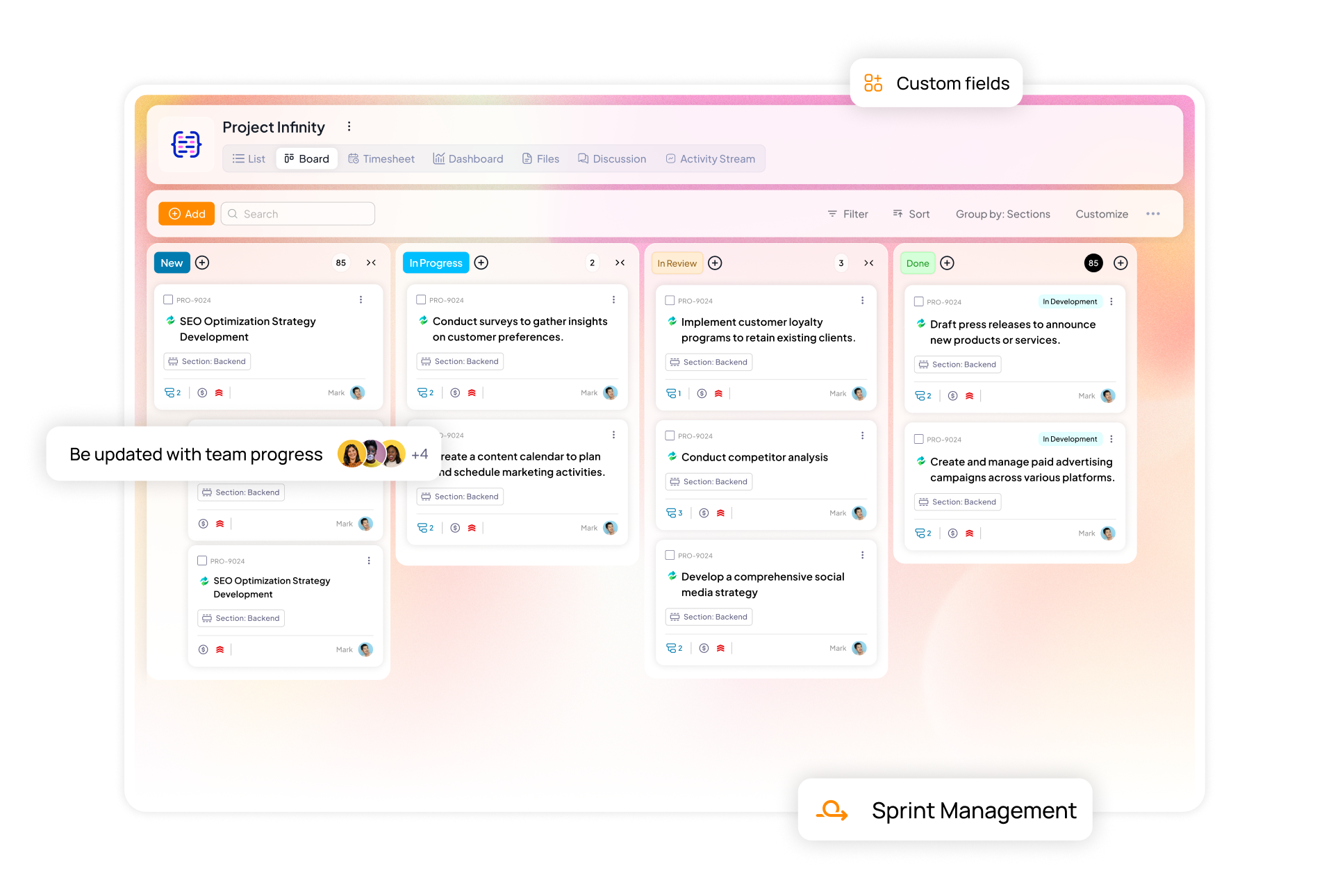
Systems like 5day.io that are designed for this environment reduce that overhead.
They function as structural supports for modern delivery by holding the moving parts together. They reduce the need for constant human correction by making the system itself more coherent.
How 5day.io’s AI capabilities improve delivery
Across 5day.io, AI shows up quietly across different stages of work to make both life and delivery a little easier. It helps smooth out the rough edges, whether that’s getting started, moving things forward, or staying aligned, without forcing teams into a completely new way of working.
There’s also a steady evolution in how these capabilities are being built out.
New agents are continuously in the pipeline as thoughtful layers that make the system feel more supportive over time. It keeps things feeling fresh, while gradually improving how work flows across the board.
At the same time, the agents increase momentum at work. When the repetitive, operational stuff through different stages in the delivery process is taken care of, teams get the space to think a little deeper, be it to make better calls, shape the direction, and really care about quality, and to truly bring in differentiation to client work.
One last word before you go
Delivery feels harder today because more work is happening at once, across more contributors, with less built-in alignment to hold it together. The real shift is in what needs to be managed: clarity, ownership, and decision-making while the work is still evolving.
Teams that adjust to this by grounding direction early and keeping the state of the work visible are able to move fast without losing coherence, and that is what ultimately determines whether delivery scales cleanly or turns into continuous rework.
Get a close view of the tool in action today, for your marketing delivery team by signing up to 5day.io’s 30-day free trial today.