
You already use at least one of these tools. Probably Claude or ChatGPT. Maybe both. And most of the time, you use the tool that’s already open, because eh, it’s good enough.
Honestly, it’s the default behavior of every time-poor marketer running around to get work out before deadline. But the problem is that a ‘good enough’ tool across the board means you’re leaving genuine performance on the table for the tasks where tool choice matters.
That’s what this guide on Claude vs ChatGPT vs Gemini for marketing maps. Across 26 specific marketing tasks, such as content, SEO, social, email, paid ads, research, and agency ops, it matches each task to the tool that performs best for it.
If you’re looking for a quick answer:
For marketing teams in 2026, the best AI tool is: Claude for tone, brand voice, and writing constraints; ChatGPT for breadth, integrations, and volume; Gemini for Google ecosystem tasks and real-time data.
Everything below is the task-level evidence behind this analysis.
But note that these AI capability assessments reflect the 2026 model state. AI capabilities shift quickly, so treat the assessment here as a starting point for your own testing, instead of a permanent verdict.
Why is this comparison different? We’re matching tools to tasks, not declaring a winner
Let’s first address why “Which AI is best?” is the wrong question for marketing teams.
The gap between these tools is not the same across every task, and that’s the problem with most Claude vs ChatGPT vs Gemini comparisons. They treat ‘best’ as a fixed property of a model, when it’s just a property of the match between a model and a specific task.
Take Google Ads RSA copy as an example. Give the same brief to all three models, and you’ll get three meaningfully different outputs.
- Claude holds the 30-character headline limit most consistently
- ChatGPT produces more emotionally varied hook options across the variant set
- Gemini can pull in live competitor ad messaging to inform the brief before writing starts
None of those are universally best. Instead, each advantage is task-specific.
The question that gets marketing teams to better results is which AI is best for this task.
How to use this guide for your marketing-specific use case?
We structured this guide around task categories, such as content marketing, SEO, social media, email, paid advertising, research, and agency operations. Each section maps specific tasks to the tool that performs best for that task, with an honest verdict and the reasoning behind it.
If you’re here for one specific task, jump to the relevant section or head straight to the 26-task quick-reference Claude vs ChatGPT vs Gemini table.
If you want the full framework on AI tools for marketing agencies 2026, read straight through. And if your team is still building out its AI prompt library, the AI prompt framework for marketing tasks is a useful companion to this guide.
Here’s how to choose between Claude, ChatGPT, and Gemini for marketing: find your most frequent task types below and use the recommended tool for each.
How AI capabilities differ across models (and why it matters for specific tasks)?
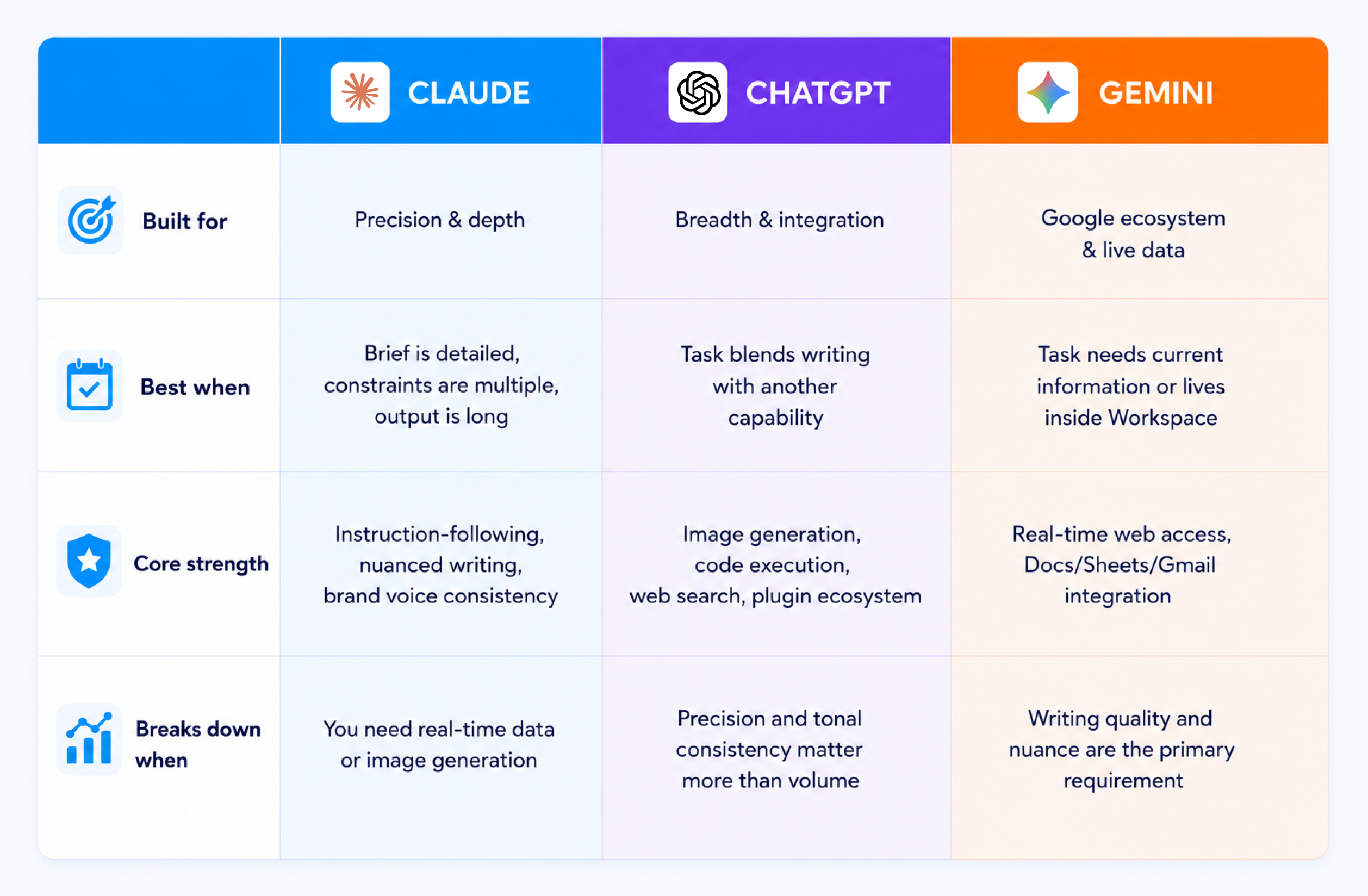
Each model is built around a distinct design philosophy, and those Claude vs ChatGPT vs Gemini differences create predictable performance patterns you can rely on once you know what to look for.
Claude is built around precise instruction following and nuanced text generation. It performs best when the brief is specific, constraints are multiple, and quality needs to hold over long outputs.
ChatGPT (GPT-4o) is built for breadth and tool integration. It offers the widest capability set of the three, with native image generation, code execution, web search, and a large plugin ecosystem. It performs best when the task blends writing with another capability, or when creative range and volume matter more than precision.
Gemini is built into Google’s ecosystem with native Workspace integration and real-time web access. It performs best when the task requires current information or lives inside Docs, Sheets, or Gmail.
These are the foundation differences for every task-level recommendation in this guide.
Claude vs. ChatGPT vs. Gemini: Core capabilities overview (2026)
Before matching tools to tasks, it helps to understand the core features of Claude vs ChatGPT vs Gemini and where each model’s capabilities begin and end.
Learning about the design philosophy behind each tool helps create predictable performance patterns that run through every task category in this Claude vs ChatGPT vs Gemini for marketing guide.
|
Capability |
Claude (Anthropic) |
ChatGPT GPT-4o (OpenAI) |
Gemini Advanced (Google) |
|
Long-form writing quality |
★★★★★ — strongest instruction following over long outputs |
★★★★ — good quality, may drift over 2,000+ words |
★★★ — generally rated lower by marketing professionals |
|
Brand voice instruction following |
★★★★★ — best at multi-constraint, style-specific outputs |
★★★★ — good, less consistent with complex voice constraints |
★★★ — adequate for simple voice instructions |
|
Breadth of capability |
★★★★ — focused on text intelligence |
★★★★★ — broadest capability set including code, image, tools |
★★★★ — strong across text and image, Google-first |
|
Real-time information access |
★★ — training data cutoff; no live web browsing |
★★★★ — Bing integration available in ChatGPT Plus |
★★★★★ — strongest real-time web access for research |
|
Google Workspace integration |
★★ — no native integration |
★★★ — available via Google Workspace marketplace |
★★★★★ — native integration with Docs, Sheets, Gmail, Slides |
|
Image and multimodal capability |
★★★ — limited image analysis; no image generation |
★★★★★ — DALL-E integration, strong image analysis |
★★★★ — strong multimodal, including image analysis |
|
Plugin and tool ecosystem |
★★★ — growing but smaller ecosystem |
★★★★★ — largest plugin ecosystem |
★★★★ — Google tools and third-party integrations |
|
Pricing (individual paid tier) |
~$20/month (Claude Pro) |
~$20/month (ChatGPT Plus) |
~$20/month (Google One AI Premium — verify current) |
|
API access for teams |
Yes — Anthropic API |
Yes — OpenAI API |
Yes — Google AI / Vertex AI |
|
Content safety defaults |
★★★★★ — conservative defaults, strong for brand safety |
★★★ — moderate defaults, more configurable |
★★★ — moderate defaults |
|
Best for marketing agencies |
Long-form content, briefs, reports, constrained copy |
Volume generation, research, data tasks, creative range |
Google workflow teams, real-time research, multimodal tasks |
All capability ratings reflect the 2026 model state. It’s wise to verify against current model releases before applying to your workflow, as AI capabilities frequently update.
Claude (Anthropic): The specialist writer
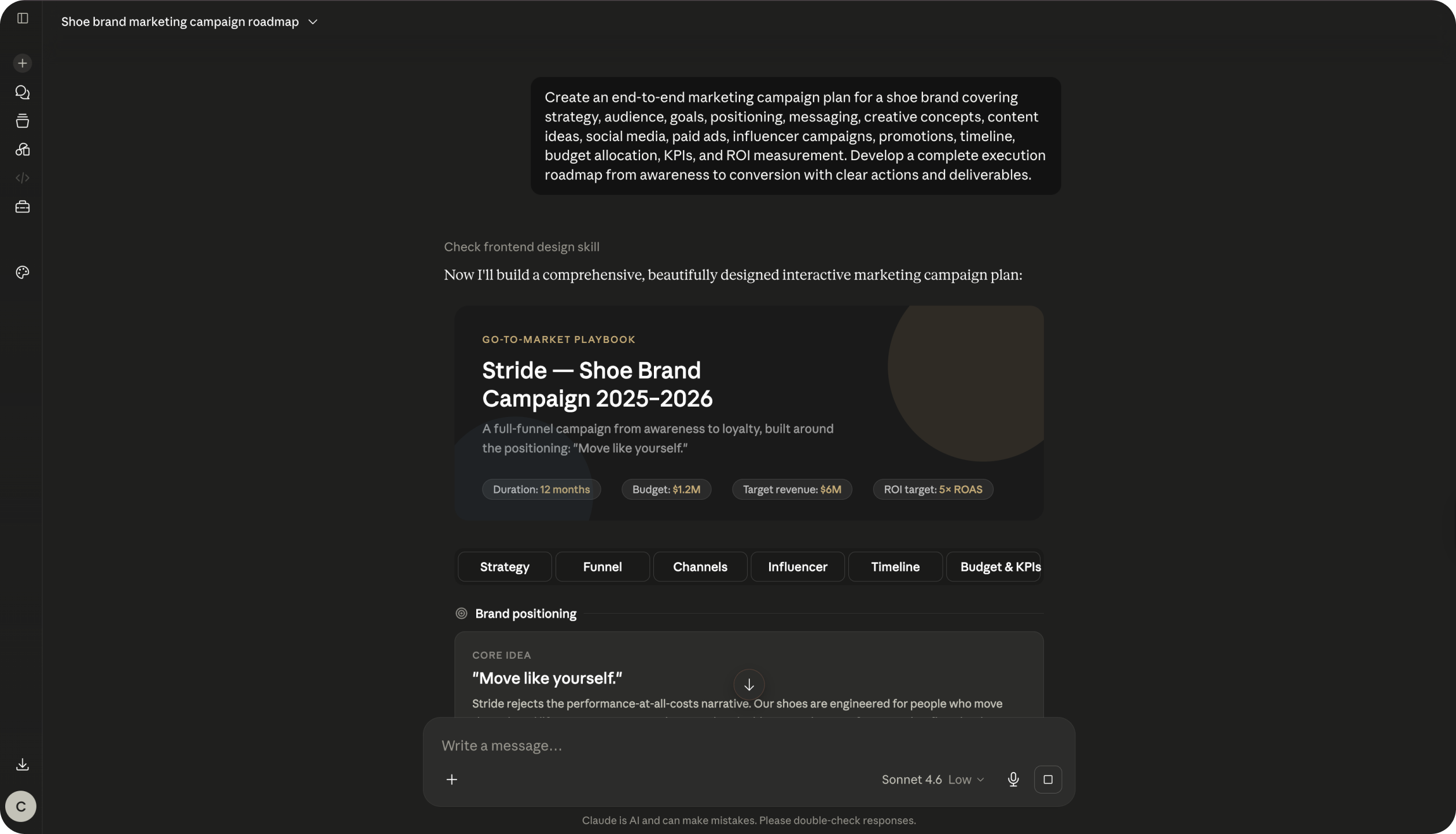
Claude’s defining advantage for marketing teams is following instructions under pressure.
When you provide it with a brief that specifies a particular tone, a hard character limit, a structure, and a natural keyword placement, Claude holds all those constraints more reliably compared to its competitors.
That precision makes it the strongest performer across writing-heavy marketing tasks, such as long-form blog posts, content briefs, email sequences, landing page copy, client reports, and constrained ad formats like Google Ads RSAs.
Where does Claude show real limitations?
Claude has no native real-time web browsing. Its training data has a cutoff, which matters for competitor research and live market intelligence. Its image and multimodal capabilities are more limited than ChatGPT’s, and its plugin ecosystem is smaller.
Think of Claude as a specialist writer; it performs exceptionally at what it’s built for, but is genuinely limited outside of it.
Claude AI for marketing teams is the strongest option when the brief is specific, the constraints are multiple, and writing quality needs to hold across long outputs.
ChatGPT (GPT-4o, OpenAI): The versatile generalist
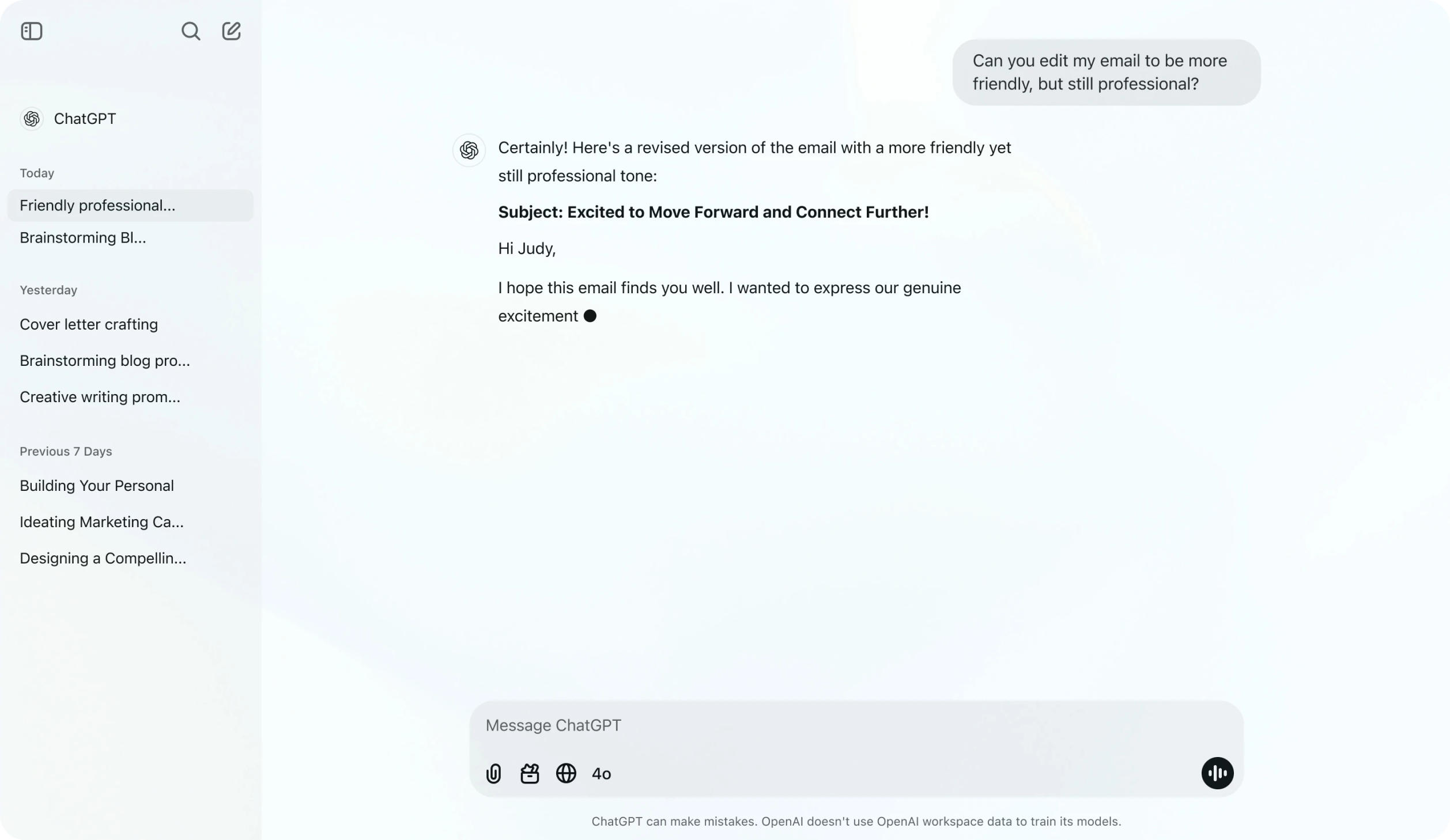
ChatGPT’s primary advantage for marketing teams is breadth. It has the widest capability set of the three:
- DALL-E image generation
- A code interpreter that can run Python on uploaded CSV files, Bing web search in ChatGPT Plus
- The largest third-party plugin ecosystem available
When a task blends writing with another capability, such as research, then draft, data analysis, then narrative, image concept, then caption, ChatGPT handles multi-modal workflows that the other two can’t match.
Where does ChatGPT show real limitations?
For pure writing tasks, it’s capable but has a known limitation. Outputs can drift in tone after roughly 1,500 words without a section-level outline, and it’s less reliable than Claude at holding complex brand voice constraints throughout long documents. Position it as the integration layer and volume engine of your marketing AI workflow, rather than using it as the default choice for precision writing.
Gemini (Google DeepMind): The Google ecosystem specialist
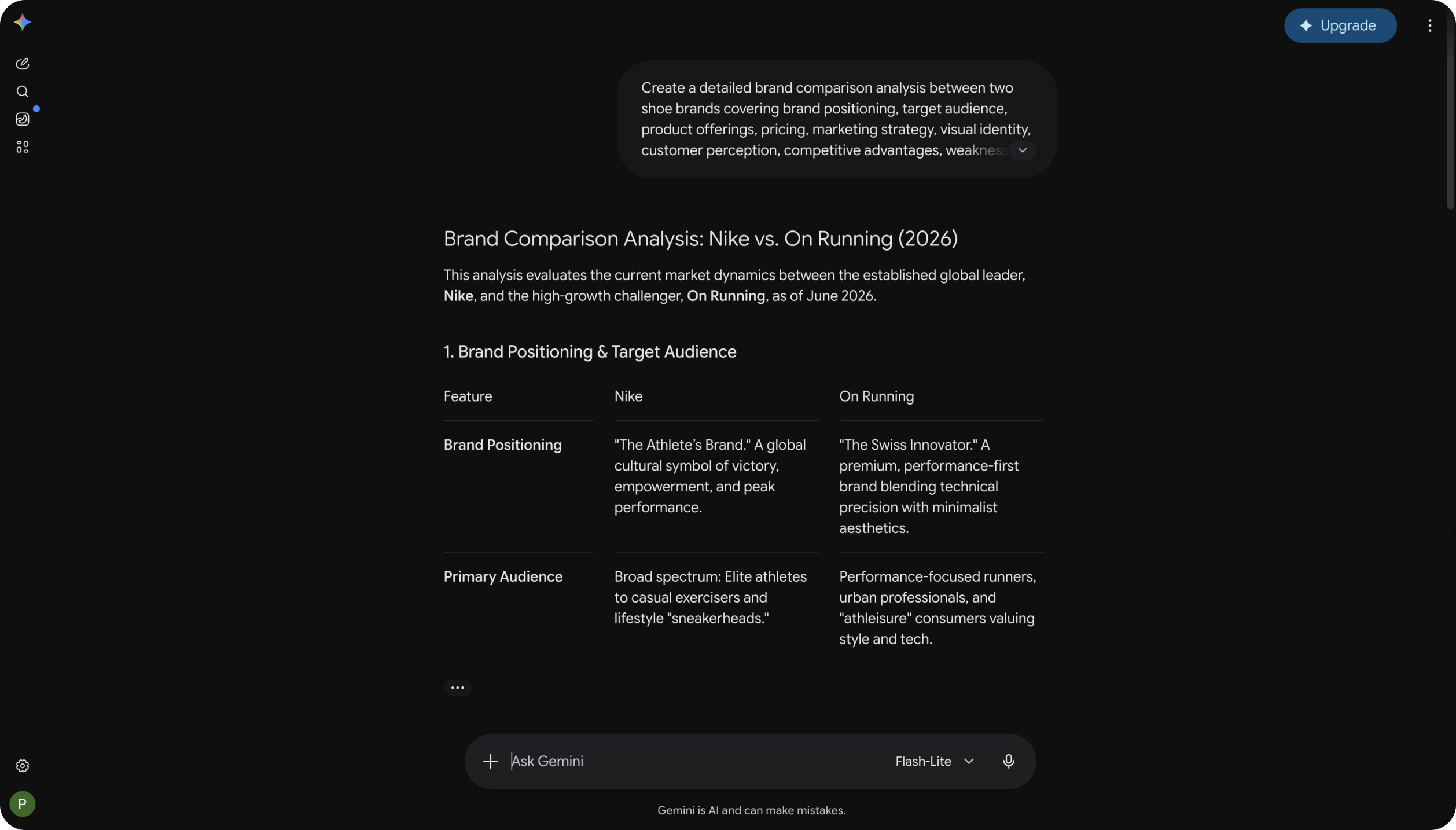
Gemini’s two clearest strengths for marketing teams are underrated and genuinely differentiated. The first is native Google Workspace integration, as Gemini Advanced works inside Docs, Sheets, Slides, and Gmail without copy-pasting between platforms. For teams whose entire workflow lives in Google Workspace, that operational advantage is significant.
The second is real-time web access, and this one is non-negotiable for certain tasks. When the work requires current competitor messaging, live market data, or recent industry developments, Gemini is the only one of the three that can access that information.
Claude and ChatGPT are working from training data that may be 6 to 18 months behind the market.
Where does Gemini show real limitations?
Where Gemini genuinely lags is the long-form writing quality and brand voice consistency, and its instruction following for complex multi-step content tasks is less reliable.
Pricing and access: What marketing teams pay in 2026?
All three tools offer a free tier with meaningful capability restrictions and a paid individual plan at approximately $20 per user per month: Claude Pro (Anthropic), ChatGPT Plus (OpenAI), and Gemini Advanced via Google One AI Premium. All three also offer team plans with centralized billing at a higher per-seat cost, and API access for teams building integrations or processing content at scale.
For agencies running all three, the combined cost is approximately $60 per user per month, a real figure for lean SMB teams to weigh against productivity return. API pricing is typically more cost-effective than per-seat subscriptions at high volume, though it requires technical setup.
For most SMB teams, the right entry point is one paid plan, based on the task category with the highest return, and expanding from there.
Content marketing tasks (Which tool wins for each?)
Content creation is the highest-volume AI use case for most marketing teams, and it’s where getting the tool choice right pays off most consistently. This is also where the differences between models are most nuanced, as Claude leads across most writing tasks, but not all of them, and the reasoning matters as much as the verdict.
Long-form blog post writing for 1,500+ words (Verdict: Claude)
Gemini vs Claude vs ChatGPT for long-form blog writing is one of the starkest gaps in the comparison.
Long-form SEO content makes more demands on an AI tool than any other writing task. It requires structural coherence across 2,000+ words without tone drift, a consistent brand voice from intro to conclusion, natural keyword integration that doesn’t read as forced, section-opening hooks that maintain momentum, and logical transitions that don’t feel templated.
Claude is the strongest performer here because its instruction following holds at scale. The voice and structure you specify at the start of the brief are still intact at the 2,000-word mark.
ChatGPT produces strong long-form output but tends to drift in tone after roughly 1,500 words without a section-level outline provided upfront.
Gemini is the weakest of the three for extended writing tasks, based on widespread marketing professional experience.
Practical tip:
Before writing the brief, give Claude a one-paragraph voice reference (a sample of the brand’s existing content at its best). That single anchor improves output consistency more than any other prompt adjustment for long-form tasks. Pair this with a structured outline, and you significantly reduce the editing rounds needed after the first draft.
Content brief and outline creation (Verdict: Claude)
A content brief is a multi-constraint document. It has to hold audience definition, tone direction, structural requirements, SEO targets, and a competitive angle simultaneously, all in a format a writer can act on without a follow-up meeting.
Claude’s multi-constraint instruction following is its sharpest differentiator here. Where ChatGPT tends to produce briefs that are structurally adequate but require rewriting before they’re usable, Claude’s output typically goes to a writer with minimal rework.
Sample prompt skeleton:
Write a content brief for a blog post targeting [keyword].
- Target audience: [description]
- Tone: [adjectives]
- Structure: [H2 count and rough word count per section]
- SEO brief: [primary keyword, 2–3 secondary keywords, search intent]
- Competitive angle: [what the top-ranking articles miss that this post should cover]
- Deliverable: a writer-ready brief, not a draft
Editing and rewriting existing content (Verdict: Claude)
Editing is where Claude’s precision is most practically valuable. Instructions like tighten the intro, strengthen the transitions, and don’t touch the examples, are multi-part, partially restrictive briefs, and Claude follows it more reliably than ChatGPT.
Practical tip:
Paste the full original draft alongside a specific editing brief, such as naming the sections to revise, the sections to preserve, and the goal of each change. Vague instructions like ‘make this better’ produce vague results from any model.
For basic grammar and clarity edits with no brand voice complexity, the gap between Claude and ChatGPT is negligible, so use whichever you already have open.
Content repurposing (Verdict: ChatGPT)
This is one of the content tasks where ChatGPT edges ahead. When the brief is to take a 2,000-word blog post and produce a LinkedIn post, an email newsletter, an X/Twitter thread, and two ad hook variations, each needing a genuinely distinct tone for its platform, ChatGPT’s creative range and format-switching ability consistently produce more differentiated outputs.
Claude’s repurposing output is good, but its platform adaptations tend to be more similar to one another in tone, which reduces the value of the exercise.
The practical distinction: if you need one strong adaptation in one format, either tool works well. If you need five distinct-feeling outputs from one source asset, ChatGPT’s breadth makes it the stronger choice.
SEO tasks (Which tool wins for each?)
Is Claude, ChatGPT, or Gemini better for SEO content writing? The answer depends on which SEO task you’re running, and they differ significantly.
SEO is not one task; instead, it’s a range of tasks that require meaningfully different things from an AI tool. The creative end (meta writing, FAQ generation) rewards precision and constraint following. The analytical end (keyword clustering, competitor gap analysis) rewards breadth and, in some cases, real-time web access. The right tool varies more across SEO subtypes than in almost any other marketing category.
Meta title and description writing (Verdict: Claude)
Meta writing is a precision constraint task in the same way as Google Ads copy is. It includes title tags at 60 characters or fewer, meta descriptions at 160 or fewer, with the primary keyword placed naturally, a clear value proposition, and enough click appeal to earn the impression. Claude’s character-count constraint adherence is the most consistent of the three. It holds the limits without being reminded and integrates keywords without making the copy feel like it was written around them.
Any model produces usable meta output with good prompting. Claude’s specific advantage is that its output requires the least reformatting. So, you’re more likely to get a compliant title on the first pass without manually counting characters.
Sample prompt structure:
Write a meta title and meta description for a page about [topic].
- Primary keyword: [keyword]
- Target audience: [description]
- CTA style: [curiosity / benefit-led / urgency]
- Hard limits: title must be 60 characters or fewer, description must be 160 characters or fewer
Write three title variants and two description variants
State the character limits explicitly every time because, for any model, if you understate, it ignores the limits.
Keyword clustering and topic mapping (Verdict: Either, negligible gap)
This is one of the clearest examples in this guide of a task where the performance gap between Claude and ChatGPT is too small to justify optimizing your tool selection around it.
Both handle keyword clustering competently with structured prompts, and both produce usable topic cluster maps when the full keyword list is provided. Switching tools specifically for this task is unlikely to produce a better outcome than simply prompting more carefully in the tool you already use.
Gemini has a practical edge in one specific scenario. When you need current search volume or trend data alongside the clustering, its real-time web access lets it pull that context in. For pure clustering from a provided list, the tool gap is negligible.
Practical tip:
Ask for clustering by search intent, such as informational, commercial, transactional, rather than by topic. Intent-based clusters map more directly to content planning decisions than topic-based ones.
Competitor content gap analysis (Verdict: Gemini)
This is Gemini’s clearest win in the SEO category, and it’s not a close call. Competitor content gap analysis requires knowing what competitors are publishing now. It covers what topics they’ve recently covered, what angles they’ve taken, and what gaps they’ve left.
All these require current web access, and Gemini is the only one of the three that has it reliably. Claude and ChatGPT are working from training data that may be 6 to 18 months behind the current competitive landscape, so for fast-moving categories, that gap is significant.
If the task is analyzing competitor content published in the last quarter, Gemini isn’t the preferred option; it’s the only viable one among the three. Use Claude or ChatGPT to draft the content once the gap is identified, and use Gemini to do the identifying.
FAQ and schema markup generation (Verdict: Claude)
Generating FAQs for schema markup is a structured output task, so the questions need to match real user search intent, the answers need to be self-contained and concise, and the formatting needs to be schema-ready without manual reformatting. Claude’s structured output quality is the cleanest of the three for this task, producing FAQ sets that require the least editing before CMS upload.
How to prompt it:
Provide the article topic, the target audience, and 3–5 seed questions you already know are relevant. Claude will extend the set and format each answer as a standalone block.
Don’t accept AI-generated FAQs without validating them against Google’s People Also Ask results or your own keyword research. AI-generated questions reflect training data, not necessarily current search behavior.
Social media marketing tasks (Which tool wins for each?)
For agencies asking which is the best AI tool for social media marketing, the answer splits cleanly by platform.
For most SMB marketing teams, social media is the single highest-volume content task, and unlike blog or email content, platform requirements here are non-negotiable. LinkedIn’s professional register, X/Twitter’s character ceiling, and Instagram’s caption rhythm for each platform demands a different thing from an AI tool.
The right choice varies more by platform than almost any other content category, which is why the recommendations below are platform-specific rather than generic.
LinkedIn long-form post writing (Verdict: Claude)
LinkedIn’s format is one of the most demanding social media writing tasks for an AI, up to 3,000 characters, with a hook that earns the ‘see more’ click, a layered argument that rewards the full read, and a professional voice that needs to sound like a specific person.
Claude is the strongest performer here, particularly for founder-voice or executive-voice thought leadership, where the post must not read as AI-generated. Its ability to follow detailed voice instructions, like tone, cadence, and how formal the vocabulary runs, consistently produces output that requires less humanization before posting.
Practical tip:
Alongside the brief, provide 3–5 of the best-performing LinkedIn posts the person or brand has previously published. That sample set is more useful than any amount of tone description. Claude can extract the voice from examples far more reliably than from adjectives.
Instagram caption writing (Verdict: Either, negligible gap)
Instagram captions are one of the tasks in this guide where the tool gap is small enough that optimizing your selection around it wastes more time than it saves. Both Claude and ChatGPT produce strong caption output, such as punchy hooks, natural hashtag integration, and on-brand signoffs, and the difference in quality with a clear brief is negligible.
The one practical exception is when you want to ideate the visual concept and caption in the same workflow. ChatGPT’s DALL-E integration gives it a real advantage. With ChatGPT, you can brief the image and the caption together and iterate on both simultaneously. Claude has a slight edge when the brief requires a very specific, tightly defined brand voice. Outside those scenarios, use whichever tool you already have open.
X (Twitter) thread writing (Verdict: Claude)
X/Twitter threads are Claude’s strongest social media format, for the same reason Google Ads RSA copy is. It requires tight character constraints, independent units that also build a cumulative argument, and a hook that must earn the expansion click in under 280 characters.
Claude writes threads where each tweet genuinely advances the argument rather than padding it. It is a clear distinction that matters for thread completion rates and engagement.
The hook tweet is where the gap between Claude and ChatGPT is most visible. Claude’s opening tweets tend to be more specific and curiosity-driving. On the other hand, ChatGPT tends to be slightly broader in its framing.
Brief structure that works well:
Topic + target audience + thread length (number of tweets) + the single key insight or argument the thread should land + one example of a hook style you like.
That last element is a hook reference, meaningfully sharpens the first tweet.
Social media calendar ideation ( Verdict: ChatGPT)
When the task is generating 20–30 distinct content ideas across a full month, like educational posts, promotional content, social proof, trending topic angles, and evergreen pillars, ChatGPT’s creative range gives it a clear edge. Sustained ideation across varied formats and tones is where ChatGPT’s breadth separates it from Claude. Claude produces good ideas but tends toward tighter thematic clustering.
ChatGPT produces a wider spread of angles, which is exactly what a month-long calendar needs.
Practical tip:
Structure the brief by content pillar rather than asking for a full calendar in one prompt.
Request 5–6 ideas per pillar (educational, promotional, social proof, behind-the-scenes, trending) separately, then compile. Both tools produce stronger ideation output with a structured brief than with an open-ended one. But for ChatGPT, the structured approach also produces more genuinely varied ideas per pillar.
Pair your AI-generated ideas with a structured AI-assisted content calendar planning workflow to keep the output actionable rather than just a list.
Email marketing tasks (Which tool wins for each?)
Claude vs ChatGPT vs Gemini for email marketing breaks down across three distinct task types, and the right tool varies depending on what you’re writing.
Email is where multi-constraint writing matters most. A single email might need to hit a subject line character limit, match a preview text length, sustain a specific brand tone through the body, land a CTA that’s assertive without being pushy, and fit cleanly within a sequence narrative arc.
The more constraints the task carries simultaneously, the more the tool choice matters, and email carries more constraints than almost any other marketing format.
Subject line writing (Verdict: Either, negligible gap)
Subject line writing is another task in this guide where the gap between Claude and ChatGPT is too small to optimize around. Both produce strong A/B variant sets, a mix of curiosity-driven, benefit-led, and urgency-based options, with comparable quality when prompted clearly.
This is one case where the prompt engineering matters considerably more than the model you’re in.
What a strong subject line prompt includes:
- Character limit stated explicitly (50 characters or fewer for mobile-safe display)
- Number of variants required (6–8 gives a useful spread for A/B testing)
- Tone mix requested (e.g., ‘2 urgency, 2 curiosity, 2 benefit-led’)
- Any spam trigger words to avoid
- 3–5 example subject lines from the brand’s best-performing emails as voice anchors
That last element is the most overlooked, providing previous high-performers with a reference point that produces more on-brand output than tone descriptions alone.
Email body copy (Verdict: Claude)
A well-written marketing email holds multiple constraints at the same time. It includes a consistent brand voice from opening line to signoff, a CTA that’s present without dominating the tone, a body length that serves the goal without padding, and a persuasion structure that moves the reader without feeling like a pitch.
Claude handles that combination of simultaneous constraints more reliably than ChatGPT, and that reliability compounds over the course of a campaign where tone consistency across touchpoints matters.
For promotional emails specifically, Claude handles persuasion architecture well. It works well for a hook that earns the read, problem framing, solution presentation, social proof where appropriate, and CTA. For nurture emails, the tone calibration (warmer, lower CTA pressure, relationship-building register) is consistently stronger.
One honest distinction:
For transactional email templates, like order confirmations, welcome emails, and password resets, the gap between Claude and ChatGPT narrows considerably.
For templated, low-brand-voice transactional content, either tool works without a meaningful quality difference.
Email sequence architecture (Verdict: Claude)
Planning a 5–7 email nurture or onboarding sequence is a structural intelligence task as much as a writing task. Each email must build on the previous one without repeating it. The sequence must move the reader toward a conversion goal across its full arc. And each email must be coherent if read in isolation, because not every subscriber reads in order.
Holding all of that simultaneously is where Claude’s long-form structural planning is at its most valuable.
In practice, Claude produces sequence blueprints, such as email-by-email purpose, subject line direction, body structure, and CTA goal per email, that are more usable. They require less rework before being handed to a writer or used as AI drafting briefs.
ChatGPT, on the other hand, can produce sequence plans, but they tend to be less structurally rigorous on the inter-email narrative arc.
Recommended workflow:
Use Claude to build the full sequence architecture first, such as purpose, angle, and CTA for each email in the sequence. Then, brief each email separately, referencing where it sits in the arc. The two-step approach consistently produces better individual emails than asking for a full sequence draft in one prompt.
Paid advertising tasks (Which tool wins for each?)
Paid ad copy is the highest-stakes writing task in the marketing toolkit. Unlike blog posts or social captions, where a slightly off-brief output costs a rewrite, ad copy that misses a character limit doesn’t run. Similarly, creative variants that aren’t genuinely distinct from each other waste media budget on testing that doesn’t generate a signal.
So, here, precision and range, at the same time, depending on the format, are what separate strong AI ad copy output from mediocre output.
Google Ads RSA headlines and descriptions (Verdict: Claude)
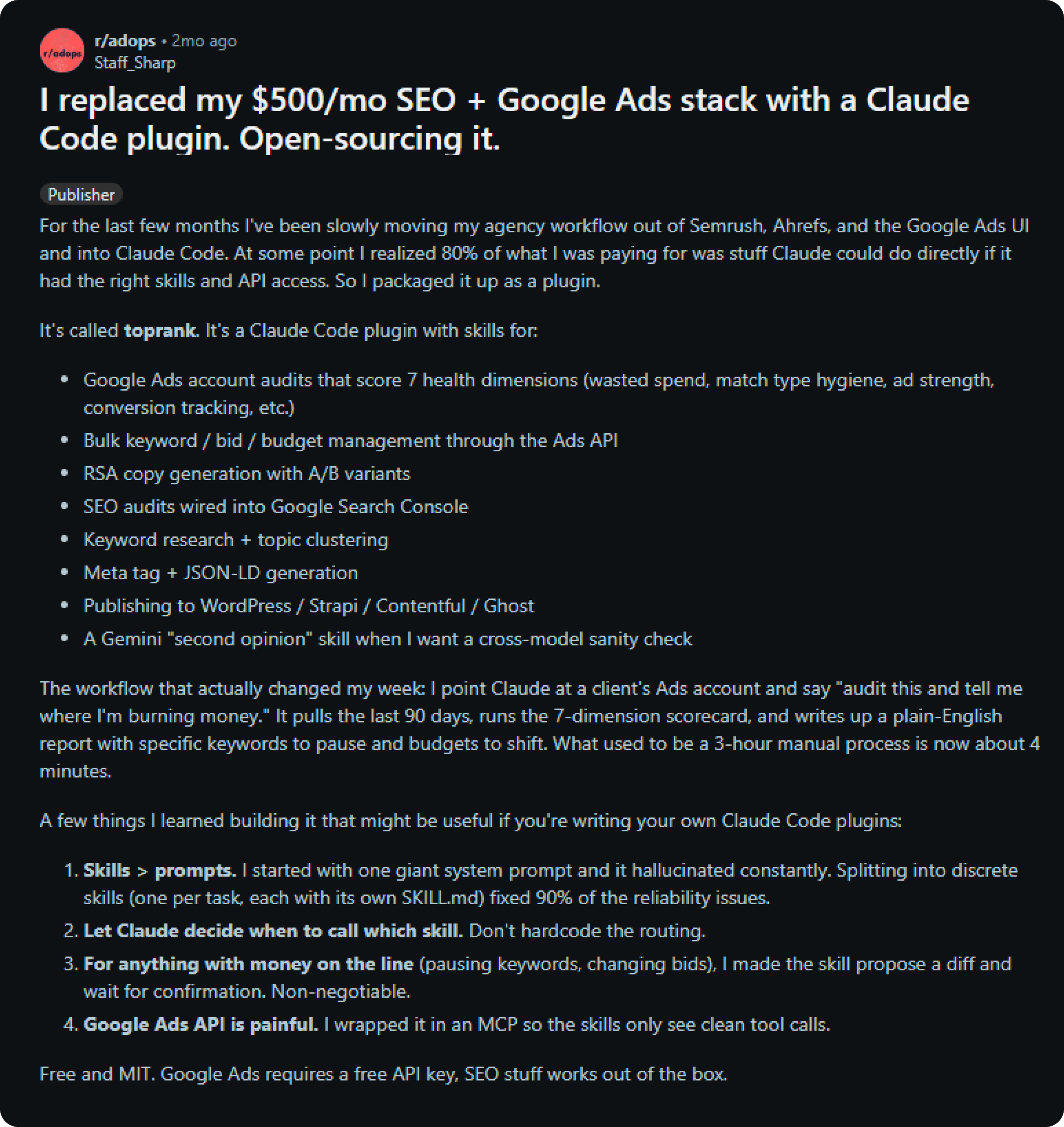
Which AI is best for writing Google Ads copy? Across Claude, ChatGPT, and Gemini, this is one of the tasks where the gap is most clearly defined.
RSA copy is constraint writing at its most demanding. For it, you need to write within the 30-character headline limit, 90-character description limit, up to 15 headline variants, and 4 descriptions per ad. Every variant must function as a standalone unit, and the primary keyword needs to appear naturally without stuffing.
One character over the headline limit, and the variant doesn’t serve. Miss the ‘standalone’ requirement, and Google’s machine learning has less to work with.
Claude is the most consistent performer for this task because its constraint adherence is most reliable. It holds the 30-character headline limit without being reminded across a full variant set, and its variants read as genuinely distinct benefit statements rather than a rephrasing of the same idea.
ChatGPT also performs well with clear prompting and is a capable second choice for volume generation.
Sample prompt framework:
Write Google Ads RSA copy for [product/service name].
- Key benefit: [primary value proposition]
- USPs: [1], [2], [3]
- Target audience: [description]
- CTA verb: [Start / Get / Try / Book / Discover]
- Hard limits: every headline must be 30 characters or fewer (count carefully)
- Every description must be 90 characters or fewer. Write 12 headlines and 4 descriptions.
Each headline must communicate a different benefit, so no rephrasing of the same idea across variants.
State character limits explicitly and repeat the ‘different benefit’ requirement, as both instructions materially improve output quality in any model.
Meta ad copy: Hook writing and primary text variants (Verdict: ChatGPT)
Meta ad creative testing works differently from RSA.
The goal is emotionally distinct variants, not structurally distinct ones. A set of five primary text variants should each open with a meaningfully different emotional appeal, such as aspiration, fear of missing out, social proof, direct offer, curiosity, so that testing reveals which emotional register connects with the audience.
Variants that open with the same emotional framing, even with different words, don’t produce a useful test signal.
ChatGPT’s creative breadth gives it an edge here. Its primary text variants are more emotionally varied across a set. The difference between ‘fear of missing out’ and ‘social proof’ hooks is more pronounced in ChatGPT’s output than in Claude’s, which tends toward slightly tighter thematic clustering across variants.
For high-volume creative testing, like 15 or more variants across multiple audiences, ChatGPT is the stronger choice.

Claude produces good Meta copy, particularly when the brief specifies a single tone or a very precise brand voice. The distinction is specifically about creative range across a variant set, not about individual copy quality.
Landing page copy (Verdict: Claude)
Landing page copy requires the most complete persuasion architecture of any ad-adjacent format. It must include:
- An above-the-fold hook that earns the scroll
- Problem framing that the target audience recognizes without being told they have it
- A solution introduction that leads with the outcome rather than the feature
- Benefit proof
- Social proof integration that doesn’t feel appended
- A CTA that is specific rather than generic
Claude’s structured persuasion output is consistently stronger for this task. It follows complex above/below-fold brief structures reliably and writes CTA copy that is specific to the offer and audience rather than defaulting to filler phrases.
‘Start your free 14-day trial, no card required’ is a different thing from ‘Get started,’ and Claude is more likely to write the former when the brief provides the information to do so.
Brief structure that produces the strongest output:
Product or service + target audience + the single primary objection to overcome + CTA goal (trial, demo, purchase, download) + 1–2 example sentences from the brand’s existing copy as a voice anchor.
The objection framing is particularly useful, as it gives Claude a tension to resolve, which sharpens the persuasion structure throughout.
Research and strategy tasks (Which tool wins for each?)
Research and strategy tasks span the widest capability range of any category in this guide.
- Some require real-time web access, which is Gemini’s territory
- Some require structured document intelligence over long, complex outputs, which is Claude’s territory
- Some require running code on uploaded data files, which is ChatGPT’s territory
No single model leads across all four tasks here, making the answer to which AI model is best for marketing research and strategy an illustration of why a task-matching approach produces better results than defaulting to one tool for everything.
Audience persona and ICP development (Verdict: Claude)

A marketing persona is only useful if it’s specific enough to inform decisions. Generic outputs, like they want to save time and money and are frustrated by manual processes, describe every B2B buyer and inform no creative brief.
Claude’s persona output is consistently the most layered of the three. It produces structured demographic and psychographic profiles that include motivational nuance, decision-making context, and objection patterns. This is the kind of specificity that a writer or strategist can build from.
What to include in the brief:
Existing customer data, common sales objections, verbatim quotes from interviews or reviews, and the decision-maker role you’re building the persona for.
Raw customer language, from reviews, interviews, and support tickets, is the single most valuable input for persona work, and Claude structures it into usable outputs more reliably than its competitors.
If you need current demographic or market sizing data, run a Gemini search first to pull live figures, then bring that context into your Claude brief.
Real-time competitor research and messaging analysis (Verdict: Gemini)
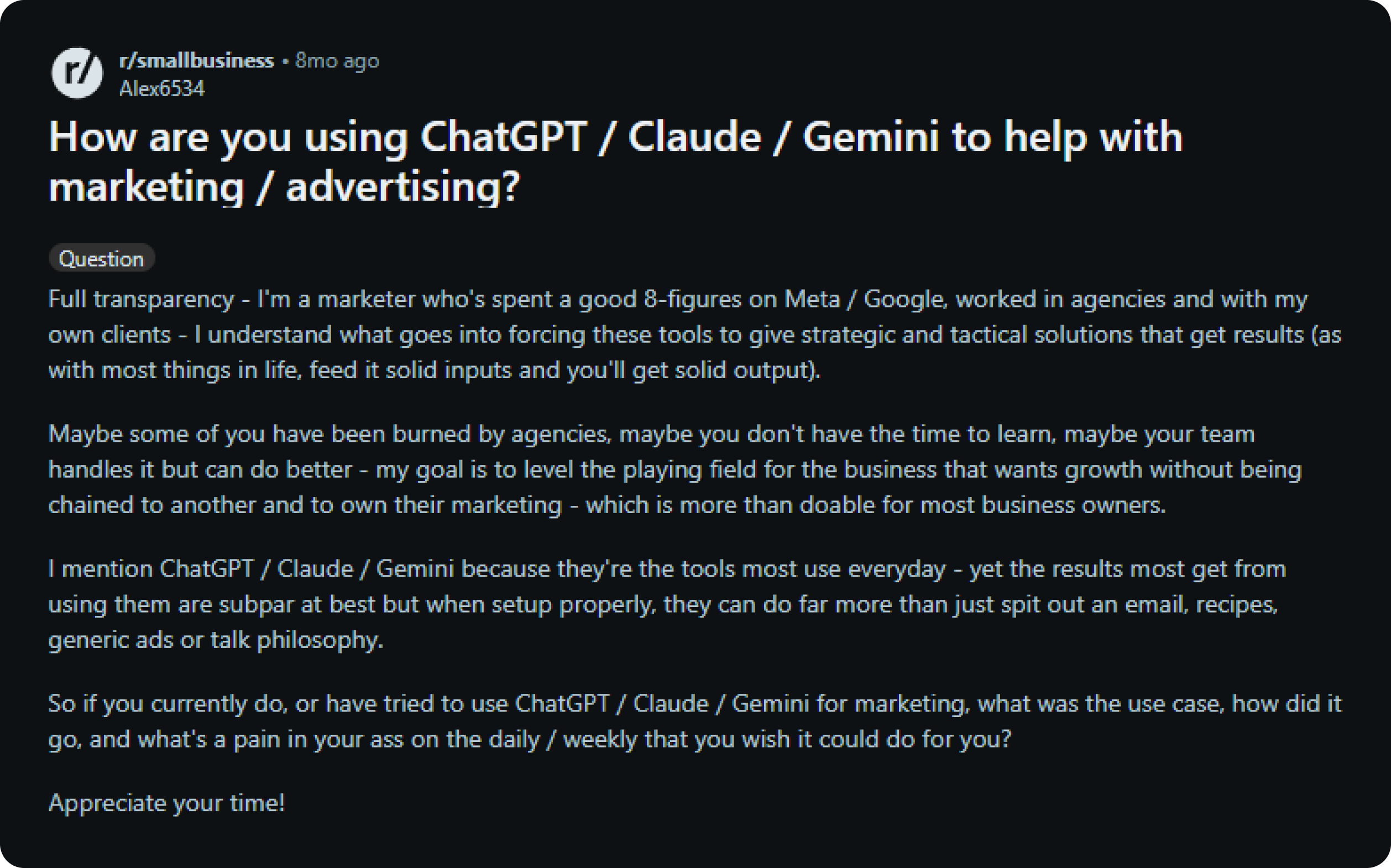
This is Gemini’s most unambiguous win across all marketing tasks in this guide. Analyzing what competitors are saying right now, how their messaging has shifted in the last quarter, and what their current ad creative looks like requires live web access.
Claude and ChatGPT are working from training data that is already behind the current competitive landscape.
For fast-moving categories, that’s a fundamental constraint.
Gemini is not the preferred option for this task. It is the only viable one among the three.
Sample Gemini prompt for competitor messaging analysis:
Analyze the current positioning and messaging of [Competitor A], [Competitor B], and [Competitor C] in the [category] market.
For each: summarize their primary value proposition, the audience they appear to be targeting, their most prominent content themes in the last 90 days, and any notable shifts in messaging compared to their previous positioning.
Identify any positioning gaps that none of the three are occupying.
Use this output to brief Claude or ChatGPT on the content or copy that fills the gaps identified.
Marketing strategy document drafting (Verdict: Claude)
A strategy document is a long-form, multi-section output with an executive audience. It involves situation analysis, objectives, strategic approach, tactical plan, and measurement framework. All this needs to hold a consistent professional register throughout while remaining specific and action-oriented.
Claude’s long-form structural intelligence is its strongest differentiator here. It holds the multi-section architecture reliably, writes executive summaries that are specific rather than padded. Further, it produces strategic language that reads as considered rather than templated.
Brief structure for strategy documents:
Business context and current situation + objectives (what does success look like, with metrics) + target audience + budget parameters if relevant + who will read the document and what decision they need to make after reading it.
Data analysis and insight extraction (Verdict: ChatGPT)
When the task involves uploading a CSV of campaign performance data and asking for trend identification, variance calculation, or benchmark interpretation, ChatGPT’s Advanced Data Analysis is in a different category. It runs Python on uploaded files, produces charts, and narrates insights, all within one workflow.
Claude can interpret data described in text, but cannot run code on uploaded files.
For data-heavy tasks, like monthly performance reports, A/B test interpretation, cross-channel attribution summaries, and route to ChatGPT. Once the analysis is done, bring the insights into Claude to draft the narrative report or client-facing summary.
A two-tool workflow that uses each model where it genuinely leads.
Agency operations tasks (Which tool wins for each?)
For SMB agencies, operations tasks, like client reports, creative briefs, meeting summaries, and proposals, represent some of the highest time-ROI applications of AI in the business.
They’re high-volume, they follow repeatable formats, and they’re time-consuming to do well manually. They’re also where a poorly written AI output has direct client-facing consequences.
Getting the tool and brief right for these tasks is worth the investment.
Client report and presentation drafting (Verdict: Claude)
Client reports have a specific quality bar that’s easy to miss: professional prose that communicates authority without jargon, executive summaries that are specific rather than padded, and a tone that builds confidence in the agency relationship.
Claude consistently produces report prose that meets that bar more reliably than ChatGPT or Gemini. Its executive summary language in particular tends to be more specific and less filler-heavy.
Brief structure that works:
Client name and campaign period + key metrics with performance vs. benchmark + top 3 wins (with specific numbers) + top 2 challenges + recommended priorities for the next period.
The specificity of the input determines the specificity of the output. Vague performance summaries produce vague reports regardless of which model you’re using.
Creative brief and campaign brief writing (Verdict: Claude)
A creative brief has an unusual requirement, such as being specific enough for a designer or copywriter to work independently but structured enough for a client to review without an explanation meeting.
Claude handles that multi-stakeholder clarity requirement better than its competitors, it takes a messy discovery call summary and produces a brief with the right sections, the right order, and the right level of specificity for each audience.
Practical tip:
Paste raw notes or a transcript from the client discovery call directly into the prompt rather than summarizing them first. Claude extracts the relevant inputs and discards the noise more reliably than most people do when summarizing manually.
Meeting notes summarization and action item extraction (Verdict: ChatGPT or Gemini)

This is one of the tasks in this guide where the tool choice should be decided entirely by your existing workflow rather than by performance differences.
Both ChatGPT and Gemini handle transcript-to-action-item extraction competently. ChatGPT is the stronger choice when working from a raw text transcript pasted into the prompt.
Gemini is the natural choice when the meeting happens in Google Meet, and the notes or recording are already in Google Workspace, as the native integration removes the manual step of copying content between platforms.
For agencies building a structured meeting-to-task workflow, where action items from client calls flow directly into project management, a platform like 5day.io that connects AI output to team task management removes the gap between AI-extracted actions and actual delivery accountability.
Agency proposal and scope of work writing (Verdict: Claude)
A proposal that wins business demonstrates understanding of the specific problem before proposing a solution, and makes the commercial section feel like a natural conclusion rather than the point of the document.
Generic capability summaries and deliverables lists don’t do that. Claude’s persuasive long-form structure and stakeholder tone calibration make it the strongest choice — the difference in register between an SMB founder and a procurement committee is a nuance Claude holds when the brief provides it.
Brief structure: Prospect’s pain points verbatim from the discovery call + the specific service being proposed + a one-sentence description of the decision-maker and their primary concern + any competitive context. Pain points verbatim are the most important input — they let Claude reflect the prospect’s own language in the opening, which is the fastest credibility signal a proposal can lead with.
The quick-reference task-to-tool matching guide (2026)
If you’ve read the sections above, you’ve seen the reasoning behind every recommendation in the table below.
If you jumped straight here, you have everything you need to match your task to the right tool, and the reasoning is in the relevant section when you want it. This AI tool comparison for marketing agencies in 2026 doesn’t offer generic verdicts; instead, every recommendation is tied to a specific task.
All ratings reflect the 2026 model state based on current capabilities and widespread marketing professional experience. Verify individual task ratings against current model releases before publishing, as AI capabilities update frequently.
The practical answer to how most marketing teams should use all three AI tools
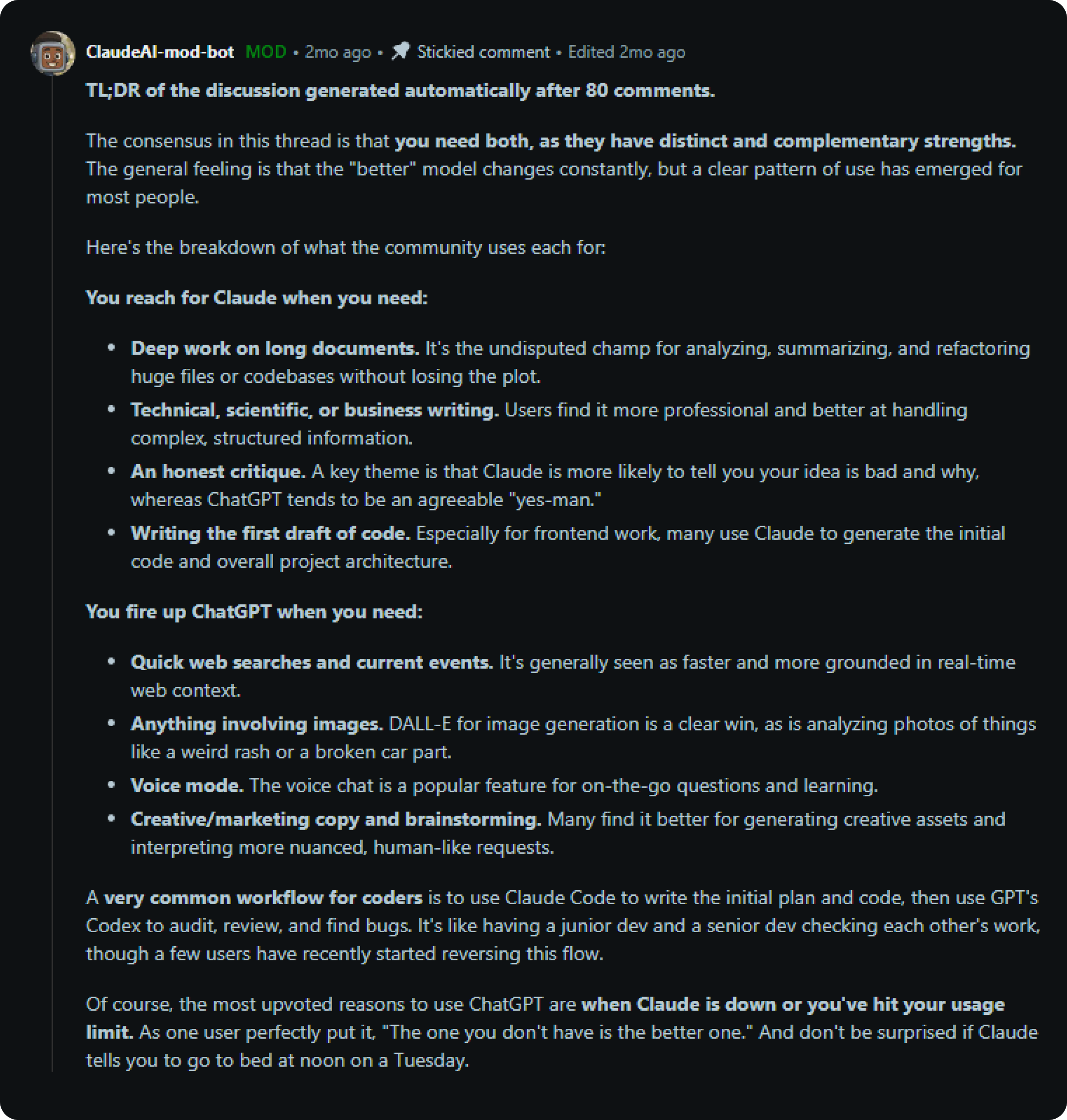
The Case for Using More Than One AI Tool
The most common mistake marketing teams make with AI in 2026 is using a single tool for everything and accepting average results on tasks it wasn’t built for. Routing tasks to the model that performs best for each task type produces better outputs than defaulting to a single tool and working around its limitations.
Most high-performing marketing teams use two or three AI tools because the efficiency gains from matching tasks to models outweigh the overhead. Using Claude for constrained copy tasks, or ChatGPT for data analysis instead of asking Claude to interpret a pasted table, are the kinds of workflow decisions that compound across a week of output.
Using three tools poorly is worse than using one tool well. The quality ceiling in AI-assisted marketing is prompt engineering. So, before adding a second or third tool, make sure you’re getting the best out of the one you already use.
How to build a multi-model AI workflow for your marketing team
Most teams add tools without adding a routing layer. The result is three open tabs and three different outputs, but no consistent process for which one ships.
Here’s what a functional multi-model workflow looks like for marketing teams.
A task routing decision
Before any AI session begins, your team should know which tool handles which task category without having to think about it. The task-level verdicts in this guide give you that framework.
The step most teams skip is writing it down as a team SOP that takes the decision off the table so no one defaults to their personal favorite.
A context handoff system
The biggest friction point in a multi-model workflow is re-briefing each one. When Claude writes a blog post that ChatGPT then repurposes into social content, ChatGPT needs the brief, the brand voice guidelines, the audience context, and the original post.
That context needs to live somewhere persistent. A shared project folder, a campaign brief template, or a platform like 5day.io that keeps brand context attached to the project (rather than re-entered each session) is what makes the handoff clean.
A review gate between tools
For the best results teams must review AI output from Tool A before it becomes the input for Tool B. Errors compound when they don’t.
A Claude-written brief that contains a factual error about the product will produce a factually wrong ChatGPT repurposing set. The workflow needs a human checkpoint between each tool handoff. Teams don’t need to edit it from end to end but require a read-through before passing it forward.
A starting sequence for teams new to multi-model workflows
If your team is currently single-tool, the practical onboarding sequence is:
- Month 1: Commit to Claude for all writing tasks and build the habit of structured prompting and brand-context uploads before adding complexity
- Month 2: Add ChatGPT specifically for data analysis (uploaded campaign reports) and content repurposing
- Month 3: Evaluate Gemini only if your team is Google Workspace-native or runs regular competitor research, but avoid adding a third tool until the two-tool routing is running cleanly
When the tool you have is better than the tool you need
For the majority of marketing tasks, the tool you’re already in is good enough. Context-switching has a real cost, and that cost rarely pays off unless the task has a hard capability gap that the current tool genuinely can’t bridge.
So the rule is if you’re in Claude and the task is one where ChatGPT is marginally stronger, finish in Claude with a clearer prompt before switching. The marginal quality gain rarely justifies the reset. Save the tool switch for tasks where the gap is fundamental:
- Real-time competitor research → must use Gemini (the other two don’t have live web access)
- Data analysis from an uploaded CSV → must use ChatGPT (Code Interpreter is a hard capability gap)
Outside those two, improve the prompt rather than switch the tool. A marketing agency AI workflow platform like 5day.io reduces the time spent on these switching decisions and keeps the focus on applying the output.
Match the tool to the task, and not your preference
The search for the best AI tool for marketing tasks leads most teams to the same dead end: a comparison article that declares one model the winner.
No AI model wins Claude vs ChatGPT vs Gemini for marketing debate across all tasks. The right choice is always task-specific, and the gap between models varies from significant to negligible depending on what you’re trying to do.
The right AI workflow is about the system you build around it. How your team briefs AI, manages output quality, and connects AI-generated work to delivery accountability matters as much as the tool. That’s what 5day.io’s ACE, a marketing team’s work management software built for AI-assisted workflows solves.
While Claude, ChatGPT, and Gemini each require you to manually feed them brand context at the start of every session, ACE agents live directly inside your marketing projects on 5day.io, where you can give it context from your campaign files, team discussions, feedback threads, and brand guidelines over time.
The result is an AI layer that already knows your brand. For marketing teams looking to move beyond prompt-and-paste workflows into a genuinely contextual AI system, ACE by 5day.io is where that shift starts.
Ready to stop feeding your AI context from scratch every session?
5day.io brings ACE agents to create on-brand assets without the manual setup. Try it free for 30 days, no credit card required.