

In 2026, teams are under pressure to hit dates without burning people out, so planning methods need to be tighter and more realistic.
No matter how well a team develops a project, there is always the risk of it falling apart when resources can’t operate smoothly. Teams often juggle between multiple tasks due to a priority-basis workflow. In such cases, key contributors are overbooked, and project deadlines are compromised.
So, why does that happen? Well, not because of weak planning. The reason is traditional scheduling that can’t cooperate smoothly with real-world constraints.
That is where critical chain project management (CCPM) can help. CCPM focuses on resource constraints and dependencies, along with time buffers, so your plan matches how work actually flows, not how you wish it worked.
In this guide, you will see how the CCPM method works, the difference between critical chain vs critical path, and expert tips that support teams to adapt critical chain project management in real-time.
What is Critical Chain Project Management (CCPM)?
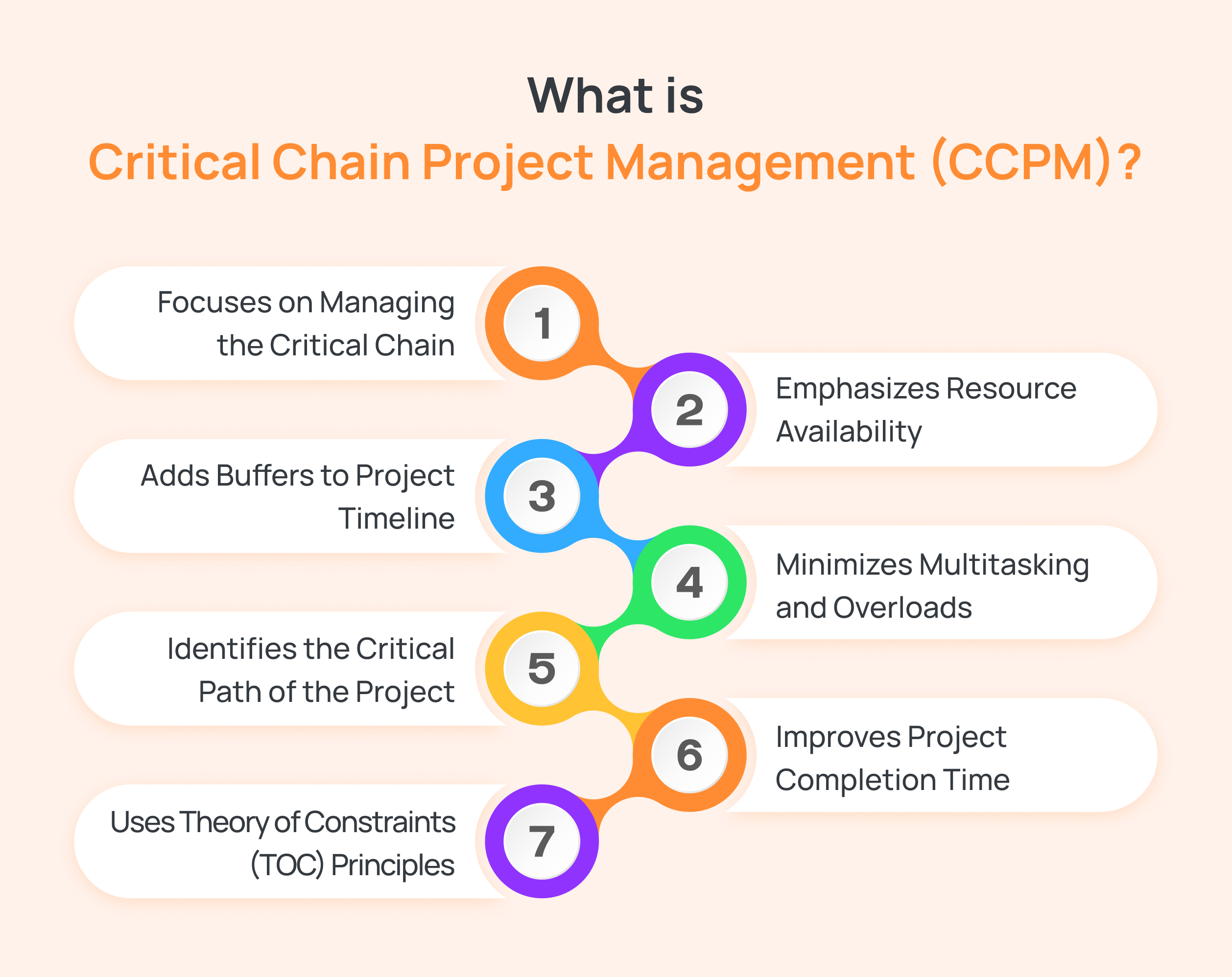
Critical chain project management is a planning method that focuses on two things at once: the tasks that set your finish date and the people and tools needed to do those tasks. It was introduced by Eliyahu Goldratt in the late 1990s as an extension of the Theory of Constraints.
Traditional schedules often assume unlimited resources and pad every task with hidden safety. CCPM does the opposite. It cuts task estimates closer to realistic effort, then places shared time buffers at key points in the plan to protect the overall delivery date, not each individual task.
The CCPM methodology turns this idea into a simple way to plan and track projects. It provides clear rules for estimates, buffers, and resource use. Thus, CCPM is a project planning method that protects the project finish date by managing resource constraints and shared buffers.
A few core ideas of critical chain project management are:
- Treat people and machines as scarce resources, not as copy-paste placeholders
- Build the schedule around the longest chain that includes both dependencies and resource limits
- Move “safety time” out of tasks and into pooled buffers at the end of the chain and at key merge points
This shift sounds small, but it changes how you plan, how you track risk, and how you talk about deadlines.
Critical Chain vs. Critical Path: The 2026 Verdict
Critical path method (CPM) has been standard for decades. It finds the longest path through your network of tasks based on dependencies alone for minimum project time. CCPM starts there but adds resource constraints, then adjusts the path to reflect people’s availability and shared skills while using project buffers to manage uncertainty.
Critical path focuses on task order and duration, while critical chain focuses on task order, duration, and resource limits together.
Here is a simple comparison you can use with stakeholders.
| Aspect | Critical Path | Critical Chain |
| Core question | Which sequence of dependent tasks sets the finish date | Which sequence of tasks and resources truly limits project flow |
| What it models | Logical dependencies | Dependencies plus resource constraints |
| Time protection | Safety hidden inside each task | Safety pulled out and pooled into shared buffers |
| Main control signal | Float or slack on each task | Buffer consumption on project and feeding buffers |
| View of multitasking | Often accepts multitasking as normal | Treats multitasking as waste that slows the whole chain |
| Good fit for | Stable projects with clear durations and low resource conflicts | Busy teams with shared resources and many parallel projects |
In 2026, you rarely see “pure CPM” or “pure CCPM.” Teams are now mixing them. Many organizations still plan with a critical path for contracts and governance. After that, they add critical chain practices to deal with resource overload and constant scope pressure.
Research on CCPM case studies reports shorter lead times and better on time delivery. Also, they show time savings in the range of 20-35 percent and on time delivery above 90 percent once teams adopt full CCPM practices.
The practical verdict for 2026 is not critical chain vs critical path, but how much critical chain thinking you add to your existing scheduling methods.
Core Components of CCPM
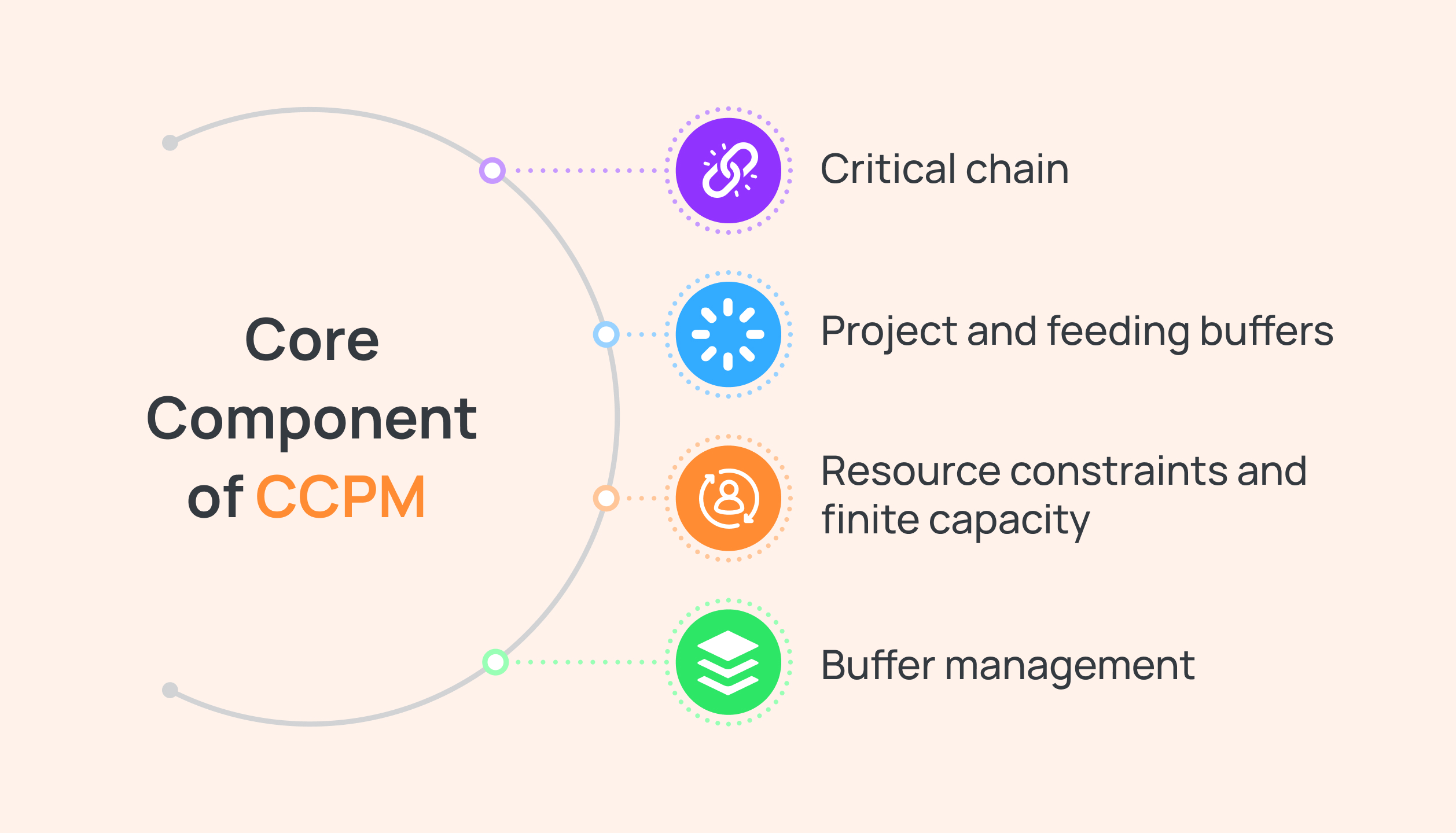
To use critical chain project management, you need a few building blocks that work together. You get value from CCPM when you treat it as a full planning system.
1. Critical chain
This is the longest sequence of tasks that considers both:
- Task dependencies
- Resource availability
You start with your usual network diagram. Then you adjust start dates so no resource is double booked. The chain that now sets your finish date is your critical chain.
2. Project and feeding buffers
Instead of padding each task, CCPM trims individual estimates closer to the effort you actually expect. You then add shared buffers:
- Project buffer at the end of the critical chain to protect the delivery date
- Feeding buffers where non-critical paths join the critical chain, to protect it from upstream delays
Buffers are tracked as a single pool of time. When you consume a buffer, you know your risk is going up.
3. Resource constraints and finite capacity
CCPM assumes your resources are finite. It does not “magically” stretch people across tasks. Schedules are adjusted until each person or machine works on one critical activity at a time.
This has two effects:
- It reduces harmful multitasking
- It makes your dates more honest, even if they are later than your first optimistic plan
4. Buffer management
Once the project starts, you track buffer burn rather than task due dates alone. Common patterns:
- Green zone. Plenty of buffer left compared to progress
- Yellow zone. Buffer use rising faster than progress
- Red zone. Time to act, not just watch reports
Buffer charts show project health faster than a long list of overdue tasks, so leaders can act before the whole plan slips.
Benefits of Using CCPM
If you already use a critical path, CCPM may feel like extra work at first. The benefit shows up once you run several projects at the same time and resources start to collide.
Critical chain project management helps teams protect deadlines, reduce multitasking, and make better use of shared resources.
Common benefits seen in research and case studies include:
- Shorter project durations. Trimming padded estimates and using buffers can reduce overall schedule length by 20–35 percent in some contexts
- Higher on time delivery. Moving safety into buffers and tracking buffer consumption tends to lift schedule reliability
- Less firefighting. You focus on a small number of tasks on the chain and the health of your buffers, not every minor slip
- Better resource use. Fewer context switches, less waiting on overloaded experts, clearer tradeoffs when new work arrives
- Clearer risk conversations. “We used 60 percent of the buffer at 30 percent of the work” is a stronger signal than “many tasks are amber”
For teams that feel stuck in constant delay, these gains matter more than having the prettiest chart.
Common Mistakes & How to Avoid Them
CCPM looks simple on paper. In practice, teams often run into behavioral and tooling issues. Most CCPM failures come from half-adoption, where teams keep old habits but expect new results.
Here are common pitfalls and ways to avoid them.
1. Leaving safety inside tasks
If you ask for “honest” durations but still add buffers at the end, you double count safety. That makes your project slower and hides where the real risk is.
How to avoid it:
- Ask for realistic, 50-60 percent confidence estimates, not “safe” ones
- Explain to the team where the shared buffers sit and how you will protect them
2. Ignoring resource constraints in the tool
Some tools show a pretty critical path but do not support finite capacity planning. Your schedule looks right on screen while people are triple booked.
How to avoid it:
- Use software that can show both task dependencies and resource load
- Do a basic capacity check for key roles before you consider the plan final
3. Treating buffers as “extra time”
Stakeholders often see buffers as slack they are free to consume, rather than shared protection for the whole project.
How to avoid it:
- Reframe buffers as “project insurance” that belongs to the team, not to any one person
- Report buffer consumption as a headline health metric in your status updates
4. Overcomplicating buffer math
You do not need advanced formulas at first. Over-engineering buffer sizing can slow you down and confuse stakeholders.
How to avoid it:
- Start with simple rules of thumb, such as using a fraction of total trimmed safety as buffer
- Improve your sizing later as you collect data on actual buffer usage
5. Forcing CCPM on every project
Some projects are small enough that CCPM adds more overhead than value.
How to avoid it:
- Reserve full CCPM for projects where resource conflicts and delays are frequent
- Use lighter scheduling for small, low-risk work and keep methods flexible
Key Things to Look for in a Software for CCPM
You can sketch a critical chain on paper, but you will feel the real value only when a tool helps you visualize workloads, buffers, and progress in one place.
The best software for critical chain project management makes resource constraints and buffer health visible, without drowning teams in configuration.
Key capabilities to look for:
- Gantt or timeline views with task dependencies
- Resource and workload views to see project management resource constraints in real time
- Simple ways to add and track project and feeding buffers
- Dashboards that highlight buffer burn, blockers, and upcoming overloads
- Timesheets or time tracking so you can refine estimates over time
On 5day.io, you can already:
- Map dependencies across tasks in a clear timeline
- See workload views for your team so you avoid overbooking key people
- Track effort and timesheets to refine how you size work and buffers
- Share clean views with clients and internal stakeholders without giving away every internal detail
You may not run a “pure” CCPM setup on day one. That is fine. Start by using 5day.io to limit multitasking, reflecting real resource limits, and keeping a clear eye on buffer health through custom fields and dashboards.
Over time, you can grow from basic critical path charts to critical chain style planning without changing tools or retraining your team on a new system.
Implementation Guide: 5 Steps to Deliver Faster
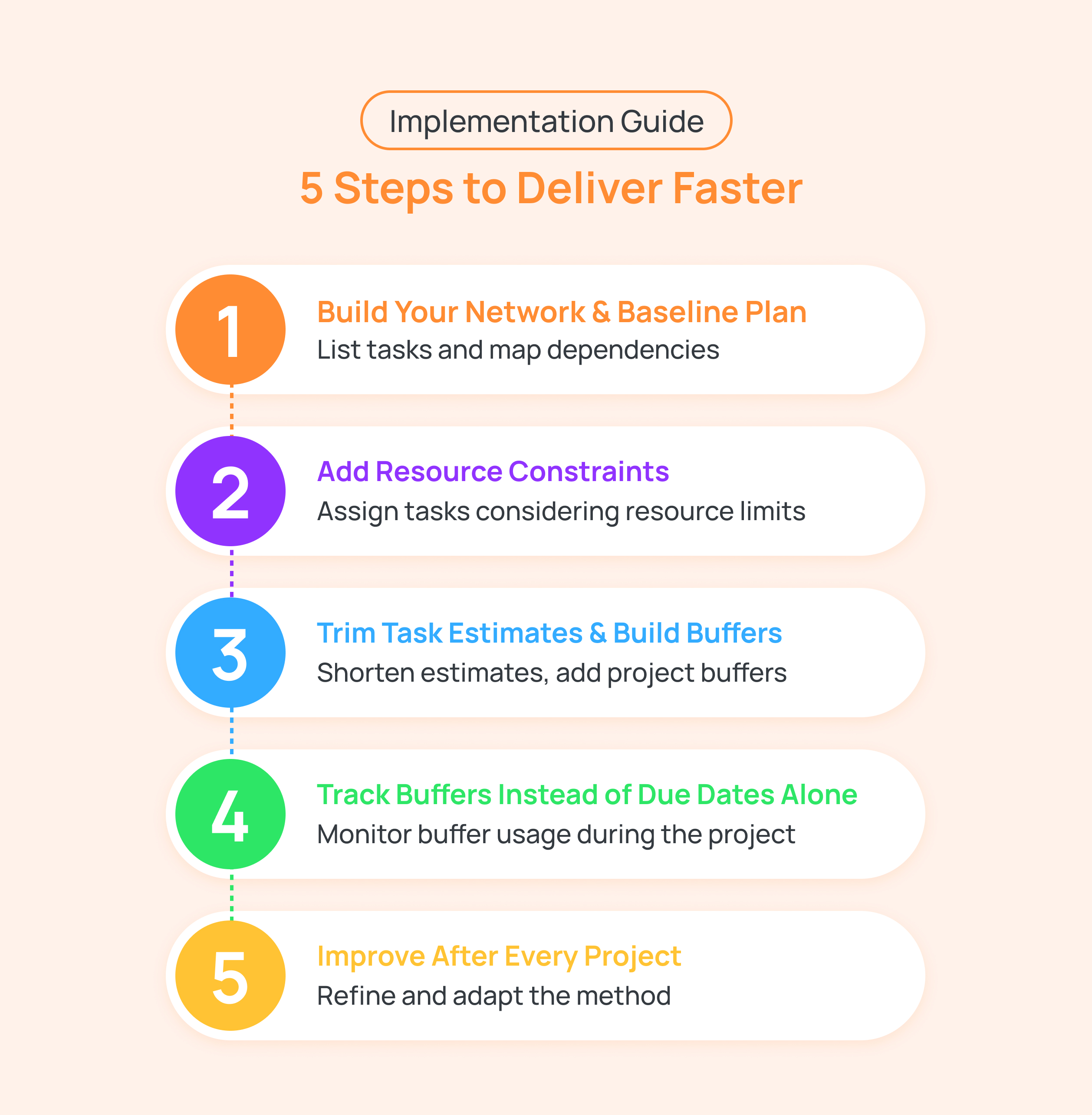
If you want to try a critical chain in project planning in 2026, start small. Take one complex project that is already at risk of delays and apply these steps.
You do not need to redesign your full PMO to start using critical chain project management tools; you can pilot it on a single project and learn by doing.
If your team wants to learn how to plan to use critical chain method in real work, you can use the steps below as a straightforward checklist.
Step 1. Build your network and baseline plan
- List all tasks and milestones
- Map logical dependencies between them
- Create a standard critical path schedule using your usual approach
If you want a refresher on the basics, the 5day.io guide on the project management process is a good starting point.
Step 2. Add resource constraints
- Assign each task to real people or roles
- Use workload views to identify people who are double or triple booked
- Adjust task timing so key resources work on one significant activity at a time
This step is where the critical chain appears. The path that now sets your end date, after resource adjustments, is your critical chain.
Step 3. Trim task estimates and build buffers
- Ask for realistic effort estimates instead of padded dates
- Reduce individual task durations to remove “hidden” safety
- Create a project buffer at the end of the critical chain
- Add feeding buffers where other paths join the chain
Keep the math simple first. You can use a fixed percentage of trimmed time as your buffer pool and refine later as you gather data.
Step 4. Track buffer consumption instead of due dates alone
During delivery, keep a buffer chart visible:
- Update progress weekly
- Track how much of each buffer you have used
- Escalate when buffer burn outpaces progress
This gives leaders one clear view of risk instead of a long list of overdue tasks.
Step 5. Improve the system after every project
After delivery:
- Compare planned vs actual buffer usage
- Check where multitasking still crept in
- Refine your estimating practices and buffer rules
Over a few cycles, you will build your own playbook of critical chain project scheduling tips tuned to your context, not just theory.
CCPM in Modern Work Environments
CCPM was born in manufacturing and construction. It now shows up in software, marketing, R&D, and even internal change programs. The common pattern is not the industry. It is the presence of shared, overloaded resources, and long lead times.
If you are already working with Scrum, Kanban, or other agile styles, it helps to connect CCPM ideas to your existing agile setup. Do you want to learn more? Read our detailed guide on what is agile project management.
Critical chain project management fits modern work when your real bottleneck is people, not tools.
Some examples:
- IT product teams with a handful of senior engineers who sit on every critical feature
- Marketing agencies where the same copy lead or designer blocks several client campaigns
- Operations and process change programs that depend on a small central analytics team
These teams already face:
- Constant task switching
- Frequent priority changes
- Hidden queues around a few experts
CCPM does not remove all chaos, but it gives you a structure to protect those people and keep flow moving. When you combine it with simple, flexible project management methodologies like agile and hybrid models, you get more honest schedules and fewer surprises.
If you are not sure which overall method fits, the 5day.io guide on how to choose a project management methodology gives you a broader view of your options.
How 5day.io Can Help You Apply CCPM
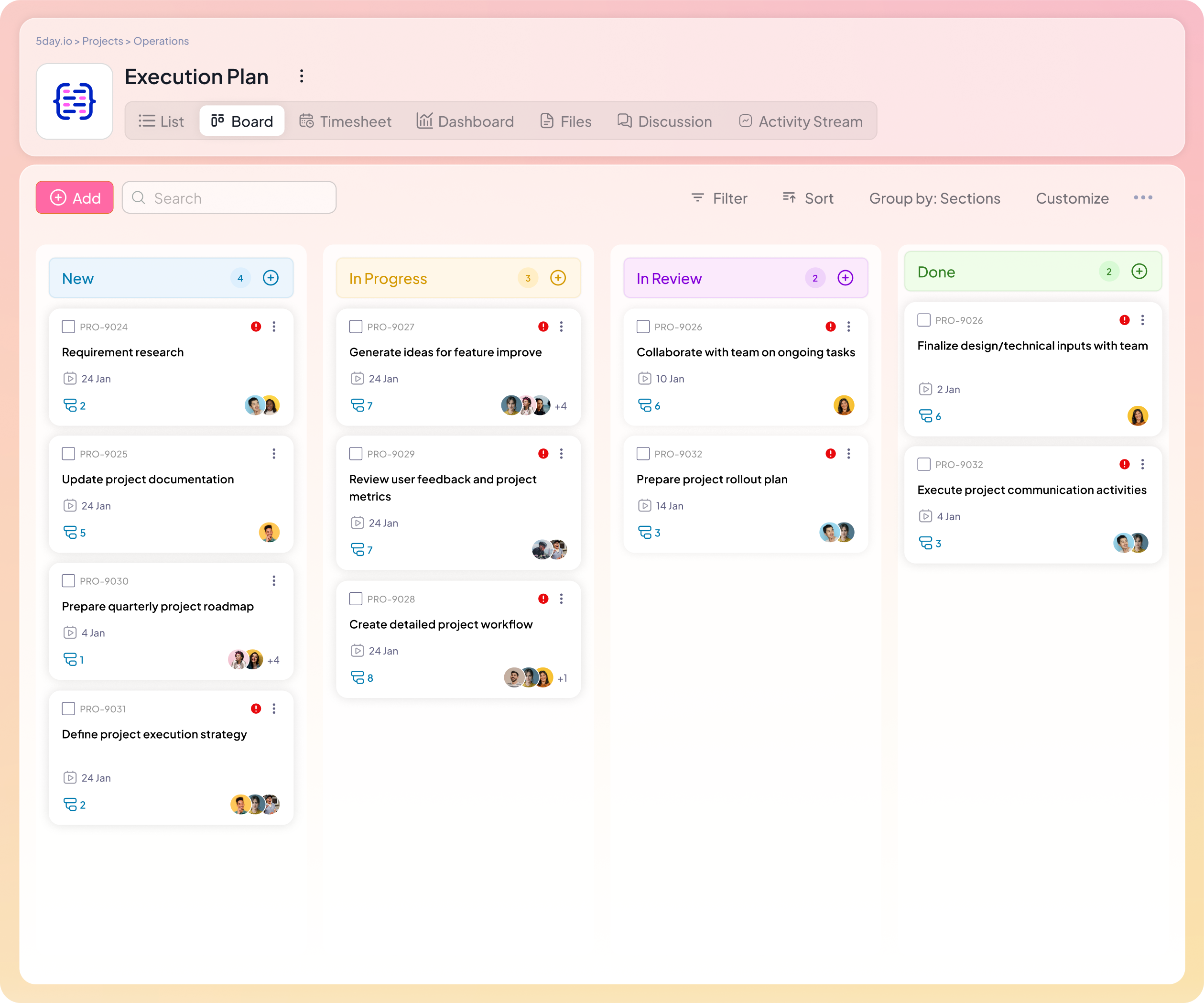
Critical chain project management is not just a theory from the 1990s. It is a practical way to plan smarter and deliver faster in 2026 when your team is already stretched thin.
Start with one pilot project, use 5day.io to make resource constraints and buffers visible, and build your own critical chain habits step by step.
Here is a simple path:
- Use 5day.io’s list views to map dependencies and build your first network
- Use workload and capacity views to see where key people are overloaded
- Add custom fields to track buffer sizes and buffer consumption
- Use 5day.io dashboards to share simple health views with stakeholders
- Refine your setup as you learn what works for your team
Ready to see how this looks in practice? Sign up for 5day.io and opt for a free demo. Our expert team will easily teach you to set up your first project. Then, try planning your first critical chain before your next big deadline. We’re sure that the results will be highly satisfying.
Conclusion
Critical chain project management gives you a more honest way to plan when people and time are your real bottlenecks. Working on how to plan smarter and deliver faster in 2026 isn’t that hard.
You do not have to replace everything you do today. Start with one complex project and map the critical chain. Then, add simple buffers, and watch how your discussions around delays and risk start to change. Over a few cycles, you will build better habits around resource use and buffer tracking.
If you want an easy start to adapting a new environment that’s much more efficient than your current setup, set up your first critical chain style project in 5day.io. You can structure tasks, see workloads, and track buffers in one clear view. It will help your team plan smarter and deliver faster in 2026.