Deadlines are a lot like gym memberships. Everyone agrees they’re a good idea, and almost nobody uses them the way they planned to.
The numbers back this up. Knowledge workers miss about 26% of their deadlines every week (Asana, Anatomy of Work Index).
Marketers have it worse, because one campaign deadline is really five other people’s deadlines stacked on top of each other.
So let’s talk about managing deadlines in a way that works: realistic dates, a little buffer, and a plan for the day something slips.
What is deadline management?
Put simply, deadline management is making sure work gets done by the date you promised. It covers setting a realistic deadline in the first place, breaking the work into steps, keeping an eye on progress, and dealing with delays before they turn into missed dates.
Putting a date in the calendar takes ten seconds. The harder part is working out what has to happen before that date and who’s responsible for each piece.
For one task, a to-do list is usually enough. Project deadline management is trickier, because deadlines start to depend on each other. If the copy is late, the design is late, and soon the launch date is in trouble.
In practice, good deadline management comes down to four things:
- Planning: setting dates based on how long the work actually takes, not how long you hope it takes
- Ownership: making sure every task has one clear owner
- Visibility: tracking progress where the whole team can see it
- Recovery: having a plan for when something slips
Why marketing deadlines are harder to hit
A marketing deadline has more people attached to it than most. Product sets the launch date, sales wants its deck, legal wants a look, and sometimes there’s a client involved too. Whatever slips upstream lands with marketing, and the launch date usually stays put.
Here’s where marketing deadline management gets hard.
Approvals take longer than the work
A banner might take a designer half a day, but getting it signed off can take a week. Stakeholders review when they find a free minute, feedback trickles in over a few days, and two approvers often want opposite things. Each extra reviewer tends to add another round, and those rounds almost never make it into the plan.
Other teams’ delays land on marketing
Product or sales usually set the launch date. Final pricing, feature names and positioning tend to arrive late, sometimes only days before go-live. Engineering can move a feature to the next sprint. Marketing usually can’t move the launch, so the delay comes out of its timeline.
Launch dates can’t move
A Black Friday campaign that goes live on Monday has missed the point. The same applies to event promotion, seasonal pushes and partner launches. A lot of project work loses some value when it’s late. Campaign work can lose nearly all of it.
One asset turns into many
The hero creative gets estimated, but its derivatives don’t. A single concept becomes a dozen ad sizes, social cuts, email versions, localized copy and a sales one-pager. This last mile of resizing and adapting often takes longer than the original idea.
Channels have their own deadlines
Ad platform reviews, media booking cut-offs, app store approvals, print deadlines and journalist lead times are all set outside your team. Tracking setup, such as UTMs, pixels and landing page QA, often get squeezed into launch day too. That’s exactly when it tends to break.
Every campaign shares the same team
Each campaign can look on track in its own plan. Then three of them need the same designer in the same week, while always-on content and ad hoc sales requests keep coming in. You only see the clash when you look across campaigns instead of within one.
“Done” is subjective
A webpage either loads or it doesn’t. Creative work has no test like that. Without agreed acceptance criteria there’s always one more tweak, and revision loops quietly stretch the timeline.
Taken together, this is why deadline management for marketers has less to do with personal time management and more to do with coordination. The fix is making dependencies, review windows and shared capacity visible early, before they turn into missed deadlines.
Why deadlines get missed
The previous section covered the pressures that come from outside the team. Most missed deadlines, though, trace back to a handful of planning habits that teams can fix themselves.
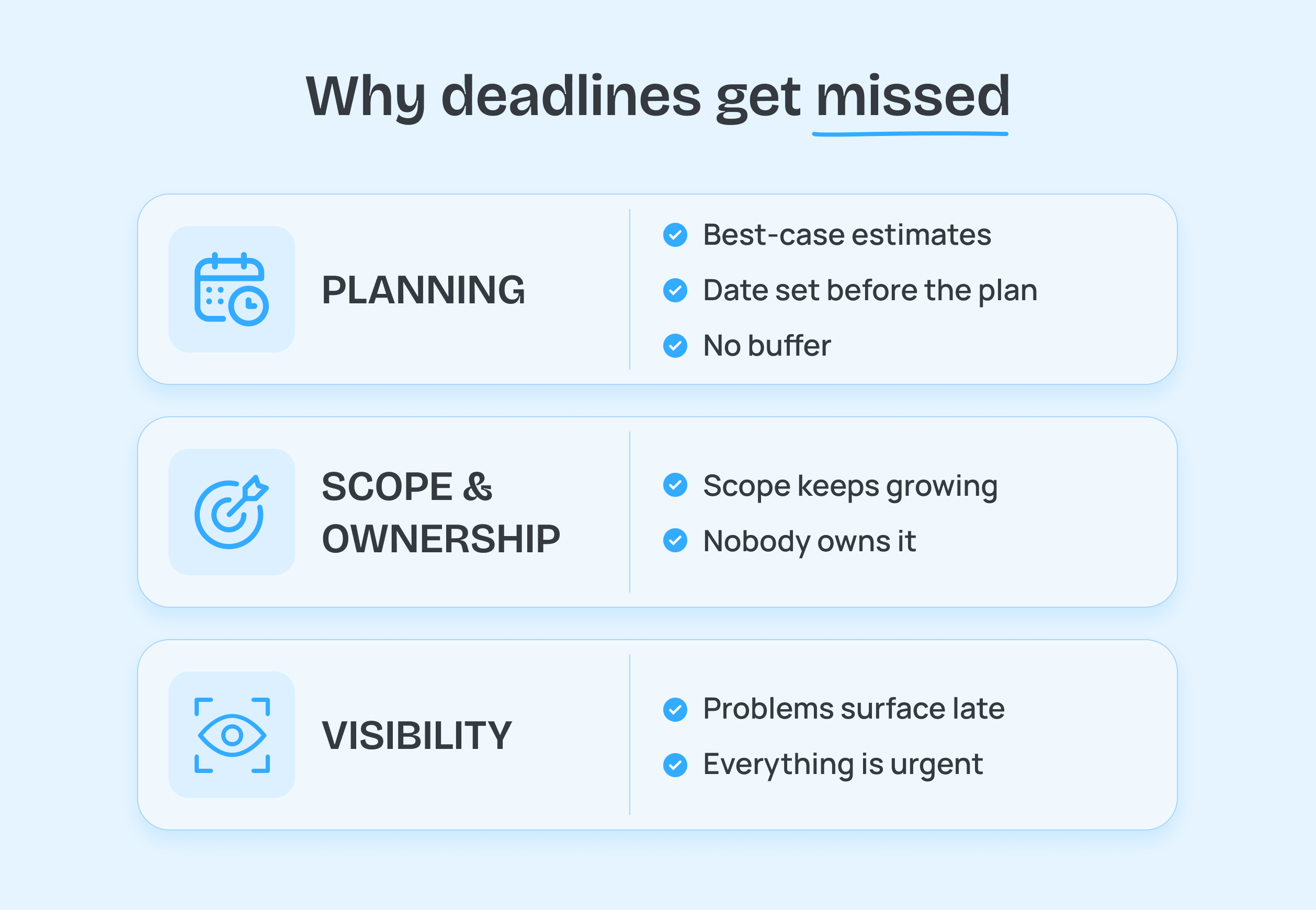
- Estimates assume the best case
People plan for the version of the week where nothing goes wrong. Sick days, urgent requests and a second round of feedback does not make it into the estimate, even though they show up on almost every project. - The date comes before the plan
A launch date gets agreed in a leadership meeting, and the team works backward to make it fit. When the date is set first and the work is scoped afterward, the deadline isn’trealistic to begin with. - Scope grows, but nothing comes off
A new channel or an extra deliverable gets added halfway through, and the timeline stays the same. Every addition needs a trade-off: more time, more people or less scope. Without one, the deadline absorbs it.
- Nobody owns it
“The team” is responsible for the landing page, which in practice means no one is. Tasks without a single named owner tend to drift until someone notices they’re late.
- There’s no buffer
Every task is scheduled back to back with no slack. So one delay, even a small one, pushes the whole chain back.
- Problems surface too late
Status updates stay green right up until the week the work is due, and then everything turns red at once. Teams that only check progress against the final date find out about trouble when it’s too late to fix.
- Everything is a priority
When every campaign is urgent, the team ends up spreading effort thin across all of them. Without a clear order of priority, the most important work competes with the loudest request.
Look closely and most of these causes share a root. The date was picked first, and the work was squeezed in afterward. Fix that, and how to meet deadlines becomes a much easier question.
How to manage marketing deadlines
Knowing why deadlines slip is the easy part. Here’s how to manage deadlines so they don’t, step by step, built around how marketing work actually runs.
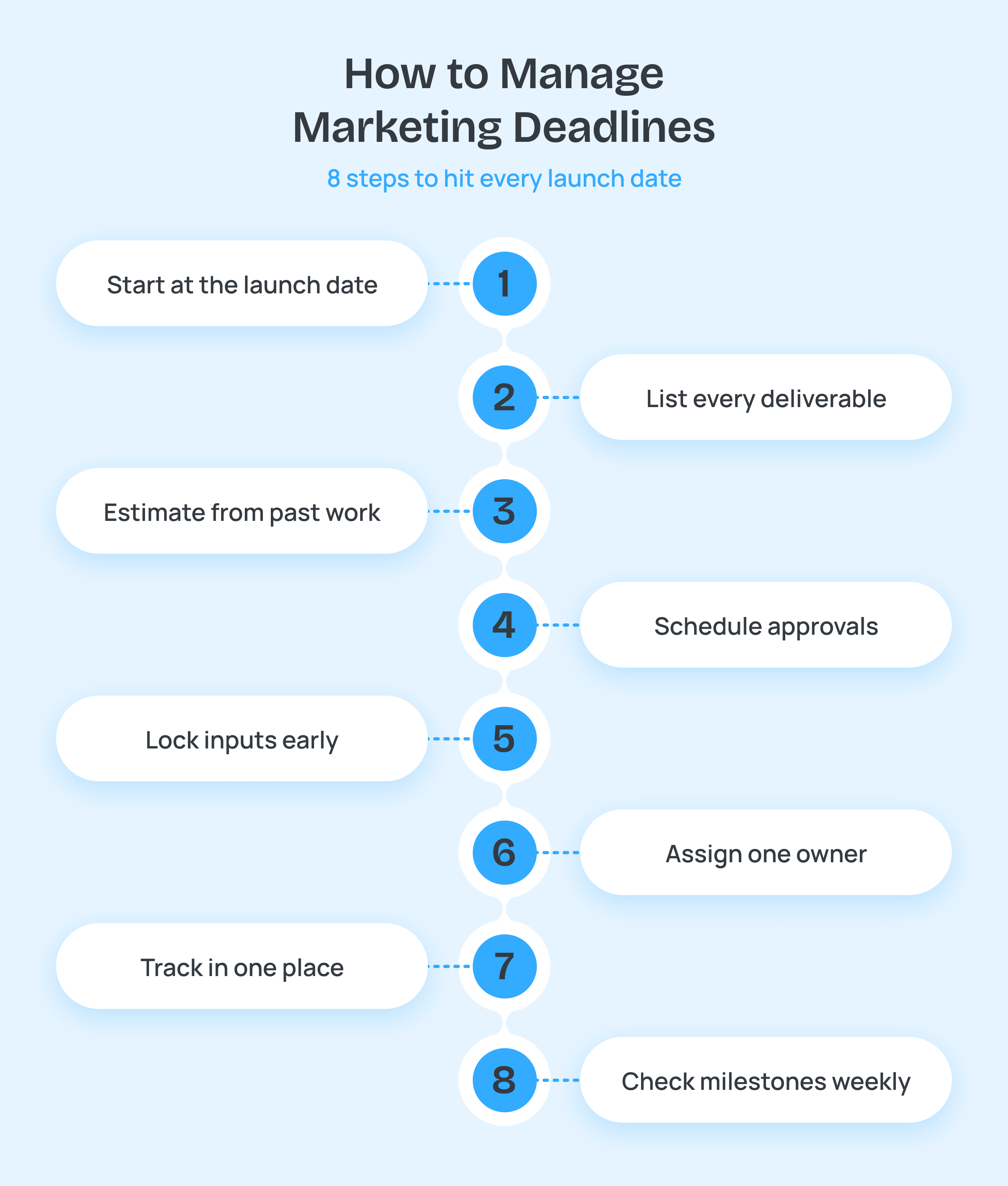
- Work backward from the launch date
Take the go-live date and walk back through each stage until you reach the brief. Once that’s mapped, set an internal deadline a few days before the real one. Keep that gap to yourself, because it’s your safety margin. - List every deliverable, including the variations
Write down everything that needs to be produced, including the small stuff. Count every ad size, email version, localized variant and sales asset. If it needs to be made, it needs a line in the plan.
- Estimate from past campaigns, not memory
To set realistic deadlines for marketing campaigns, look at how long similar work took last time, using time tracking data where you have it. Then add buffer where the risk sits, such as approvals, new formats and anything involving legal. Spreading the same padding across every task doesn’t help.
- Schedule approvals like any other task
Every review needs to be in the plan, with:
- A named reviewer and a date
- A fixed review window, for example 48 hours
- One combined round of feedback instead of separate notes from each person
- A single decision-maker when reviewers disagree
- Set cut-off dates for inputs
Agree in advance when final pricing, messaging and product details must be locked. If an input misses its cut-off, either the launch scope changes or the date does. Make that rule clear upfront so it isn’t a surprise later. - Give every deliverable one owner
Each task needs one person accountable for getting it done and one person who approves it. Shared ownership means no one follows up. - Track everything in one place
A shared deadline tracker, whether that’s project management software for marketing teams or a well-kept board, should show every task, owner, due date and dependency. - Check progress against milestones, not just the final date
Hold a short weekly check-in on milestones: Is the copy approved? Are the creative assets in review? If a milestone slips, adjust right away, while there’s still time to cut scope, add help or move the date. This is how to hit campaign deadlines consistently.
Sample marketing campaign timeline
Below is a marketing campaign timeline for a typical six-week product launch, planned backward from go-live. Adjust the weeks to fit your campaign, but keep the order and the approval points.
Weeks before launch | Key work | Owner | Milestone |
6 | Campaign brief, goals, channel plan, input cut-off dates | Campaign lead | Brief signed off |
5 | Messaging, hero copy drafts, media booking | Copywriter, product marketing | Messaging approved, media booked |
4 | Hero creative, landing page wireframe | Designer, web team | Hero creative approved (one combined feedback round) |
3 | Ad sizes, social cuts, email versions, landing page build | Designer, web team | Final pricing and product details locked |
2 | Brand and legal review, ad platform submission, tracking setup, email QA | Campaign lead, marketing ops | All assets approved, ads submitted |
1 | Buffer: fixes, final QA, sales enablement, internal briefing | Campaign lead | Go/no-go check |
Launch | Go live, monitor the first 48 hours | Whole team | Campaign live |
A few things to note:
- Week 1 is a buffer week. Everything should be finished by the end of week 2. Week 1 is there to absorb the delay you didn’t plan for.
- Inputs lock in week 3, before the variations get produced. Changing pricing after 30 ad sizes are done means making them all again.
- Ad submission happens a week early, because platform reviews and rejections are outside your control.
- For smaller campaigns, squeeze the weeks together if you need to. Just don’t skip steps or shuffle the order, and hold on to that buffer at the end.
How to manage multiple deadlines across campaigns
One campaign at a time? Lovely idea, but that’s rarely how marketing works. Usually there are four or five on the go, plus whatever sales asked for this morning. So how to manage multiple deadlines really comes down to choosing where the team’s hours go, and telling people what you chose.
A good first step is admitting that some campaigns matter more than others. Rank them by business value, then give each tier its own level of effort:
Tier | What belongs here | How it’s handled |
Tier 1 | Product launches, revenue-critical campaigns, key accounts | Full process, senior people, protected time |
Tier 2 | Webinars, nurture programs, regular promotions | Standard process, shared resources |
Tier 3 | Social posts, small sales requests, recurring content | Templates, light review, done when there’s room |
Then run a 15-minute check at the start of the week with four questions. A marketing operations management tool with a workload view turns this into a five-minute job.
Who’s overloaded this week?
Look at each person’s workload across all campaigns, not just within one.
Do any busy weeks overlap?
If two campaigns hit creative production at the same time, start one earlier.
What came in that wasn’t planned?
Ad hoc requests go into one queue with a set turnaround. They don’t jump the line.
What has to move?
If something urgent was added, say what it delays.
How to handle client deadlines at a marketing agency
Agency work adds one more thing outside your control: the client. You can plan everything perfectly and still lose a week waiting on feedback.
Here’s how it usually goes. The client agrees to launch on the 30th. The agency sends the first draft on the 10th, right on schedule. Feedback arrives on the 17th, from three people who want different things. The second draft goes out on the 19th. Sign-off finally arrives on the 26th, with a few more changes attached. The team spends the weekend on them, and launch is still set for the 30th.
Every one of those delays started with the client, yet the agency paid for all of them. A few rules agreed before kickoff stop this from happening.
Put these four things in the SOW or kickoff deck:
- Feedback window: two business days for client reviews.
- One point of contact: one person on the client side collects all comments and sends them together.
- Revision rounds: two are included. Anything beyond that is billed or adds time.
- Date rule: late feedback pushes the launch back by the same number of days.
Now replay the same project with those rules in place. Feedback is due on the 12th. On the 13th, the account lead sends a short note: “We’re still waiting on feedback. To keep the 30th, we’ll need to drop the video cut. Otherwise, launch moves to the 2nd.” The client chooses. And the team gets its weekend back.
If you’re wondering how to handle client deadlines at a marketing agency, that’s most of it. A late reply becomes the client’s call to make instead of a cost your team absorbs.
What to do when a marketing deadline is missed
Plans slip, even good ones. When yours does, there’s a four-step drill: Assess → Alert → Adjust → Review.
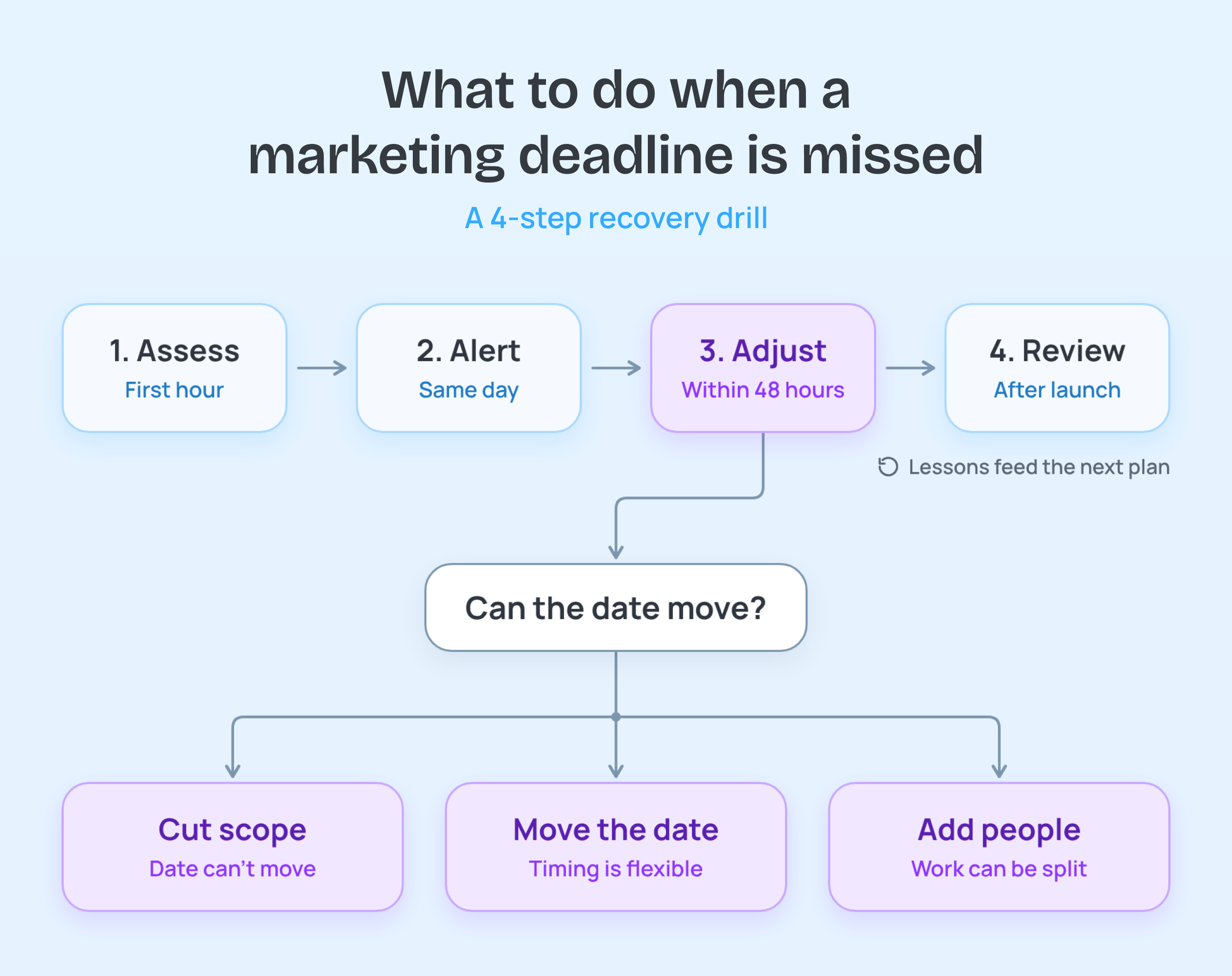
- Assess (first hour):Answer three questions: What’s late? By how much? What does it hold up?
- Alert (same day): Stakeholders handle bad news much better when they hear it early. Send a short note that says what slipped, what it affects and what they can choose from. Something like: “Heads up, the landing page is now Thursday instead of Tuesday. That delays the launch email. We can launch Tuesday with ads pointing to the current product page, or move everything to Thursday. Which works better?”
- Adjust (within 48 hours): Pick the trade off that fits:
- Date can’t move (event, sale, product release) → cut scope and launch with fewer assets
- Full campaign matters more than timing → move the date
- Work can be split and help is free now → add people
- Review (after launch): Hold a 20-minute review built around three questions
- Where did the delay start?
- Could we have seen it coming?
- What will we change next time?
Keep it about the process, not about who’s to blame. If people get blamed, they start hiding delays instead of raising them.
Managing deadlines in marketing comes down to a few habits: plan backward from the launch, schedule approvals as tasks, lock inputs early, and raise delays the same day. Those are the deadline management skills that matter most.
A spreadsheet works as a deadline tracker for one campaign. Once you’re running several, you need deadline management software that shows dependencies, approvals, team workload and at-risk tasks all in one place. That’s where project management software for marketing teams earns its place, especially for agencies.
5day brings all of this into one workspace built for marketing teams, so every campaign, approval and deadline stays visible – Try 5day.io for free!