
The real challenge for ready-to-scale marketing agencies is making resource planning dependable to ensure what is sold can be delivered without quietly eroding team capacity or delivery quality.
As agencies grow, revenue forecasts sit with leadership, and the true cost of delivery surfaces only as teams begin absorbing the load. Misalignment builds gradually, showing up as constrained creative space, delivery strain, and operational friction.
5day.io brings the structural visibility needed to manage this complexity. By unifying capacity, timelines, and commitments, it helps agencies gain clarity on how future work aligns with available capacity and where pressure is likely to emerge.
This article explores how marketing agencies can use 5day.io to approach resource planning with greater discipline, aligning commitments with capacity through shared, informed oversight.
What optimized resource planning actually means
Most conversations about resource planning collapse into frameworks and neat diagrams that look reassuring but rarely survive contact with real work.
A more useful way to think about resources is to stop treating them like machines and start treating them like batteries.
Machines are expected to run at full capacity as long as they are switched on. Batteries behave differently. They drain unevenly, and they need recovery time to perform well over the long term. Teams operate the same way. When you plan as though people are machines, short-term output may rise, but long-term performance always suffers.
True optimization shows up in outcomes.
It looks like:
- Predictable delivery without relying on heroics or last-minute sprints.
- Leaders being able to say no to work they cannot execute well, without panic or guilt.
- Understanding the future cost of today’s commitments before they are made
This is where many planning conversations go wrong, because they fail to distinguish between capacity, availability, and allocation.
| Capacity is what exists in theory, based on headcount and working hours | Availability is what is actually usable once meetings, context switching, leave, and energy are accounted for | Allocation is what has already been promised to existing work |
Optimized planning lives in the space where these three are clearly separated and continuously visible.
When they are blurred together, leaders consistently overestimate what the organization can handle.
These principles form the foundation of resource planning best practices for agencies managing multiple clients and overlapping campaigns.
The ideal utilization that healthy teams aim for
This is also why healthy teams rarely operate at 95 or 100 percent utilization. At that level, there is no buffer, no room for unexpected work, and no margin for quality. Teams running at 70 to 80 percent utilization may look underused on paper, but in reality, they are resilient. They can absorb change, think deeply, and deliver work that holds up under scrutiny.
Over time, these teams outperform those that are permanently maxed out, precisely because they are not running on empty.
There is a dangerous myth at the heart of over-optimization, and it deserves to be named directly. The myth is that maximum utilization equals maximum performance. In reality, pushing teams to the edge consistently leads to declining quality and an organizational culture where people either burn out or disengage quietly. The cost of this does not show up immediately, which is why it is so often ignored until it becomes expensive to fix.
How 5day.io approaches resource planning differently
For agencies and growing teams, 5day.io functions as a lightweight team resource planning and workload management tool, built for real client work.
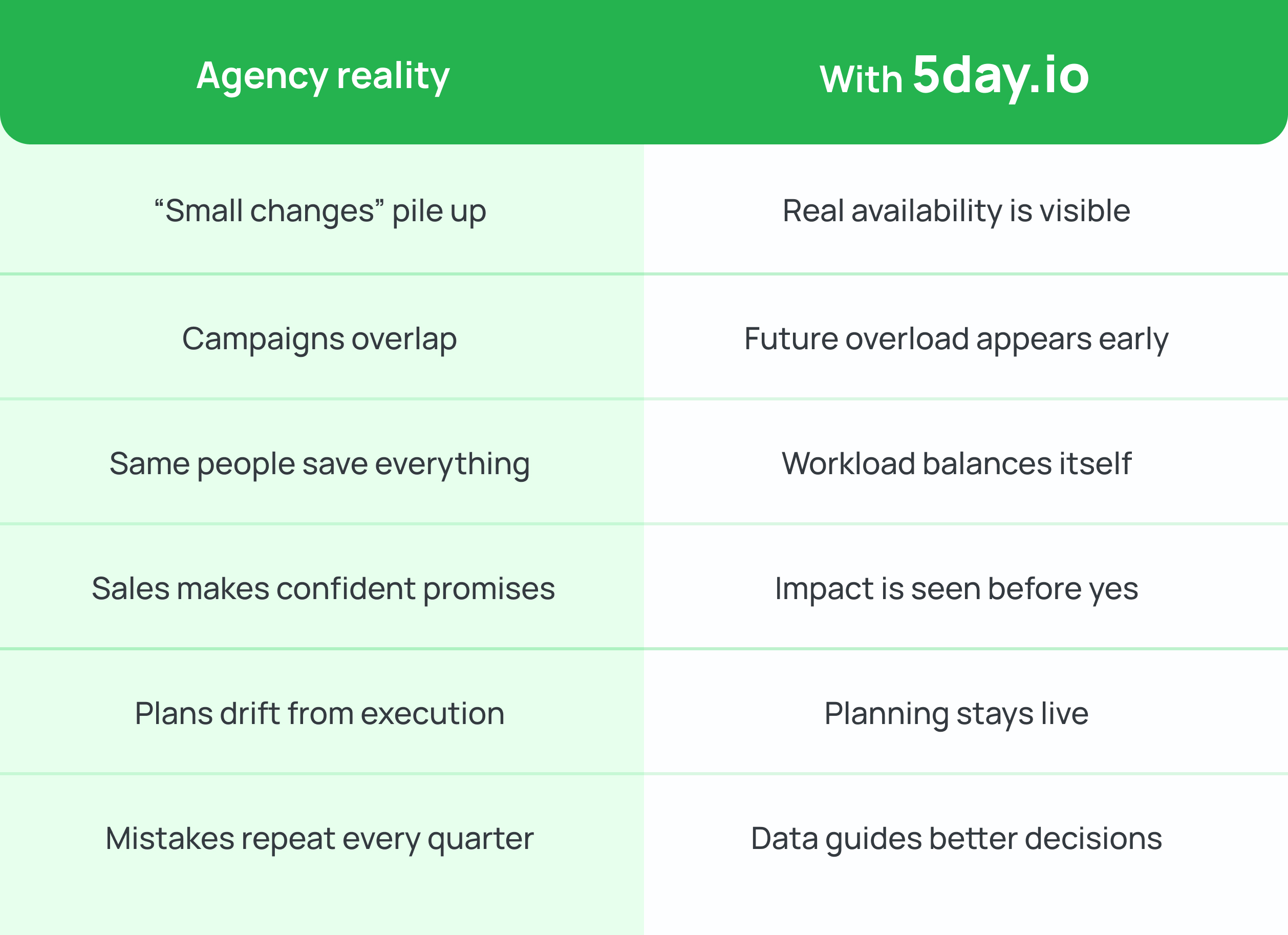
When every “small change” quietly eats capacity
In agencies, work rarely arrives cleanly scoped and neatly timed. Capacity leaks everywhere.
5day.io changes this by grounding planning in how time is spent. When billable work, non-billable work, internal reviews, client calls, and time off are logged distinctly, availability is measured concretely. Agency leaders can finally see that a designer who looks free on the project plan is spending 40 percent of their week in revisions and internal syncs.
Planning decisions stop relying on assumptions and start reflecting lived agency reality.
When campaigns overlap, and timelines collide
Marketing agency projects overlap one another. Each project looks reasonable on its own, but together they create invisible pressure that only surfaces when deadlines are missed.
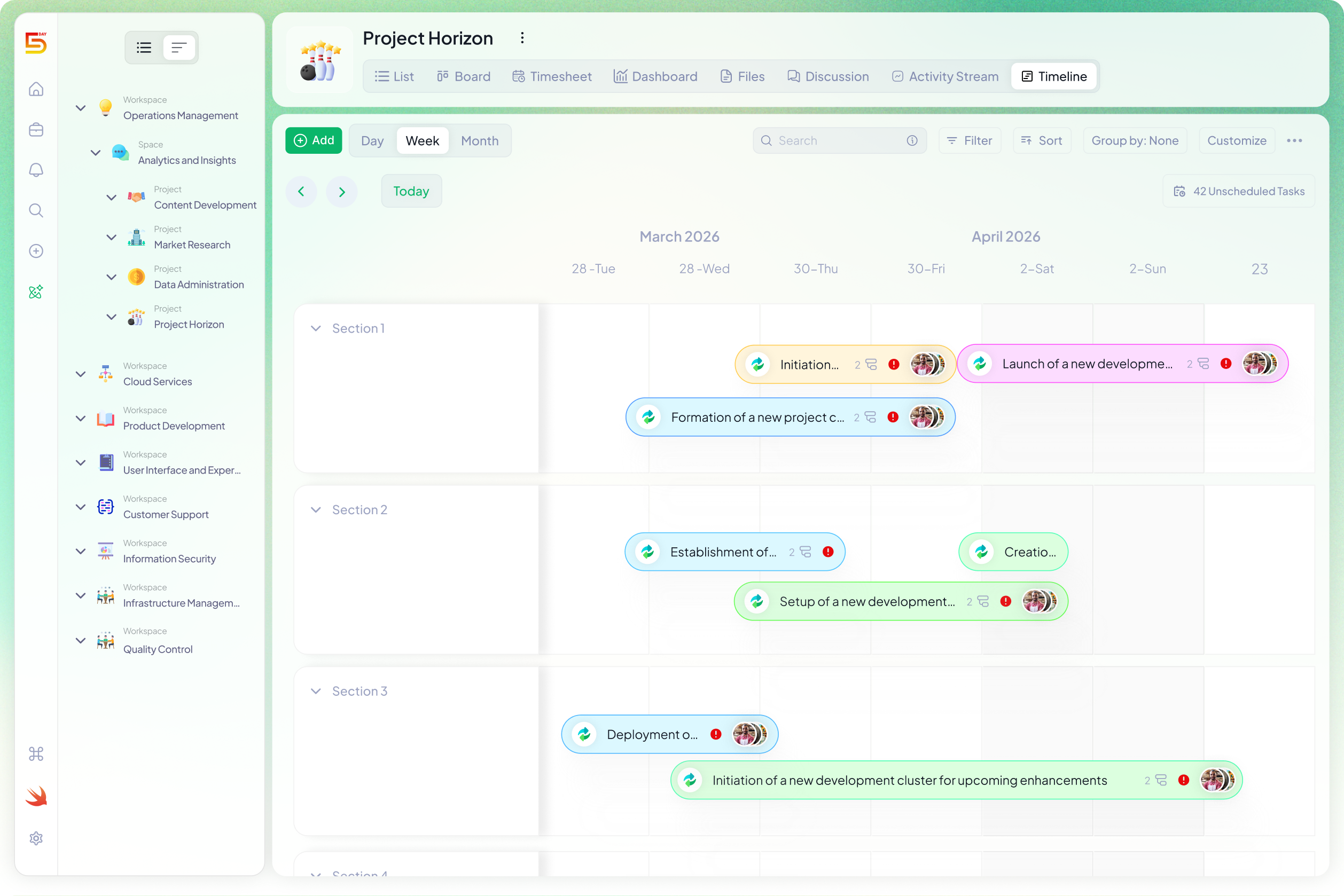
5day.io makes this visible by spreading work across time.
When campaigns, tasks, and subtasks are mapped with real start and end dates, estimates, and dependencies, the workload can be viewed weeks ahead.
You can see that the same copywriter is expected to handle three campaign peaks in the same fortnight. This allows agencies to rebalance early, before quality drops or late nights become normalized.
When account planning and delivery drift apart
One of the biggest failures in agency resource planning happens between sales, accounts, and delivery. Work is sold with confidence, then delivery teams are asked to “make it work.” By the time feasibility is questioned, the commitment is already made.
With 5day.io, planning conversations happen against the same shared reality. Account leads can see the downstream impact before committing to new work. Ops teams can model what adding a new client or campaign does to timelines and people. Decisions become grounded, not optimistic. This changes how agencies say yes.
When planning tools fall out of sync with real work
Many agencies have planning tools that look great during reviews and become irrelevant during execution. Plans live in one place. Work happens somewhere else. Updates lag. Trust erodes.
5day.io avoids this by keeping planning and execution together. Discussions, files, feedback, and task updates live alongside the work itself. When priorities change, the impact is immediately visible.
When agencies repeat the same mistakes every quarter
Without feedback loops, agencies keep repeating the same planning errors.
5day.io closes this loop through analytics tied directly to tasks and time entries.
Agencies can see which types of work consistently overrun, which clients consume disproportionate effort, and where capacity breaks most often. Over time, this allows agencies to price better, plan smarter, and protect margins without relying on gut feel.
What this changes for agencies in practice
When resource planning reflects how the agency behaves, everything steadies. Growth no longer feels like something that threatens the team every time a new client signs.
That is the difference 5day.io brings to marketing agencies. It respects its complexity and gives agencies the clarity they need to manage it without burning out the people who make the work possible.
The real-world challenges that kill resource planning
| Human challenges | Operational challenges | System challenges |
|
|
|
Common mistakes to avoid when implementing resource planning tools
When a resource planning initiative stalls or quietly fades away, it is usually responding to context.
When visibility feels like surveillance
One of the earliest mistakes happens before anyone even opens the tool.
Teams can sense immediately when visibility is being used to police productivity instead of protect capacity. When that happens, people adapt by logging defensively, smoothing rough edges, or disengaging altogether. What was meant to surface reality ends up distorting it.
When consistency quietly collapses
Another common breakdown comes from inconsistency rather than resistance. Early on, energy is high, and data feels fresh. Over time, updates slip, timesheet entries lag, and small gaps begin to appear. Since planning systems depend on momentum, even minor lapses compound quickly.
Once people stop trusting the data, they stop using it to guide decisions, and the system slowly loses relevance.
When tools replace conversations instead of supporting them
There is a quieter mistake many leaders make without realizing it. They assume that once the system exists, alignment will follow automatically. In reality, no tool replaces human conversation.
When planning, data is used to shut down discussion rather than invite it; teams feel overruled. Numbers without context can create as much friction as intuition without data.
When expectations move faster than learning
Impatience creates another form of failure.
Resource planning tools are often rolled out with the hope that clarity will appear almost immediately. When early insights feel messy or obvious, leaders may conclude the tool is not working. What is often missed is that the first phase of resource planning is about learning patterns.
Optimization comes later, once reality is understood.
Why this is a cultural shift, not a software rollout
All of these missteps point to a deeper truth. Resource planning is not a technical switch you flip. It is a cultural shift in how work is made visible, how limits are respected, and how trade-offs are discussed.
Tools enable this shift, but they cannot force it. Success depends on leaders modeling curiosity over control and teams feeling safe enough to tell the truth about capacity.
Step-by-Step: Using 5day.io to Optimize Resource Planning
Below are practical steps of project resource planning using 5day.io in real agency environments.
Step 1: Get visibility into actual capacity, so you stop planning on fiction
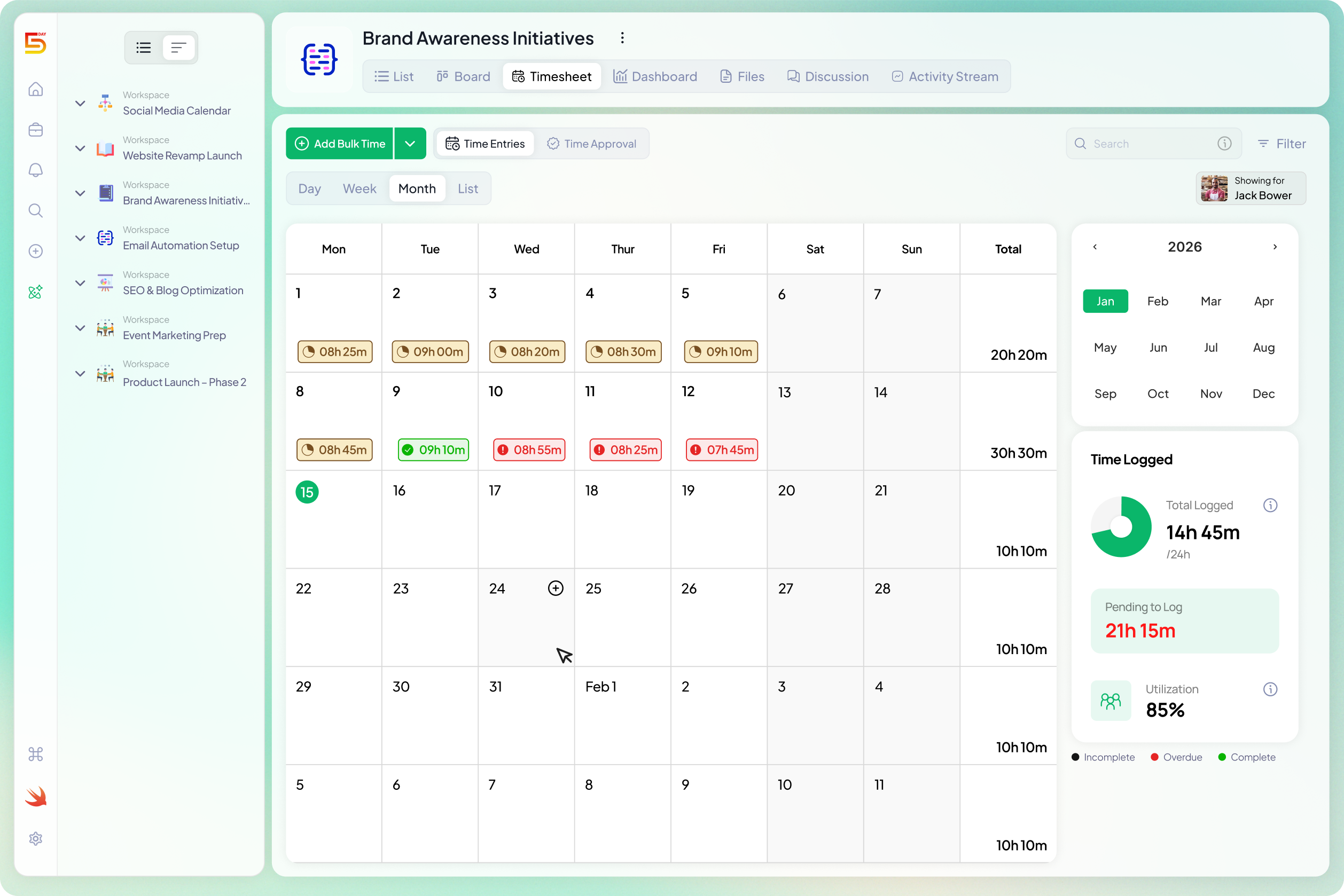
Most tools begin by asking you to define capacity upfront, usually as a fixed number of hours per day. 5day.io flips that sequence.
It asks you to observe reality first and let capacity emerge from how time is actually used.
How to do this in 5day.io
- Start by configuring time categories so they reflect how work truly happens in your organization. In 5day.io, time is not treated as a single bucket. It is explicitly split into billable time, non-billable time, internal work, and time off, each tracked and reported separately. This immediately exposes where capacity is already being consumed outside of project delivery.
- Next, ensure people log time in the way that suits their workflow. Some log daily, some in bulk, some retrospectively. 5day.io supports all of this without breaking reporting, which means you get participation without forcing behavior.
- Then review capacity using week or month views rather than daily snapshots. This is where the “eight hours a day” myth collapses. You begin to see partial availability, overtime trends, and recurring internal drains that never show up in project plans.
Why does this feel different from other tools?
Most tools define capacity first and ask people to fit into it. 5day.io lets capacity surface from real data.
Step 2: Map work against timelines, so overload appears weeks earlier
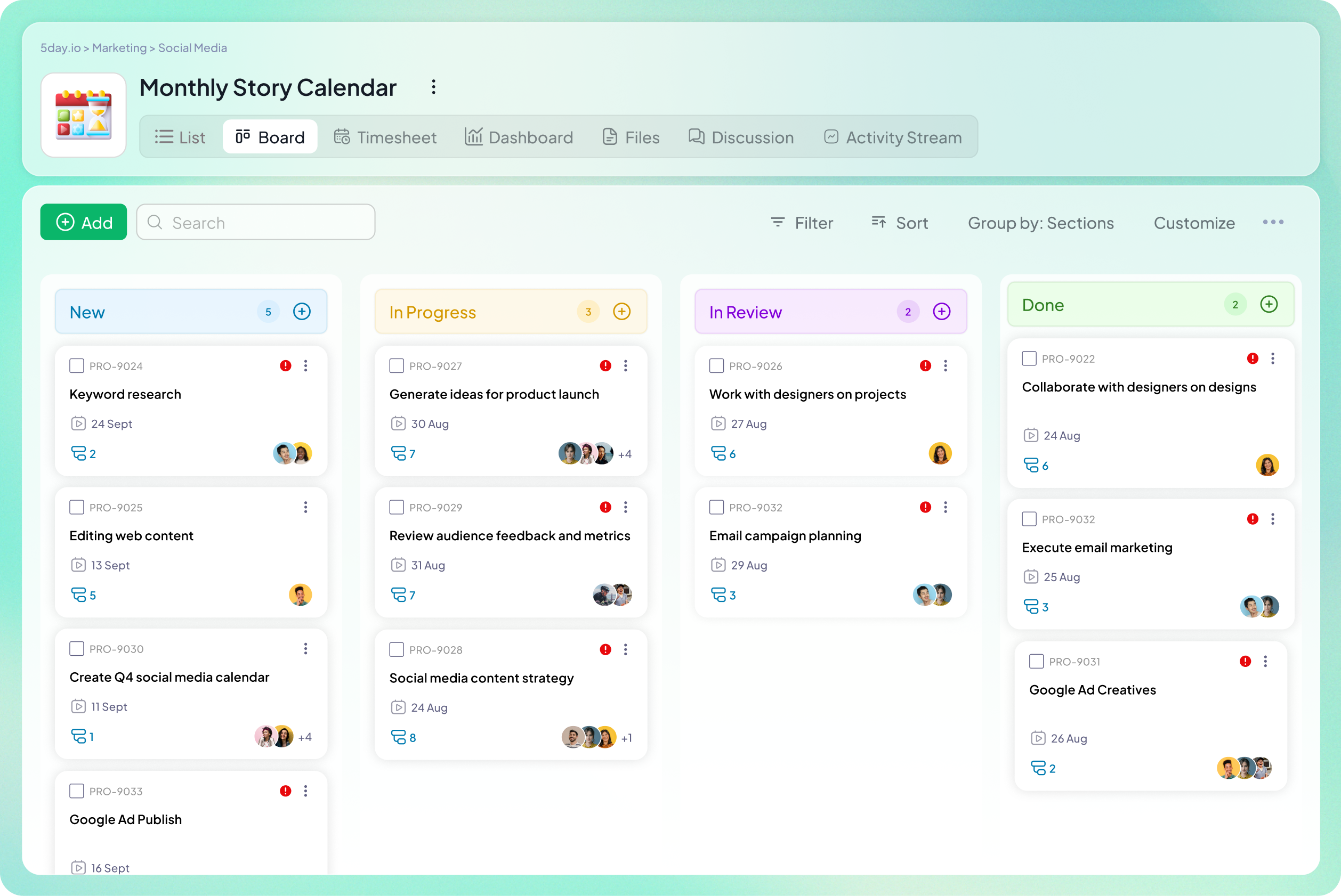
Once capacity is grounded in reality, the next failure point in most teams is that work is still planned as static lists. 5day.io treats work as something that unfolds over time.
How to do this in 5day.io
- Create tasks and subtasks with real start and end dates, not just due dates.
- Add time-based estimates in hours, days, or story points, depending on how your teams think about work. These estimates are not decorative; they directly influence workload distribution across timelines
- Use dependencies where work cannot realistically run in parallel. This prevents timelines from looking deceptively flexible when they are not.
- Switch between list, board, and timeline views to see how work stacks up over the coming weeks.
When the same person appears repeatedly across overlapping timelines, future overload becomes visible long before it turns into a problem.
Why does this feel different from other tools?
Many tools show you who is assigned to what. Few show you when that work actually competes for the same attention. 5day.io makes time the organizing layer.
Step 3: Balance workloads intelligently, so burnout never becomes invisible
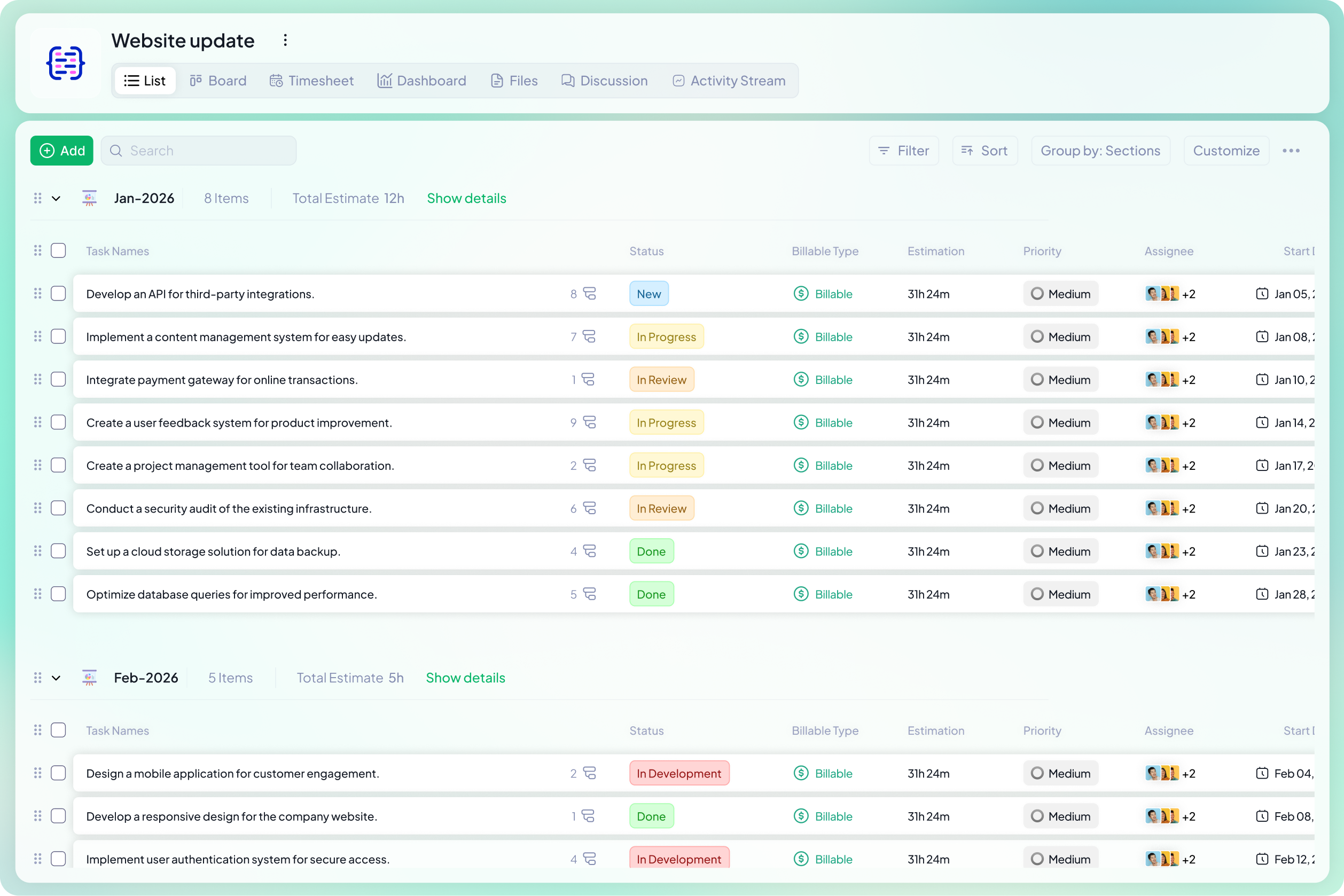
This is the point where most teams default to heroics. 5day.io gives you a way out before that happens.
How to do this in 5day.io
- Review workload distribution at the assignee level using project views and timesheet data together. Because tasks support multiple assignees and assignee-wise estimation, you can rebalance work without rewriting entire plans.
- Look for patterns rather than incidents. If the same people consistently show higher utilization across projects and weeks, the issue is systemic, not situational.
- Redistribute work by adjusting assignments, splitting tasks, or shifting timelines while there is still flexibility. Since discussions, comments, and files live directly on tasks, these changes happen in context.
Why does this feel different from other tools?
Most tools surface overload only when something breaks. 5day.io lets you rebalance quietly and early, without escalating pressure or singling people out.
Step 4: Plan for what’s coming, so today’s yes doesn’t sabotage tomorrow
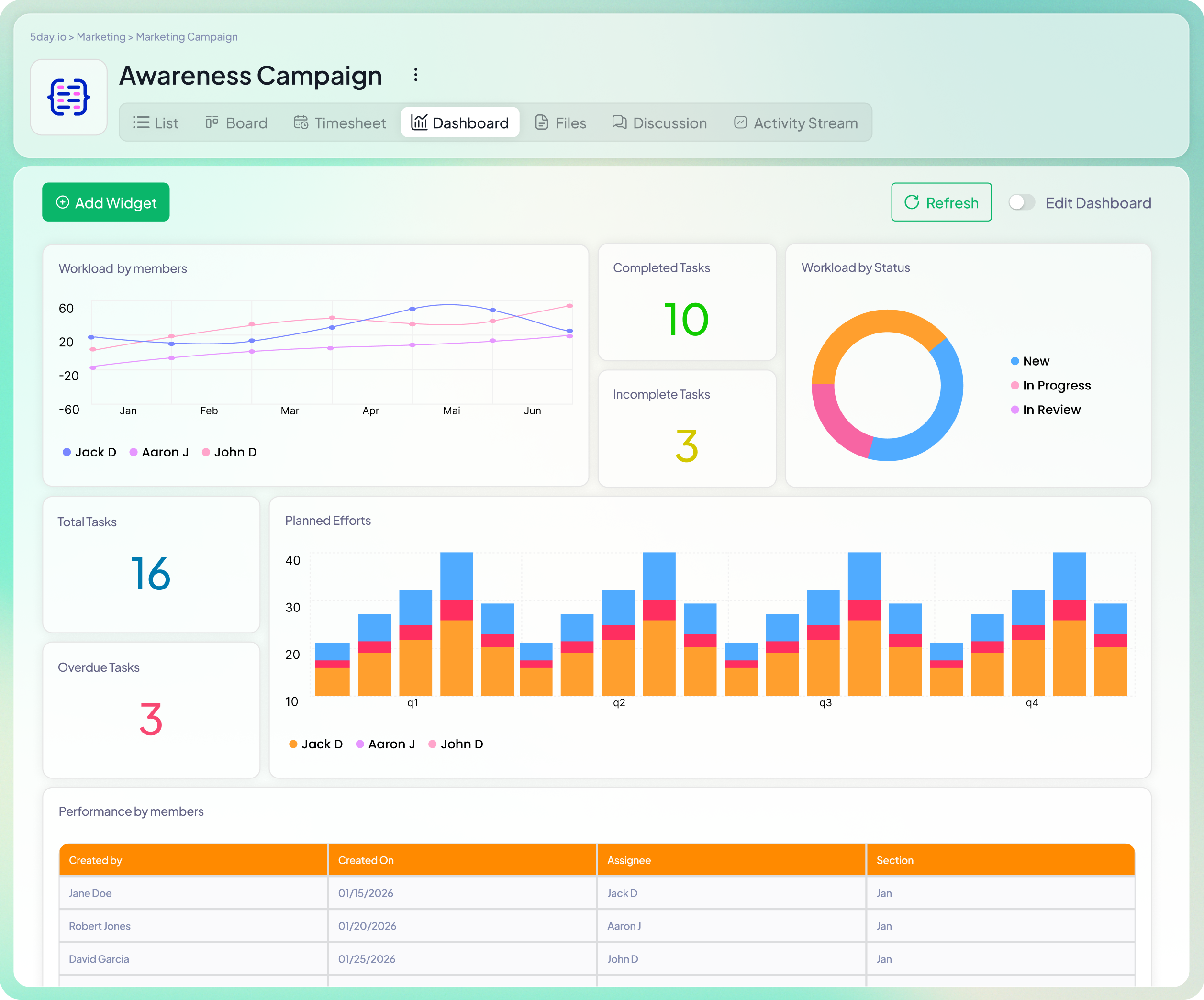
Optimized resource planning is about understanding the cost of decisions before they are locked in.
How to do this in 5day.io
Use existing project timelines and workload data to evaluate new work before committing to it. Ask simple but powerful questions: where will this effort land, who will absorb it, and which weeks will feel the strain.
Project analytics pull directly from tasks, subtasks, and time entries, giving you evidence instead of intuition when evaluating trade-offs
Because work schedules, holidays, hybrid setups, roles, and permissions are already part of the organizational structure, these scenarios reflect how the organization actually operates, not an idealized version of it.
Why does this feel different from other tools?
Most planning tools help you commit faster. 5day.io helps you commit wiser by making the downstream impact visible before approval.
Conclusion
As teams grow, the systems that once relied on instinct and familiarity begin to strain under their own weight.
Each new commitment carries quiet risk, and delivery holds together through personal stretch instead of deliberate choice.
5day.io changes this by making reality visible. When time, effort, and future commitments are clearly seen in one place, planning stops depending on guesswork and starts guiding decisions with confidence.
If you’re looking for resource planning software for small teams or growing agencies, 5day.io is designed to scale with how work actually happens. See 5day.io in action on solving resource planning challenges today. Sign up for our 30-day free trial today!