

Ask any marketer whether podcasting is oversaturated in 2026 and you’ll usually get a confident “yes.” Every few months, someone declares podcasting dead.
And on the surface, the skepticism makes sense. Open any podcast app and you’ll find millions of feeds, many abandoned after a handful of episodes, many more indistinguishable from one another.
But “oversaturated” is doing a lot of work in that argument. Because in a way, it guides the conversation towards how many podcasts are on the web. But really, it should be steered toward how many are still active and useful to their relevant audience.
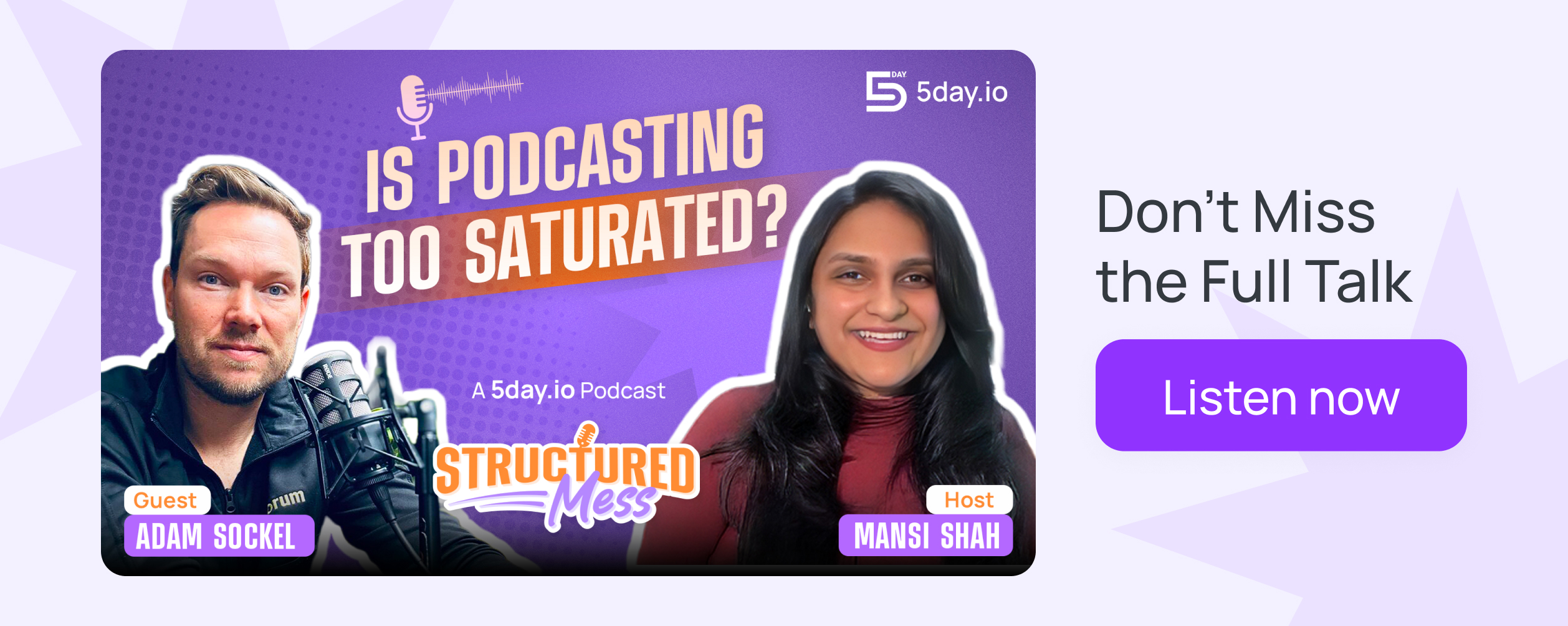
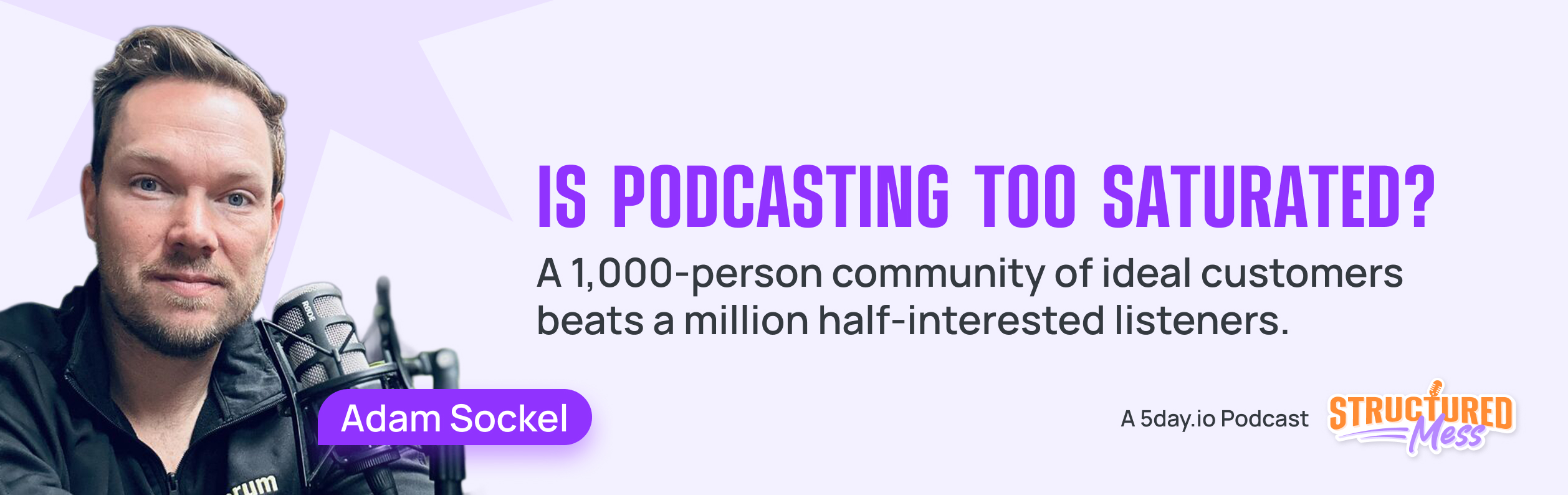
So, I sat down with an expert, Adam Sockel, Expert in Podcast Marketing at Share Your Genius. It’s a company that helps B2B teams start a branded podcast journey.
In this article, we’ll look at what data shows aboutpodcasting in 2026 and get a viability checklist for deciding whether your brand should launch a podcast. The crux of this article is taken from the video above, so listen to it to understand the lived experience from an expert. Let’s see, are podcasts oversaturated in 2026?
The State of Podcasting in 2026: What the Data Actually Shows
If podcasting were truly oversaturated, you would expect the numbers to tell a simple story:
- Too many shows
- Flat audiences
- Shrinking attention
Instead, the picture is more complicated, and more interesting.
Yes, there are millions of podcast feeds. But most of them are not competing for anyone’s attention.
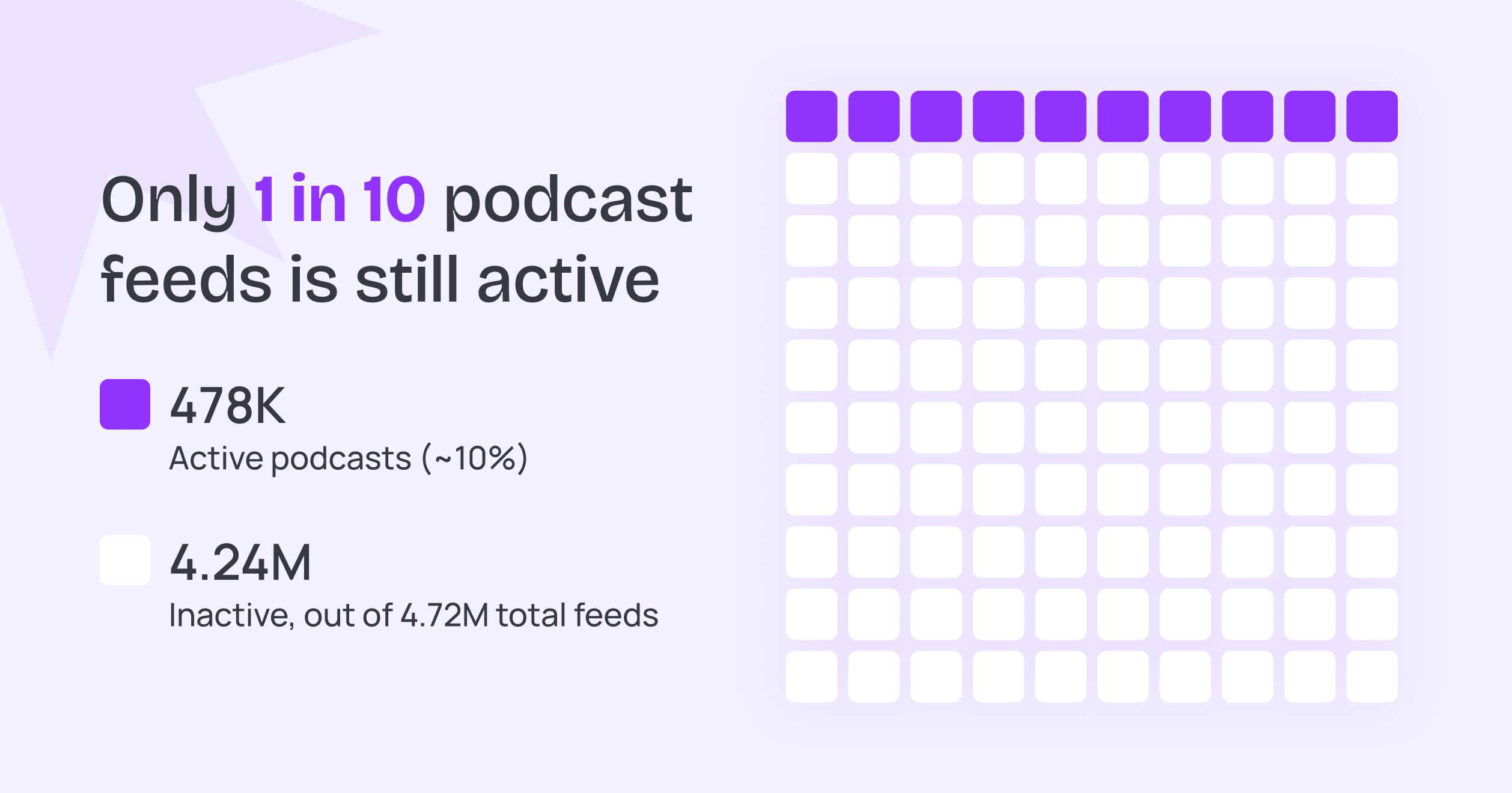
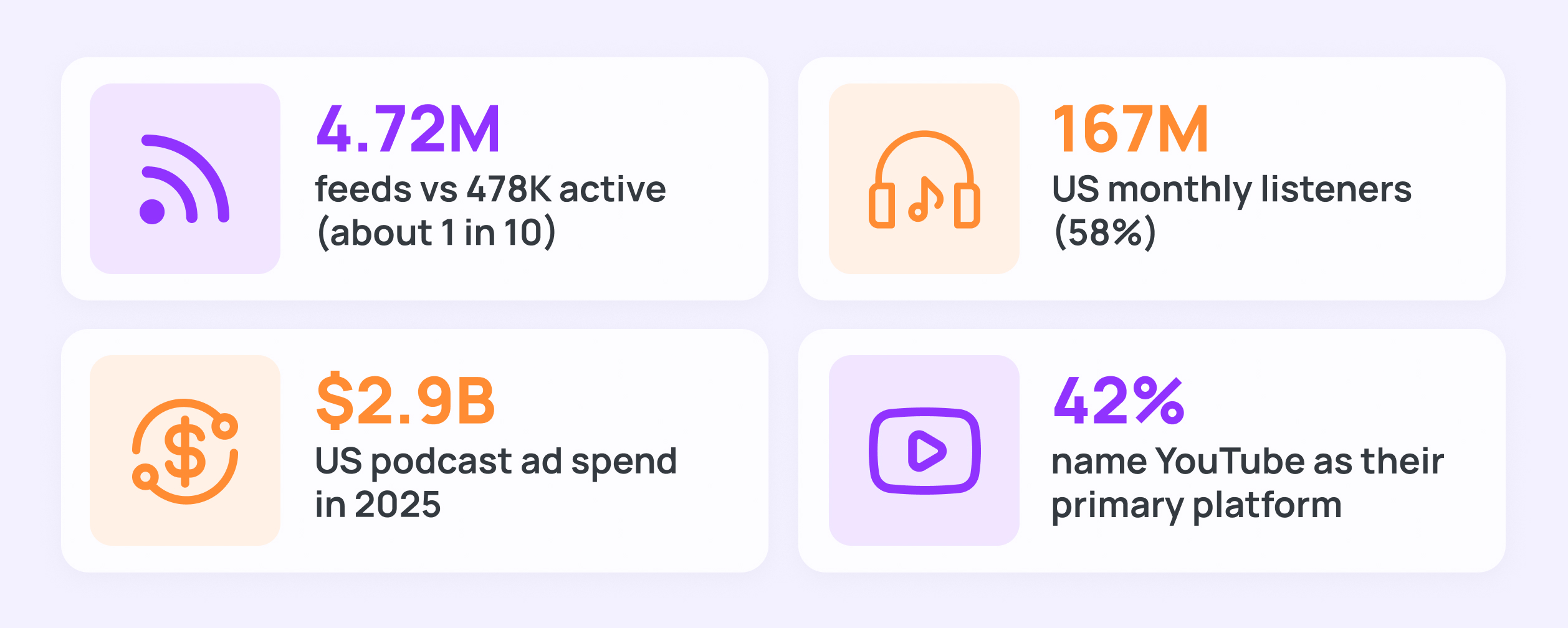
Podcast Index data cited by Libsyn puts the total at roughly 4.72 million feeds worldwide, while only about 478,000 shows published a new episode in the past 90 days.
That means the vast majority of the “podcast market” is an archive of abandoned experiments.
Meanwhile, demand has not slowed down
In the U.S., 167 million people, 58% of Americans aged 12 and older, listened to a podcast in the past month, according to Edison Research’s Infinite Dial 2026. That is an all-time high. Globally, listener estimates for 2026 land around 619 million people.
The money follows the attention
U.S. podcast advertising generated approximately $2.9 billion in 2025 and is projected to reach about $3.0 billion in 2026, according to IAB and PwC figures cited by Libsyn.
The biggest shift, though, is where podcasting now lives
YouTube has become the default front door for the medium.
Among monthly U.S. podcast listeners, 42% name YouTube as their primary platform; among weekly listeners, 37% say it is the service they use most. This is ahead of Spotify and Apple Podcasts. The data again comes from Infinite Dial’s research.
This change is because podcasting is no longer only an audio format you consume while driving or doing dishes. It is a video-first discovery engine and a distribution channel.
This proves that the barrier to launching has never been lower, but at the same time, the barrier of being worth listening to has never mattered more.
Macro Saturation vs. Niche Saturation
“Podcasting is saturated” is a claim about a market that does not really exist.
There is no single podcast market. There are thousands of genres: true crime, comedy, sports, self-improvement, marketing, healthcare, RevOps, manufacturing, venture capital, local business, and every narrow intersection in between.
A show can be brutally oversaturated in one category and nearly uncontested in another.
A general true-crime podcast, for example, is entering a category with enormous established audiences, recognizable hosts, production budgets, and years of accumulated trust. The same is true for broad comedy interview shows and generic marketing podcasts.
In those spaces, “another podcast” while not automatically being a disadvantage, does require a distinctive angle to breakthrough.
B2B niches often look very different.
For example, a podcast for RevOps leaders at mid-market SaaS companies may not need hundreds of thousands of listeners to be valuable. If the show reaches the people who can buy, refer, partner, or influence a purchase, a few hundred highly relevant listeners per episode can outperform a much larger but unfocused audience.
For a brand or agency, the goal is to become the most useful voice in a specific room.
That means defining the niche by more than topic. “A podcast about marketing” is too broad. “A podcast for B2B marketing leaders figuring out how AI changes content operations” is a market. The second version gives you a clear guest universe, a repeatable content angle, a reason for the right people to subscribe, and a much easier path to distribution.
Niche saturation also changes what success looks like.
In a broad category, success might mean downloads, rankings, and sponsorships. In a niche B2B podcasting category, success might look like:
- The right prospects accepting guest invitations
- Sales teams using episode clips in follow-ups
- Guests introducing the host to other ICP contacts
- Prospects mentioning the show during sales conversations
- Partnerships emerging from guest relationships
- The podcast becoming a searchable library of category expertise
So before asking whether podcasting is oversaturated, ask if your specific niche oversaturated or merely under-served?
In many B2B categories, the answer is the latter. There may be plenty of content, but very little of it is consistently produced and useful to the buyer.
Podcast Viability Framework
A podcast should not be a leap of faith. Before starting to build your idea, run it through a simple viability test.
This determines whether starting a podcast is the right vehicle for your specific goal, audience, investment, and capacity.
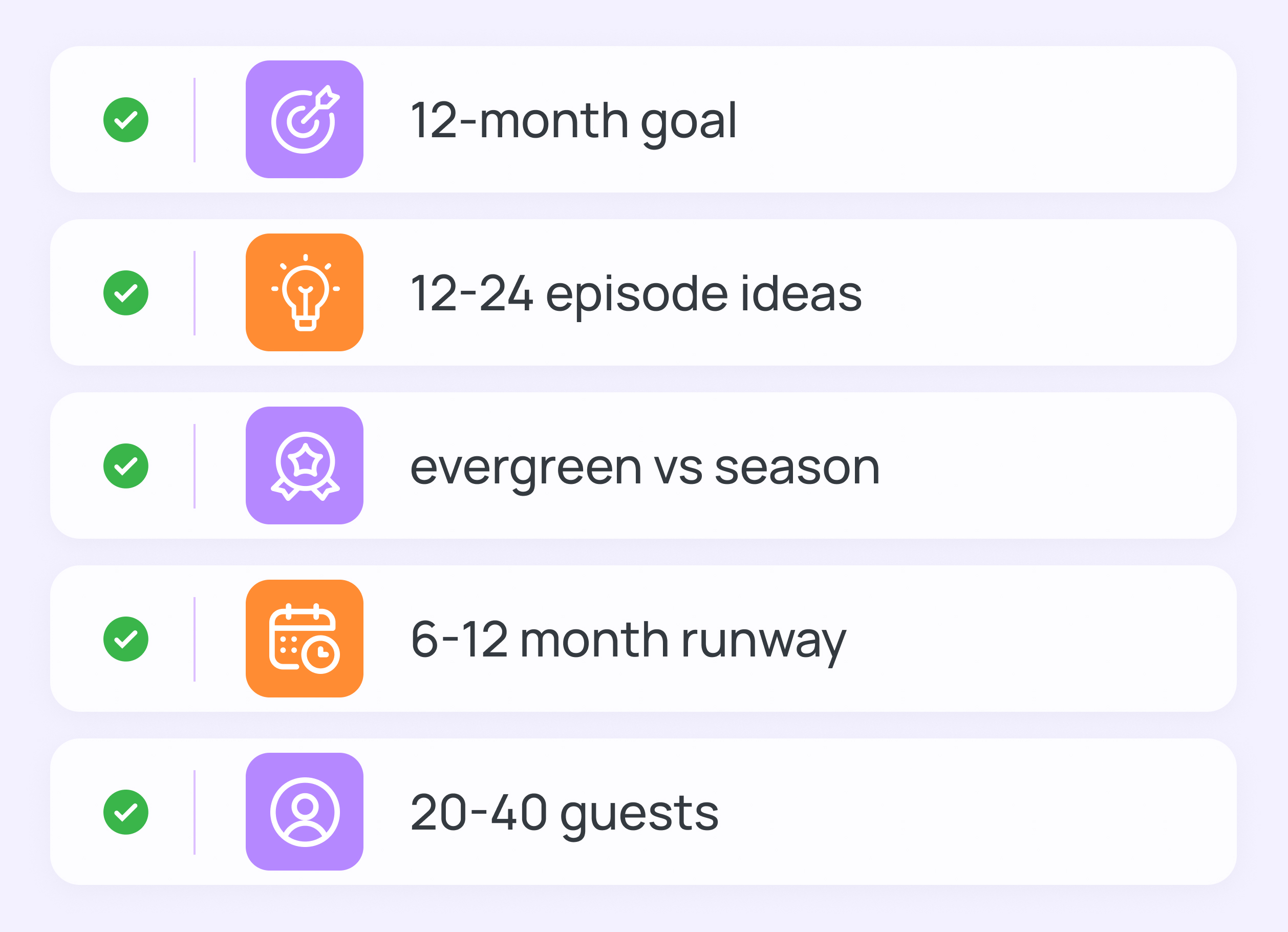
Ask these five questions before launch.
Can you define success 12 months from now?
“More brand awareness” is not a strategy. Neither is “we want to be thought leaders.”
Choose a specific, primary outcome:
- Generate qualified pipeline conversations for a particular service line
- Build relationships with 30–50 ICP guests
- Create a searchable library of expertise around one category problem
- Support a product launch, research report, or community
- Increase branded search and inbound inquiries over time
A podcast can support several goals, but it needs one primary job. Without that, every future decision like guest selection, episode format, distribution, reporting, becomes subjective.
Do you have a show’s worth of ideas?
Many podcasts fail because the concept only has enough fuel for two or three conversations.
Before launching, map at least 12–24 episode ideas. Look for:
- Recurring problems your ICP faces
- Debates inside your category
- Lessons from customer work
- Questions your sales team hears repeatedly
Should it be evergreen or a limited season?
Not every podcast needs to run forever.
An evergreen show makes sense when you want to build long-term authority or develop a repeatable content engine.
A limited season, on the other hand, is a smarter choice when the podcast supports a time-bound initiative.
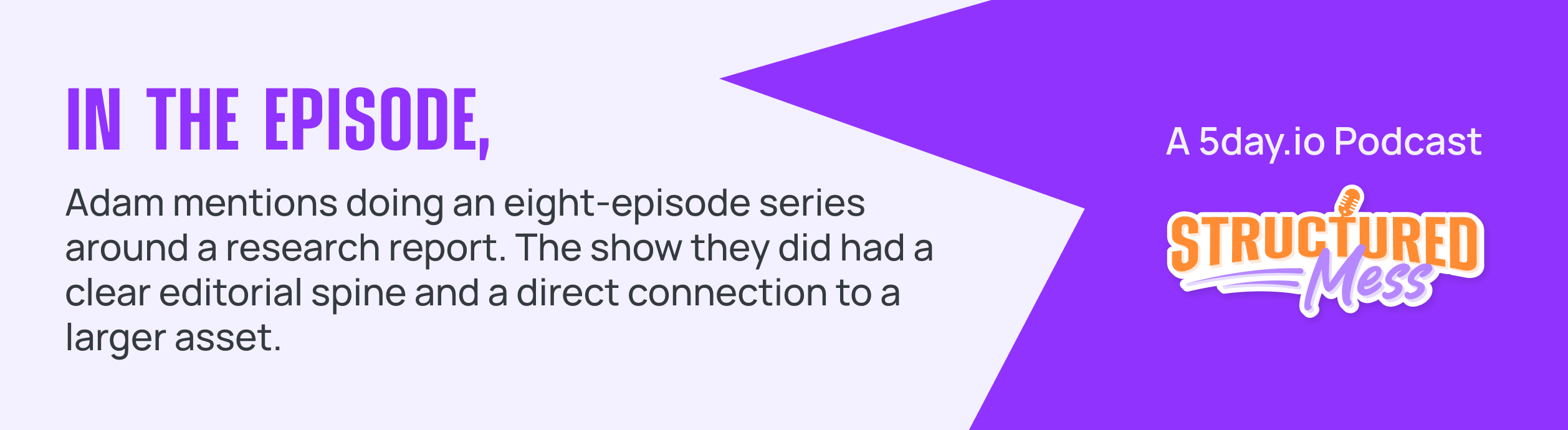
A short season can also be a lower-risk way to test an idea before committing to an ongoing show.
Can you commit for 6–12 months before judging results?
Podcast growth is rarely immediate. Discovery takes time, especially for B2B shows that depend on niche audiences and search-driven video consumption.
If you plan to evaluate the podcast after three episodes based on downloads, you have already set it up to fail. Give the show a real runway of 6–12 months with consistent publishing, promotion, and iteration before deciding whether it is working.
At the same time, do not ignore early signals. Measure signals like guest quality, audience feedback, content reuse, sales conversations, and whether the show is reaching the people it was designed for.
Do you have access to the right guests?
A podcast is only as strong as the people willing to join it.
You do not need celebrities. You need guests your ICP can learn and hear from.
Before launch, build a guest list of 20–40 realistic names. If you cannot identify enough credible guests, or cannot find a credible path to reaching them, that is a strategic problem to solve before production begins.
How to make your podcast stand out in 2026?
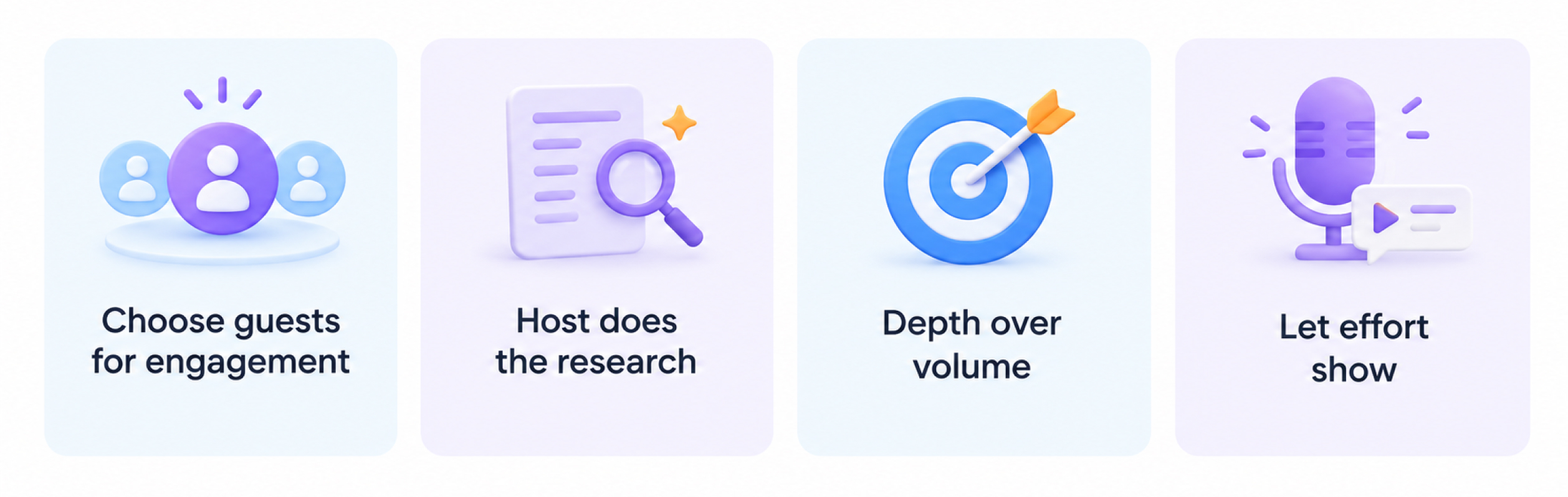
The podcasts that stand out in a crowded market build their fundamentals with unusual intention. These are the recurring themes we have seen and discussed in the episode.
Choose guests for engagement
A recognizable guest can create a spike in attention. But an engaged guest creates compounding value.
The best guest is the person who:
- Has a specific, relevant point of view
- Can tell stories rather than repeat talking points
- Is willing to challenge conventional wisdom
- Brings an audience that overlaps with your ICP
- Will share the episode and participate in distribution
- May introduce you to other strong guests
A practitioner with 2,000 followers who is deeply embedded in your buyer community will probably be more relevant to you than a big-shot name.
Let effort show
Audiences can feel when a show is made carelessly, and, they can feel when it is not.
Effort does not need to mean expensive production. It means:
- Thoughtful guest selection
- Real preparation
- Strong editing
- Clear episode framing
- Useful takeaways
- Respect for the listener’s time
In a crowded market, the winning podcast is the one that makes a specific audience feel, “These people understand my world and therefore, this conversation is worth 45 minutes of my attention.”
Wrapping Up
I think we are asking the wrong question altogether when we talk about whether podcasting is oversaturated.
The question is whether you can build a show that is more useful and consistent than what your audience already encounters.
If the answer is yes, the crowded market is not a barrier. It is evidence that attention is valuable and that most participants are not competing seriously for it.
That is exactly the thinking behind Structured Mess, 5day.io’s podcast built by marketers, for marketers. 5day.io is a marketing ops management tool built to help you execute your work.
Each episode brings marketing experts together to unpack what is happening in the industry: the workflows, pressures, tools, decisions, and shifting expectations shaping modern marketing teams.
If you want a clearer view of how marketing is evolving, Structured Mess is where those conversations happen.
Listen to Structured Mess and join the conversation.