

Marketing plans look solid in isolation. Each campaign has a brief, and each deadline feels reasonable on its own. But when priorities collide, and decisions depend on context, problems arise. Over time, teams adapt and step in to keep work moving. It works, until it doesn’t.
The uncomfortable question most marketing leaders avoid asking is: if you stepped away for a month, what would still run without hiccups?
Uncertainty shows where the marketing management process falls short. That happens when the process has never carried that load before.
In this article, you’ll learn how teams identify those weak points and improve their marketing management workflow. More importantly, you’ll also learn the steps that keep execution reliable as volume and complexity increase.
What is the marketing management process?
The marketing management process is the systematic approach to campaign planning, testing, executing, and analyzing marketing efforts to meet business objectives. It covers everything from market research and goal-setting to campaign execution and performance tracking.
Essentially, marketing management turns strategy into action using a documented workflow.
It involves developing and using strategic marketing programs and processes that align with broader business objectives. Clear processes and coordination keep campaigns on track.
Managers typically break this into 5 steps of marketing process. For example, common components include:
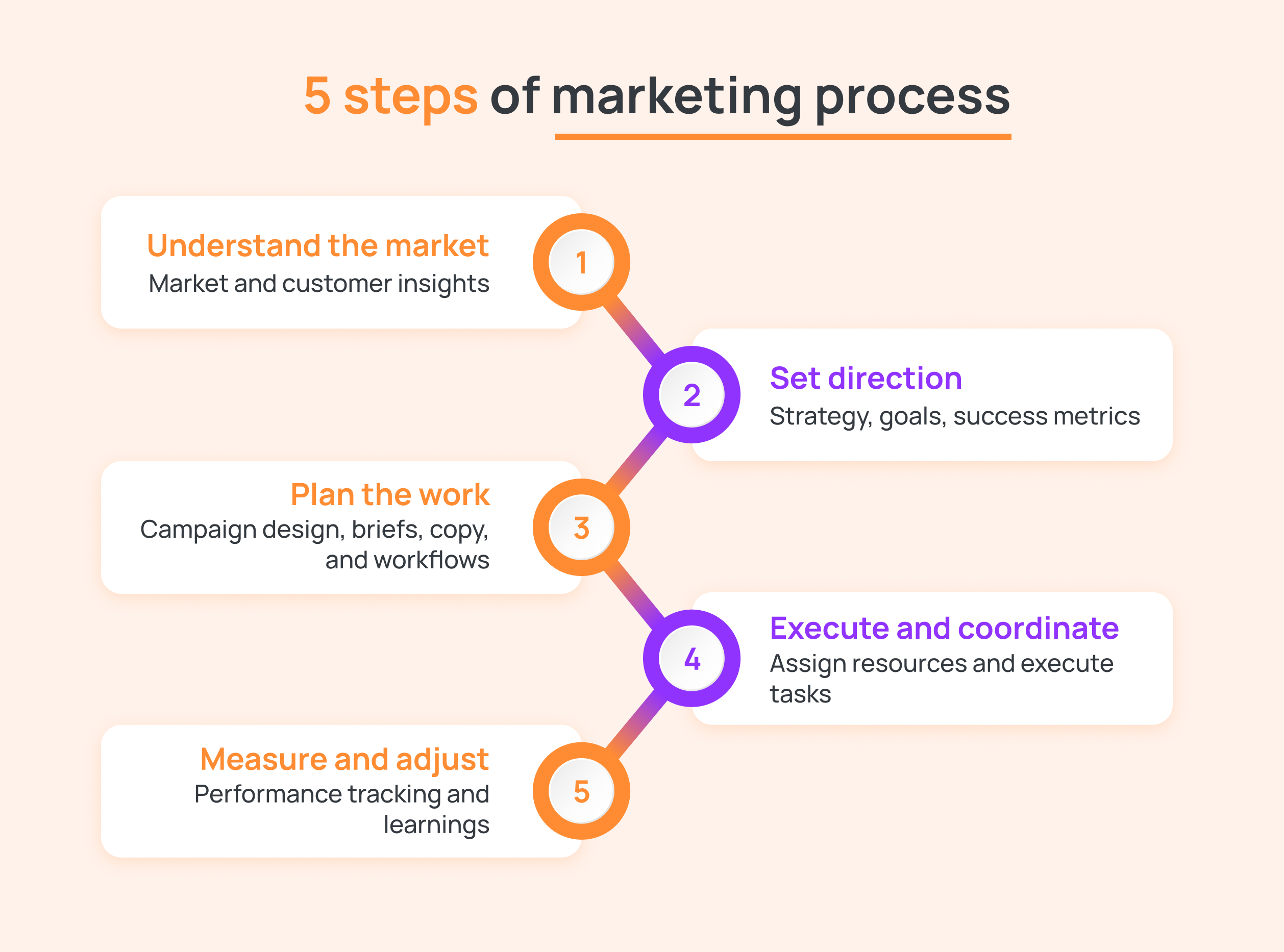
1. Market and customer analysis
This involves conducting research on customers and market trends. This insight directs strategy and helps marketers to understand the real need.
2. Strategy and goals
Define clear marketing goals (brand awareness and lead generation, etc.) and outline tactics to achieve them. Set SMART or OKR metrics tied to business outcomes.
3. Product/Campaign planning
Develop messaging, creative assets, workflows, and campaign plans. Create templates or briefs that outline tasks, deliverables, deadlines, and required approvals for each campaign.
4. Execution
Launch campaigns by assigning resources and executing tasks. Use checklists or project boards to ensure every step (design, copywriting, editing, publishing, etc.) happens on time.
5. Monitoring and control
Track performance with reports and dashboards. Adjust tactics based on metrics (clicks, conversions, lead gen, ROI) and learnings.
Each stage depends on clear workflows and coordination. This helps treat marketing like a managed project and ensure each task (from creative brief to campaign review) fits into an organized flow.
Why does optimizing your marketing process matter?
Teams need ongoing marketing process improvement to stay Agile and keep up with constant change. Optimizing workflows delivers better results.
A 2023 Gartner survey found that marketing organizations with strong operational excellence efforts were 43% more likely to meet or exceed performance goals than those without such focus. This highlights the measurable benefits of improving marketing operations and processes.
In short, refining processes boosts efficiency and results.
Further, optimized processes also tackle common sources of waste.
According to a 2024 Gartner survey, 84% of marketing leaders and employees report high levels of ‘collaboration drag’. The main reasons include too many meetings, excessive feedback loops, and unclear decision authority when working across functions.
These factors create operational friction and slow execution.
By contrast, efficient workflows free your team to focus on creative strategy instead of repetitive busywork. Well-defined steps and roles mean everyone knows what to do next.
Effective project management gives real-time visibility into campaign progress and potential bottlenecks, so teams catch issues early.
Here are some reasons optimization pays off:
1. Greater efficiency
Clear workflows reduce duplicate work and reduce handoff delays. Teams spend less time coordinating and more time executing. Projects move steadily forward with minimal idle time.
2. Higher quality and consistency
Standardized templates and approval paths ensure every deliverable meets the same criteria. No more assets lost in email or team members missing assigned tasks. For example, dedicated content workflows keep writers, editors, designers, and reviewers synced.
3. Better morale and accountability
When roles and deadlines are clear, team members know what’s expected of them. This reduces confusion and allows staff to work autonomously without dropping balls.
Clear ownership and automated reminders (for due dates or approvals) keep people engaged.
4. Faster time-to-market
Optimized planning and review cycles speed up campaign launches. Agile approaches (sprints, frequent standups) let you iterate quickly on feedback, whereas bulky processes slow you down.
In practice, teams with efficient workflows can run more campaigns in the same period.
5. Improved ROI
All these gains add up to better returns on marketing spend. If your team wastes fewer hours and launches more effective campaigns, the bottom-line impact is significant. Many leaders find that process gains yield higher ROI improvements than small budget increases.
Steps to optimize your marketing management process

Strong marketing execution depends on how teams adapt in ongoing systems. Teams that perform well do not stop to redesign their process every time something changes. Instead, they build processes that adjust as work moves forward, based on what they find and decide in real time.
The steps below focus on building that kind of flexibility into your marketing management process. Each step helps teams respond faster during execution and plan better upfront.
1. Audit current processes and workflows
Start by mapping out exactly how work gets done. Document major campaigns and list each step from kickoff to completion. Ask questions like where delays happen or if tasks are piling up in approvals.
Look for pain points. By inventorying your current process, you uncover inefficiencies. Audit the current marketing process management to identify gaps and opportunities for improvement. Document every bottleneck you find.
Survey the team or create a whiteboard flowchart of your core workflows. If more than 60% of employees feel overburdened, ask what slows them down. Compile a list of repetitive tasks and manual checklists that cost time.
2. Align goals and metrics
Define clear, measurable objectives for your marketing efforts. Translate high-level business goals into campaign-specific KPIs, like lead generation and conversion rates. Use SMART or OKR frameworks to make these objectives actionable.
For instance, if the company’s goal is 20% revenue growth, set marketing targets, such as 30% more SQLs this quarter or reduce cost-per-acquisition by 10%. Ensure every team member understands these goals.
Tie marketing metrics to business objectives. This alignment means you’re leading your improvement process with real outcomes.
Let’s say, if your key metric is content downloads, then link each campaign task (blog writing, email promotion, etc.) to that metric. Now every part of the process has a clear purpose.
3. Map and standardize workflows
With goals in place, document and optimize each repeatable process. Break out core workflows (like content production or lead nurturing) step-by-step. Visualization helps here, so draw a flowchart or checklist of the process. This often reveals unnecessary loops or unclear handoffs.
Identify recurring tasks, like weekly newsletters and performance reports, and convert them into templates or standardized procedures.
In 5day.io, for example, you can build campaign templates for content calendars or event promotion. Such standardization removes guesswork.
Finally, agree on a single source of truth for each project. Whether it is one document or board that everyone updates, choose that, rather than fragmented emails or spreadsheets.
For instance, create a documented ‘campaign launch’ checklist:
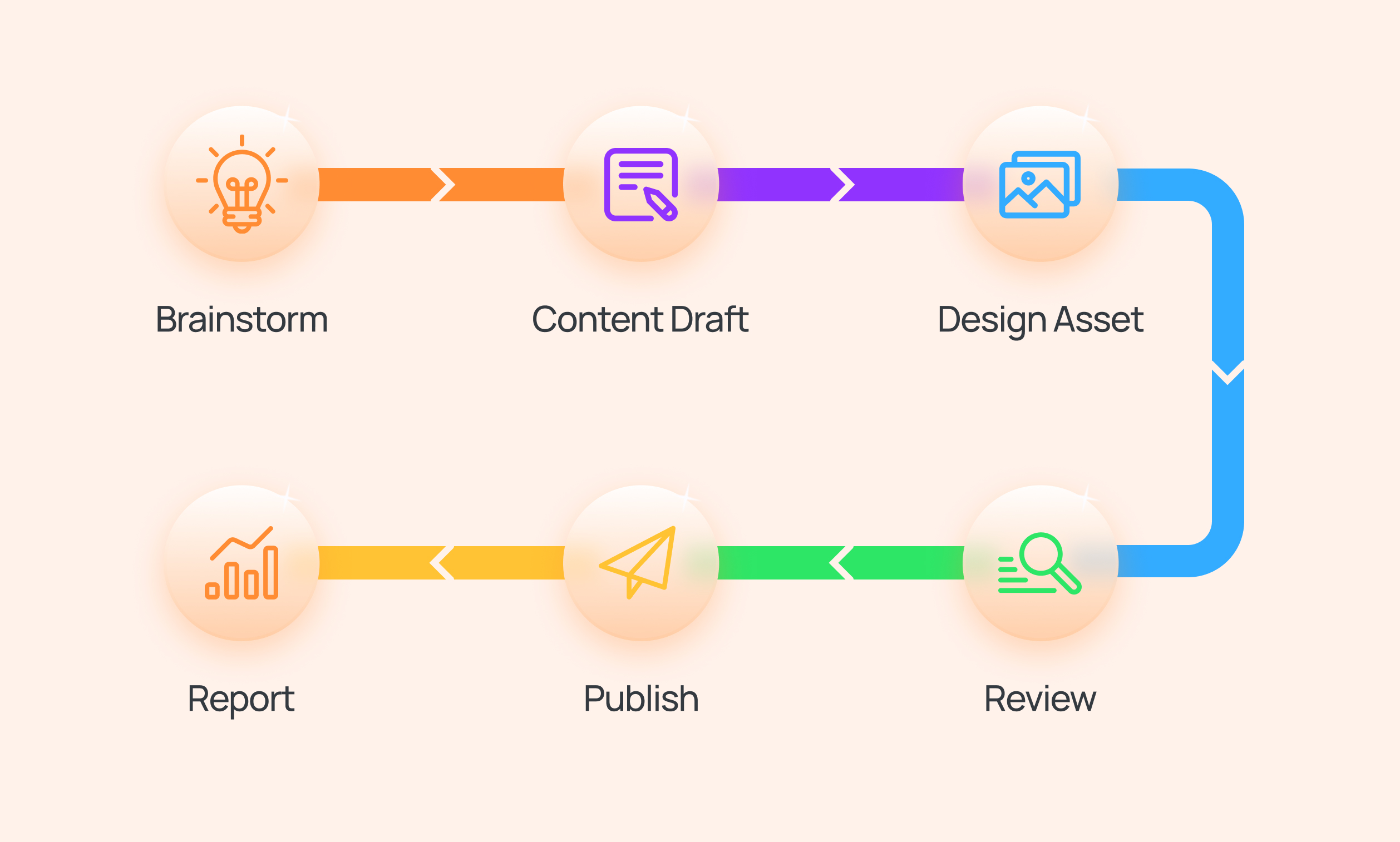
Assign each step to a role with a deadline. Now, whenever you launch a new campaign, you simply duplicate this workflow.
4. Use the right tools and automations
When you define a clear process, you equip your team with technology to enforce it. Choose a marketing workflow management software or work management tool that matches your needs.
Seek features like customizable templates, shared calendars, visual task boards, and discussion. Make sure your tech stack supports collaboration and integration.
Unify analytics, CRM, ad platforms, and content tools to keep data in sync. Use automation rules to assign follow-up tasks when approvals or status updates happen. These automations remove manual handoffs and cut errors.
5. Assign roles and train your team
Rollout is as important as setup. Make sure every team member understands their role in the new process. Define who is Responsible and Accountable (RACI) for each workflow step. Clearly assign task ownership and deadlines.
Consider running a pilot project to test the new system. Use this trial to gather feedback and refine the process. Provide training sessions or documentation on the tools and templates.
Address resistance by communicating benefits. Emphasize that the new process will reduce redundant work and increase transparency. In-tool comments and threads keep communication clear and prevent decisions from getting lost in email.
6. Track performance and refine at fixed intervals
Marketing workflow optimization is not a one-time event. So, it’s important to use dashboards and reports to track KPIs in real time. Track metrics like campaign cycle time and conversion rates.
Hold regular check-ins (stand-ups or retrospectives) to surface issues early. Continuously compare against the targets you set. If data shows a bottleneck, like review cycles taking too long, tweak the process or maybe add a reviewer or set shorter deadlines.
You must evolve your process and measure it for success. By treating your workflow as a living system, you improve efficiency and results over time.
How does 5day.io support optimized marketing management?
5day.io supports marketing teams that juggle creative projects and campaigns. It combines project and work management features made to meet marketing needs. These features include:
1. Custom templates
These let you kick off campaigns instantly with a proven workflow (content calendars, event plans, etc.). Once you create a template, every new campaign follows the same streamlined path. It reduces the setup time and prevents missed steps.
2. Automation for recurring and routine work
Built-in automation handles repetitive actions that slow teams down. Automation features allow teams to set up a recurring task schedule without human intervention.
The system also sends reminders and updates task statuses without manual follow-up. As a result, work keeps moving even when teams manage many campaigns at once.
3. Centralized task and deadline visibility
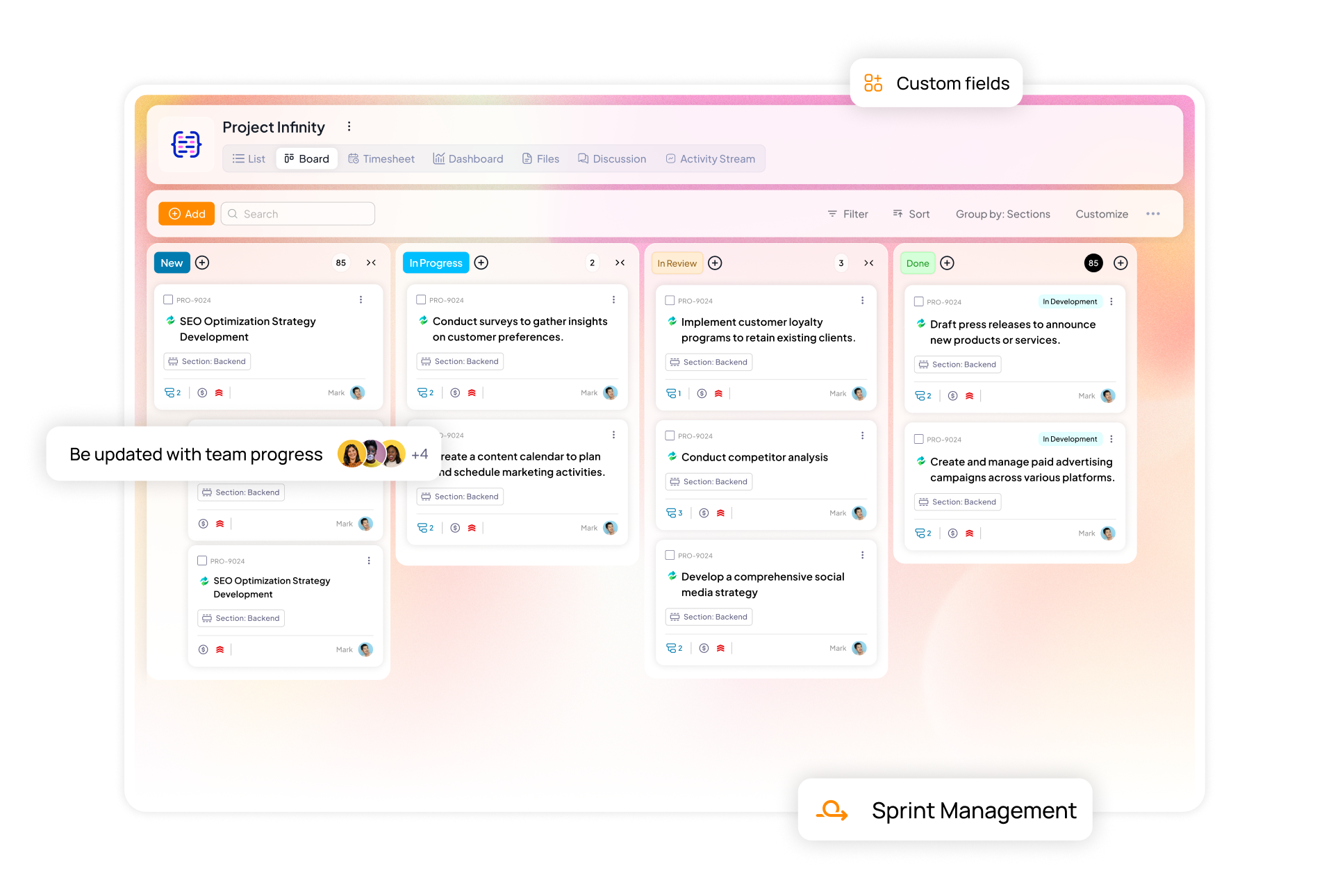
The dashboard and Kanban views give teams a live view of all tasks and deadlines. Team members can see what they own and how their work connects to larger campaigns. Drag-and-drop prioritization also helps teams adjust quickly when plans shift.
4. Workflow-driven handoffs and approvals
Workload views help balance effort across people and timelines. When a task moves forward, the system assigns the next owner or sends an approval request. Automations handle approvals and handoffs, cutting email back-and-forth and speeding delivery.
5. Built-in collaboration and contextual feedback
5day.io keeps feedback tied to the work itself. Stakeholders comment directly on tasks or attached files, so context stays intact. The system links creative briefs and copy drafts to each task and notifies approvers when it needs their input.
6. Analytic and real-time insights
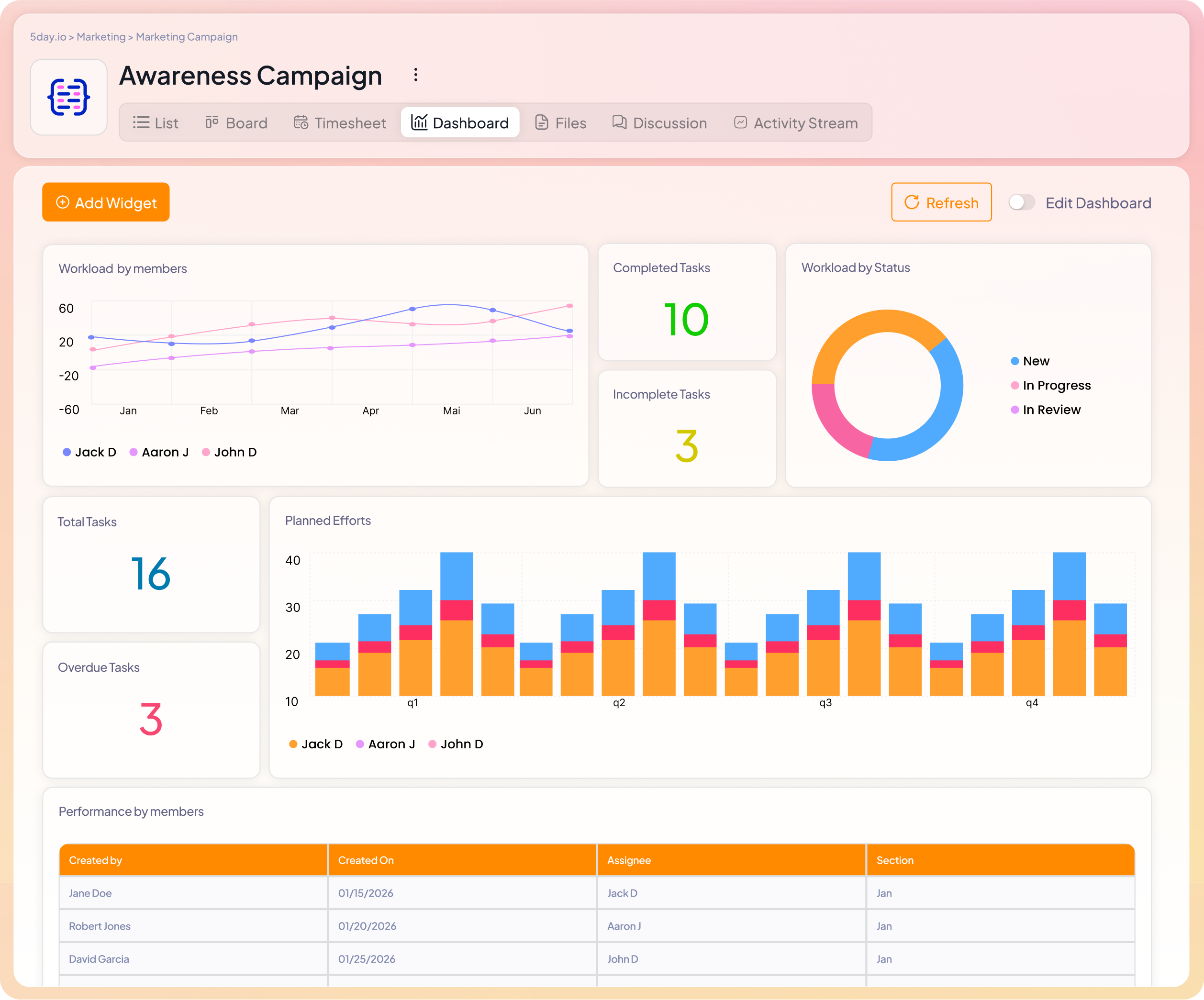
Analytics dashboards show how campaigns progress in real time. Teams can track task completion, budget versus actuals, sprint burn-downs, and custom KPIs. Filters by campaign or channel make it easier to spot risks early and adjust before delivery slips.
7. Integrations with existing marketing tools
Integrations with Google Drive, email, and chat tools connect execution data with the rest of the marketing stack. Files and updates stay accessible without forcing teams to switch systems or duplicate work.
Common mistakes to avoid while optimizing the marketing management process
Most marketing workflow optimization efforts start with good instincts. The issues with optimizing the marketing management process arise when teams introduce changes. Adjustments that help early-stage teams can create drag once execution speeds up.
Teams often make these mistakes when they optimize an active marketing management process.
1. Overcomplicating the process
Adding too many steps or review loops slows you down. Bloated workflows with endless handoffs lead to missed deadlines and wasted time. Keep approvals lean and focus on quick turnaround.
2. Ignoring data and metrics
Without tracking outcomes, you won’t know if changes help. That’s why it’s important to tie workflow changes to measurable project KPIs. Tracking the right metrics is essential for continuous improvement.
Build simple dashboards to check if deadlines and goals are on track. Try not to skip this analysis step for successful campaign management.
3. Skipping team buy-in or training
Rolling out a new process without involving your team leads to low adoption. Communicate the ‘why’ clearly and train everyone on new tools. (Neglecting to address resistance can undercut your efforts.)
Offer tutorials or pilot runs so users feel confident. Build a feedback loop to understand if new changes are hindering the team’s work.
4. Sticking with old habits and tools (like spreadsheets)
A common misstep is to pretend everything’s fine while teams keep juggling disconnected files. Modern marketing demands a centralized work management software.
Relying on email chains or scattered docs means waiting for miscommunication to happen. Embrace a marketing industry project management tool like 5day.io so all tasks and data stay in sync.
5. Not iterating
Implementing a ‘perfect’ process once and never revisiting it means stagnation. Without continuous feedback and analysis, you may miss new inefficiencies. Schedule regular reviews to spot what’s still slowing the team and make tweaks.
Pro tip: Optimize smartly by keeping processes simple and team-backed. Overengineering or poor communication may damage even a well-planned strategy. Stay flexible and let the data guide continuous improvements.
Make your marketing management process smarter with 5day.io
A marketing management process often starts as support. It helps teams plan and organize. Over time, it becomes something else entirely. The risk is that the responsibility quietly shifts from the system to the people running it.
5day.io helps to reverse that shift to optimize marketing operations.
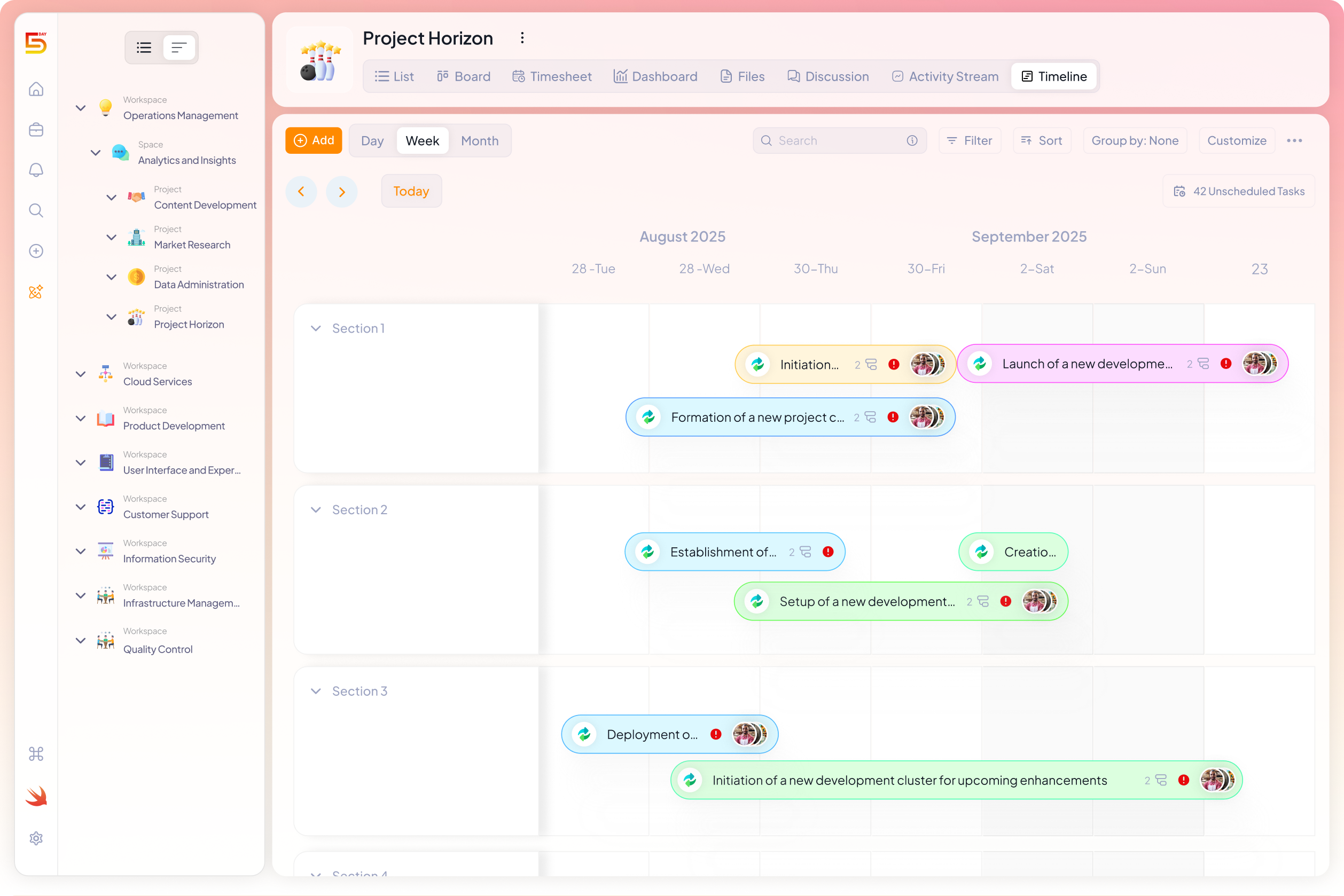
When marketing work lives in one place, teams don’t need extra reviews to spot process issues. Signals surface during execution itself, because the teams can:
- See where campaigns compete for attention and slow one another down
- Identify tasks with unclear ownership or stalled decisions
- Notice when effort increases without progress, often revealing rework or misaligned expectations
- Track how approvals and project dependencies affect timelines as work moves forward
- Find whether the process handles complexity or shifts it onto people
For growing teams, this structure replaces spreadsheets and status meetings. With the right project management software for marketing team, progress stays visible, and reporting reflects how work is moving.
If you want your marketing management process to carry more weight as complexity grows, try running your next set of campaigns in 5day.io. No credit card required.