

Every development workflow already contains waste. The question is whether teams can see it in time to act.
Lean project management gives teams a decision filter that clarifies which work deserves attention and when teams should start or stop.
In 2026, as development teams balance speed with accountability, Lean shows its value in the small decisions that compound over time.
In this article, you’ll learn the five principles of lean project management through the lens of modern development work. Further, you’ll explore how teams use these principles to design focused workflows.
What makes Lean project management different?
When it comes to Lean vs Agile project management approaches, the focus is on targeting waste and flow. In Lean’s view, anything that does not deliver value to the customer is waste (muda), and organizations must remove it.
For example, Lean teams remove bottlenecks and cut features that don’t serve users. The PMI defines Lean as delivering exactly what is needed, when it’s needed, using minimal resources. Lean pushes teams to deliver the most value while removing waste at every step.
This focus sets Lean apart from Agile, which centers on flexibility and rapid feedback. While Agile emphasizes adaptability and iterative delivery, Lean emphasizes efficiency and flow throughout the process.
Lean teams will spend time mapping the entire value stream to spot delays, whereas Agile teams may focus more on handling changing requirements, sprint-to-sprint. Most teams blend both using Agile iterations but asking Lean questions in planning and retrospectives.
Over time, Lean PM embeds a culture of continuous improvement and respect for people. It involves the whole team in spotting and solving problems (Kaizen or incremental improvement).
Developers, testers, designers, and other team members question the process at every step: does this work create real value for users, or does it consume time and resources?
By encouraging teams to challenge waste and take ownership of decisions, Lean project management helps development teams deliver better outcomes without putting unnecessary effort.
The five core Lean principles for zero waste project management
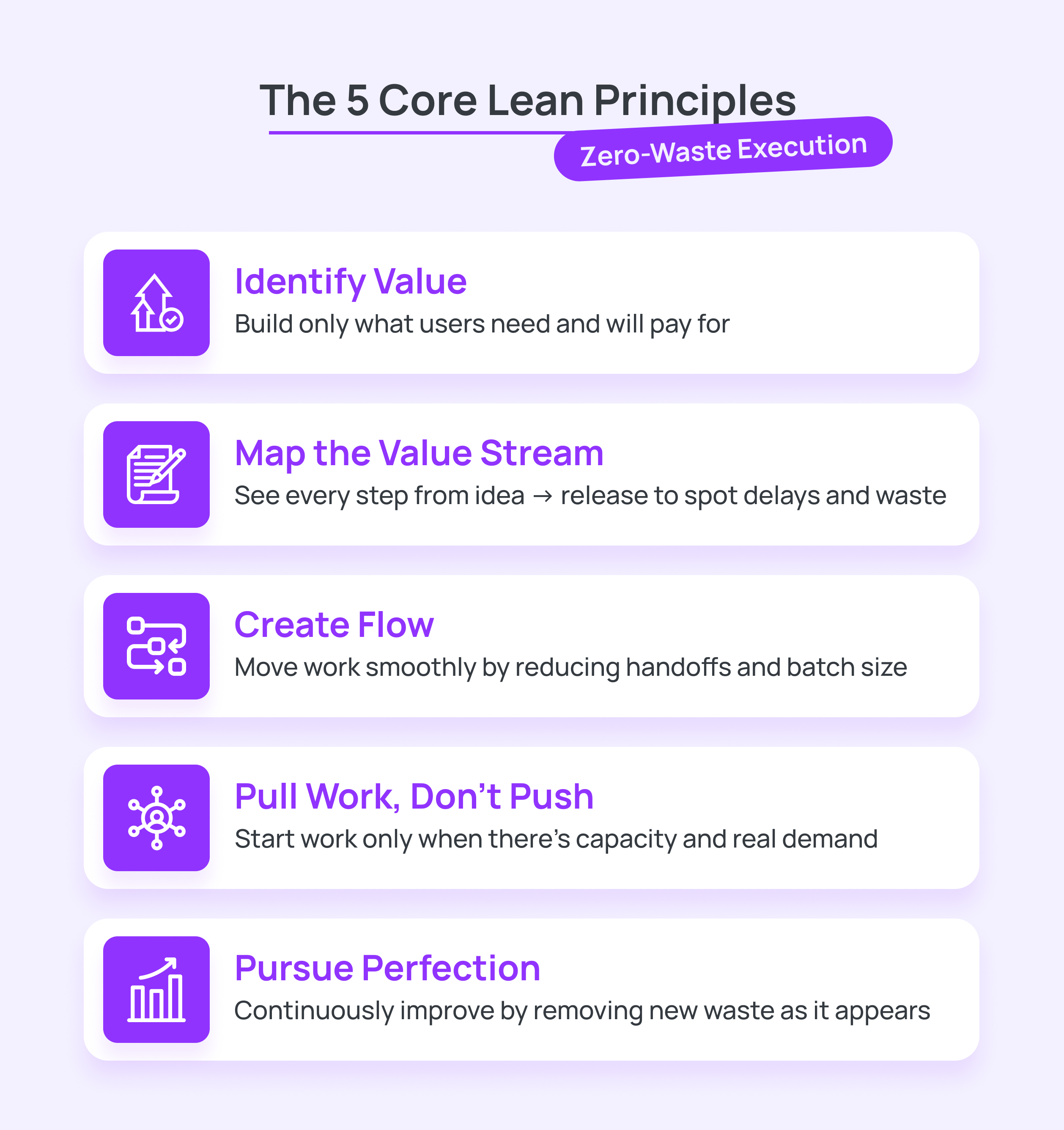
At its core, Lean project management has five fundamental principles. Each step leads to higher customer value and less waste. You can think of Lean project management principles as a checklist your team applies from project start to finish:
1. Identify customer value
First, define what your stakeholders want. Value means what the customer (or internal sponsor) is willing to pay for. It could be performance, features, quality, or speed.
Ask questions like what problem does the deliverable solve, and which requirements matter to them? This ensures your team doesn’t build unnecessary features or spend time on non-essentials.
2. Map the value stream
Draw a value stream map of the entire Lean workflow for dev teams from idea to delivery. List every step, including design, coding, testing, reviews, and releases.
Note which steps add customer value and which are pure waste. This visualization highlights bottlenecks and delays.
For example, long approval chains and overloaded backlogs create waste that teams should eliminate. Lean specialists classify common waste types, such as overproduction and waiting, to help teams spot and remove inefficiencies faster.
3. Create a continuous flow
Reorganize the remaining value-added steps so the work flows without interruptions. That might mean breaking work into smaller batches or removing silos.
The goal is to cut waiting or handoffs that pile up. For example, use Kanban boards to see work-in-progress and limit tasks per person. When work items move smoothly from ‘to-do’ to ‘done,’ cycle times drop and team efficiency rises.
4. Establish a pull system
Instead of ‘pushing’ work into the pipeline, let downstream demand trigger upstream activities. In software terms, this could mean only starting new features when the team has capacity, or building a feature only once it has a committed user.
Kanban works by having team members pull the next priority task only when they finish the current one. The pull approach prevents overproduction of half-done work and aligns effort with real needs.
5. Pursue perfection (continuous improvement)
Lean never finishes. After removing the obvious waste, repeat the cycle. Examine outcomes, ask questions, and improve. This ‘kaizen’ mindset means Lean process improvement for dev teams.
Technology and customer expectations change, so teams must revisit what ‘value’ means on a regular basis. Even small iterative changes, like tweaking a step or tool, can compound into big gains over time.
Applying Lean to software and development teams
For development teams, Lean shows up in every decision. It influences when work starts and how long it stays in progress once priorities change.
These practices explain how software teams use Lean when project planning and delivering work.
1. Cut out unnecessary work
Lean software teams trim features and tasks that don’t serve user needs. Teams review code, documentation, handoffs, and processes with a clear filter.
It means dropping low-impact features and avoiding process complexity that slows delivery.
2. Build quality in
Rather than waiting for final testing, Lean dev practices like test-driven development (TDD) and code reviews bake quality into the process.
For example, running automated tests on every commit catches defects early and prevents rework (a classic Lean goal). Pair programming or peer reviews are simple ‘flow’ tools as they keep work moving by spotting issues early.
3. Small batch releases
Lean encourages short iterations and frequent deliveries. By releasing early and often, teams get feedback fast, ensuring they’re building what customers want.
This aligns with Lean’s pull principle as teams only build more when demand (user feedback) pulls for it. Tools like feature flags or CI/CD pipelines support this by making deployments quick and low friction.
4. Empower the team and share knowledge
Lean’s respect-for-people means each developer is involved in process improvement. Teams hold regular retrospectives to identify waste and fix issues, embodying Lean’s continuous improvement.
They also embrace cross-functional teamwork to bring designers, devs, and QA together to avoid handoff delays.
5. Measure and improve flow
Development teams track flow metrics to ensure processes stay healthy. Common metrics include:
- Cycle time from start to finish on a task
- Lead time from request to delivery
- Items completed
- Deployment frequency
- Change failure rate
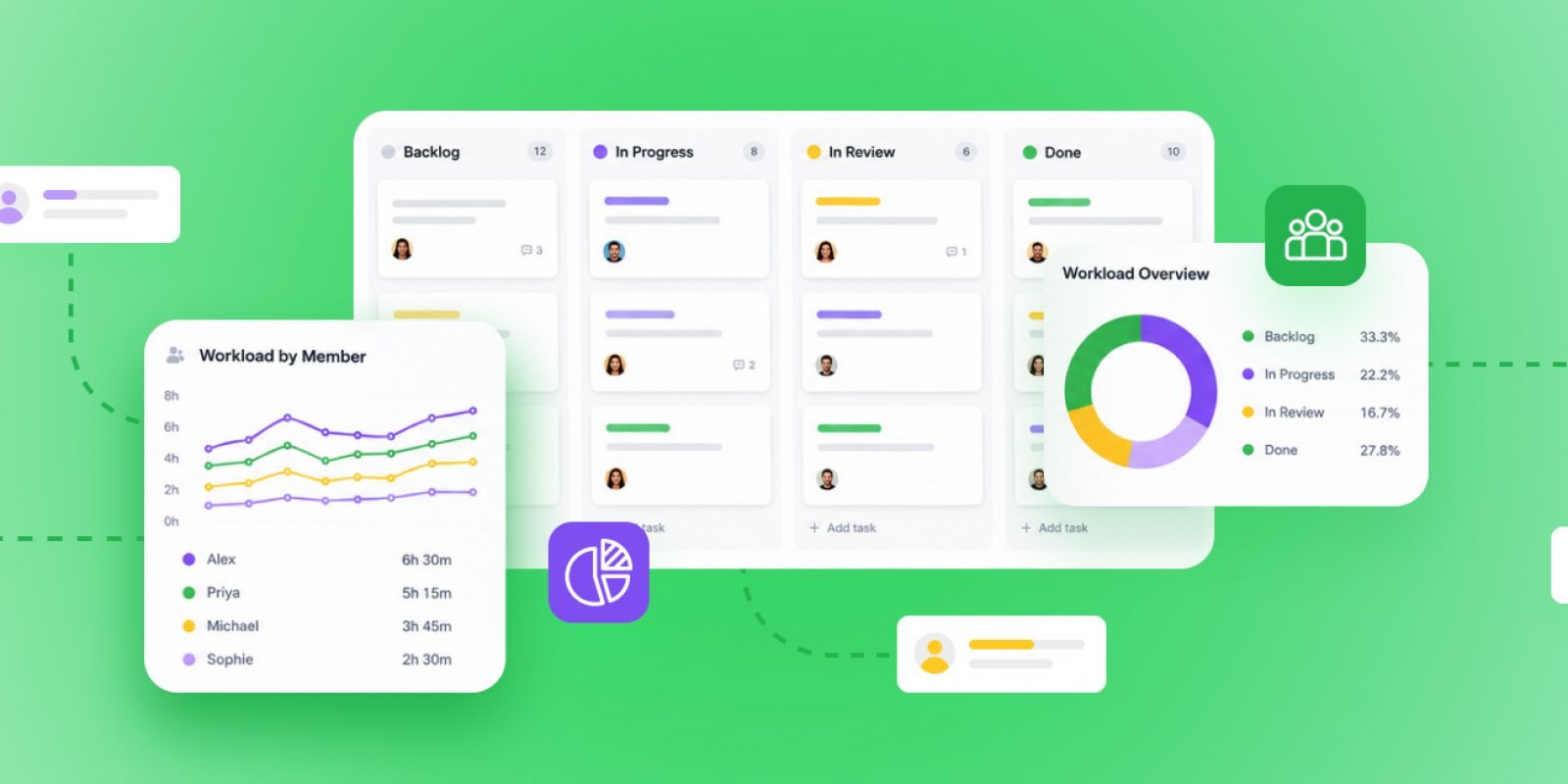
These numbers help spot bottlenecks. For instance, if cycle time spikes, it signals a flow issue to fix. Tools with analytics dashboards (version control metrics, build times, etc.) make this data easy to collect.
Lean practices for 2026: trends and what they mean for Dev teams
By 2026, most development teams already follow some form of Agile or DevOps. What differentiates high-performing teams is how they refine execution as tools and expectations evolve.
The Lean project management methodology works more as an execution discipline. The trends below Lean application in modern development environments.
1. AI-integrated flow control and predictive planning
Lean flows break when teams can’t see bottlenecks early. That’s why AI is finally shifting from suggestion tools to workflow intelligence engines.
AI platforms now automate the detection of schedule risks and workload imbalances, allowing teams to act before bottlenecks turn into delays. Tools analyze real delivery data (not static plans) to forecast workload and flag potential issues in real time.
This shift strengthens Lean execution by exposing waste earlier. Because instead of detecting waste after the fact, AI augments visibility into emerging waste patterns. It can flag stagnating work items or oversubscribed contributors, enabling proactive course corrections based on data.
What this means for Lean teams?
AI becomes a core part of the flow system, helping enforce WIP discipline and surface true bottlenecks without manual dashboards.
2. Hybrid/Agile toolsets
The best tools for Lean project management for 2026 no longer force a single process. They let teams mix Lean, Agile, and even Waterfall methods in the same workflow.
Hybrid project management models combining Lean efficiency with Agile flexibility and structured governance are predicted to dominate execution models across industries.
Teams apply Lean flow principles within a hybrid method to balance predictability for compliance or release windows with continuous delivery. Lean’s pull systems and small batch flows coexist with strategic planning checkpoints.
What this means for Lean teams?
Teams no longer choose a single framework. They design execution models that preserve Lean’s visibility and waste focus while supporting hybrid planning needs.
3. Value stream management (VSM) as operational infrastructure
In Lean, teams need to see the value stream to reduce waste. By 2026, value stream mapping shifts from a one-time workshop to a live, automated view of workflows.
Delivery platforms now embed VSM tools, capturing cycle time, flow units, rework, handoffs, and delays in real time and mapping them to customer outcomes.
This turns Lean from a review habit into a continuous feedback system. As a result, teams see flow metrics live and tweak work in flight, instead of relying on retrospectives.
What this means for Lean teams?
Real-time value stream insights make waste visible earlier. This expands Lean’s influence from occasional review into everyday execution optimization.
4. Low-code / no-code democratization and Lean efficiency
Low-code and no-code tools are no longer limited to citizen developers. They now play a practical role in how engineering teams assign effort.
By 2026, teams increasingly use LCNC tools to build internal dashboards and prototypes. This reduces time spent on non-core engineering work and prevents senior developers from rebuilding standard functionality from scratch.
From a Lean perspective, this removes a common source of waste, such as over-engineering simple solutions. Teams reserve deep engineering effort for work that differentiates the product.
What this means for Lean teams?
LCNC tools speed up delivery by reducing unnecessary custom code and keeping engineers focused on high-value problems.
5. Platform engineering and internal developer platforms
Platform engineering has moved beyond tooling convenience and become a Lean execution enabler.
Internal developer platforms standardize how teams build and deploy software. Shared templates and approved pipelines reduce handoffs and custom integrations that slow delivery.
By 2026, teams that invest in stable internal platforms see fewer workflow interruptions and smoother movement across CI/CD and environment stages. Less friction in the system means fewer delays and less rework.
What this means for Lean teams?
A shared execution platform stabilizes flow and removes waste caused by one-off configurations and manual workarounds.
6. Metrics shift from output to flow and outcome
Because of this, Lean draws a clear line between activity and value. In 2026, more teams move away from velocity and task completion as primary success signals.
Instead, teams track flow-based and outcome-driven metrics such as cycle time, lead time, feature adoption, and defect escape rates. These metrics reveal the work movement and whether it delivers meaningful results.
This shift supports better decisions. Teams stop optimizing for more work done and start optimizing for faster learning and real customer impact.
What this means for Lean teams?
Flow and outcome metrics replace vanity KPIs and expose waste that task counts hide.
7. Remote and distributed work optimized for Lean flow
Remote work changes how waste shows up in delivery systems. Delays now come from unclear ownership and excessive coordination.
In response, teams adopt practices that emphasize asynchronous collaboration and documented decisions. Centralized, visual workspaces replace status meetings and scattered updates.
By making the real state of work visible to everyone, teams reduce misunderstandings and duplicated effort. These are two of the most common sources of waste in distributed environments.
What this means for Lean teams?
Distributed teams need stronger visibility and shared context to maintain flow and avoid execution drift.
Lean project management principle examples
Many forward-thinking dev organizations have already fused Lean into their 2026 workflows. For instance, Lean project management for SaaS product teams might use a digital Kanban board where pulling the next story card triggers a CI/CD build (a literal pull system). Or a game development studio might use automated QA pipelines so that, as soon as a developer marks code ‘ready,’ tests and deployment happen without extra steps.
Each of the Lean project principles examples embodies Lean ideas of pull and built-in quality, showing how Lean principles translate into practices.
Tools that support Lean project management
Adding more Lean project management tools rarely improves execution. What matters is whether a platform supports Lean behavior or works against it. Lean-supporting tools reduce activity tracking and sharpen decisions across the team.
1. Kanban and visual boards
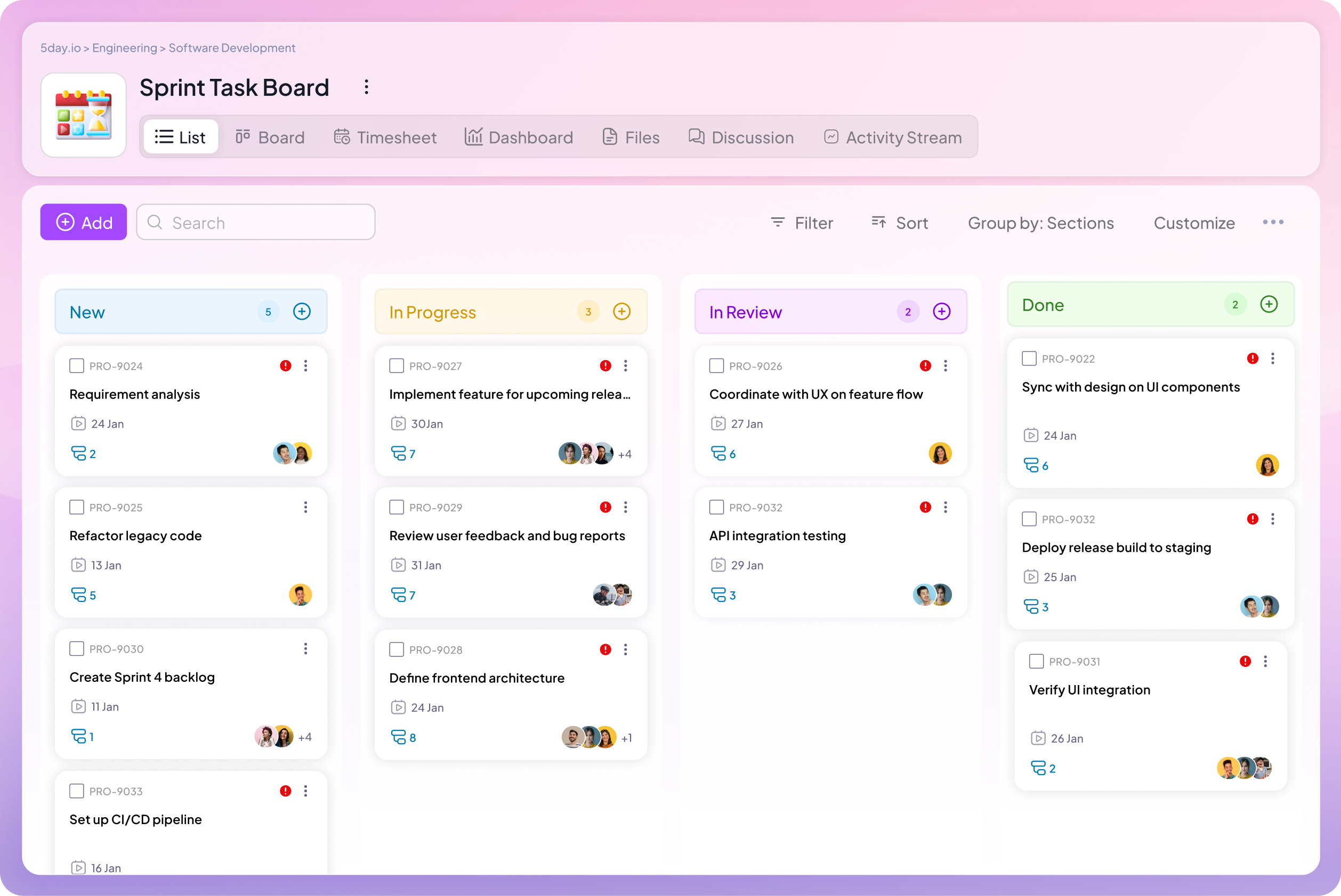
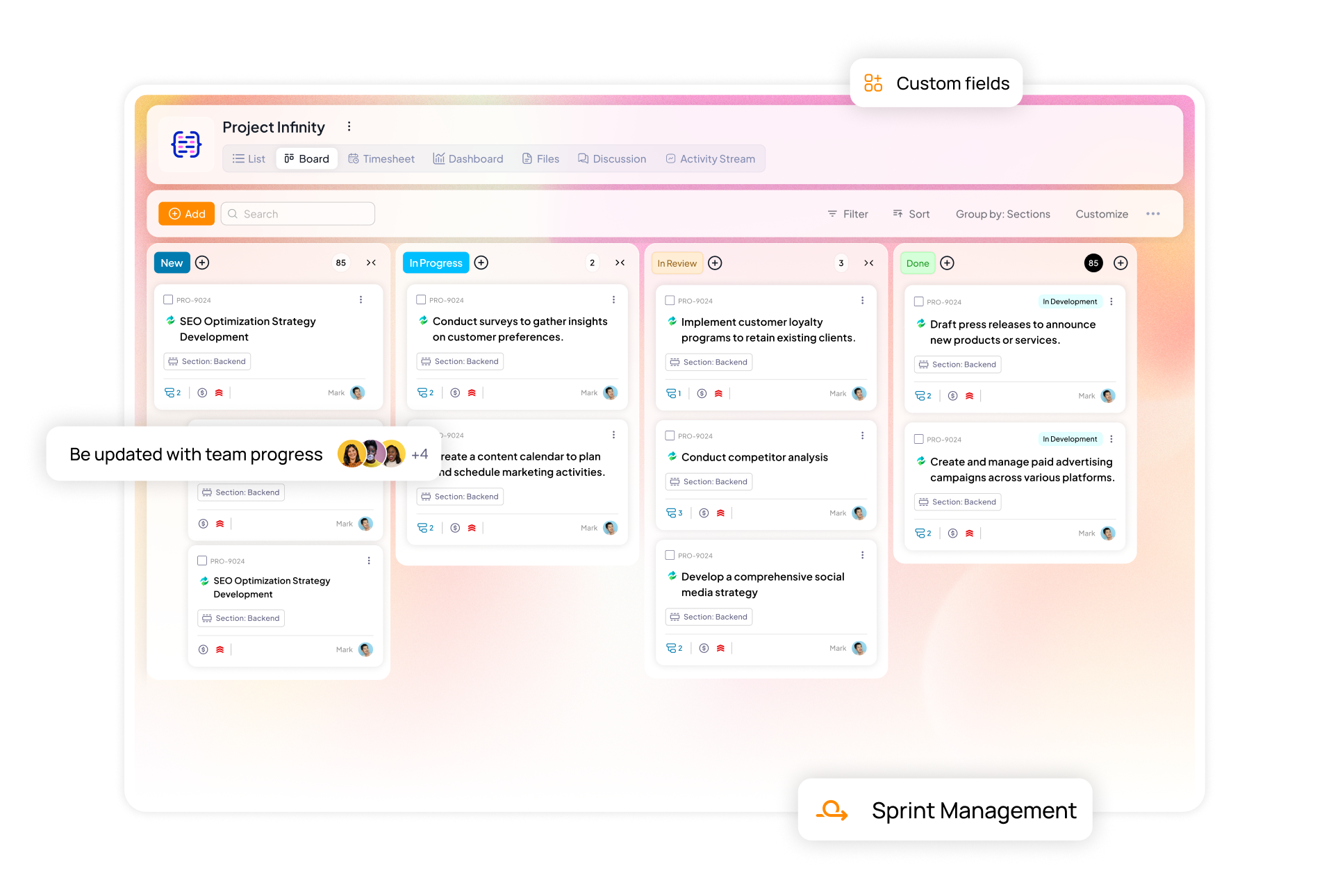
Tools like 5day.io offer Kanban-style boards where you can visualize work and limit in-progress tasks. Project management tools with built-in Kanban, for example, help teams reduce cycle time and increase efficiency.
Seeing cards move from left to right lets you spot jams and tackle them. Many teams pair Kanban boards with WIP limits, such as no more than three tasks in the development phase at once, to enforce Lean flow.
2. All-in-one PM platforms
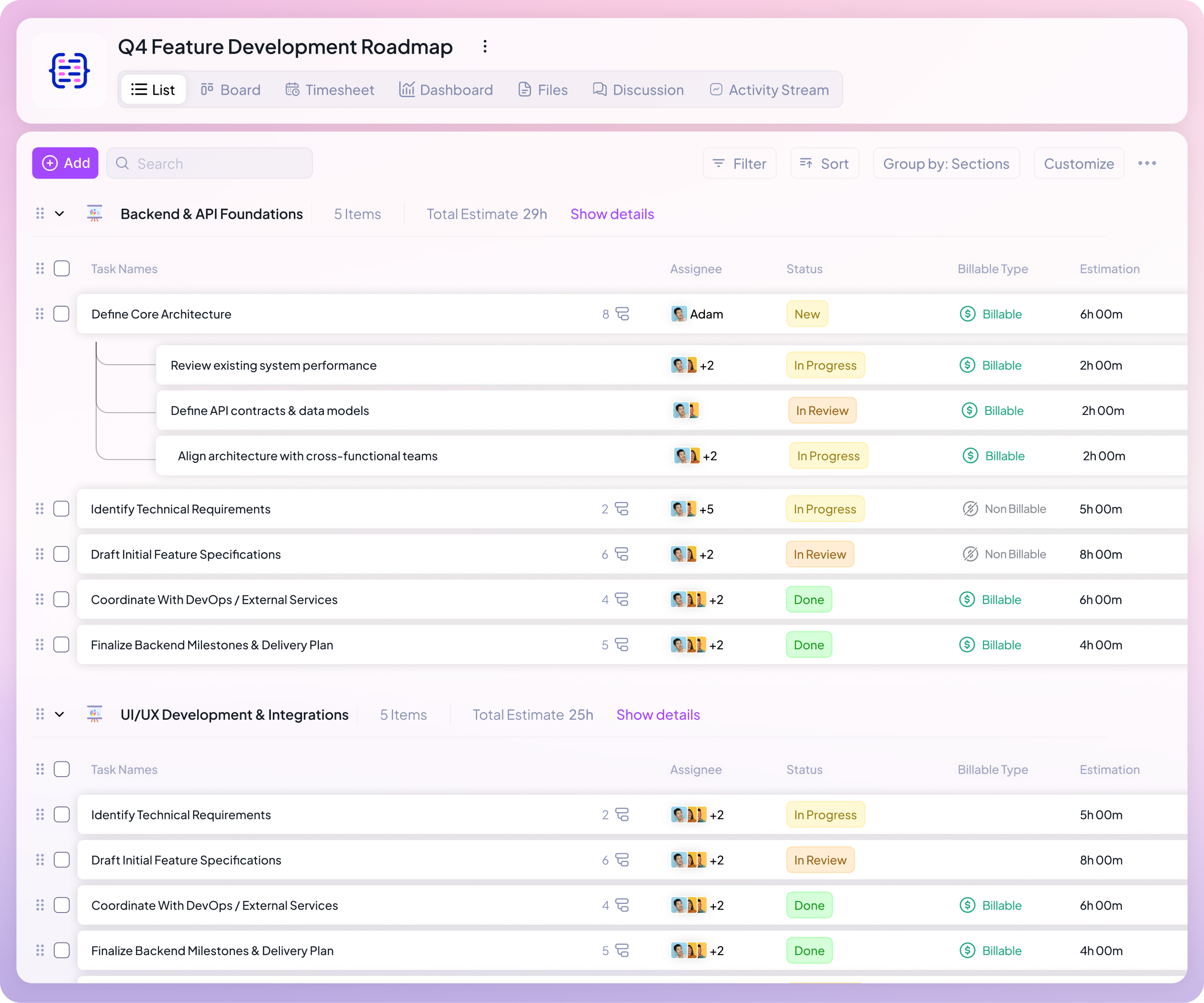
Modern project management tools, like 5day.io, include Lean-friendly features (task dependencies and dashboards). For instance, flexible views and real-time dashboards with customizable boards support visual management of work, a key Lean practice.
They also allow setting up boards and templates so you can map your value stream and automate routine handoffs. Some tools offer Kanban+Gantt hybrids with backlog grooming, helping teams visualize the entire value stream in one place.
3. Value stream mapping tools
While you can sketch a value stream on paper, digital tools like Miro or Lucidchart can help you create and share VSMs online. These are especially useful for remote teams doing Lean ‘gemba walks’ over video or workshops.
Lean-specific software, like Kanbanize or Planview LeanKit, goes further. These allow you to map and manage value streams, often with built-in analytics on cycle time and flow efficiency.
4. Continuous improvement tools
For the Kaizen/retrospective side, platforms like Retrium, Parabol, or even built-in retrospective features can help your team identify process waste and brainstorm solutions.
Even integrated communication tools, such as Slack or Microsoft Teams, work well for quick Lean check-ins or announcing improvements.
5. Automation and DevOps
DevOps toolchains (CI/CD servers like GitLab CI or GitHub Actions) align with Lean by automating repetitive tasks (builds, tests, deployments). For example, as soon as a developer finishes code, the CI pipeline automatically runs tests and can deploy to staging.
This removes ‘waiting’ waste. Infrastructure-as-code and containerization (Docker/Kubernetes) are Lean-friendly too, as they can cut manual environment setup waste.
Lean project management best practices checklist
Here’s a checklist of Lean best practices to help your development team stay on track (check them off regularly):
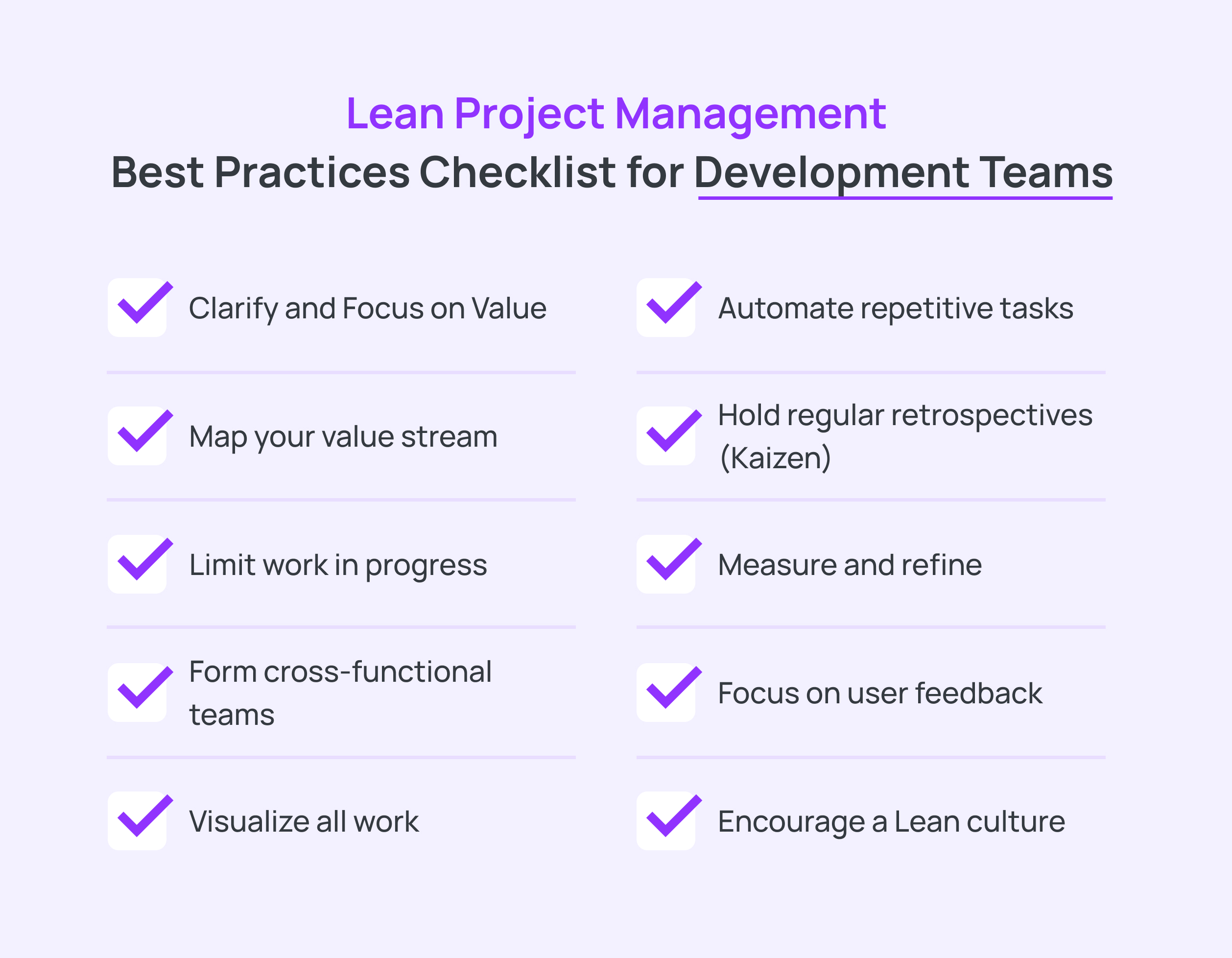
1. Clarify and focus on value
Always start by defining what success looks like for your customer or user. Make sure everyone understands the target metrics or features that matter.
2. Map your value stream
Document every step of your process from feature ideation to delivery. Teams can use a visual map (or a one-page flowchart) to find delays and waste.
3. Limit work in progress
Enforce WIP limits on boards and pipelines. If people can only focus on a few tasks at once, work flows faster.
4. Form cross-functional teams
Include all necessary skills (developers, QA, designers, etc.) in each team to reduce handoffs. The fewer times a task changes hands, the less delay it incurs.
5. Visualize all work
Use Kanban boards, Gantt charts, or dashboards so the entire workflow is visible. Everyone should see what’s ‘in progress, ‘blocked, or ‘done’ at a glance.
6. Automate repetitive tasks
Script builds, tests, deployments, and routine updates whenever possible. Remove manual steps that add no value (like sending status emails, merging branches by hand).
7. Hold regular retrospectives (Kaizen)
After each sprint or release, gather the team to review what went well and what bottlenecks occurred. Every cycle is an opportunity to remove newly found waste.
8. Measure and refine
Track key Lean metrics (cycle time, lead time, throughput, defect rates) and set improvement targets. Share these metrics with the team so everyone can spot trends.
For example, if deployment frequency is low, investigate why (builds are slow or too many approvals).
9. Focus on user feedback
Lean teams tie deliveries to real feedback. Use beta tests, prototypes, or MVPs to confirm you’re building the right thing. This avoids wasted effort on unwanted features.
10. Encourage a Lean culture
Empower everyone to suggest improvements and question processes. Celebrate when the team finds and cuts waste to support Lean behavior.
How 5day.io supports Lean project management for development teams
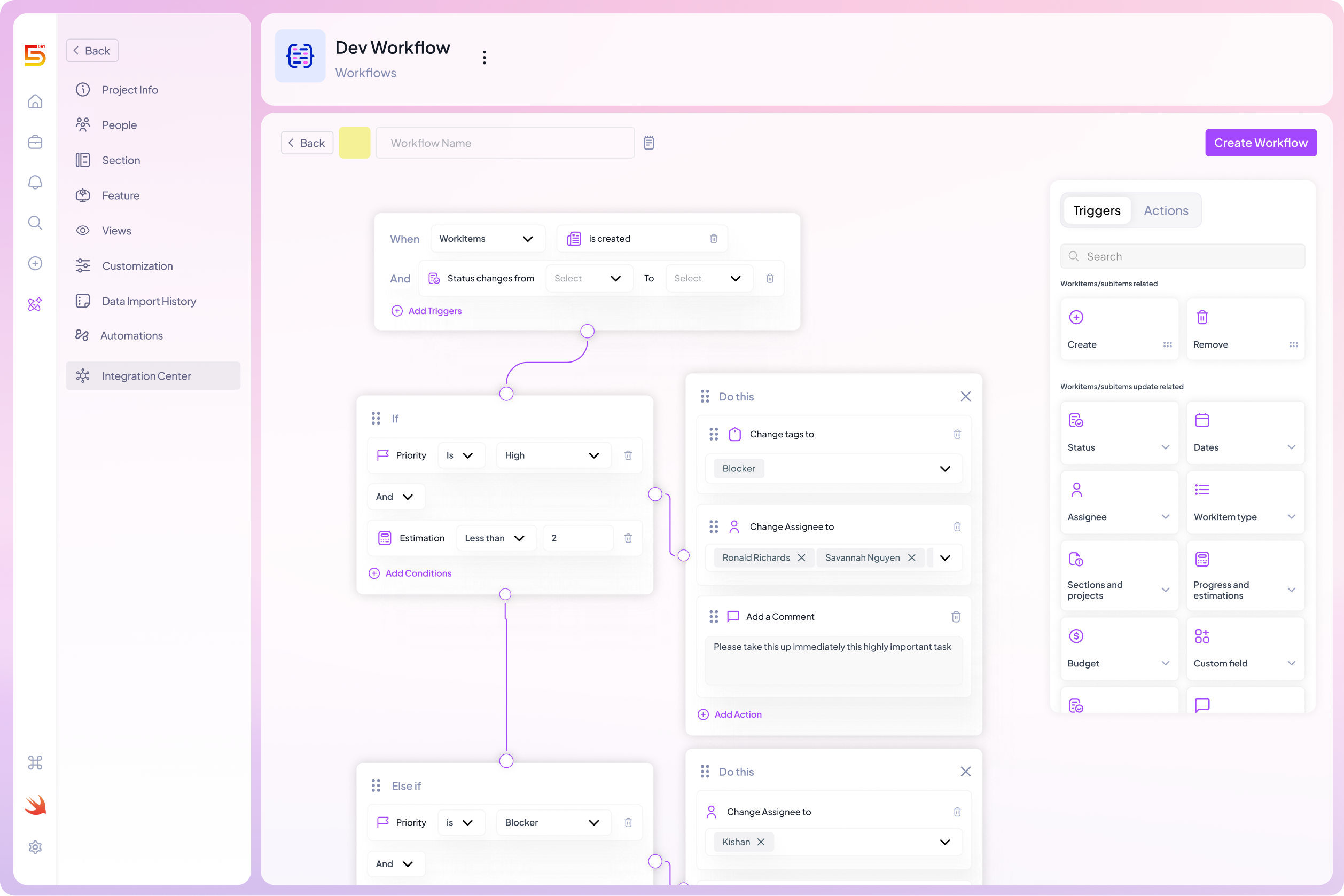
In 2026, most development teams know about the Lean principles. The real issue is the scale. This includes more parallel projects, shared engineers, tighter delivery windows, and less tolerance for rework.
In that environment, Lean success depends less on discipline and more on whether the work system makes trade-offs visible.
That’s where 5day.io fits.
Development teams use 5day.io as a shared execution layer where work and time intersect. Instead of managing Lean practices, teams see their impact in day-to-day execution.
In practice, teams use 5day.io to:
- See how work flows across projects, not just within individual boards
- Keep ownership explicit, so work doesn’t stall between roles or approvals
- Track WIP across the system, making overload easier to spot early
- Log time against real tasks to expose rework and scope drift without extra reporting
- Check project health signals and respond before delivery risk escalates
- Keep decisions and changes attached to the work, reducing follow-ups and re-explanations
For Lean teams, this setup removes a common friction point that is the need for separate tools or reviews to understand progress. The system reflects reality as it happens.
To see Lean project management for development teams in real execution, try 5day.io with your own projects. The best part is no setup overhead and no credit card required.