


A marketing gap analysis will help you compare where your marketing is right now with where it should be. It shows the space between your current performance and your target goals, so you are not just guessing why leads are slow, traffic is flat, or competitors seem to be moving faster.
For marketing teams, this gap can appear in many places. It could be weak SEO visibility, unclear messaging, poor lead quality, missing content, underused tools, low conversion rates, skills your team still needs to build, etc.
The good news is that a gap analysis isn’t that hard to perform, but what about the benefits? Well, it gives you a clear map. Once you know what is missing, what is underperforming and what needs priority, it becomes much easier to plan smarter campaigns, improve results, and stop wasting time on activities that only look busy.
Now, let’s begin our in-depth view on how to run a marketing gap analysis step by step, with practical examples and a simple structure your team can use to turn gaps into action.
What is a Marketing Gap Analysis?

A marketing gap analysis is the process of comparing your current marketing performance against your desired outcomes. This helps you identify the specific areas that are underperforming or underdeveloped. It is a structured way to see the distance between current state and target state across:
- Channels
- Content
- Audience reach
- Competitive position
- Resources.
Gap analysis is a way to compare actual performance against desired performance. Forbes describes Gap analysis where a company or process is, where it should be, the gap between the two, and how to implement change.
Marketing gap analysis definition
A marketing gap analysis is a structured review of where your marketing stands today and where it should be. It helps recognize what is creating the gap, and what actions will close it. It is useful when you need clearer priorities and a more realistic plan.
A good analysis should answer four questions:
- What is happening now
- What should be happening instead
- What is causing the gap
- What will we do next
That is also why a template for gap analysis should not just be a blank grid. It should include targets, evidence, priority, owner, and deadline so the work can move into execution.
When Should You Run Marketing Gap Analysis?
You should run a marketing gap analysis when performance starts drifting, when a new planning cycle begins, or when the business changes direction.
Gap analysis is useful when teams face performance issues or need improvement. Also, it should be considered when a company keeps missing key metrics or work feels misaligned. Gap analysis is especially useful during strategic planning and stakeholder reporting.
In practice, the most common triggers are:
- quarterly or annual strategy reviews
- declining channel performance
- budget planning
- product or campaign launches
- a new competitor taking share
A gap analysis also works well as an early discovery deliverable for agencies. It gives clients a baseline and helps your team avoid jumping into content or SEO without first understanding what is actually missing.
Gap Analysis Vs SWOT: What’s The Difference?
These terms often get mixed together, but they do different jobs.
Framework | Main focus | Best time to use it | Main output |
Marketing gap analysis | Current vs desired marketing performance | When you need priorities and an action plan | A list of gaps, priorities, owners, and next steps |
Competitive analysis | Competitor activity and market position | When you need external market context | A view of competitor strengths, weaknesses, and opportunities |
Content audit | Existing content quality and coverage | When you need to review owned content | A content inventory with findings and fixes |
SWOT analysis | Internal strengths and weaknesses plus external opportunities and threats | Early strategy review or business planning | A strategic snapshot of business context |
Competitive analysis is researching direct and indirect competitors and their strengths or weaknesses. SWOT is a matrix for internal and external factors.
Marketing gap analysis is more operational than SWOT. It forces you to compare current marketing reality with a defined target and then build a plan to close the gap.
A simple way to remember it:
- SWOT helps you frame the situation
- competitive analysis helps you see the market
- content audit helps you review assets
- gap analysis helps you decide what to fix first
The Five Types of Marketing Gaps You Need to Identify

One reason marketing teams struggle with how to do a gap analysis is that they only look at one type of problem, usually content or SEO. That is too narrow. A better approach is to check five dimensions.
Channel gap
This is the gap between where your audience spends attention and where your brand shows up. For example, HubSpot says 42% of marketers reported using LinkedIn as part of their strategy in 2025, up 11% year over year. If your B2B audience is active there and your team is absent or inconsistent, that is a channel gap.
Content gap
This is the gap between what your audience wants and what your brand posts. Content gap analysis can assist in identifying the subjects and content that your audience is seeking that has been neglected or ignored.
Audience gap
This is the gap between the people you are reaching and the people you actually need to reach. Good traffic can still be weak traffic if it does not match buying intent or role.
Competitive gap
This is the gap between what competitors do well and what you have not matched yet. Competitive analysis helps show where you stand in the market landscape. That makes it a useful input, but not the full analysis on its own.
Budget and resource gap
This is the gap between what your goals require and what your team can realistically support. Gartner’s 2025 CMO survey shows why these matters: most CMOs say budget is still not enough to execute strategy fully.
Gap type | What it reveals | How to measure it | Example |
Channel gap | Missing or weak channel presence | channel mix, reach, conversions by source | Strong audience fit on LinkedIn but no LinkedIn program |
Content gap | Missing topics or formats | keyword coverage, content inventory, search intent mapping | Competitors rank for buyer questions you do not answer |
Audience gap | Wrong people or weak targeting | CRM data, lead quality, persona fit | High traffic but low qualified pipeline |
Competitive gap | Areas where rivals outperform you | share of voice, offer comparison, messaging review | Competitor owns a use case you barely mention |
Budget and resource gap | Misalignment between goals and capacity | spend vs return, team bandwidth, production speed | Big content goal with no writer time or review capacity |
Quick summary of the five dimensions
- Channel gap shows where you are absent or weak
- Content gap shows what your audience still cannot find
- Audience gap shows who you are missing
- Competitive gap shows where rivals are ahead
- Budget and resource gap shows where ambition is bigger than capacity
Step-By-Step Process: Research To Action Plan
Step 1: Define your goals and benchmarks
Start with the future. The first step in a gap analysis is to define business goals, and the future state should explain where you want the business or process to be. Your targets should be specific and measurable.
Targets get easier when KPIs are defined in plain terms and tracked consistently. Project management KPIs can help set clean success signals before scoring gaps. For marketing, that usually means one business goal and a small set of supporting KPIs.
Examples:
- increase qualified leads by 20% in two quarters
- lift landing page conversion rate from 2.1% to 3.5%
- improve pipeline share from organic search
- grow product sign-ups in one segment
Do not start with “we want more visibility.” Start with what success must look like.
Step 2: Audit your current marketing performance
Now document the current state. This section should include both quantitative and qualitative data. The current state analysis should be as specific as possible and backed by numbers.
For a marketing audit, review:
- channel performance
- conversion data
- campaign results
- audience quality
- content coverage
- sales or customer feedback
- budget and resource use
Useful sources include Google Analytics 4, ad platforms, CRM reports, SEO tools, email reports, and call notes. Common success measures include sales and web traffic, which is a good reminder to connect the audit to real business outcomes.
Evidence matters, but it also needs a place to turn into tasks and tracking. Data-driven project management for marketing teams connects findings with execution and outcomes.
Step 3: Research competitors and benchmarks
A marketing gap analysis should not happen in a vacuum. Compare your current state with the market, not only with your own internal target. Competitor research helps you understand where you stand against direct and indirect rivals.
This step should answer:
- which channels competitors use well
- which content themes they cover better
- which offers or messages they lead with
- where your team is behind
- where you can ignore the crowd and focus elsewhere
Step 4: Map the gaps clearly
Once you have goals, audit data, and market context, list the gaps in a simple matrix.
Area | Current state | Desired state | Gap | Evidence |
LinkedIn thought leadership | 1 post a month, low reach | weekly posts tied to ICP pain points | channel gap | competitors active, no steady publishing |
SEO content | missing bottom-funnel pages | pages for top buyer questions | content gap | low non-brand traffic on decision keywords |
Lead quality | high form fills, weak SQL rate | stronger ICP fit | audience gap | sales flags low-fit leads |
Paid search | spend flat, CAC rising | tighter targeting and offer match | budget gap | lower conversion efficiency |
This is the point where many teams stop. Do not. A list of gaps is not a plan yet.
Step 5: Prioritize by impact and effort
You do not need to close every gap at once. Experts recommend focusing on the most critical gaps first. That is the best answer to “how do you prioritize gaps in a marketing analysis?”
A simple scoring model works well:
- business impact
- ease or effort
- cost
- speed to learn
- owner readiness
Then sort the work into:
- quick wins
- strategic builds
- later bets
- low-value noise
A gap that has a high impact and low effort should move first. A gap that is medium impact, but resource-heavy might need a later phase.
Step 6: Build the action plan
A gap list is still a draft until it moves into a clear delivery process with owners and deadlines. Project management process thinking helps turn analysis into work that ships.
Now turn the analysis into work. The final stage of gap analysis is ideas and improvements, or action steps. The action plan should include responsible people’s execution considerations.
Your action plan should include:
- action item
- priority
- owner
- deadline
- dependency
- success metric
This is also where project management software for marketing agencies becomes useful. Once gaps become tasks, the team needs a single place for owners, deadlines, assets, and approval to flow.
For example, 5day.io is a leading software in this industry. It provides templates, campaign tracking, custom access, and clearer execution visibility, which fits this stage naturally.
Step 7: Schedule the next review
A gap analysis should not be a one-time workshop. It is useful during strategic planning and reporting cycles. Once the plan is active, progress should be tracked against objectives and key results.
A simple cadence works well:
- quarterly for active marketing programs
- before annual planning
- during client onboarding
- after a major performance drop
- after a launch or campaign cycle
Six-step summary
- define the future state
- audit the current state
- compare against competitors and benchmarks
- map the gaps
- prioritize by impact and effort
- turn the result into owned work
Free Gap Analysis Template (Embed/Download)

If you do not already have a free gap analysis template, use this copy-ready version in Excel or Google Sheets.
Section | What to include |
Goal area | channel, campaign, audience, content, budget, or conversion |
Current state | current KPI, current process, or present issue |
Desired state | target KPI or target operating condition |
Gap description | what is missing, weak, or misaligned |
Gap type | channel, content, audience, competitive, budget/resource |
Evidence | report, benchmark, customer feedback, or competitor finding |
Priority | high, medium, low |
Owner | who will fix it |
Deadline | target date |
Action plan | the next step to close the gap |
Status | not started, in progress, done |
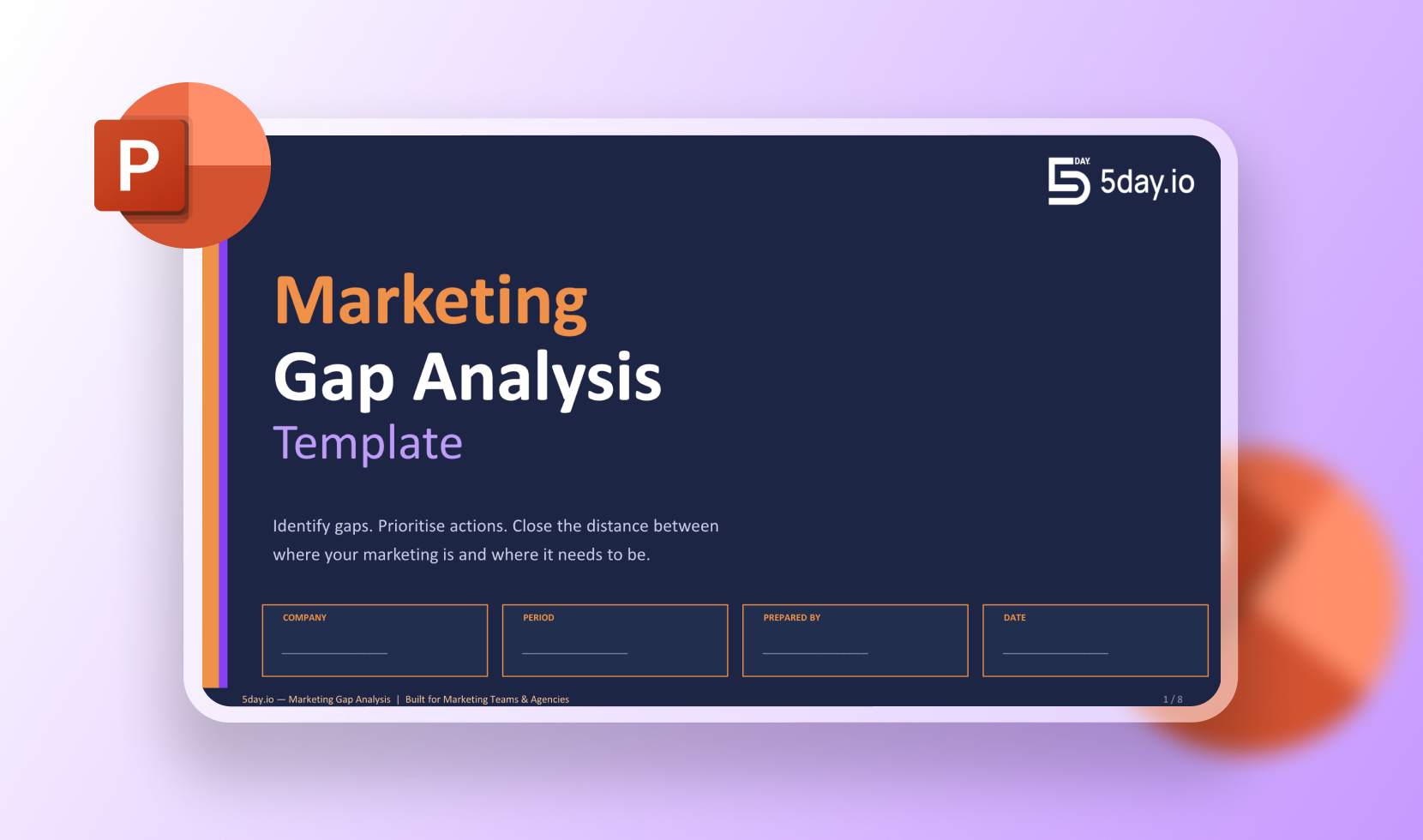
A strong marketing gap analysis template should also have one extra field that generic templates often miss: business impact. That makes prioritization easier.
If you want adjacent planning resources after the analysis, 5day.io already offers:
- Free SEO marketing plan template
- Free product launch marketing plan template
- Free social media content calendar template.
Those are useful once you know which gap you are trying to close.
Real-World Example
Here is a simple agency example.
A digital marketing agency onboards a B2B SaaS client. Traffic looks healthy, but pipeline quality is weak. The team runs a marketing gap analysis and finds five issues:
- strong search traffic but weak decision-stage content
- almost no LinkedIn program despite a B2B audience
- paid search running with old offer copy
- no clear lead scoring tie to campaign reporting
- no owner for post-webinar follow-up
The team then scores the gaps. The first two become high priority because they can improve lead quality fast. The paid search rewrite becomes a quick win.
The CRM reporting issue becomes a medium-term project. This is also a good example of gap analysis for agencies because it creates a clean client onboarding story: current state, desired state, gaps, and next actions.
Once the findings are approved, the agency can move the work into an execution system. 5day.io’s client onboarding and content calendar resources along with vital marketing workflows are useful here because they connect planning with day-to-day delivery.
Common Mistakes to Avoid in a Marketing Gap Analysis

The first mistake is treating it like a content audit only. Content matters, but channel mix, audience fit, and resource gaps matter too. Content gaps are one part of a broader marketing picture.
- The second mistake is using vague targets. If your desired state is soft, your gap will be soft too. Teams should define measurable goals first.
- The third mistake is finding gaps and doing nothing with them. A good analysis needs prioritization, owners, and deadlines.
- The fourth mistake is running it once a year and forgetting it. Marketing changes too fast for that.
- The fifth mistake is ignoring qualitative signals like sales feedback, support tickets, and client comments. The current state analysis should include both quantitative and qualitative data.
Turning The Analysis into Execution
The real value of a marketing gap analysis is not the worksheet. It is what the team changes next. Once the analysis is done, the work needs a home. For many teams that means turning each approved fix into a campaign, content project, workflow update, or client deliverable inside a calmer work system.
That is where 5day.io, a leading marketing industry project management platform fits well. Its marketing team and agency pages focus on campaign planning, custom templates, controlled client visibility, and execution tracking. Our content calendar and campaign-planning content also show how strategy can move into real project work without getting lost in scattered files or side conversations.
Key Takeaways
- A marketing gap analysis compares current performance with target performance and turns the difference into action
- It works best when you review channel, content, audience and resources together
- It should be run during planning cycles, client onboarding, performance drops, and major strategy changes
- A useful template needs current state, desired state, evidence, priority, owner, and deadline
- Competitive analysis, SWOT, and content audits are useful inputs, but they do not replace gap analysis
- The process only matters if findings become owned work with clear priorities