
If you are comparing tools like Basecamp, Awork, and 5day.io, you are definitely trying to fix a big problem in your marketing operations.
And it is a daunting task because every tool carries an opinion about how work should happen.
Now I know you might be thinking as to how we, from 5day.io, a tool made for marketing teams specifically, will write this objectively. But the goal of this article is not to pitch you our tool. It’s to help you understand which one works best for you.
Some tools slow things down in the name of control, while others push for speed but demand clarity and discipline in return.
When you adopt one, you are setting the pace at which your team will operate every single day.
That is why this comparison matters. This Basecamp vs Awork vs 5day.io comparison helps you understand which project management tool is best for your team. We’ll go over your marketing team’s working style, which tool works best for each step, what their strengths and weaknesses are and what kind of trade-offs you need to make with each tool (including ours).
Quick overview of the tools: Basecamp vs Awork vs 5day.io
Aspect | Basecamp | Awork | 5day.io |
Focus | Communication | Planning | Execution |
Best For | Simple, collaborative work | Structured projects | Fast-paced delivery |
Setup | Instant | Heavy upfront | Starts while working |
Workflows | Flexible | Predefined | Evolving |
Tasks | Basic | Structured | Context-rich |
Collaboration | Chat-first | In-task (formal) | In-task (fluid) |
Reporting | Minimal | Structured | Real-time |
Scalability | Limited | Strong (needs upkeep) | Scales naturally |
Trade-off | Lacks structure | Can feel rigid | Less deep planning |
Basecamp is designed to keep things simple and communication-heavy. It works well for teams that want minimal setup and is a clean, easy way to stay aligned, but it starts to feel restrictive when marketing agency automation workflows require tighter control.
Awork takes a more structured approach. It brings clarity to planning and execution through defined workflows, which is valuable for teams managing multiple moving parts, though it can introduce a higher cognitive load as processes become more detailed.
5day.io is built around speed and delivery. It prioritizes execution and visibility, helping teams move work forward quickly with minimal friction. Unlike other tools, it places less emphasis on deep documentation or long-form context management.
In essence, each tool optimizes for a different priority, communication, structure, or execution.
Do you want work to be controlled, created, or delivered?
When you’re evaluating tools at this stage, you’re really asking a more practical question: what kind of workday are we trying to bring in?
Scenario 1
Let’s take a typical day at your agency. Your team is handling a multi-channel client campaign with impossible timelines. There are dependencies across designers, writers, and performance marketers, and since this is a big account, there’s virtually no room for slippage. In that environment, clarity upfront matters.
Someone needs to know what happens next, who owns what. A tool like Awork fits naturally here because it reinforces that discipline. Work is mapped, and progress follows a defined path.
The trade-off is that every new task or exception asks the team to think through the system before acting.
Scenario 2
Now think about a content team brainstorming campaign plans and responding to feedback from clients or internal stakeholders. The work doesn’t start with a perfect plan, but it becomes clear as conversations take place.
In that kind of environment, too much structure gets in the way. Basecamp supports this flow because it keeps communication central and lets work evolve without forcing it into rigid formats. The downside shows up later, when the volume of work grows, and teams need tighter visibility or control.
Scenario 3
Then there are teams that are already past planning and exploration. They are executing against deadlines and trying to push deliverables across the finish line without losing momentum.
What they need most is speed and clarity: what’s pending, what’s moving, what’s done. 5day.io aligns with this pace by reducing friction between tasks and outcomes. Work feels more direct.
The three operating models of marketing project management tools
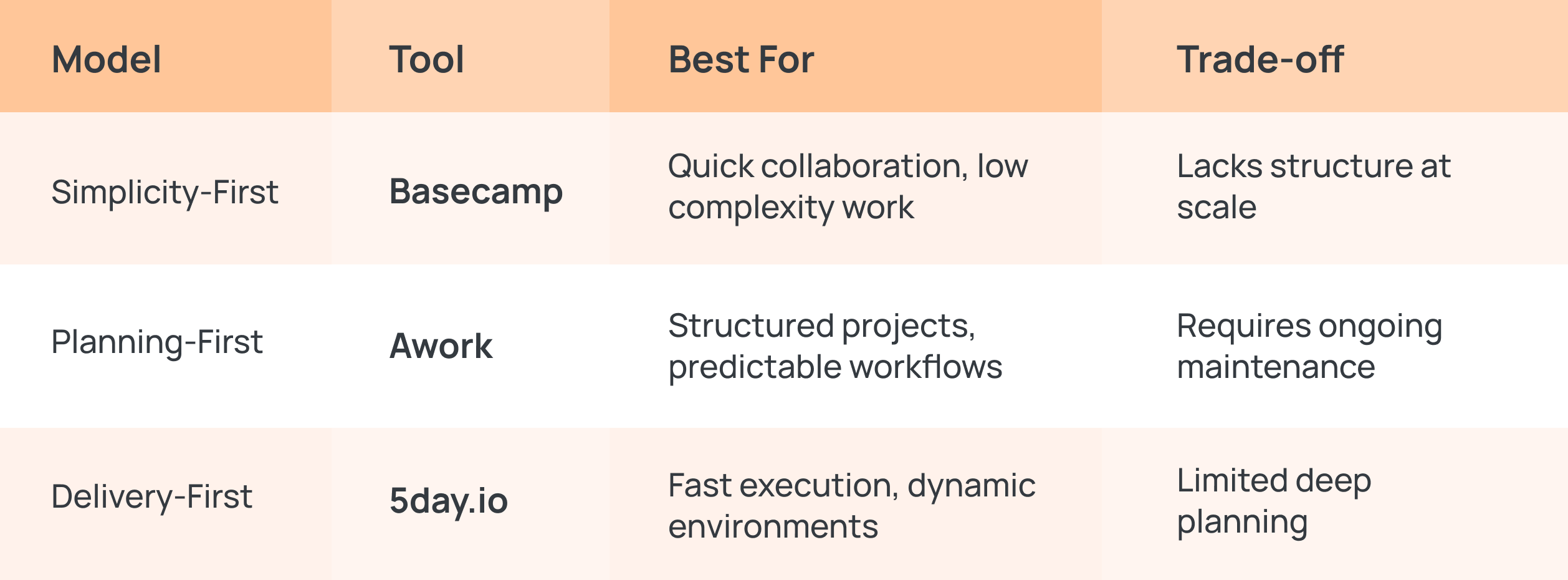
Simplicity-first (Basecamp)
Basecamp feels easy almost immediately. You create a project, add people, and you’re already inside the work. There’s no pressure to define everything upfront, no sense that you need to “set things up properly” before you begin. You just start, and for a lot of teams, that feels like a relief.
It works especially well when the goal is to keep everyone in the loop, lots of conversations, updates, files, and quick coordination. Everything lives together, so you’re not jumping between tools trying to piece things together.
What’s interesting is that Basecamp stays out of your way on purpose. It doesn’t try to structure your work for you. It doesn’t ask you to think in terms of dependencies or hierarchies. Work can begin as a simple idea or a conversation and grow from there, which is why it feels so natural to use.
But that same simplicity has a flip side. The structure you don’t create in the tool just lives in people’s heads. Over time, things like ownership, sequencing, and priorities can start to get a little fuzzy. And as work grows, teams often end up creating their own systems outside the tool just to keep things clear.
Basecamp works beautifully when the work is straightforward, and the main need is staying connected, not managing complexity.
Planning-first (Awork)
Awork feels very different from the moment you start using it. There’s an expectation that work should be thought through before it begins. You break things down and define responsibilities so that when execution starts, there’s already a clear path.
That clarity can feel incredibly reassuring, especially when you’re dealing with multiple clients or moving parts. You can see who’s doing what, what’s coming up next, and where things might get stuck. It gives you a sense of control that’s hard to get otherwise.
This is really where Awork stands out; it believes that good execution comes from good planning. And when your work is predictable or repeatable, that approach works really well. Things run more smoothly because nothing is left vague.
At the same time, it does ask something from you in return. The system needs to be maintained. And when work is messy or constantly changing, that effort can start to feel like a burden. Instead of helping you move faster, it can slow you down a bit.
Awork works best when your work benefits from being thought through in advance, and when it’s stable enough to stay that way.
Delivery-first (5day.io)
5day.io feels like it’s built for teams that are already in the middle of things. There’s no pause to plan everything out, no expectation to get the structure perfect before you begin. You just start, and the tool moves with you.
It’s very easy to go from “this needs to be done” to actually doing it. Tasks come together quickly, conversations happen right where the work is, and everything stays connected without extra effort. You’re not managing work from a distance, you’re inside it as it happens.
That’s really the core idea here. Execution isn’t something that comes after planning; it’s the center of everything. The tool is designed to keep momentum going, not to slow you down with the process.
This makes it a great fit for teams that thrive on high-energy—marketing, delivery, client-heavy environments, where priorities shift all the time, and getting things done matters more than getting everything perfectly structured.
But it does mean that deep planning and detailed documentation aren’t really the focus. And while that feels freeing when speed matters, it can feel a bit limiting if your work depends on structure, compliance, or long-term traceability.
Awork vs Basecamp vs 5day.io features: Where each tool holds, and where it starts to strain
When evaluating Awork vs Basecamp vs 5day.io, the difference comes down to how each tool handles project planning, communication, and execution.
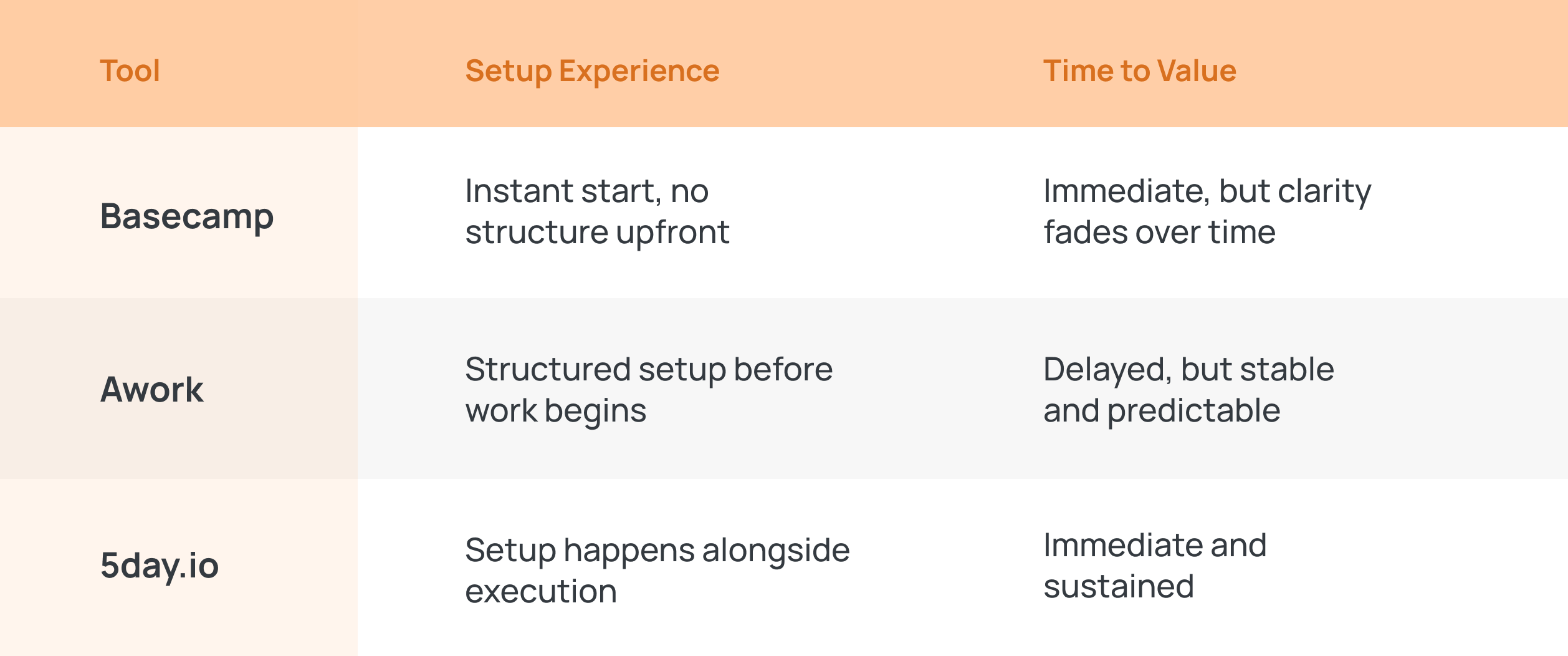
Set up and time to value
Basecamp
The experience of getting started is almost deceptively smooth. You create a project, invite people, and you are in. There is no sense of preparation. For a team that just wants to begin, especially in situations like onboarding a new client or kicking off a small internal initiative, this feels incredibly natural.
But what Basecamp does here is postpone the complex setup.
Because nothing is defined upfront, the structure of the work, such as who owns what, what depends on what, and what needs to happen next, is not enforced or even clearly represented.
The time to value is immediate, but the effort required to sustain clarity grows quietly over time.
Awork
Awork takes almost the opposite stance. It assumes that clarity must exist before execution begins. When a team enters Awork, they are shaping it. There is an expectation that workflows will be defined, and responsibilities will be assigned deliberately. This makes the initial phase feel heavier.
There is a pause before the work, a moment of design.
However, once that effort is made, the system begins to return value in a very different way. Teams are not constantly figuring out what comes next; the system reflects it. The time to value, therefore, is not immediate; it is earned. And it continues to pay off only as long as the structure is maintained with discipline.
5day.io
With 5day.io, setup is not treated as a prerequisite to work; it is treated as something that should happen in parallel with it. The platform is already structured into workspaces, spaces, projects, sections, and tasks, but teams are never forced to build this hierarchy before they begin.
In practice, this creates a very different onboarding experience. A team can enter the system, create a project, and immediately start adding tasks tied to real work.
Details such as ownership, timelines, priorities, and context are layered in as execution progresses. Even organizational elements like users, roles, clients, and templates can be introduced gradually through built-in setup capabilities such as bulk imports and role-based permissions.
The result is that teams are not setting up a system in order to work; they are working, and the system is organizing itself around them. This is what makes time to value feel immediate, even though the underlying system is quite powerful.
Workflow design
Basecamp
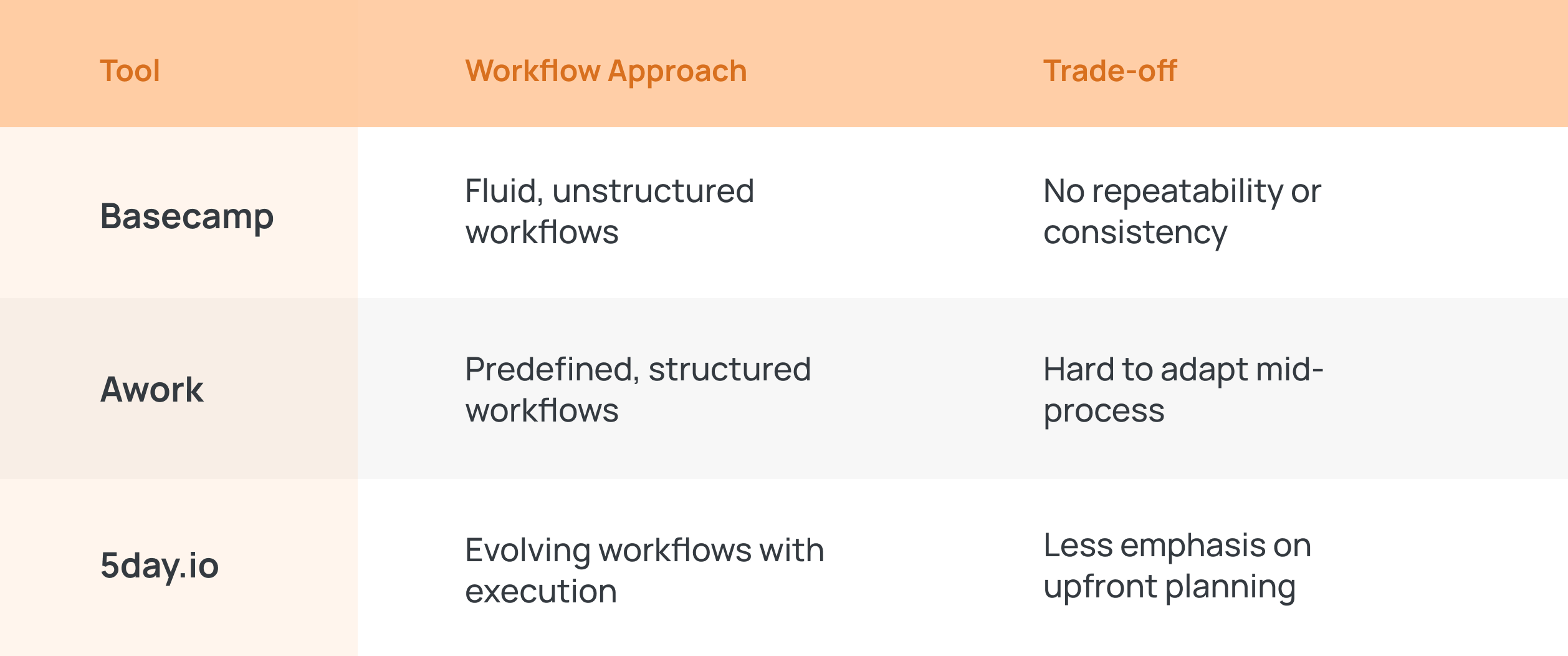
Basecamp treats workflows as something that should remain fluid, almost invisible. It does not try to formalize how work should move. This works beautifully in environments where there is creative project management going on.
Teams can move freely without feeling constrained by predefined stages or rigid systems.
But the absence of structure comes with a subtle cost.
When workflows need to repeat, when there is a rhythm to the work, like weekly deliverables or recurring campaigns, the lack of a defined system means that teams are effectively starting from scratch each time.
Patterns are not captured, and consistency relies entirely on human effort and discipline. Over time, this leads to small inconsistencies that compound.
Awork
Awork approaches workflows as something that should be deliberately constructed and then reused. It treats them almost like infrastructure.
Once a workflow is defined, it becomes a repeatable model that guides execution.
This is incredibly powerful in environments where consistency matters, such as product teams running sprints, marketing teams executing campaigns, and operations teams managing processes.
The advantage is clear: teams do not have to reinvent their approach every time.
But this strength introduces its own tension. Real-world work rarely follows a perfect plan. When something shifts mid-process—which it inevitably does—the workflow must be adjusted.
In stable environments, where there is proper this is manageable. In dynamic ones, it can feel like the system is always catching up to reality.
5day.io
5day.io is built on the understanding that workflows rarely remain stable long enough to justify heavy upfront design.
While the platform supports sophisticated workflow capabilities such as custom work item types, status workflows, priorities, sprint management, and automation, it does not force teams to define them all upfront.
Instead, workflows evolve alongside execution. A team might begin with a simple flow—such as tasks moving from “To Do” to “In Progress” to “Done”—and gradually introduce additional stages like “Review,” “Client Approval,” or “Scheduled” as the nature of the work becomes clearer.
All this can be done and shipped easily with 5day.io’s new workflow automation feature. Relationships and dependencies between tasks can be added dynamically, using features like linked tasks and start-to-start or end-to-end dependencies.
This approach allows teams to adapt without friction. Over time, workflows become more refined, but they are always grounded in actual execution rather than theoretical planning.
Task management
Basecamp
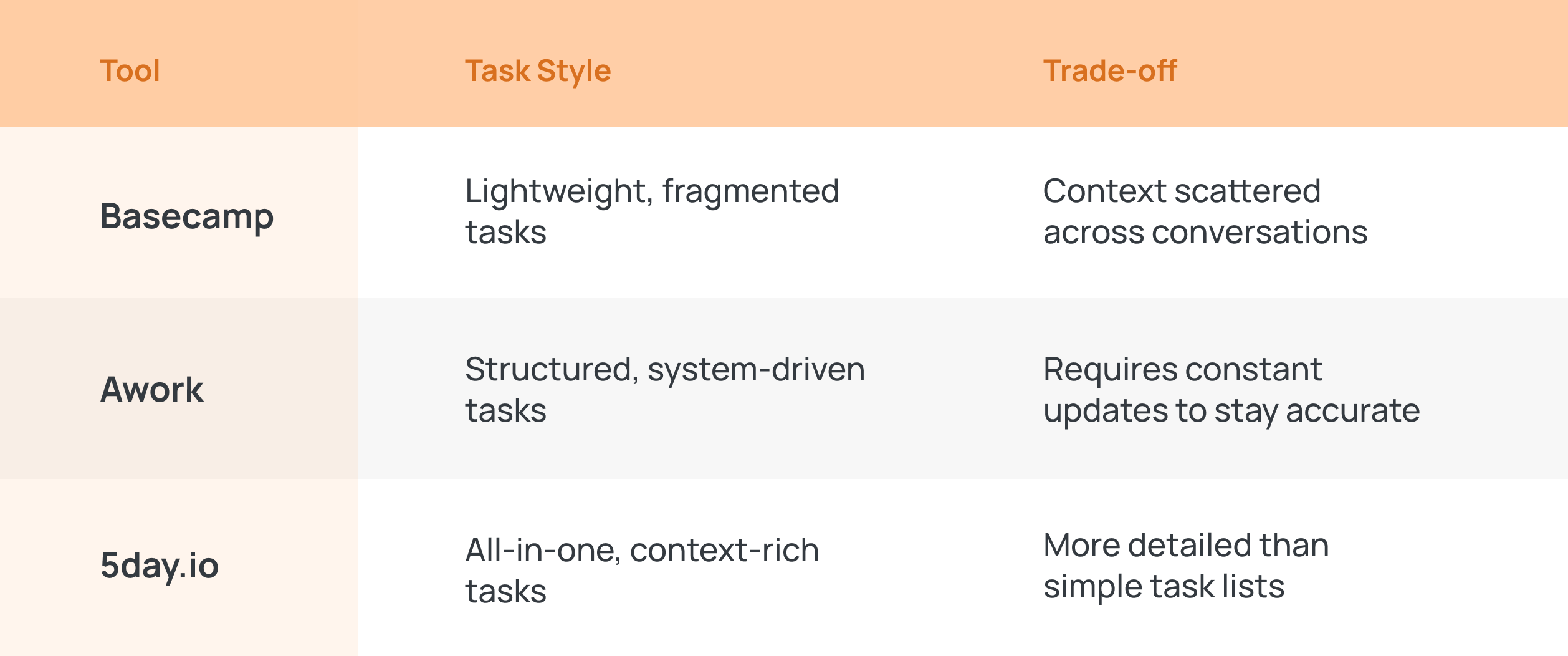
In Basecamp, tasks are intentionally kept light.
A task tells you that something needs to be done, who is responsible, and perhaps when it is due. But it does not attempt to hold the full context of the work, in terms of the full length of conversations, dependencies, and so on.
This design works when tasks are simple and self-contained. But as soon as tasks require deeper understanding or involve multiple contributors, the fragmentation becomes more noticeable.
To fully grasp what needs to be done, a team member often has to trace back through conversations, piece together information from different places, and interpret intent. The system does not provide a single, unified view of the task; it provides fragments that must be assembled.
Awork
Awork, on the other hand, treats tasks as structured units within a larger system. Tasks can be broken down, and tracked through defined stages. This creates a sense of order and clarity.
However, this structure comes with an expectation. Tasks need to be properly defined and updated ruthlessly. If the team does not consistently interact with the system and keep making changes, the accuracy of that structure begins to degrade.
Awork provides a powerful framework for task management, but it relies heavily on the team’s commitment to keeping that framework aligned.
5day.io
Each task in 5day.io can include detailed descriptions, start and end dates, progress tracking (manual or automated), time estimates in hours, days, or story points, and classifications such as priority, tags, and task type.
Tasks can also be marked as billable or non-billable, which becomes critical for client-facing teams.
Beyond these basics, tasks serve as containers for execution.
Files can be attached directly, and discussions can take place within the task. What’s more? Every action is recorded in an activity stream.
Custom fields allow teams to capture structured data specific to their workflows, whether that involves budgets, ratings, deadlines, or external links. Tasks can be broken down into subtasks, linked to other tasks through dependencies, and even automated or made recurring.
In practice, this means that a task is no longer a pointer to work happening elsewhere.
Collaboration
Basecamp
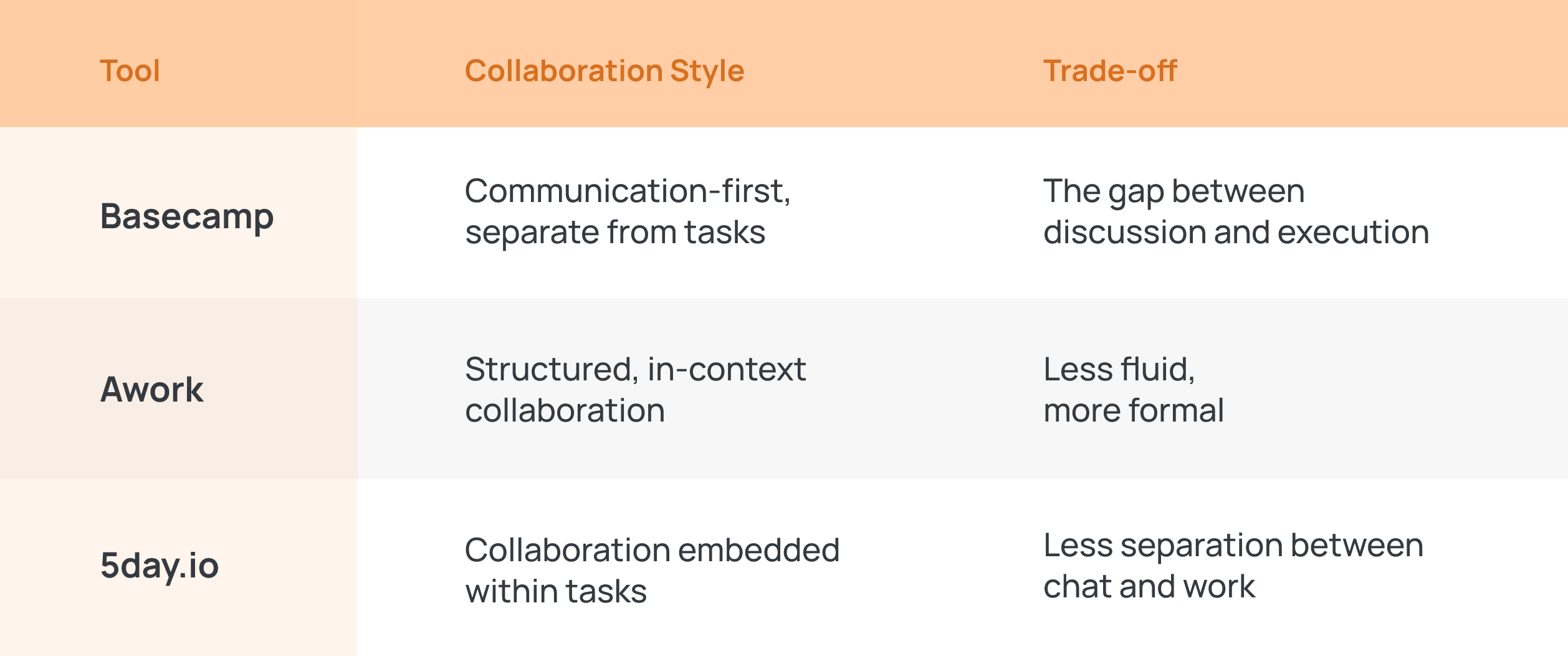
Basecamp assumes that if people are talking in the same space, alignment will naturally follow.
But there is a subtle separation between communication and execution. Decisions are made in conversations, but those decisions are not always automatically reflected in the work itself. Someone has to translate discussion into action, into tasks, updates, or changes. This creates a small but persistent gap.
Awork
Awork brings collaboration closer to execution by embedding it within its structured environment. Conversations happen in context, inside tasks, within projects, alongside workflows. This makes it easier to trace decisions and understand how they relate to the work.
At the same time, this approach introduces a certain formality. Collaboration becomes more deliberate, more tied to structure. In busy environments, this can feel slightly restrictive.
Awork prioritizes clarity and traceability, but sometimes at the expense of conversational ease.
5day.io
The platform supports file uploads and management. You can also find threaded discussions with comments and replies, tagging of individuals or related tasks, and support for rich media such as images and videos in the task itself.
This changes how teams interact with work. Conversations remain tied to the exact deliverable they refer to, and decisions are preserved within the same space.
For teams handling multiple stakeholders, this reduces ambiguity significantly. There is no need to search across tools to reconstruct context.
Reporting
Basecamp
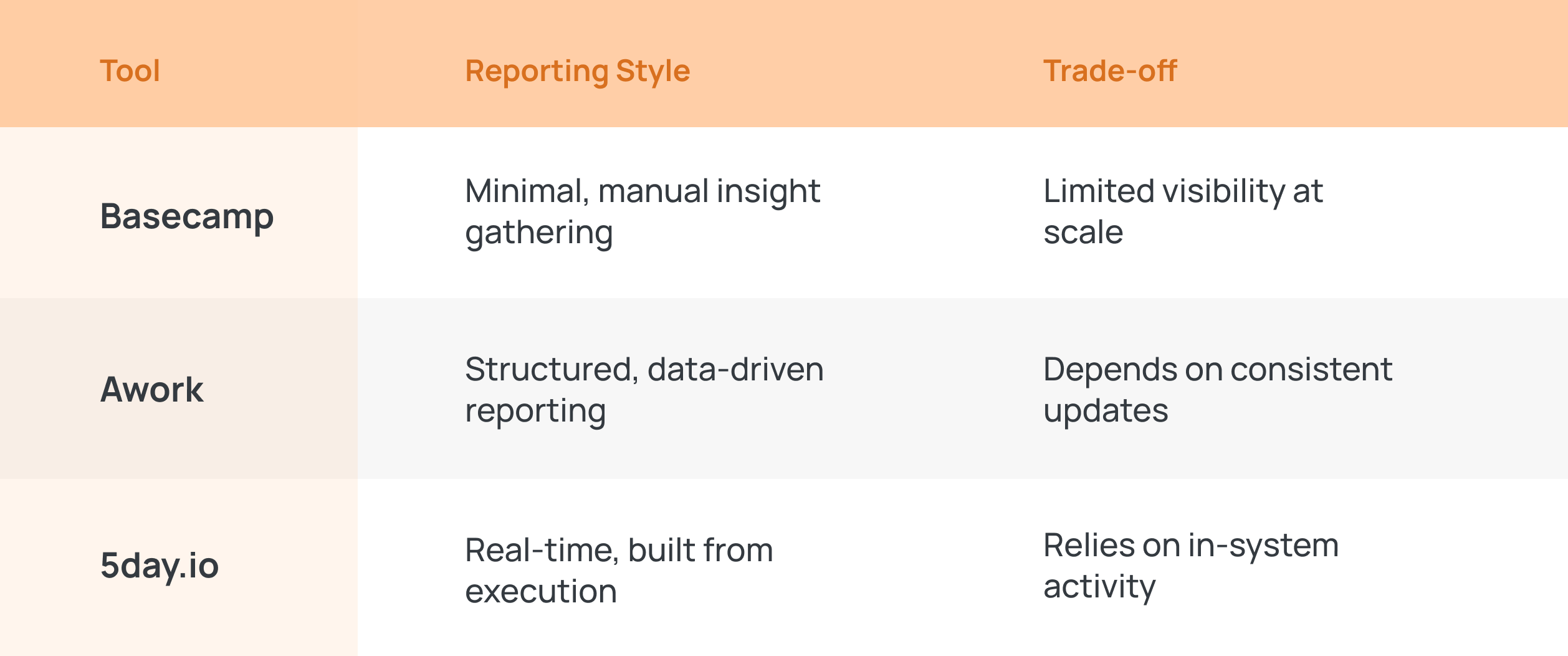
Basecamp takes a minimal approach to reporting, rooted in the belief that teams do not need heavy analytics to function effectively. It provides a basic sense of progress, but little beyond that.
However, managers often find themselves lacking a clear, real-time understanding of what is happening. To gain deeper insights, they must rely on manual updates. The system does not surface insight; it requires it to be assembled.
Awork
Awork, by contrast, treats reporting as a natural extension of its structured approach. Because tasks and workflows are defined, the system can generate detailed views of progress and performance. Managers can see what is happening and how it aligns with plans and expectations.
Yet this strength is also conditional. The accuracy of client reporting depends entirely on how well the system is maintained. Awork can provide deep visibility, but only if the data feeding it remains consistent and accurate.
5day.io
5day.io approaches reporting as a natural extension of execution rather than a separate activity. Because tasks, time tracking, and collaboration all happen within the same system, visibility emerges automatically.
At the project level, teams have access to customizable dashboards with multiple widgets, including charts such as bar, line, pie, and doughnut visualizations, as well as tabular views and single-value metrics. These dashboards can track both task progress and time entries.
Time tracking on 5day.io is deeply integrated into the system, with features that allow teams to log time in multiple ways. You can categorize it as billable or non-billable, overtime, and manage approvals.
In practice, this means that reporting does not require additional effort. A delivery manager can immediately see which projects are progressing, where delays are occurring, and how team capacity is being utilized.
Pricing
Basecamp’s structure includes a free tier for one project (up to 20 users), Plus at $15 per user/month (billed for employees only, clients free), and Pro Unlimited at $299/month flat (unlimited users/projects).
Awork features Basic starting at €8/user/month (1-5 users), Standard at €12/user/month (2-20 users), and Professional at €16/user/month (5+ users), with higher Enterprise tiers.
5day.io starts free (up to 5 users, 5 projects), then Growth at $9.99/user/month and Scale at $15.99/user/month with advanced features like automations.
Aspect | Basecamp | Awork | 5day.io |
Free Tier | Yes (1 project, 20 users) | ||
Entry Paid | $15/user/mo | €8/user/mo (Basic) History | |
Mid-Tier | N/A | ||
Unlimited/High | Enterprise €20+/user (custom) History | ||
Billing | Monthly/annual | ||
Trial | 14 days History | 30 days History |
Scalability
Basecamp
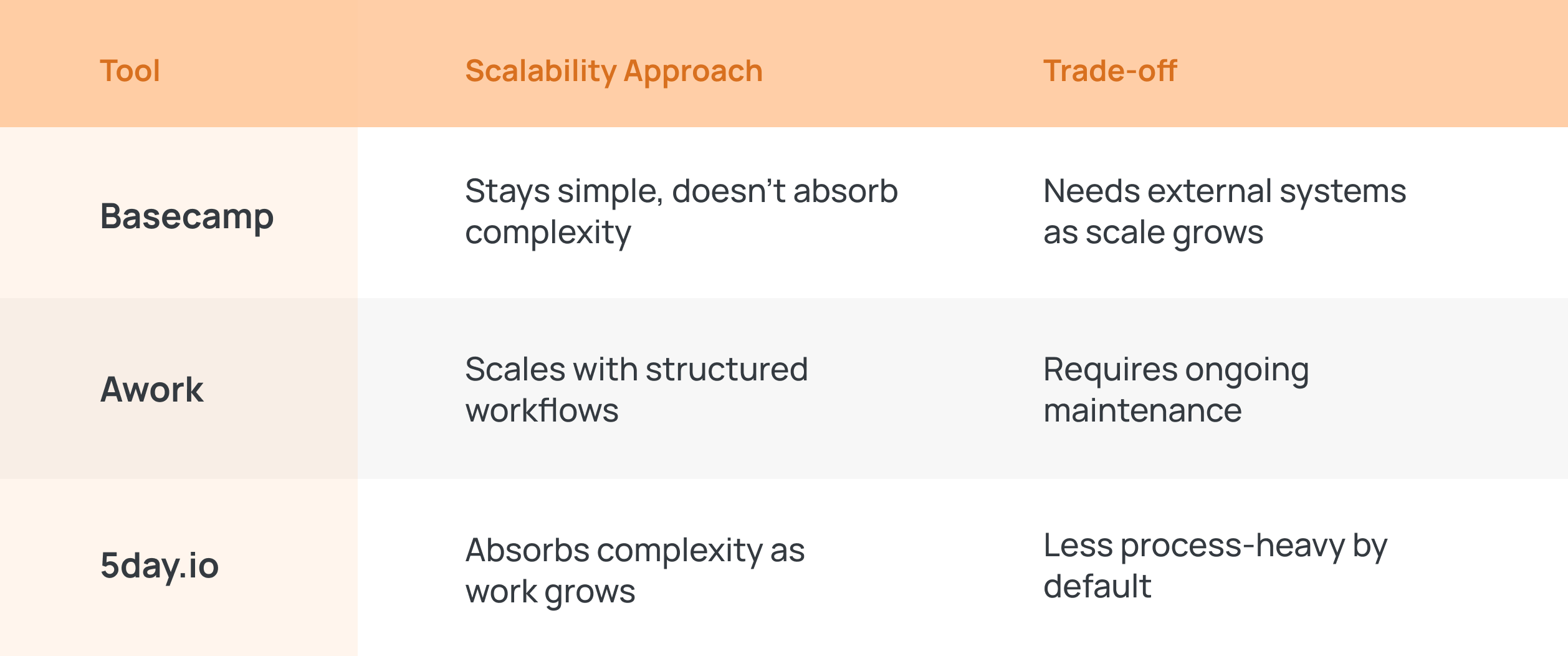
Basecamp scales effectively in environments where work remains relatively simple.
As teams grow, the tool continues to provide a shared space for discussion and coordination. But when complexity increases, the system does not evolve to accommodate it.
Instead, teams begin to introduce additional layers outside the tool. Basecamp itself does not absorb this complexity. It remains what it is, and the burden of scaling shifts to the team and its surrounding tools.
Awork
Awork is built with scalability in mind, particularly in structured environments. As organizations grow, they can expand their workflows and handle increased complexity within the system itself.
This makes it well-suited for larger teams and more demanding operational contexts.
However, scalability in Awork is not automatic. It requires continuous effort. Workflows must be maintained, structures updated, and processes refined. Without this, the system can become dense and difficult to navigate.
5day.io
5day.io is designed to scale with the volume and complexity of work without increasing the burden on the team. The platform supports multiple project owners, client associations, role-based access controls, and custom permissions, allowing organizations to grow while maintaining clarity and control.
Because tasks carry their own context and workflows evolve dynamically, scaling does not require additional layers of management.
A growing agency can add new clients and increase the number of active projects without redesigning its processes or introducing new tools.
The system absorbs complexity rather than pushing it back onto the team.
What does migration look like?
Tool | Migration Experience | What It Feels Like in Practice |
Basecamp | Quick and low-effort to get started | Teams can move in and begin almost immediately without much planning. However, as work grows in complexity, they often find themselves rebuilding structure outside the tool or rethinking their setup entirely. |
Awork | Structured and deliberate | Migration involves setting up workflows, task hierarchies, and timelines upfront. Teams need alignment, planning, and some level of training before they can operate smoothly, but once set up, the system provides strong control and clarity. |
5day.io | Fast, flexible, and execution-driven | Teams can migrate and start working almost instantly. Tasks, context, and structure can be added progressively, so there is no need for a heavy setup phase. The tool adapts as work flows in, making adoption feel natural and frictionless from day one. |
How to decide if it’s the right fit for you: Basecamp, Awork or 5day.io?
- Start with how your team behaves under pressure. The right tool aligns with your natural working style, not an idealized version of it.
- If your team relies heavily on quick alignment and minimal setup, Basecamp will feel intuitive and easy to adopt.
- If your team prefers clarity before execution, where tasks and dependencies are clearly defined upfront, Awork will give you the control and predictability you need.
- If your team is constantly juggling deadlines and multiple deliverables, 5day.io will support faster execution without slowing you down with process overhead.
- Look closely at your project complexity. The more interdependent and layered your work is, the more important visibility and structure become.
- Consider your team size. Smaller teams can operate with lighter systems, while larger teams need clearer coordination mechanisms to avoid misalignment.
- Think about delivery pressure. In high-pressure environments, even small delays caused by tools can compound quickly and impact outcomes.
- Evaluate your process maturity. If your workflows are still evolving, you need flexibility. If they are already well-defined, the structure will reinforce consistency.
- Finally, choose the tool that supports how your team actually gets work done on a busy, chaotic day, not how it operates when everything is calm and predictable.
Review methodology
This comparison is grounded in real-world usage, not feature lists. We tracked how work moved from setup to execution, delivery, and reporting, paying close attention to time to value, adoption friction, and cognitive load.
The focus was simple: identify where work slows down, where teams rely on workarounds, and how each tool holds up under real operational pressure.
So, what next?
Take a close look at 5day.io with our 30-day free trial and see how we can make it almost intuitive and effortless for you to manage your work management software needs like a breeze.