
A strong marketing agency proposal is a trust-building document that helps the client reduce uncertainty before making a decision. A marketing proposal is a document that explains the scope and budget of a marketing project so stakeholders can review and approve it.
Smart Insights adds useful context here because a proposal is rarely the pitch by itself and instead works as part of a wider buying process where prospects compare agencies and decide which team feels capable and credible enough to trust.
This is why your proposal can lose a deal even when your agency has the skills to deliver because the prospect is not only asking if your team can do the work. They are also asking if you understand the real problem and if you can manage the project without adding more risk.
This risk reduction view comes from a clear pattern in strong proposal guidance because effective proposals focus on the client challenge and expected impact, while also showing proof of past work, clear scope and transparent pricing instead of simply listing services.
What Is a Marketing Proposal and What Is It Actually For?

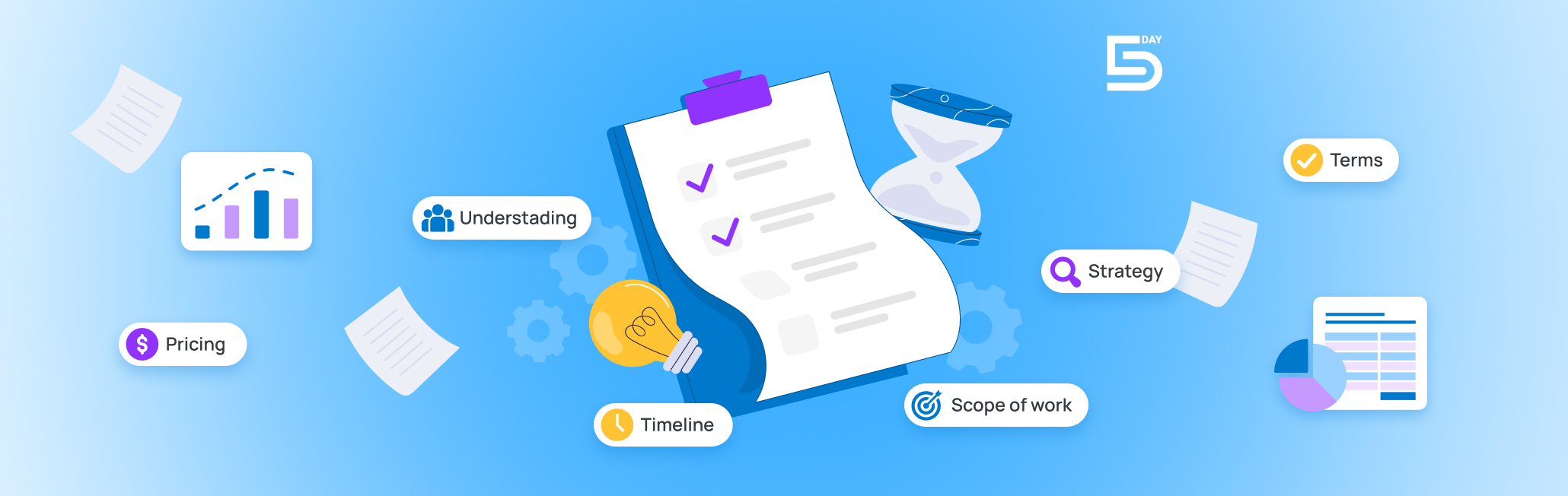
A marketing proposal explains the client challenge and the strategy you recommend, along with the timeline, investment and expected outcome. A proposal should explain the project scope and budget clearly enough to win approval. Focus on these core sections while creating a marketing proposal:
- Executive summary
- Business challenge
- Proposed solution
- Implementation plan
- Success metrics
- Budget
- Expected impact
In practice, the real job of a proposal is to reduce uncertainty. It should help the prospect feel that:
- You understand the problem
- Your plan is credible
- The scope is clear
- The price makes sense
- The next step is easy
This is the mistake that often makes or breaks an agency proposal. When the document feels like a brochure instead of a decision tool, the prospect may lose confidence even if the agency can deliver the work.
What Should a Marketing Agency Proposal Include?
Here’s a Practical Breakdown of the proposal sections that help clients make a clear decision:
Expert’s Advice: A good marketing agency proposal does not need every section to be long. It needs each section to answer one important client question clearly and move the decision closer to approval.
How To Write a Marketing Agency Proposal That Wins
A winning proposal does not need to be long. It needs to reduce doubt. Every section should help the buyer understand the problem, trust your thinking, and feel confident about the next step.
Lead with the client problem first
The opening should show that you understand the client’s situation before you talk about your agency. This is usually your executive summary. It should briefly explain the main challenge, the cost of leaving it unsolved, and the direction you recommend.
Why it matters
Most buyers decide very quickly if a proposal feels relevant. If the first section sounds like a generic agency introduction, the proposal starts losing force. If it reflects the client’s actual pain point, the document feels tailored and more credible.
What to include
- The core business or marketing problem
- The likely reason it is happening
- The outcome the client wants
- Your high-level recommendation
Use the situation analysis to build trust
This part should prove that you understand the business beyond the short brief or discovery call. It should show that you have looked at the market, the current performance gap, the likely blockers, and the context around the work.
Why it matters
This is where trust is earned. If the diagnosis is shallow, the whole proposal feels templated. If the diagnosis is sharp, the client starts seeing you as a serious partner.
What to include
- What is happening now
- What is not working well enough
- What may be causing the issue
- What the client risks if nothing changes
Explain the strategy before listing deliverables
Before you list tasks, explain the logic behind them. A proposal should show why your approach makes sense for this client at this stage. That means moving from problem to strategy before moving into activity.
Why it matters
Deliverables without reasoning feel transactional. Strategy creates meaning around the work. It helps the buyer understand that you are not just selling services. You are solving a business problem with a considered approach.
What to include
- The strategic direction
- Why this path fits the client’s goals
- How the approach connects to the expected outcome
- What the work is meant to improve first
Make the scope clear enough to protect both sides
This is where the proposal becomes operational. The scope should explain what is included, what is not included, how the work will be delivered, what the timeline looks like, and what the client is expected to provide.
Why it matters
A vague scope creates confusion after the deal is signed. That confusion usually turns into scope creep, delayed approvals, margin pressure, and strained communication. A clear scope protects the agency and gives the client a cleaner view of what they are buying.
What to include
- deliverables
- phases or milestones
- timeline
- client responsibilities
- limits or exclusions
- revision or approval expectations
Use proof that matches the buyer’s concern
Case studies, examples, and results should reduce risk. The best proof is not always the biggest name. It is the example that feels most similar to the problem the prospect is trying to solve.
Random logos may look impressive, but relevant proof is what helps the buyer believe you can deliver. The client should be able to think, “They have handled something like this before.”
What to include
- One or two relevant case studies
- A short explanation of the challenge
- What your team did
- The result of business improvement
- Why this example matters for the current prospect
Present pricing with context, not just numbers
Pricing should feel connected to the value, scope, and delivery model. Do not drop a fee into the proposal with no framing. Show what the buyer gets, how the pricing is structured, and what makes that structure sensible.
Why it matters
Pricing often becomes a problem when the buyer sees cost before they understand value. A well-framed pricing section lowers that tension and makes the number feel earned instead of abrupt.
What to include
- pricing model
- what is covered in the fee
- optional tiers or phases if relevant
- payment terms
- any important commercial assumptions
End with one clear next step
The proposal should close with a direct action. That might be signing the agreement, selecting a package, approving the scope, or booking a walkthrough call.
The proposal closes better when the buyer can picture the first 7 to 14 days clearly. Learn about client onboarding for marketing agencies to learn more about the process.
Why it matters
A vague ending creates hesitation. If the buyer has to think too much about what to do next, the proposal loses momentum. The average time between a buyer opening a proposal and the deal closing is 2.5 days, so even small friction after the proposal is opened can hurt conversion.
What to include
- the exact next action
- who should take it
- what happens after that
- any timeline for moving forward
After you onboard the client, there are various steps that ensure high client retention rates, and a project management software will ease a lot of tasks here.
Pricing Section Strategies: How to Present Agency Fees Without Losing The Deal

Pricing is where many good proposals collapse. The problem is not always that the fee is too high. It is often the case that the fee is badly framed.
The 4 Pricing Models Agencies Should Know
Agency pricing should do more than show the amount because it needs to explain the value behind the investment and reduce price shock while helping the client choose the right level of support with confidence.
Pricing model | How it works | Best for | Main advantage | Main risk | Decision impact |
Single price | One fixed fee for a clearly defined scope | Fixed projects with simple deliverables | Easy to understand and approve | Can create a yes-or-no decision with little flexibility | Medium |
Tiered pricing | Good, better and best options with different service levels | Retainers and flexible scopes | Gives clients choice and creates useful price anchors | Weak tiers can confuse buyers or make the middle tier feel forced | High |
Value-anchored pricing | Start with the expected business outcome before showing the fee | Higher-value strategic work | Reduces price shock by linking cost to expected value | Needs credible evidence and clear assumptions | High |
Phased pricing | Break the work into stages or milestones | Larger deals or cautious buyers | Lowers the first commitment and builds trust step by step | Can reduce the initial contract size | Medium-high |
When you show pricing in tiers, the client does not have to make a simple yes-or-no decision because they can choose the level of support that fits their needs. This often makes the investment feel more reasonable and easier to approve.
Pricing lands better when the model matches how the agency actually delivers work. Reading about project based vs retainer pricing models for agencies can help you understand it better.
Why Tiered Pricing Often Works Best For Agencies
When you show pricing in tiers, the client does not have to make a simple yes-or-no decision because they can choose the level of support that fits their needs. This often makes the investment feel more reasonable and easier to approve.
This reduces the pressure of one large decision because the prospect can choose an engagement level that fits their budget and confidence. This is a strategic inference, and it is supported by the tiered pricing and anchoring research discussed above.
How To Anchor Value Before Price
If you present the price too early, then the buyer starts comparing costs before they understand the impact. When you first explain the expected outcome timeline to the team and prove the price, it feels easier to judge.
Proposals with recurring fees can show a big lift in deal value in the dataset. Ongoing service framing can change commercial outcomes in a meaningful way.
Marketing Agency Proposal Template

Use this proposal structure as your starting point before you tailor the details to your service and client needs.
- Executive summary
- Client situation analysis
- Proposed strategy
- Scope of work
- Team and credentials
- Case studies and proof
- Pricing and investment
- Timeline and phases
- Onboarding process
- Terms summary
- Call to action
- Appendix
Note: Your Team can use this as a flexible starting point and adjust each section based on your service offer, client problem and pricing model. Also, a proposal reads stronger when the plan is easy to picture as real work with owners and dates. Read our detailed guide about how to create a project plan to support the implementation plan section of the process.
Common Marketing Agency Proposal Mistakes That Lose Deals

- Leading with the agency instead of the problem: Prospects care first about their risk and their business challenge. Your agency story can come later once they feel understood.
- Using vague deliverables: A loose scope makes the proposal feel unsafe. Clear deliverables help the buyer understand what they are approving and what your team will actually handle.
- Giving only one pricing option: One price forces the buyer into a yes-or-no decision. Tiered pricing gives them more control and helps them choose the support level that fits their budget and confidence.
- Sending the proposal without planning the walkthrough: A proposal should not be sent and left alone. A guided walkthrough helps you explain the logic behind the strategy and answer concerns before momentum drops.
- Weak process confidence: These signals point to one lesson. A confident and guided proposal process can improve outcomes because buyers feel supported instead of left to figure things out alone.
Not just this, sometimes even after onboarding a client, deadlines are missed due to excessive tasks that the team fails to manage efficiently. In this case, the marketing team project management platform can be the saviour.
Proposal Win Rate: How to Measure and Improve It
Proposal win rate tells you how many proposals you sent become won deals. To calculate it, divide closed-won proposals by the total number of proposals sent. The fastest ways to improve proposal win rate usually come down to process quality. Here are some expert tips to ensure your team is increasing proposal win rates efficiently:
How to calculate it?
First, let’s understand how to use a formula to calculate the proposal win rate:
Proposal win rate = Closed-won proposals ÷ Total proposals sent
If your agency sent 20 proposals in a month and won 6 deals, your proposal win rate is 30%.
Why does this metric matter?
A low win rate does not always mean your pricing is too high or your services are weak. In many cases, it points to process issues. The proposal may be too generic. The next step may be unclear. The document may be strong, but the follow-up may be weak.
That is why the proposal win rate should be treated as a process metric, not just a sales metric.
The real numbers to track around your proposal
Do not stop at the win rate alone. A better view comes when you track the small steps around the proposal journey.
Core proposal metrics
Track these numbers every month:
- proposals sent
- proposals viewed
- proposals moved to a follow-up call
- proposals revised
- proposals won
- time between proposal send and deal close
These numbers help you spot where deals are slowing down.
What these numbers can tell you
- Proposals are sent but not viewed; it might be a matter of timing or follow-up.
- The positioning may be weak and/or the value may be unclear if proposals are viewed but not discussed.
- When proposals are continually revised, but still are not being closed, the problem could be scope, price, or buyer confidence.
- If proposals close too slowly, the process might be too frictionless once the proposal is opened.
How to improve proposal win rate
The fastest gains usually come from improving process quality. Strong proposals not only explain the work well. They also make the buyer’s decision easier.
Make the proposal easier to say yes to
A proposal should feel clear, specific, and low-risk. The buyer should understand:
- the problem
- the recommended solution
- the scope
- the pricing
- the next step
If any of those parts feel vague, momentum drops.
Tip: read your proposal like a buyer, not like the person who wrote it.
Reduce friction after the proposal is sent
A lot of agencies focus only on the document itself. But the process after the proposal matters just as much.
Follow-up should feel structured, not passive. The buyer should know what happens next and when.
Tip: Send the proposal with a planned next step. That could be a review call, a decision date, or a short walkthrough.
Many deals slow down when follow-ups and approvals stay messy after the proposal is sent. Marketing team communication breakdowns solutions fit your “reduce friction after sending” point.
Improve buyer confidence with better proof
Buyers move faster when they feel the agency has solved similar problems before. Relevant proof reduces doubt far better than generic agency claims.
Tip: include one or two highly relevant examples instead of adding too many broad case studies.
Use revisions carefully
One round of revision can help clarify fit and remove objections. Too many revisions often signal that the proposal was not scoped or framed well enough in the first place.
Tip: treat revisions as refinement. If the proposal needs major restructuring after sending, the discovery stage would have been weak.
Tighten the handoff between proposal and onboarding
A proposal feels stronger when the buyer can already imagine what happens after saying yes. That is why onboarding, workflow, and delivery visibility should feel connected to the proposal.
Tip: add a short section that explains what the first 7 to 14 days will look like after approval.
Using AI and Templates to Scale Your Agency Proposal Process

AI can improve an agency proposal process when it speeds up drafting while keeping the message specific to the client. It should support strategic thinking rather than make every proposal sound generic.
Good use cases include:
- Turning discovery notes into a first draft situation analysis
- Drafting scope language with a service template
- Turning case study notes into proof summaries
- Rewriting a pricing section in different tone styles
- Creating first draft follow-up emails
Templates are just as important. According to 5day.io’s marketing workflow, recurring marketing work becomes easier with reusable templates for content production, campaigns, social scheduling, client onboarding, etc.
The same logic applies to proposal operations. A repeatable workflow saves time and helps accepted proposals move into delivery with clearer approvals, analytics, and billable time visibility.
How 5day.io Helps After the Proposal Is Approved?
A proposal is not only a sales document, as it becomes the point where your sales promise starts turning into delivery work. Once the client approves the proposal, you need a clear way to manage onboarding timelines, tasks, and review flow. This is where project management software for marketing agencies like 5day.io becomes important.
Controlled client access and reusable workflow templates, project visibility, time tracking and onboarding support. This makes it a practical marketing team project management platform after the proposal stage because it helps agencies connect sales promises with delivery work and client expectations.
Sign up with 5day.io today and start managing clients & tasks efficiently
Key Takeaways: Strong Proposals Build Confidence Before They Sell
The best marketing agency proposal is not the most polished deck or the longest document. It is the clearest tool for reducing client risk, which shows that the agency understands the problem and has a credible plan, along with the pricing logic and creates a clear path between approval and delivery. That is why the strongest proposals solve first and sell second.